But so what? Mining and coinage inflates too.
Is it a synonym for naturally?
But so what? Mining and coinage inflates too.
Is it a synonym for naturally?
Mining and coinage inflates the money supply very marginally since it takes a lot of capital to get the gold out of the rock and into a coin. It does not appear magically with a stroke of a pen as in fractional reserve banking.
artificialy would be an antonym for naturally
Apologies if my terminology is off, it has been many years sibce I crunched on Mises and Rothbard. If you do follow their writings though, the logic is sooo clear.
But without mining and coinage the money supply does not expand neither under fractional reserves.
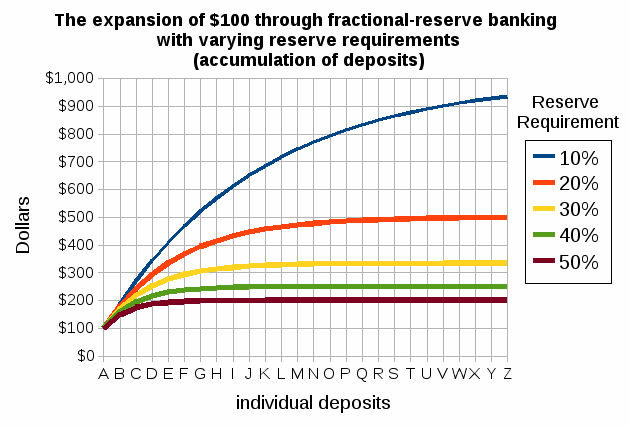
Reserve requirements affect the potential of the banking system to create transaction deposits. If the reserve requirement is 10%, for example, a bank that receives a $100 deposit may lend out $90 of that deposit. If the borrower then writes a check to someone who deposits the $90, the bank receiving that deposit can lend out $81. As the process continues, the banking system can expand the initial deposit of $100 into a maximum of $1,000 of money ($100+$90+81+$72.90+…=$1,000). In contrast, with a 20% reserve requirement, the banking system would be able to expand the initial $100 deposit into a maximum of $500 ($100+$80+$64+$51.20+…=$500). Thus, higher reserve requirements should result in reduced money creation and, in turn, in reduced economic activity.
That $1000 is the end of the world. No more money can exist without increase in the base money.
While the amount of actual gov. paper and coinage (m0) does not increase with fractional reserve banking. The virtual money supply (M1,2,3) does increase through bank issued paper.
Reduced money creation will not reduce economic activity, it will only increase the value of a money unit. Likewise Increased money creation will decrease the value of a money unit.
Your one-liners don’t even make half sense. Mining gold increases the supply of commodity money (assuming gold is being used as money). That’s not the same thing as increasing the supply of fake, paper money. Under fractional reserves, by definition, the supply of paper money increases.
Wrong.
Banks are not allowed to issue paper money. And the money supply cannot increase without increase in base money. Reserve ratios cannot be too small.
Banks issue other ‘fidiuciary media’ which work just like paper money.
Sheer nonsense.
Then it is inflationary just as fractional reserves.
Not indefinetly.
That does not make them the same. It is at least not legal tender.
I do wonder if you’re just playing dumb…
Right. No scam lasts forever. Eventually you have Weimar Germany, civil war, global war and the like. Now, do you think you can manage to make a half intelligent comment ?
I see. People who buy things using credit created by banks don’t really own what they buy because they are paying with a medium (that according to you) is not legal tender…
So what makes one inflationary and the other not?
Learn the difference between commodity money and fiat money and then come back ?
It’s a matter of degree. Real money is limited to a reasonable degree by the amount of capital needed to produce it. Fractional reserve created money knows few limits and eventually inflates to a perverse degree.
For example, my grandpa’s twenty dollars once bought an ounce of gold. My same twenty dollars will now buy me about two hundredths of one ounce of gold.
It’s more than that. Commodity money and fiat money are fundamentally different.
How is fractional reserve banking not inflationary?
haha I have learned a lot from this thread. Thanks everyone!
The differences aren’t irrelevant. If I’m using the money I have in the bank as physical money by using checks while someone else is using that same money because they borrowed it, you have two things happening:
First, this is about fiduciary media, no one was talking about fiat money. Learn the difference.
Second, then what? Once credit expansion made it through the system there is no more expansion. Banks cannot create credit indefinetly without risking runs. Additional money creation requires more base money in reserves.
Edit:
All I am saying it is inflationary exactly as much as hard money. If the amount of base money, coins for example, doubles, the entire money supply doubles under both systems.