Agreed & agreed with Stranger above; an un-intended consequence for physically fighting the enemy is breeding possible sympathy for the enemy, even though they (the state) are clearly the oppressors.
I think the power of ostracism is actually going to become more apparent to more people thanks to social networking; there is a fair bit of it (as well as drama) going on within Facebook / MySpace circles if you look hard enough ;).
I don’t think those were libertarian anarchists. Rather they were left-wing anarchists. It’s not clear whether ‘people’ didn’t like their means or rather their ends.
Do not bother invading the states, but make all federal land into An-Cap.
Deal with states later.
Currently there are 3 million active and reserve in the military, If we could become half of that I say we have a good old fashion coup on our hands. A coup where we do not want power.
I agree with Item 1 of your plan Yet, Juan is right to say that the military is in fact a closed community with its majority in an ideological symbiosis with the state (what he calls commies).
To join the military is not a great plan item to me though. I think that militia is the way to go, once there is enough manpower to make a difference. But, this is far away to date.
And always remember your own signature as Basiat is right in my opinion (I am a former planer [:)])
If we were the military we wouldn’t have to fight them.
Obviously only a .00000000000001% chance of this happening but I think it is a better plan than a counter-economy, when was the last time that worked in an industrial nation? Not as good as the trusty old Coup d’état.
Problem is, the military are part of the government. Not only that, they are the part of the government holding the guns.
It’s customary for some libertarians (many ?) to classify societies using two categories : industrial societies based on contract and militaristic societies based on hierarchy and coercion
Mises : “It is noteworthy to remember that British socialism was not an achievement of Mr. Attlee’s Labor Government, but of the war cabinet of Mr. Winston Churchill.” http://mises.org/midroad/mr6.asp
Also, the military exists as a direct consequence of the ideas of nationalism and tribalism, which are especially brutal forms of collectivism.
Well, consider that a military coup is a prominent feature of third-world banana republics. Also a coup doesn’t abolish government, it only replaces a few old members of the oligarchy with new ones.
Since when is the old Coup d’état “trusty?” If I remember correctly, the strategies that have been most effective for liberty are “guerrilla” type things. The Coup d’état has generally been used by the Hitlers, Caesars, FDRs and Stalins.
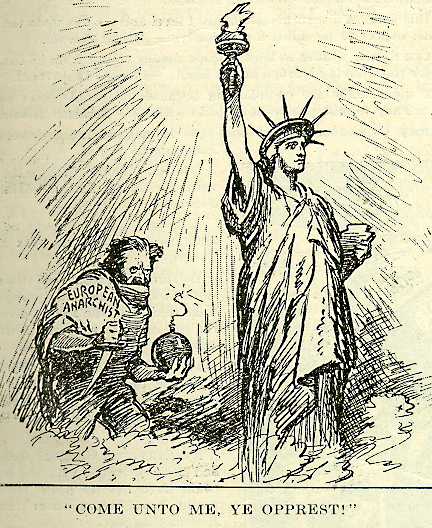
The reason most people have a hard time taking anarchy seriously is in part due to “propaganda of the deed,” that made anarchists look like lunatics, the result of which is a general attitude towards anarchism like this:
Actually that’s not true at all. Agorism does suggest black market provision of the what the state has a “core” monopoly over. The illegal provision of defense is central to agorism, but not as much during the early stages.
True. But what I said is “more emphasis.” No matter what SEK3 or anyone says, I’m convinced that nonviolent resistance is a much sounder strategy than open confrontation. I thought SEK3 placed more emphasis on nonviolent resistance but I could be wrong. I don’t have any moral qualms with black market takeovers of the core monopolies, but as you say, in the early stages it won’t occur so much because of practical reasons. I think it’s much more successful to resist passively.
If you want to try to start a black market police force to arrest senators and IRS agents, go ahead and try but I think it will have a tragic ending. Hopefully I’m not misunderstanding the OP but that’s the general theme I got: “forget about civil disobedience, let’s use a little more force.”
The problem we face is knowing at what point we do have sufficient public support, and whether it takes as much public support to overthrow the government’s smoking ban, for example, as it does to overthrow the private police ban. If we can challenge the smoking ban and win by protecting those who smoke in public from government retaliation, then we have made a small revolution that gains us more freedom and more public support.
The reason the early anarchists failed is that they did not have the right targets. The enemy is not any man but an institution, and institutions are physically immune. The moment they killed a president, another man was immediately instituted as president, and therefore their action had no positive effect whatsoever except make it easier for crazy men to become presidents.
If enough people violate the smoking ban together, and enough people ignore the fines and penalties they have received, then the ban is effectively null and void.
The problem then is having an organization that can coordinate such a thing. That is what our political party ought to do.
I agree that we need to know, at least in terms of a magnitude, what public support we have. Yet, I do not think we can get very far by lobbying for specific issues, like the smoking ban, without conveying our basic principles. Because on the next issue, say global warming, the public, holding believes contrary to our principle of freedom and personal property, will not join in unless they realize that their whole belive system is contaminated with collectivistic ideas.
This is why I believe that education and convincing others is more important than any specific action, though these actions are not useless, if they achieve at least a state that leans closer toward our own philosophy.
Most people do not have a belief system. They simply do what they are told. If we start with the obviously unfair issues and progressively work our way to the more revolutionary issues, people will transfer their loyalty to us and be ready to accept more unconventional ideas. It is not necessary for them to understand the entire philosophy in its full complexity.
For example, overthrowing the smoking ban could be followed by attempting an overthrow of the prescription drug ban, then the medical licensing monopoly, then compulsory insurance programs, and so on. As people see that we have the power to bring them freedom, more and more of them will come to us to appeal for justice in their conflict with the state. Once we get that ball rolling, we have become a de facto competing government and it is only a matter of time before we completely liberate the country.
Well, I have to agree I have been using the term wrong. Lobbying is arguing to get privileges, which is not what you proposed. So I take that one back.
I have to disagree on your remarks regarding the belief system. Every indivudual has one or even more. It is those things people are certain about to be right, we call a belief system. Often there is more than one belief system that opposes each other, in one person, which is called incongruence and leads to unpleasant states. Belief systems are actually what people use to define their goals, which in turn define the means and as a last step defines their actions.
Given you are right, that would mean, freedom would have to be enforced onto those that “just do what they are told” by those that “know”. This is quite the opposite of freedom and liberty as it is understood by libertarians and the classic liberals. Loyality is a requirement of the collectivist systems, not of a free society. Supposed people would be loyal to a libertarian system because they do what they are told, such a system would soon become another oligarchy and tyranny.
The whole libertarian creed is about individual freedom and liberty and requires that each individual understands that he/she is free and does not have to do what he/she is told. Told by whom? On what rights? To whos benefit?
The basic principle of freedom is not hard to grasp. Like one and one equals 2 is not real infinitesimal calculus. This principles are only 2. First I own myself and everything i have rightfully aquired. Second it is imoral and therefor a crime to start aggressing against someone others property. The rest of the philosophy follows out of this.
And, even if I know you meant it not literal, one can not liberate a country, one can only make people aware about the fact that they are free. Everything else follows from that. It is the old means and ends thing.
 Yet, Juan is right to say that the military is in fact a closed community with its majority in an ideological symbiosis with the state (what he calls commies).