Achilles and the Tortoise

I readily admit I don’t understand the mathematical depth needed to illustrate and resolve this riddle. Frankly it seems so simple it’s absurd. Everyone knows that Achilles would blow by the tortoise, so imo empiricism is enough. If you had to understand why, I would first break it down into why we’re looking at it in the way of mathematics.

Between any two independent objects, there is a distance. However, a kilometer is not a yard, and a yard is not a foot. It depends on how you look at it. The fact, though, is that no matter how you look at it, measurements don’t actually exist. Basic dimensions of length, width and depth certainly exist at different degrees, but the fact remains: the middle of anything is purely subjective, just as the length of a distance between two objects is purely subjective; not only that, the systems we’re using to measure and find the middle of anything don’t actually exist! That’s it, that’s the answer: mathematics and other systems of measurements are mental constructs, therefore there is no paradox of any kind. Sense-experience gives us all the information we need.

In other words, I’d put my money on Achilles; I don’t know many who wouldn’t.
trik,

The question never was about who will win the race. The question was about human reasoning. Zeno is giving an analysis of the situation in which every step of his argument, as well as the way he ties it all together, is rock solid common sense. And yet the conclusion is obviously false.

Which leads to the real question. Obviously we must conclude that something is wrong with his argument. And yet we don’t know what it is. What is the flaw? We aren’t asking whether Achilles will win, but rather, why will he win.

Saying that it’s all subjective and other hand waving arguments get us nowhere, because we rely on our reasoning [if we have moved beyond the stage of couch potato] all the time. We would like to know what the flaw is in Zeno’s rfeasoning, so that we do not make the same mistake in another situation where the outcome is not so obvious, and might lead to disastrous consequences.

Saying it’s all subjective anyway is another way of saying don’t bother with math or logical thinking anymore, they give you unreliable results. Which is exactly the conclusion we want to avoid. We want to be able to rely on math and logic in the future, not sit around pointing with our hands like cavemen.

The Achilles and the Tortoise paradox is a variant of :

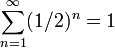
To walk x meters, you must walk x/2 meters, to walk x/2 meters you must walk x/4 meters, and so on. Since this goes on forever, I’m supposed to think I can’t walk x meters? Wrong!

An infinite number of half steps can be finite! As shown by the following geometric series,

This thread should close now, but again people will continue talking out of their behind.

Friedmantle,

The second paragraph is correct, but saying it refutes the first is a non sequitor.

Please arrange your argument in a syllogysm so we can see how it all fits together. Because for now it sounds like this:

  1. I can define arbitrarily the abstract concept of the sum of an abstract object called an infinite series.

  2. Therefore, I can walk x meters without first walking x/2meters. And I can walk x/2 without first walking x/4, etc.

But 2 is clearly false. for every N, I must indeed walk x/[2exp N+1] before I can walk x/[2exp N].

For which value of N have you shown this to be false?

EDIT: Maybe you mean that even though 2 is false, I can still somehow manage to magically take a giant leap forward somehow. Maybe. But that conclusion does not follow from the summation you displayed.

It’s simple. Zeno didn’t understand infinitesimals very well. Archimedes had an idea of infinitesimals when he developed a way to compute the perimeter of a circle by using inscribed polygons.

But thanks to the development of a rigorous mathematics of infinitesimals by Newton and Leibniz (and later formalized by Cauchy, Riemann, and Weierstrass), we can find solutions ‘paradoxes’ such as these.

I think the paradox has important implications to the applicability of abstract reasoning to the real world. When we speak of real, physical distance, we speak of it as if it were a geometrical line. A geometrical line can be subdivided infinitely and it has long been proved that the sum of infinitely many infinitesimals can converge to a finite sum. So that resolves the abstract aspect of the argument. The question that remains is really this: is a geometrical line actually a good abstraction of physical distance? If not, why not?

Clayton -

It’s simple. Zeno didn’t understand infinitesimals very well. Archimedes had an idea of infinitesimals when he developed a way to compute the perimeter of a circle by using inscribed polygons.

But thanks to the development of a rigorous mathematics of infinitesimals by Newton and Leibniz (and later formalized by Cauchy, Riemann, and Weierstrass), we can find solutions ‘paradoxes’ such as these.

But you haven’t stated what the solution is, just appealed to authority. “It can be shown”. OK then, show us.

And Zeno understood infinitesimals very well. What error do you see that he had?

BTW Newton and Leibniz were screamingly unrigorous. Their logic was as full of holes as a swiss cheese. Cauchy et al did not just formalize, they saved Newton’s and Leibniz’ skins. But it still remains to be shown here [but for my humble analysis, I think], where the resolution of the paradox is.

Clayton,

Converging to a finite sum doesn’t help us at all. Convergence is a statement about the existence of a least upper bound. A series with infinitely many non zero terms does not actually add up to it’s least upper bound. Zeno is asking how do they actually add up enough for Achilles to win.

Put it this way. A mathemetician can define a new type of operation, finding the least upper bound of an infinite series, and calling that operation by the misleading name of addition. But Zeno is arguing that Achilles does not perform the act of finding a least upper bound. He does simple plodding ordinary arithmetical addition, as he takes a step at a time. And doing that will never sum to the least upper bound. That is his question.

“A series with infinitely many non zero terms does not actually add up to it’s least upper bound.”

Least upper bound (sup) is a property of ordered sets, not series. And this quote is absolutely false. The infinite geometric series I posted does add up to 1. Perhaps you’re confusing sequences and series.

That’s a valid concern you have, Dave. I have thought about it for years, though, albeit inconsistently. Lately I have started to view a sort of duality in the world; mind you not one Platonic, but I see systems and then I see reality. People see shapes, they design things, they intelligently find unique ways of explaining phenomena and building systems to classify and explain other phenomena.

Anyhow, I see trying to figure out the logic of this paradox like trying to figure out the logic in a Dali painting. If you superimpose logic on a Dali painting, it won’t ever make sense, no matter how long you concentrate. I believe it is the same with Zeno’s Achilles paradox. You can try to make sense of it within the system, all the while you know it’s a painting; or in this case, it’s an abstractly constructed race with infinite divisions that don’t actually exist.

So it’s not a matter of giving up; more my honest opinion after reframing truth: I know that Achilles will win; the why of it may be non-existent; a weakness in the mathematical system. I don’t think it’s a weakness, though; I think it’s systems vs. reality. Then it makes complete sense.

The infinite geometric series I posted does add up to 1.

Only if you define addition of a [positive termed] infinite series as finding its least upper bound, which Zeno argues that a person walking around on planet Earth does not do. His act of walking does not find least upper bounds, but does ordinary arithmatical addition, which is undefined for an infinite number of terms. Read the second paragraph of my post that explains.

A series is defined as a sequence of partial sums, so that a series is indeed just an ordered set, and its sum [if the terms are positive] is the least upper bound of that set.

Here’s Hardy speaking in Chapter 4 of his masterpiece:

Thus to say that the series u1 + u2 + . . . converges and has the sum s,
or converges to the sum s or simply converges to s, is merely another way
of stating that the sum sn = u1 + u2 + · · · + un of the first n terms tends
to the limit s as n → ∞,

Which means:

More precisely, if any small positive number is chosen, we can
choose N so that the sum of the first N terms, or any of greater
number of terms, lies between s − epsilon and s + epsilon; or in symbols
s − epsilon < sn < s + epsilon,
if n>N. In these circumstances we shall call the series
u1 + u2 + . . .
a convergent infinite series, and we shall call s the sum of the series,
or the sum of all the terms of the series.

In other words, the series doesn’t “add up” to s in the normal arithmatical sense. It has s as a limit, meaning the sequence of partial sums gets close to s, with out necessarily “adding up” to it. Only after we define convergence, and limit, can we extend the ordinary definition of addition to include a new concept, called “the sum of an infinite series”, and say that in this new use of the word addition the series adds up to s.

But Zeno argues, correctly until shown otherwise, that Achilles does not plod around finding limits as he walks along. He does addition in the older sense only, as the length of each step is added to that of the previous one.

trik,

I can only reply to you by repeating myself, so let’s drop it here.

Smiling Dave,

A series of any kind is not a set!. A set in mathematics is defined as a ‘collection of object’. The real numbers, rational numbers, and complex numbers are sets; a series plainly isn’t. Please do not misuse the term “least upper bound.”

Also, you’re correct that a series convergences if its sequence of partial sums converges (using the traditional, for every epsilon, there exists N approach).

So basically, a series converges to s, if for any positive real number epsilon, there’s partial sum, such that all partial sums greater than or equal to that one lie within epsilon units of s.

THE THING is, nothing actually stops the partial sum from being equal to s itself. For example, I can define the following sequence.

[Summation Symbol (i= 1 to infinity) ai ] where ai = 2 for 1 <= i < = 2 and ai = 0 for i > 2,

which is the sequence

2 + 2 + 0 + 0 + 0 + 0 + 0…

This sequence does add up to 4 (in the normal sense as you put it).

Of course a series is a set. It is a function [which is a set] from the natural numbers to the real numbers.

More precisely, a function is a set of ordered pairs [and of course ordered pairs are sets] with the property that every occurrence of a first element is paired with the same second element. This is the standard way to define functions, in ZF set theory.

If the series has infinitely many positive terms [as Achilles steps do] then the series cannot possibly add up [in the ordinary sense] to the limit. Only if all but a finite number of terms are zero does it add up in the ordinary sense.

Fair enough if that’s how you see a series (although the function is really then the sequence of partial sums). But still, the function isn’t an ordered set, since you’re not defining the order < on the set of 2-tuples; the ordered set is actually the image of the function. There is a difference.

true.

I do admit my earlier argument was a bit hand-wavy. I believe I’ve solved it now (original Tortoise/Achilles paradox). Here it is.

Let V1 and V2 be the speeds of Achilles and the tortoise respectively. Of course we assume that V1 > V2 and the tortoise has head start of d from the starting line. The original paradox goes like this. By the time, Achilles reaches d, the tortoise will have traveled to some distance d + a1 for some a1 > 0, by the time Achilles reaches d+a1, the tortoise will have reached d + a1 + a2. Since this goes on forever, Achilles never actually reaches the tortoise.

It takes a finite amount of time for Achilles to go from one point to another (to where the tortoise once was). So for instance, let t_1 denote the time it takes for Achilles to reach d, t_2 the time it takes for Achilles to reach d + a1, and so on. If we could show that

Sum (i = 1 to infty) t_i is finite, that shows that in finite time, Achilles reaches the tortoise.

By simple linear kinematics, t_1 = d/V1. (Note I am just using velocity * time = distance). During that time, the tortoise travels a distance of

t_1 * V2 = d/V1V2. The time it takes for Achilles to travel to d/V1V2 (from d) is precisely d/V1^2 *V2. Proceeding inductively, we obtain that

t_i = d*V2^(i-1)/V1^(i). Therefore,

Sum( i = 1 to infty ) t_i = Sum(i =1 to infty) d/V1*(V2/V1)^(i-1).

Notice that V2/V1 < 1 by assumption, hence we have a geometric series with the radius less than 1. The above sum converges to

d/V1 / (1 - V2/V1) - (the formula for the value of a converging geometric series).

In essence, we are done. What we have shown is that the sum of the times for Achilles to move from his position to the Tortoise’s is a finite value (beginning with Achilles moving from the starting line to d). Hence, in finite time (the value of the geometric series), Achilles will be in the same position as the tortoise. With his velocity greater, he overtakes the tortoise.

Hmm, I think you’re introducing hidden assumptions, such as that an addition requires some non-zero amount of time or effort. There is nothing inconceivable about an actual infinitude of sums. In fact, we can construct a perfectly consistent arithmetic which incorporates infinity as a number (cardinal or ordinal). It turns out that not only is there the ordinary infinity we are all familiar with but there are actually higher orders of infinity. There are infinitely many infinite cardinals, each strictly greater than all others before. This is the subject of study of large cardinal theory.

To summarize: Tell me why 1/2+1/4+1/8+… does not actually converge to 1.0 rather than just a “least upper bound” that “approaches” 1.0 “arbitrarily closely.”

Clayton -

Your “in other words” simply contradicts Hardy - he doesn’t say that it doesn’t add up to s, merely that when we say “this adds up to s” we are also say something about the partial sums of the series.

Infinite series are very non-mysterious. To wring your hands over infinity or infinite sums is like doubting the mathematical status of zero or negative numbers. No numbers exist. We say they “exist” only because they are useful abstractions that follow certain rules that we find interesting (because we have human brains that evolved in the physical world and which “package” the physical world in certain ways). Did you know there was a substantial philosophical argument regarding the use of zero? After all, zero denotes nothing yet whatever denotes the nothing is itself something, which is a contradiction. We can say the same for infinity - whatever denotes infinity is itself finite, which is a contradiction. But the fact is that it isn’t a contradiction at all because we can differentiate between an object (abstract or real) and its representation.

Clayton -

In essence, we are done. What we have shown is that the sum of the times for Achilles to move from his position to the Tortoise’s is a finite value…

I think there is still a flaw here, the same one as before. Let us say that your series sums to T. What you have shown is that every partial sum is less than T and that for any given epsilon, one can find an N such that the Nth partial sum [and all partial sums from the Nth one on] is greater than T+ epsilon.

But you haven’t shown that Achilles actually is in the race for time T. Now we could argue that all we need do is keep an eye on a stopwatch and see that he is out there for T seconds or minutes or whatever, but that is not the point. Zeno is arguing that his analysis shows that Achilles doesn’t live until time T, an dhe is asking where the flaw lies in his analysis. He is not asking for an alternate analysis, but for the flaw in his.