My statement was not an argument opposed to anyone side of the discussion, I only advanced it because there seemed to be a consensus between the discussants that time was unquestionably infinitely indivisible/continuous/not quantised, and whilst not wanting to argue that it was indeed quantised I wanted to put forth the idea that its a possibility to be considered.
It seemed relevant and worth doing so because several posts by different posters explicitly relied on time’s ‘continuous’ nature.
Not entirely. I can measure space with a ruler. I can measure time with a clock. There’s no abstraction there.
Saying that we’re “really” seeing timeless 4-D objects smeared through 3-D space+time, even if true, doesn’t help us reach any better understanding of the nature of time.
Who knows what things “really” are? The math and concepts of the 4D “block universe” are convenient. Occam’s Razor recommends itself here.
a four-dimensional complex vectorspace with an actual metric, the Euclidian.
Ya you can use the trick of quaternions here, but special relativity and flat space breaks down as soon as you have a gravitational field - you may have to take into account the metric tensor.
‘plank time’ is often referred to as smallest ‘meaningful’ unit of time, the issue of whether there are smaller ‘unmeaningful/unmeasurable’ units is then kind of metaphysical…
Planck time is just a bunch of important constants multiplied together to arrive at a specific duration. Into the multiplication you can also throw in dimensionless constants for fun. Hence, the smallest possible duration might be 100x bigger, or 100x smaller. Or there might not be a smallest duration. There’s NO experimental evidence. (But in some cases Planck units are useful for facilitating math.)
True. We cannot distinguish between a sufficiently finely divided substance and a truly continuous substance. But the point remains that we experience the world as a continuum.
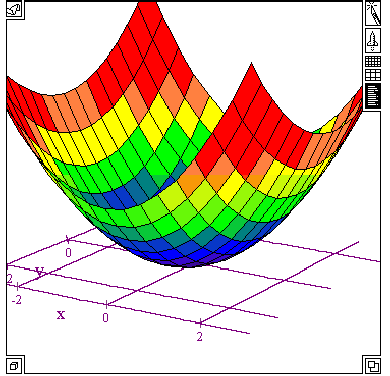
Now, consider an arbitrary plane, z = k, k > 0. The resulting intersection of the plane and parabola will be a circle of radius z^(1/2).
We can think of this shape as something being seen by a Flatworld resident. If we treat the z-axis as “Flatworld time” (t), the Flatworld resident will see a line segment of length 2*t^(1/2). But the time variable is not discrete, it is not a series of “moments”, it’s a continuous variable.
Even a countably infinite number of discrete circles of the correct radius stacked one on top of another would not be mathematically equivalent to the continuous case described above.
Well, a continuum is something which is “continuous”, meaning, it is not discrete.
The number line is the classic example. The discrete number line consists of a series of points… I envision them as having an “air gap” between each one. The continuous number line, however, has no air gaps. Any point along the continuous number line melts into the points on either side of it, so tightly that no air gaps can be found. And no matter how much you compact the discrete number line together, the air gaps never go away (remember, the points on the line are infinitely small), so you can’t get a continuous number line by packing in a sufficient number of discrete points (yes, there’s a proof for this).
Well, now that you mention it, I guess it depends on whether the Flatlander is inside or outside the circle. If he’s inside the circle, nothing will change in his view as he will just see a circle around him in every direction (does he have perspective vision?) Assuming he can’t immediately perceive distance, he has no way to tell how far away the circle is apart from moving over to the circle and bumping into it.
I was speaking initially as if the Flatlander was outside the circle.
Conceptually, it’s the idea of a speck - something of negligible size. The concept is important to understanding limits and calculus, and it’s often wrongly derided. In nonstandard analysis, a valid branch of mathematics, infinitesimal numbers are first-class citizens. So if f(x)=xx, then (f(x+epsilon)-f(x)) / epsilon = 2x + epsilon. Taking the “standard part” of this yields 2x, or the derivative of f(x). In nonstandard analysis, there is an integer N so large that it’s bigger than any real number and a simple example of an infinitesimal number is simply 1/N. I believe surreal and hyperreal numbers have multiple levels of infinitesimals and infinite numbers.
And, by the way, what does it mean to be “countably infinite”?
Define the sequence 1, 2, 3, etc. as countable. It’s also infinitely long.
Then the even numbers are also countably infinite since they can be arranged in one-to-one correspondence with the above sequence: 2, 4, 6, 8, etc. Want negative even numbers? Fine, then use 0, 2, -2, 4, -4, etc.
Even rational numbers (fractions) are countably infinite. A simple way to see this is to create a grid of numbers where the number at position (x,y) is simply x/y. Then draw a spiral going through all the numbers and you’ve put them in one-to-one correspondence with 1,2,3, etc. (Note: you get some duplicates like 1/2 = 2/4 = -1/-2 = etc. and nonsense like 0/0 and 1/0 so simply ignore these problems as you encounter them).
Cantor’s “diagonalization” argument shows that real numbers are not countably infinite. Consider just the real numbers between 0.0 and 1.0. Suppose you succeded at putting them all into one-to-one correspondence with 1,2,3, etc.:
1 0.141592653…
2 0.292222222…
3 0.317493923…
etc.
Then it’s easy to find a real number not in your list that proves you wrong. To find this number, for the first digit after the decimal point choose something other than what #1 has - anything but a 1. For the second digit, choose something different from what #2 has - anythnig but a 9. And so on. Then the number 0.235… differs from every item in your list. It’s not in your list.
It’s impossible to “count” the real numbers. While, in some sense, both integers and fractions have the same number of elements - both being countable - there are too many real numbers - they are said to be uncountable.
baxter took care of the second half of your post… I’ll answer this.
Why can’t time be a series of moments? Let me point out that you’re dipping your toes into a deep philosophical pool with lots of questions and few answers. The “Continuum Hypothesis” is, indirectly, what’s behind all this. It’s more than a century old but it remains unconfirmed/undenied by a century’s worth of the best mathematical and philosophical minds.
Basically, the mathematician Georg Cantor showed that there are different orders or sizes of infinity. He called these the transfinite cardinals. Numbers have two different senses, the cardinal and the ordinal. The cardinal sense of a number answers the questions “how big?” or “how much?” The ordinal sense of a number answers the question “which one?” If I say, “take the third left after you go past Safeway”, I am using the number three in its ordinal sense. If I say, “put three pears in the basket” I am using the number three in its cardinal sense. Cantor derived arithmetics for both transfinite cardinals and transfinite ordinals (the arithmetics of each is slightly different from the other).
Cantor is the father of set theory. Imagine a set of three numbers… {4, 5, 6} (the braces are standard notation for a set). What are all the possible combinations of these three numbers?
Well, the first combination is none of the numbers:
{} (the empty set)
The next three combinations would be one of each of the numbers:
{4}
{5}
{6}
The next three combinations would be two of each of the numbers:
{4,5}
{5,6}
{6,4}
The last combination would be all three numbers taken together (the original set):
{4,5,6}
The set of all combinations of the elements of a set (otherwise known as the “set of all subsets”) was called the powerset by Cantor. To take the powerset of a set, you just say P(x) where x is the set whose powerset you want. So,
It turns out that there is a relationship between the size (cardinality) of a set and the size (cardinality) of its powerset:
|P(x)| = 2^|x|
Where the ||'s mean “size of” or “cardinality of”.
Cantor showed that the powerset operation is valid for infinite sets. But this presents an immediate problem. If the powerset operation is valid for infinite sets, what is the meaning of the cardinality relationship between the set and its powerset? What is 2 to the power of infinity??
Cantor used his famous diagonal argument to prove that the cardinality of the powerset is, in fact, well-defined for a powerset of infinite sets and that it is strictly greater than the size of the original infinite set! He then showed that you can take the powerset of the powerset of an infinite set (and so on), giving rise to an entire (infinite) hierarchy of infinities! It’s beautiful stuff. I recommend Rudy Rucker’s book Infinity and the Mind if you’re curious to learn more (much more). It’s approachable and fun and he really delves into the philosophical side of things more than the mathematical (but he’s a mathematician, so he actually knows what the hell he’s talking about).
That is the definition of a geometric point. It has no length, width or depth, yet it has a definite location. If you stick a ruler up to it to measure its size, the result will always be 0. So, it’s “infinitely small” or of zero size. Yet, it definitely exists.