actually i said, “0 is a bookkeeping symbol, which doesn’t represent anything all by itself”. if a symbol doesn’t represent anything, there is nothing subject to a question of existence or non-existence, or even the possibility of impossibility of any action.
the only interpretation left is to ask whether the symbol itself, a round shape, “exists”. and yes, that shape does exist, as an ink mark on a piece of paper, a shape envisioned1, or even a 3D object…although an ink mark is also 3D of course. but i’ll settle this once and for all with photographic proof!
1depending on the definition of “exist”…which is THE underlying issue we would have to resolve for all of us to be happy campers in this thread, i think.
just like 1, the so-called imaginary unit i is a symbol that corresponds to whatever aspect of experience we link it with. since i’m not familiar with any of the fields where i is used and did not have an easy example to work with, i left it out as i thought the point had already been made. anyway, the principle is the same:
if i decide “1” means “1 apple”, then “1 + 1 = 2” is a class of praxeological statement-forms telling me that, for instance, if i find one apple and find another apple, I have found two apples.
i am no electrical engineer, but suppose we decide that the imaginary unit i corresponds to something in electronic circuitry where we have linked “-1” with a certain object (or physical state of affairs; abbreviated hereinafter). suppose we have also defined what multiplication corresponds to in that system. then perhaps we find an object that can be multiplied by itself to yield that “-1” object. we name it i. why? because then mathematics has a nice set of praxeological tautologies that can tell us useful things about that system that we would have a hard time deducing otherwise.
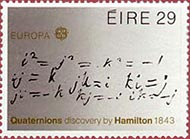
SUMMARY: what is i? a symbol that corresponds with whatever we decide it corresponds to for a given application, of course after we have already decided what 1, -1, 0, and so on correspond to. once we have done that, we can make use of the many mathematical theorems about complex numbers, with the faith that the mathematicians have done the hard work of logical proof for us already.2 unlike 1, i has no readily familiar example of correspondence to most people’s everyday experience, such as counting how many noses you have on your head. again, the symbol does “exist” but only in the sense of being a blot of ink on a piece of paper, in image held in the mind, and so on. some are shown below…
2with the all-important caveat that we have to make sure the mathematical symbols are linked with correspondents in actual experience in such a way that the formal manipulation of mathematical symbols cannot end up telling us nonsense.
now this line of discussion has gone like this…
me: “infinity” doesn’t correspond to anything
you: we could describe some properties of, say, Aleph_0 without saying what it really is
me: that won’t work unless we have some idea of what type of thing it is: a number, a set, a smell, treason, a brand of raisin bran, etc.
you: the same could be said about 0, -1, and i
me: those are symbols that can correspond to certain states of affairs when linked with experience (“1 apple”), and this can be useful
and finally i would like to say that one could, by the same logic outlined in this post, decide something that “infinity” corresponds to in actual experience. but insofar as “infinity” can be usefully linked with experience, it cannot mean what it does in most math works. for example, we decide “i have infinity apples” shall mean “i have more apples than i could ever need or want or whatever”.
in short, we cannot “mean” what we cannot think or imagine, as i understand the verb “to mean”: to hold a thought in one’s mind and utter a sound (or write symbols) in an attempt to get the listener to hold the same thought in her mind.
well Clayton, i fully agree, and see-and-say is a good illustration of that.
and i know this thread has been long and chaotic, and probably feels quite weird.
BUT, the original reason we were talking about mathematical formalism was that i was saying the notion of infinity was brought into other fields, which i just remembered includes religion!, as if it was valid because those ever-rigorous math people all agree on it.
in short, if we agree that infinity is a symbolic formalism, i suspect there is no disagreement in this neighborhood of the thread.
i essentially agree with this: see the bold, or see the post right before this one for a more complete answer.
that’s actually a good example. i mean praxeology not strictly as “human action” but action by any entity capable of rational decision-making, which i think [personal opinion] probably includes birds, dogs, cats, and many other animals. (i can’t recall if Mises agrees with this or not.)
i said, “it is a question of how one defines mathematics, but i would argue that at least most of mathematics is best demarcated as a sub-branch of praxeology”. if we define the purview of mathematical statements to include statements that speak directly about the motion of physical objects in an elliptical path, rather than about ellipses as ideal shapes, it would not then be fully contained in praxeology. it may, however, be fully contained within “praxeology together with thymology”, except i am not prepared to claim that because i am not sure the exact definition of thymology.
can you actually imagine this? i know you can imagine flat creatures with the thickness of a piece of paper living in a box that is only as thick as a piece of paper, and only seeing long, thin rectangles…but can you really imagine 2D? can you imagine something of zero thickness? and if you cannot, how can you actually mean anything by the words “2D creature”?1
1assuming you agree with this definition: mean (v.): to hold a thought in one’s mind and utter a sound (or write symbols) in an attempt to get the listener to hold the same thought in her mind. if you don’t agree with the definition, why not?
“I mean praxeology not strictly as “human action” but action by any entity capable of rational decision-making, which i think [personal opinion] probably includes birds, dogs, cats, and many other animals. (i can’t recall if Mises agrees with this or not.)”
Mises:
“The a priori sciences—logic, mathematics, and praxeology—aim at knowledge unconditionally valid for all beings endowed with the logical structure of the human mind.” (Human Action)
Basically the same idea.
“I would argue that at least most of mathematics is best demarcated as a sub-branch of praxeology”.
Great point.
Would this be for the reason that we can conceive mathematics as a science instructing on the necessary (a priori or apodictic) consequences of a specific group or kind of human acts?
E.g., If you have 4 (your current state of affairs), and you take 2 away (an action or a means, depending on how one conceives it), you will then have 2 (the necessary end or result of your action). ??
Mathematics can be demarcated or conceived as a sub-branch of praxeology for a reason such as this ?
Regarding the above two ideas; that praxeology is a science describing the laws that apply to acting beings generally (human or not), and that mathematics can be conceived as a branch of praxeology, may I ask, through what course of study were you able to reason to these conclusions ?
Yes, I think “symbolic formalism” would be a sufficient description of infinity.
I think the issue merits further thought, however. In this lecture, Steven Pinker argues that human language actually contains a latent theory of physics within it and he delves into grammatical constructs to illustrate this. He points out that we say that an ant crawls along the edge of a plate but across the surface of the plate. You do not say “the ant walked along the plate” if you’re trying to communicate that the ant walked across the surface of the plate. The mind is dividing the plate into idealized 1-dimensional and 2-dimensional surfaces and rejects the usage of the word along when referring to the act of crossing a 2-dimensional surface. You do not say “he walked along the floor” you say “he walked across the floor.”
I think that much of mathematics actually resides in this realm of shared idealizations of the physical world. Many of the things that are taken to be “natural” in mathematics - for example, prime numbers - are actually very strange when you think about it and why we should find those particular kind of abstract objects so interesting is puzzling and, I think, deserves an explanation and I think Pinker’s theory of language goes a long way to doing just this.
I believe that infinity is just exactly one of these kind of shared idealizations.
Mathematics have little to nothing to do with praxeology
Yes. Praxeology involves axioms that are either a priori or empirically true. It is not always so with mathematics: there, one is free to choose crazy axioms and then study the consequences. The results may or may not clearly correspond with anything in the real world. A striking example is the plethora of superstring theories, which amount to little more than playing mathematical games.
And all accepted mathematics is rigorous
This is a contentious issue. “Accepted” is contingent on which axioms are adopted. Many of Euler’s results (e.g. the reflection formula for the Zeta function) are not rigorous by modern standards, but they may be true and accepted before “rigorous” evidence is contrived after the fact. Computer-generated proofs may be rigorous, yet so long and complicated, that they are not accepted. The Riemann hypothesis is seemingly accepted, judging by its frequent use in proofs, despite not being proven itself.
if we are not talking about bending in any direction, in what sense are we saying that a long, thin pole “bends”?
A pole in a gravitational field bends in the same way that a geodesic on the Earth bends. A flat-earther walking along the geodesic might not perceive the bend, but a large-scale geometrical study would reveal it. The numerical magnitude of bending - the curvature - can be computed from the Ricci or metric tensor.
i found the following definition in Nonstandard Analysis, by Dr. J. Ponstein…this definition smuggles in the idea that it is even possible or meaningful
Indeed, the possibility and meaning is imbued in the definitions. Just like defining the successor operation and saying 0’=1 assumes that its even possible or meaningful to have numbers other than zero. Your insistence on “existence proofs” makes you sound like a constructivist-type mathematician http://en.wikipedia.org/wiki/Constructivism_(mathematics. I’m not sure how far that mentality can be carried, since presumably they depend on axioms as well.
David Hume was aware of the technology used to spread out the “points” making up space, such as telescopes and microscopes, but he wasn’t aware of the technology used to spread out the time including those points, such as slow-motion cameras. Probably you won’t agree with my exposition of that, but try to bear with me real fast. There are situations where the frame-rate of our vision isn’t high enough to capture something. For example, just like the fact that you could back up from something until your mind can’t divide it anymore, you could launch something past your field of vision so fast that your mind can’t capture it at all. But that doesn’t mean that it isn’t there: It would be possible to use special equipment, such as a slow-motion camera, to “spread out” the “time frames”, so you could see it. But that’s exactly analogous to what he was talking about when he was saying that just because we can’t see something doesn’t mean that it isn’t there, because you could use a small telescope to “spread out” the light that was always flowing from the dot that he was talking about, so you could start seeing it again. Just like saying that something moving too fast to see it doesn’t mean that it doesn’t even exist, saying that you’re too far away from something to see it doesn’t mean that it isn’t there. Just like the fact that something is moving so fast that we can’t see it anymore doesn’t destroy it, the fact that something is so far away that we can’t see it anymore doesn’t destroy it! Just like we can’t launch something so fast as to destroy the matter making it up, we can’t step back far enough as to destroy the point, or whatever we’re talking about.
So what was it that I was trying to explain?
Well, first, let’s look out for a possible equivocation on the word “point”.
A point could either be a 3D object in space - which you called an “actual point” - or it could be a 2D point making up a part of your field of vision - which you called a point “in your mind’s own perceptual space”. Let me refer to an actual point - a 3D dot - as a “dot”, and refer to a point in your mind’s own perceptual space - a 2D point making up a piece of your field of vision - as a “colored point”. Maybe this will help clear up the confusion. Let’s take David Hume’s example in those terms. Draw a dot on your wall, and step away from it until it disappears. Well, right before it disappears, your mind is representing it as a single colored point on your visual field. I’m not saying that the dot - which is a real existence - is the colored point on your visual field. I’m just saying that, right before it disappears, your mind is representing it as a single colored point on your visual field. It’s only one view of the dot, and it happens to be a view where your mind is showing it to you as just a single colored point. The import of this example is simply that it allows you to see how small a single “pixel” of your visual field is. It shows you how small a piece of color on your visual field can get before it disappears.
But why did I care to bring up that distinction?
I think that a lot of the confusion here probably came from the fact that we were equivocating on the word “point”. I was saying that we see an arrangement of 2D points for each moment of time that we experience, and you thought that I meant that “real time” - whatever that is - actually has moments, and that they are made up of 2D points. Well, that would be totally absurd, and it isn’t what I’m saying. I’m saying that our experience of time (time in “your mind’s own perceptual space”) is broken up into a series of moments, and that each experience (a single view of space “in your mind’s own perceptual space”) is broken up into an arrangement of 2D colored points. I’m not sure that you will accept this yet, but maybe this has cleared up some of the confusion. Either way, I’m going to move on, and see where else I can go in this post.
We might only be able to experience a certain frame-rate, but things like slow-motion cameras show us that things are going on that our frame-rate can’t pick up. It shows us that there’s more to what we’re seeing right now than just the X number of frames that we see in any given span of time. We find that we can “spread” a span of time out, so we can more things about it. We notice that we can spread an event taking up 60 frames into an event taking up 600 frames, and find 10 times the amount of information. (Notice that high frame-rate cameras are useless unless we slow down the speed! If there are 600 frames to be seen per second, and we can only see 60 per second, we would need to “spread it out” from 1 second of time into 10 seconds of footage.) It isn’t clear - at least to me - how far we could go with this process, but who knows. We used to only be able to magnify things up to whatever amount of times, and now we can do it a lot more. I’m sure that telescopes were a lot weaker back when David Hume was around, but we might still be able to go farther. In the same vein, I’m sure that slow-motion was a lot worse 20 years ago, but who knows how far we will be able to go. In this sense, both “real space” and “real time” might be “infinitely divisible” - divisible to the point that any loss of information is totally negligible, but that doesn’t refute what I was saying, that each of our “views” of this “real space” or “real time” are finitely divisible and made up of simple, indivisible parts. It’s extremely important to understand this distinction - that between “real space/time” and our “views” of it.
But, indeed, let’s not get too carried away with this: It would be a backwards method to say that we go from “real space/time” to our “views” of it. It’s really that sets of our views - our views organized in certain ways as to satisfy our desires - are what define this “real space and time”. Real space and time is nothing but sets of our views of them. Even calling them “our views of them” is an artifact of the backward method. Really it’s just this: We experience things, and then we group them into categories as to reflect how we feel about them in terms of satisfying our desires - of course it all comes back to human action.
In short: Space and time might be infinitely divisible - if that means being divisible until we get bored, but each member of the categories making these ideas up aren’t.
Let me go out on a limb here and start talking about something that I don’t know anything about.
Really I don’t know anything about calculus, but based on random things that I have heard about it over the years, I have always got the feeling that calculus is an attempt to model things that are inherently “continuous” - that is, we can divide them into we don’t find any utility in continuing - in our mind’s framework, which is “discrete”. It’s something like this. We divide our view of motion into as many parts as we need until we think that the calculations are coming out well, but our views of motion are always a sequence of discrete parts. And doesn’t the fact that dividing our views of something into so many parts gives us better answers say something about “real time”, like that it is “continuous” in a sense (really just in the sense that accurately modeling physics requires us to model motions as many more parts than we could experience in normal time)? Maybe you could set me straight here, because I’m working with a bunch of wild assumptions, and no better understanding of calculus than a class that I failed in high school and a few Wikipedia articles that I read three years ago.
Now let me get back to something that I actually know something about.
Hopefully you got something out of this post, and maybe next I will try to explain how we move from our view of time - a sequence of appearances made up of colored points arranged in 2 dimensions - to our idea of real space and time. Maybe in the next post I will try to give a quick overview of how we come up with our idea of 3D objects when we don’t have anything to work with but a sequence of 2D images! Something fascinating about it is that it’s possible to conceive of a situation - an arrangement of desires - that would make 3D objects not make any sense. 3D objects aren’t an ultimate given to our mind - like causality, but are a contingent fact of our world!
is not that the whole sales pitch of math to non-mathematicians? “INSTRUCTION SETS SOLD HERE! get your instruction sets, then all ya gotta do figure out how they link up with whatever real-world issue you’re facing. after that, the math geniuses have done all the hard logical figuring work for you. just plug n’ chug!”
but i actually will give a counterexample that seems to go against this in order to make the point:
<9x9=81 could be used to learn something completely unrelated to human action: i know there are 9 boxes of 9 donuts each in my kitchen, so i can know there are at least 81 donuts there. “there are 9 donuts” is not an action, so although 9x9=81 CAN be a praxeological statement, it doesn’t have to be. so not even all basic mathematics is contained in praxeology.>
but what is the point in knowing there are a certain number of donuts, if not to guide one’s actions? any practical use of 9x9=81 will eventually have to be phrased or thought such a way that the action element is explicit in the statement/thought. i can say “there are 81 donuts” with no action element, but once anyone goes to use it for any purpose they will effectively be thinking, if not speaking, of it in a praxeological way, such as “i know i need 80 donuts. i also know this donut shop sells them in boxes of nine. since 9x9=81, i know if i obtain nine boxes of donuts, i will have enough.” some might say “well 9x9=81, so i will have enough” but they are at least thinking the underlined praxeological if-action-is-taken-then-a-true-by-definition-result-will-happen statement.
that’s fascinating. language seems to be embedded with a basic set of epistemological and physical assumptions, but they are shared as you say. it’s kind of like sharing a car, sometimes other people don’t go where you want to go, or aren’t as careful drivers as you’d wish, but you can’t get out of the car (speak your own language that matches your personal assumptions about how the world works) or else you’ll never get to where you want to go (communicate with others).
i heard you say you work in software. do you think there is any way something like this point can, actually or metaphorically, carry over to programming languages? something like, the basic choice of programming language creates a “universe” in which to work to build something…or maybe that certain types of systems are easy to build in one language versus another, perhaps partly because the language was designed with some latent theories of how things work (or should work) in mind?
geodesic meaning the shortest path between two points? if so, walking along the earth from Wales to Stockholm does not really trace out a geodesic, as the shortest path would be to burrow through the earth.
or geodesic meaning a curved path along the surface of the earth? then we can say which direction it bends: downward from the POV of the person walking.
yeah i have constructivist sympathies. for natural numbers, i’d define them as a symbol representing a count of 20, or 7 iterations of a process, or 5 pillows. existence proofs:
as to the part about 3D is only sets of 2D, i think there is more to it. if we never move, and nothing around us ever moves or changes, we only see 2D faces of everything, but we still perceive more than that. more than we are seeing. i would almost say we are feeling something while we are seeing:
I think that it was David Hume who said that, even if we were to suspend ourselves in a cage 10 stories up with absolutely no danger of falling, we would probably still feel the intense emotions associated with being in danger of falling 10 stories down. But we must realize that, if we don’t have the idea of 3D objects, that 2D image isn’t anything but one that our body is hard-wired to say is really serious. (I’m not going to say that it’s something that our body is hard-wired to say that we really don’t want it or something, because some people enjoy putting themselves in those situations.) I can “feel” something really strong even just looking at that picture, but the only way that I know that it has anything to do with 3D objects is because I have seen that running through certain sets of 2D objects before or after getting that feeling is “causally connected” with it. It’s like trailing. Sure, we’re hard-wired to see some 2D frames as having the “trailing” thing coming after it, as if it’s moving, but I only know that it’s “as if it’s moving”, because I see that the 2D frames which generally come before or after those trailing 2D frames are usually… well, you know.
So it’s simply that we know through experience that certain 2D frames, or even certain bodily sensations, are associated with sets of 2D frames which form our ideas of 3D objects, that makes it so seeing just one 2D frame, or feeling like one emotion while looking at just one 2D frame, gives us a glimpse into the 3D objects. But, then again, it’s nothing different than the fact that seeing a snapshot of your hand with the “trailing” thing going to the left makes it obvious that your hand was moving to the left. Was it that the other 2D frames were actually “contained” in that 2D frame, so you could “see motion in just one frame”? No, it’s just that you know through experience that seeing that snapshot in your mind generally follows seeing the other snapshot in your mind, so your mind simply transitions from the snapshot of your hand making to trail, to its “usual attendant”. It’s just experience that lets us know that certain 2D frames are associated with certain sets of 2D frames making up 3D objects! Without the experience, they wouldn’t be anything but 2D frames!
(Start from that still image with left trailing, and then try to think about it moving from the left to the right without your mind transitioning from one 2D frame of your hand farther to the left, to another one of your hand farther to the right. It’s not possible! And start from that 2D image that you posted, and then try to think about the fact that you’re really far up, or that the cars down there are moving in 3D space, without letting your mind transition from one 2D frame - where you’re “higher”, to other ones - where you’re “lower”. It’s just not possible! When I think of the fact that I’m really high up in that picture, I imagine sky-diving headfirst off of the top, and then right at the end dipping upwards as to follow the path of the cars. That’s a sequence of 2D images!)
But how do I deal with the fact that touch and proprioception show us 3D objects directly? Well, I don’t, because I don’t think that they actually show us 3D objects directly. I don’t want to make this too long, because I haven’t even managed to explain how we form our idea of 3D objects yet, but I want to point in the right direction. Basically it’s this. Grab your mouse, and feel your hand wrapped around its 3 dimensions. What’s going on there? What I feel is a mild “touch” sensation with a smooth texture (I’m not sure whether texture is basic or not yet) distributed around the 3D object. But what’s it mean to be distributed around the 3D object? Basically I don’t think that it would mean anything until we know what 3D objects are! I can’t contemplate my hand being wrapped around the mouse without seeing my mind transition between the 2D frames making up my idea of the mouse. It’s just like sound. Sure, you could say that we directly see 3D objects through sound, because we hear that a sound comes from farther or closer. But really what is the mechanism that makes it seem like sounds are coming from a certain location? Certainly the sound itself doesn’t really have a location, considering that you might hear a phone ringing jumping around the room, first located on your cellphone, then on somebody else’s, then finally settling on a scene on your television. What happens is that we already have our idea of 3D space (which is nothing but sets of 2D images categorized in terms of our desire toward them!), and our mind just transitions so easily from the sound (which has no place), to the 3D object that we feel caused it, that we’re apt to confound them, until we feel as if the sound has a place. Same with touch, and same with proprioception. But what happens if you’re born blind? How do you develop your ideas of 3D objects, so you touch and proprioception could be distributed along 3D space? I have no idea. Maybe you can tell me. But, either way, I was just talking about how touch and proprioception (and sound!) pretend to show us 3D objects directly, not how they would show it to us through a sequence of frames. I’m almost certain that they can’t show it to us directly, but I’m sure that they could show it to us indirectly, through a sequence of frames.
how we perceive 3D objects is out of my realm of investigation so far.
…so what follows on this topic is entirely SPECULATION by me…
first i will say i think the problem has to be bite-sized. start with something VERY simple. otherwise there is little chance we can penetrate this. it’s just too big and complicated an issue.
atheists argue endlessly with theists about whether god exists. the issue isn’t “god”, the issue is “exists”. define exists and you’ll know the answer to this age-old question. the reason it is age-old is no one ever does this, because they are stuck on the “god” part.
in the same way, we are talking about how we comprehend 3D objects. what are they, and so on. so far discussion has focused on the 3D, but the real action i think is in what an object is, or what we are trying to get at when you call something an object. clarify that and the rest might fall into place. otherwise we could go back and forth for pages talking about whether god exists without ever defining exists, and that would suck.
how do we even know what an object is?
even a 2D object on a screen?
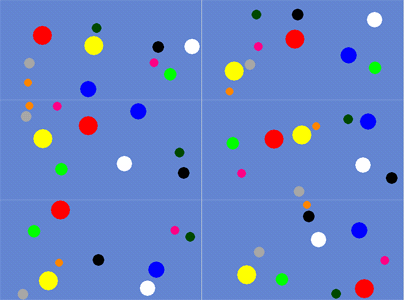
imagine you are born isolated from from all outside sensory input, except a 2D visual display is connected to your optic nerve. you gain points tradable for food when the big red circle touches the right edge of the screen, and lose points when it touches the left edge. you can control the blue circle to a degree by flexing certain muscles. this is the entirety of the outside world to you! if food is at all expensive in those points you’re acquiring, you’re going to really care about those collisions and become a master at manipulating that blue ball.
so, what is an object to you in this case? i don’t even have an answer yet. i haven’t thought about this, unlike the rest of what i wrote so far in this thread.
by the way, i realize the falling sensation is instinctive and all. i chose that image for maximum impact, but i think it can be shown more mundanely.
something that is farther than, say, arms’ length from you might have a different feel from something closer…and of course it depends on what that thing means to you, and to your ability to grasp it, etc. some of it is probably instinctual, so it could be quite a messy problem to fully get one’s head around.
That’s a sequence of 2D frames, but I see something similar from one frame to the next. It isn’t that, with every new frame, I see something totally new, but that, with every new one, I see that it changed slightly. But how does that happen? Well, let’s start out with something a bit easier. Imagine the same picture, except all of the balls are gone except for the red one. There’s the blue background, and the red ball is moving about it totally unobstructed. So how do we see the red ball as something separate from the background? No idea yet. But I think that we will need to answer that question before we can get anywhere with this.
I think we have some idea. First, we have the ability to sense a distinction between red and blue (necessary but not a sufficient condition for distinguishing the “red ball” from the “blue background.”) The next problem is much more difficult, philosophers have been struggling with it since the time of Plato - how does the mind validly correlate a bunch of particulars into a single universal? If we look at the red-ball-only movie frame by frame, these are the “physical facts”. Yet when these frames are played in order before your eyes, you perceive something more than a series of unrelated movie frames, like a family genealogy slideshow.
I think, today, we can understand this process a little better through Solomonoff’s theory of induction. Basically, I think the mind is constantly formulating hypotheses about the “raw data” which is coming into the brain, searching for patterns that it is able to recognize (it’s not able to recognize all patterns, only some patterns). The constructed hypotheses are what create the sensation of wholeness to a series of otherwise unrelated physical sensations.
Some patterns are learned, for example, the multiplication table. There is clearly no evolutionary or biological basis for recognizing the patterns in a multiplication table. But patterns that are reflections of the physical world, like the billiard ball frames in your post, probably have dedicated “pattern recognition” circuitry in the brain.