Is AnLib the same as AnCap?
Be sure to visit this video and the original one to offer your rating. (Of course the moveon.org one disabled comments, but at least you can offer a thumb)
It depends one your definitions and who you ask… According to Rothbard, the answer would be no. For example, he would say that David Friedman isnt liberrtarian but he is most definately an anarcho-cap
In my case, no. But a good example might be my opinion on homesteading. Libertarians have a lot of different derivations of property, who can own what, how, etc. I have a different derivation but I just don’t care that much. I think that Locke’s version is morally and consequentially “good enough”. Same with Rothbard/Hoppe. I’m just kind of indifferent even if I think there are strong logical reasons against their versions.
A nice, long, candid interview with Ron Paul, demolishing the typical statist positions of higher taxes, deficit financing, and militarism:
The US has become a “foodstamp nation.”
Clayton -
Could you give us an executive summary of it?
he wants the workers to choose what job they get. by managing the economy as a whole. he realizes people may not want what their jobs produce, because presumably everyone will flock to the clean fun jobs, like being an artist, so compromise will be needed.
he assumes that people will prefer that those doing the dirty jobs will work less, as opposed to preferring getting the product they were used to getting. because after all, now its the workers making the decisions about themselves.
in the present system its power and wealth that decides, with mere consumer input being secondary.
bottom line, its not just about workers in their own factory running the shots, but a much bigger picture, about all workers running the whole economy, free of power and wealth forcing them to do stuff, since they are no longer wage slaves.
About the whole wage slavery thing. I imagine it can be solved quite easily. Just set things up that any worker, instead of being paid a wage, becomes a partner. Make an estimate of what percent of the final product his work is responsible for, and give him that percent of the profit [or loss] when the money actually comes in, i.e. when the products are actually sold a few months down the line.
The worker/employer dichotomy is statist thinking. I work as an engineer. I employ landscapers. My employer signs contracts with other companies to deliver products that I help engineer. So that makes my employer an employee. Like my employer, I am a worker and an employer. I also invest some of my money, so that makes me a capitalist. I also save some money in cash, so that makes me a self-insurer.
The power of the Establishment in steering the market towards arbitrary ends is vastly exaggerated. Like a madman with his finger on a nuke launch button, the Establishment can definitely lay waste to the economy if things are not going to their liking but that’s really the only power they have: the power to destroy when things don’t go their way. And, since the breakdown of the Copenhagen summit in 2009, I think we are witnessing a breakdown even in this power, as the one-time globalist Elites are turning inward and trying to protect their home turf from economic armageddon while paying lip-service to the globalist agenda.
As for what sorts of jobs people will take, there is no other way to know than to allow completely free pricing in the labor market. I think the distorting effect of the minimum wage, for example, is trivialized by most economists, even Austrians. The minimum wage is not a trivial matter, it is causing gross distortions in the labor market and society, as a whole. Just forty years ago in the US, home delivery of fresh milk was common. The milkman wasn’t rich but he could support a small family on his income. These kinds of jobs do not exist anymore and “technological/economic progress” is not a believable explanation, in my view. The reason is the effect of stifling regulations, anti-competitive labor and employment policies that keep the unions and the big corporations in charge of everything except some rural teenagers doing lawnmowing for cash and some “illegal” house-cleaning maids in Southern California.
The effects of this are more wide-reaching than just the abolition of a few low-paying jobs. According to Say’s Law, in order to be able to demand something, it must first be produced. So, if something is never produced (because the wage rates at which production of that thing could be profitable have been abolished), then it can never be demanded. An entire segment of economic activity has been outlawed. Capitalism has been described as “production by the masses for the masses.” I think the sub-minimum wage economy could be described as “production by the poor for the poor.” By abolishing such production, the poor have only one option: privation. The social engineers, meanwhile, clap each other on the back and congratulate each other on what a fine, clean, decent, well-paid society we have become - and the milk goes undelivered.
Clayton -
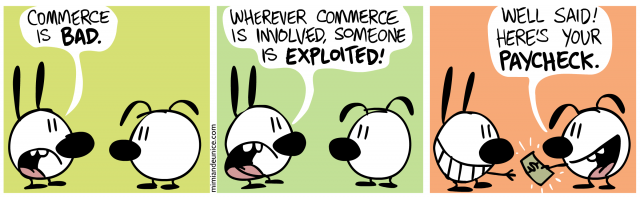
Even talking about this is a waste of time. The minute you even hint at these whiners sharing in company losses their whole argument shuts down.
http://news.yahoo.com/invisible-millions-pay-price-statelessness-103342973.html
Up to 15 million people are stateless, not recognized as nationals by any country … They often can’t start a business, own property, hold a driving license or open a bank account."
Yay for the world’s general perception being that the state gives you your rights!
In all fairness, is that all that different from the one ancap vision that those uninsured by a PDA would have difficulty living in society?
This is disgusting:

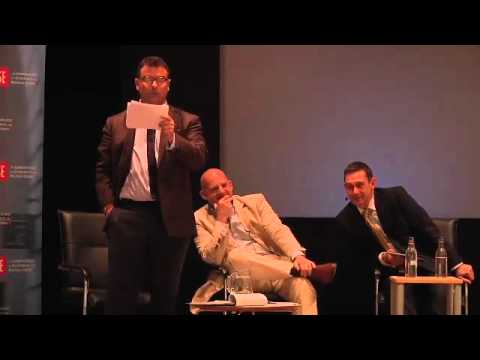
The LSE Hayek -v- Keynes Debate…
To all those unbelievers who think that AnCap will not provide appropriate protection to people:
http://news.yahoo.com/woman-90-beats-back-burglars-cane-152447976.html
Re: Contract for the American dream,
They announced point 1 and that’s all I needed/cared to see.
This seems a propos:
The latest in the ongoing series of unbelievable LEGO production-line creations: