Money socialists of the world unite!!!
There are two fundamental facts in my original post that are irrefutable. The question then becomes do Austrian economics recognize, or better yet, take these two fundamentals into account? From my less than expert observation of Austrian economics, I would suggest they are ignored. Let’s review them both; exponential growth of debt & and all new money is created by debt:
In a subsequent post, I showed the following graphs to prove my point:
Link to Complete Article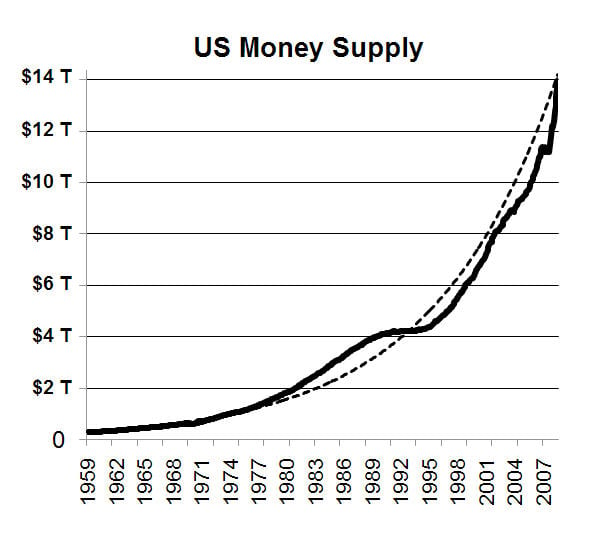
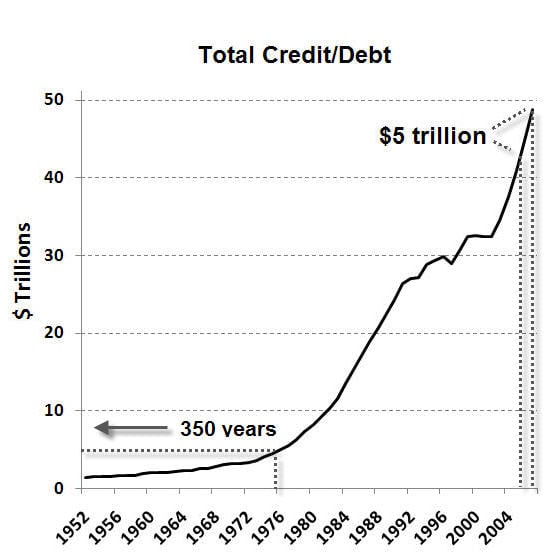
I think we can come to some logical conclusions based on the math:
- Eventually a debt based money system like ours will collapse as the exponential growth of debt cannot be sustained. We are at that point as there are not enough wanting and worthy borrowers to feed the perpetual debt machine. Government has stepped in as the “borrower of last resort” but soon, it too will be overwhelmed.
- Our debt based system was DESIGNED to fail in order to transfer wealth and private property from the people to the banks and those who own and control them. Folks, this is the issue of our age - our monetary system is a scam, a huge Ponzi scheme. We are submitting to debt slavery by choice as we can end it anytime we want.
Look forward to comments…
Larry
Larry
Debt grows exponentially in the REGULATED SUPER FIAT BANKING system. No one is denying that.
Austrian theory of currency is a theory of free market currency, which is not fundamentally different from any other good.
We have said this numerous times.
You are retarded.
You have come to half the truth which is a big step. You’re right in agreeing that debt will grow exponentially. But then you fumble in describing our current system as a “REGULATED SUPER FIAT BANKING.” I don’t know what you are describing and I don’t think you do either.
The Federal Reserve is a privately owned and operated debt based system. First, we had the gold standard which failed miserably in 1933 and the U.S. lost most of it’s gold. It didn’t matter that our money was “supposedly” backed by gold, the problem was that the exponential growth of debt out-grew the amount of gold in reserves. The gold reserves would have to grow exponentially along with the creation of new money (debt).
This cannot be sustained regardless of whether we use gold, paper notes, or clam shells; the problem would continue as it is a function of math and the money specie is secondary at best. Here is a clarification of your comment:
Debt grows exponentially in the DEBT BASED BANKING system. No one is denying that.
Larry
What failed in 1933 was NOT a gold standard. It was a gold-exchange standard foisted on the world by the British.
Rothbard:
The gold-exchange standard worked as follows: The United States remained on the classical gold standard, redeeming dollars in gold. Britain and the other countries of the West, however, returned to a pseudo-gold standard, Britain in 1926 and the other countries around the same time. British pounds and other currencies were not payable in gold coins, but only in large-sized bars, suitable only for international transactions. This prevented the ordinary citizens of Britain and other European countries from using gold in their daily life, and thus permitted a wider degree of paper and bank inflation. But furthermore, Britain redeemed pounds not merely in gold, but also in dollars; while the other countries redeemed their currencies not in gold, but in pounds. And most of these countries were induced by Britain to return to gold at overvalued parities. the result was a pyramiding of U.S. on gold, of British pounds on dollars, and of other European currencies on pounds–the “gold-exchange standard,” with the dollar and the pound as the two “key currencies.”
Now when Britain inflated, and experienced a deficit in its balance of payments, the gold standard mechanism did not work to quickly restrict British inflation. For instead of other countries redeeming their pounds for gold, they kept the pounds and inflated on top of them. Hence Britain and Europe were permitted to inflate unchecked, and British deficits could pile up unrestrained by the market discipline of the gold standard. As for the United States, Britain was able to induce the U.S. to inflate dollars so as not to lose many dollar reserves or gold to the United States.
The point of the gold-exchange standard is that it cannot last; the piper must eventually be paid, but only in a disastrous reaction to the lengthy inflationary boom. As sterling balances piled up in France, the U.S., and elsewhere, the slightest loss of confidence in the increasingly shaky and jerry-built inflationary structure was bound to lead to general collapse. This is precisely what happened in 1931; the failure of inflated banks throughout Europe, and the attempt of “hard money” France to cash in its sterling balances for gold, led Britain to go off the gold standard completely. Britain was soon followed by the other countries of Europe.
It’s funny that you quoted Snowflake, then responded to him, but the response to what you wrote is exactly what Snowflake originally said. You’re not seeing the obvious: the State is a monopoly, and the Fed is merely an arm of that monopoly. The monopoly will create as much money as it needs/wants/can. The Fed’s quasi-private status is just a legal loophole and PR strategy that makes it easier for the monopoly to do what it wants. The Fed’s quasi-private status benefits both Congress and the Fed.
Thanks. This means a lot coming from you.
Status quo style debt. Not free market debt.
Yeah I do. See below.
Sort of. It has lots of government powers. This is what I mean when I say regulated super fiat banking.
Setting the federal funds rate
Setting the Discount Rate
Determining Fractional Reserve Policy
Lender of Last Resort
etc etc. The wikipedia article is very very long. You will see that the functions of the federal reserve bank stem from government fiat.
Also part of our financial system are things like the FDIC which backs all deposits thus insulating banks from failure and further enabling fractional reserve policy.
… … … Everyone’s point is that this would never happen on the free market. Of course it can happen if government gets involved.
Can’t you differentiate between the free market and central planning?
No you have it all wrong AJ. It is actually funny that he quoted me and responded to me exactly what I originally said. He’s not seeing the obvious; the state is a monopoly and the fed is merely an arm of that Monopoly. Come on AJ I thought you were smart… try to keep up with me and drkrbyluv
Stop calling it a private system. Our system could never work in a free market. It needs government support and privilege to survive and would not exist without it.
The private sector.
How would it go to “the people” if the government is printing the money? I’m pretty sure it would go to the government or to banks who would loan out the money to entrepreneurs, exactly like what happens now. “The people” are not the government and if the government simply prints all the money necessary to fund itself, rampant inflation would ensue harming “the people” tremendously.
Why would the government charge a 1% creation fee? Why not just keep that 1% in the first place or not create it at all? It makes no sense to print up a bunch of money, give it to a bank and then demand 1% of that money back. And 1% of all loans in the economy originating from the banking sector would most definitely NOT be enough to fund the government. Taxes would still have to exist or else the government would just be printing to finance itself, which is stupid and again begs the question, why the 1% creation fee?
The problem is that it doesn’t seem that you recognize the solution: a commodity-based money issued by private banks/mints. Further, you should read the daily articles and whatnot where frac-reserve fiat monopoly currency is excoriated.
Funnier still, if you look closely you’ll see he actually refuted himself:
“First, we had the gold standard which failed miserably in 1933 and the U.S. lost most of it’s gold. It didn’t matter that our money was “supposedly” backed by gold, the problem was that the exponential growth of debt out-grew the amount of gold in reserves. The gold reserves would have to grow exponentially along with the creation of new money (debt).”
…and how would gold reserves do that? [:P] Of course they can’t, so he’s implying that the government/Fed would ignore the gold standard and just pretend the money was backed by gold. Yet he wants fiat paper controlled by that same government, thinking that that will be…better?! Someone’s watched too much of The Money Masters.
None of this invalidates the Austrian Business Cycle Theory. I should also note that in your proposed system where government prints money and gives it to banks, the ABCT would still apply.
I agree.
I don’t remember choosing this system. And I’m not really sure what exactly I can to to end it anytime I want.
Actually: we do. You simply are under the erroneous notion that the federal reserve system is wholly private; it isn’t. It is a federally-mandated (FRA of 1913) cartel of quasi-private/quasi-government banks, whose Board of Governors is appointed by the US Federal Government. Further, this:
is only a quarter-right, and that being that the US was losing gold. But why? Because the fed wanted to prop up the inflated pound, which had been set at pre-WW1 levels by the UK. The UK was losing a bunch of gold from arbitrage, in essence, and the fed wanted to help stem that. Was it a gold standard? Not in any real market sense. It was an artificial creation of post-WW1 states.
No, he has come to the full truth. I don’t know what else you would call our banking system if not super regulated and fiat in nature. I think he knows exactly what he is describing.
With members appointed by the government and given vast special legal privileges that could never work on the free market. Calling it private does a disserivce to the private sector.
Hardly. You really should read some Rothbard on this. Besides, when the total money supply is not fully tied to gold, but partially to credit expansion by the banking system, how exactly is this a true gold standard? The vast fluctuations in the supply of money when the US was on the “gold standard” did not arise from gold being mined in vast quantities and then suddenly being lost. These fluctuations in the money supply were the result of credit expansion and contraction stemming from fractional reserve banking, not gold.
No one here is defending the status quo.
And yet ONLY the US Treasury’s Bureau of Engraving can print FRNs and utter coinage. So you really REALLY need to bone up on that which you discuss.
It’s a waste of time. He wants fiat money, he loves the government and its printing press.
If the original poster had read the Economics of Illusion by A Hahn, where Hahn answers this exact question of about inflation and National Debt, he wouldn’t make these pointless arguments. But, he didn’t read it, because apparently he finds printing money (redistribution of property) appealing.
Thanks Knight! I finally got something usefull out of this thread besides a frustrating chuckle. Your posts help improve my vocabulary at times.
ex·co·ri·ate ( k-skôr
 -
- t
t , -sk
, -sk r-)
r-)
tr.v. ex·co·ri·at·ed, ex·co·ri·at·ing, ex·co·ri·ates
1. To tear or wear off the skin of; abrade. See Synonyms at chafe.
2. To censure strongly; denounce: an editorial that excoriated the administration for its inaction.
You really have no idea what your talking about.
This much is true.