Fair enough, let me give you a common example of ‘counterparty risk’, that is specifically not involved in a particular transaction. Say a major corporation decides to borrow cash, and does so by issuing bonds. Bond brokers buy these bonds, and sell them to a pension fund. The pension fund has an audit, and decides they are cash poor, so they offer those same bonds on the secondary market. You buy those bonds at a slight discount from their face value. Your counterparty risk isn’t with the pension fund, it’s with the corporation that issued the bonds. Specificly the counterparty risk here is the risk that the corporation defaults before the bonds come due. Yet, you had no agreement with that corporation at all, only the pension fund. As Peter mentioned, there is no particular bitcoin transaction processing node that has any obligations to you at all, therefore there is no counteryparty risk.
When you hold bitcoins, you become party to the bitcoin network. Transacting in bitcoins involves multiple parties. The risk that those parties will fail to carry out the tasks that bitcoin members reasonably expect from them is hereby declared “counterparty risk.” semantic dictators may now take their signs and go home, the mere technicality of the absence of a written contract has no bearing, unless you are a semantic legalist. In that case, simply take your dictionary down from the shelf, and pencil the words “bitcoin” in under the entry for “money” and have done with it.
Gold is easily verifiable, butif you cannot doso yourself, the technician that verifies the authenticity of the bullion is party to a contract with you and that is counterparty risk, even if there is no written contract and you just invite a dude you know over and say “hey man could you look at these coins and tell me if I got ripped off? And bring your scale and acid kit too, I will buy you a case of beer for your opinion”
You’re still using that term wrong, but I think that is actually irrelevent, since both you and I seem to understand how you are using it now. Let’s just move on, okay?
Let address your concern, but let me first restate it so we are both clear that I do actually understand it. You are saying that, by using bitcoin, I run the risk that by the time I’m ready to actually buy something with them, the peer-to-peer network that functions as a clearinghouse could cease functioning for some unknown reason. This is the risk that you are describing, calling the p2p network itself a third party to my transaction with a particular person. I acknowledge that this risk exists, and that it does not for natural money, because without the p2p network in some functional state Bitcoin itself does not exist. Personally, I consider this risk vanishingly small, because nothing short of the complete destruction of the Internet itself could accomplish this, and even that is in question. However it is a non-zero risk.
I’m glad we are on the same page. And to address an earlier concern, a cryptographic network that enabled sending large encrypted messages without transferring equally large balances would be industrially useful, especially if you could do it from mobile phones. These crypotgraphic problems would be additional work for the bitcoin network, which woukd be rewarded by the small deduction in balance. If bitcoin or its successor could do that, it would be a contender.
Actually, the bitcoin network can send arbitrary data, encrypted or otherwise, and obuscate both the sending node and the receiving node via rapid redundency, and timestamp that data packet while it’s doing so. Bitcoin supports an arbitrary script method that, when paid for, will get the mining node that captures that block to execute that script. It’s a rudimentury scripting language, and is presently disabled because it’s still considered potential attack vector, but it’s possible. Since that data would be replicated all over the network, doing so with large data sets is considered bad form anyway, although outlinks to someplace else on the Internet would be fine. More likely is a ‘merged mining’ parallel blockchain that would support such things, like namecoin does now as a distributed nameserver. Bitcoin can do a number of other rather useful things with that scripting system as well, such as ‘timelocking’ which basicly involves creating a transaction to be processed at a later date and not before, permitting a kind of automatic escrow; and ‘channeling’ which allows two persons to set up a mutually fixed ‘deposit’ with each other for a predefined amount & time period. This last one would be useful for smaller online ‘wallet services’ functioning as banks to permit their users to transact with each other without creating a transaction every single time, and settle up at the end of the period with a single, special transaction.
All it needs is a secure front end and a few years of devo then. Somebody start writing code
Somebody already is writing code, and the front-end is the easy part.
@Malachi
You stretched my metaphor and I’m supremely offended.
Saying that the “swiss army knife”-knife is better because it can be used for other purposes completely misses the point of the metaphor.
Translation:
Arguments like, “Well what if the internet around the globe is shut down!?” is a red mark against Bitcoins, but an insignificant one. It would be cool if Bitcoins had industrial uses, but it doesn’t reduce Bitcoins value for its intended purpose, it just means if Bitcoins were renounced for their intended purpose they’d have no industrial value to fall back on. When you’re saving billions in transaction costs, who’s really going to be afraid of that?
I’ll just leave this here…
You Can Now Buy And Sell Bitcoin By Connecting Any U.S. Bank Account
Good news! Our bank account integration feature finally launched.
You can now connect any U.S. bank account to buy or sell bitcoins on Coinbase! The process is fast and simple, and we’d love to have you try it out.
Here are the steps after you sign in:
- Add and verify a bank account (for most large banks in the U.S. we’ll be able to instantly verify the account - smaller banks or credit unions may take a few days to verify while we credit two small amounts to your account and wait to see if you can verify the amounts).
- Now you can buy or sell bitcoins, and the USD amount will be debited or credited to your bank in 2-3 business days.
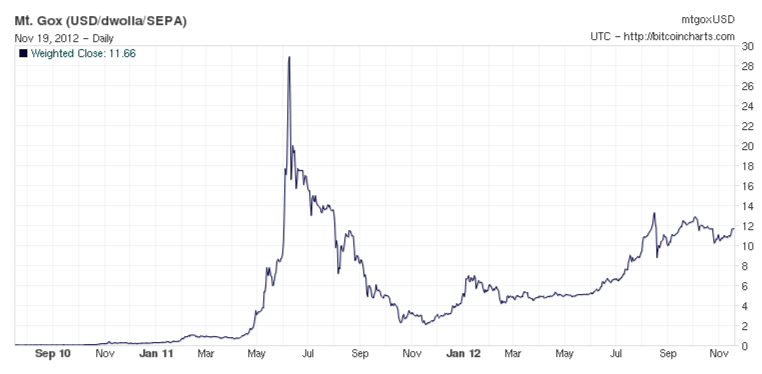
Would you invest in a money with a chart like this?  I pretty sure most of you did..
I forget where I read this, but that chart is exactly what you’d expect from uptake and mass acceptance. This same shape has been noticed in so many new things that it’s become characteristic. Even the Dotcom boom follows this same chart, with an early explosion of hype that broke and then lead to continuing growth over time.
Before the spike is early adopters. The spike is where it suddenly becomes big news and investors rush in hoping not to miss the boat. This caused overvaluation and the resulting selloff, which then settles into a relatively calm slow-growth shape.
If anything, this chart adds credibility to bitcoin. It’s been stable for a long time now.
Would you invest in a money with a chart like this?
What happened to this money at the end of 1979? 
I thought that you were talking about Bitcoin, and was about to respond with “I did!”, but I’m certain that Bitcoin didn’t exist before 2009, so I have difficulty understanding how it had a value in January of 1968.
I’m pretty sure he or someone made that chart and just fuzzed up the years.
That chart is the price of gold. That was his point, the similarity between the two.
Isn’t that silver?
Yes, it is silver, I didn’t even look at the y-axis.
I just looked at the file namein “View Image.”