Looking at that post, it seems that you only disagreed with points three and four, but I don’t really understand your objections/positions.
You said,
- I disagree. If you cannot measure the change in output from hiring an additional worker, you cannot measure marginal productivity. And it is my understanding we are attempting to discuss how the demand for labor is derived, which is only one side of the market for labor. So I am not sure how market mechanisms and prices would help you.
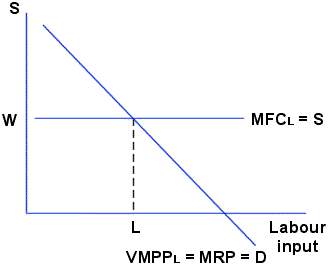
Are you saying that producers actually try to measure the marginal productivity of each laborer before they hire them/pay out salaries? My position, just to be clear, is that capital tries to absorb the entire labor supply, and engage in production. The most productive capital and the most productive employment of capital gets first dibs, and so on and so forth until the entire labor supply is absorbed. The market, through competition, pushes wage rates towards the marginal productivity of labor–but we should never expect it to actually reach or remain at this position. So an increase in the supply of real capital (brought about by savings) has to absorb a relatively fixed supply of labor, which pushes up real wage rates, and increases productivity (basically the same as saying that MPK falls, Q rises, MPL rises). As opposed to entrepreneurs using production functions trying to figure out how much labor to employ, and what to pay them.
Maybe I’m not understanding what you’re trying to say.
You also said,
- Trade unions are irrelevant for deriving the demand of labor. Trade unions are typically about restricting the supply of labor, so this bullet point should probably be dropped (or maybe clarified if I am misinterpreting).
But trade unions elevate their wage rates above their marginal product, necessarily diminishing demand, and lowering the real wages rates of “out-sider’s.” Are you saying that wage rigidity doesn’t affect the demand for labor? If so, you’re going to have to explain why elevating the minimum wage rate generally leads to higher unemployment amongst teenagers and minorities. It may not mean anything for your linear homogeneous production functions (though it may), but we’re talking about the real world.