Never mind =] People who want to stick to their bodies will be free to do so =]
you are quibblying about his everday common speech use of the word uncertainty . (being pedantic) you could have merely suggested a better word for him, as friendly suggestion. i make such suggestions often myself. you chose to be belligerent.
honestly, did you make any attempt to understand what he was trying to say, or where you just trying to one-up-on him?
If you look at the original quotation I suggested that he was wrong, I wasn’t trying to be confrontational, I merely thought he’d appreciate the suggestion that he made a mistake in his economics. Now, if he’s too stubborn to admit he’s wrong, then fine, he’ll be worse off because of it. I understood what he was saying, and it was wrong. Just like if I said “the time preference rate decreases as wealth decreases” I’d be incorrect, no matter how you intepret my position.
As for his “everyday common speech use of the word” (what an incoherent sentence), I wasn’t aware that “uncertainty” means something along the lines of a situation in which people are relatively certain about the future.
it was a phrase not a sentence, i believe it be coherent even without it being proper grammar.
LS was making a picture of a future scenario where ones well being is under a foreseeable, remediable, or at least mitigatable threat, threats are often posed as uncertainties. if something is threatening you, there is a chance you will suffer. it was the future threat aspect he was drawing attention to. he wasn’t playing roulette’s and other games of betting with you.
I’d be able to take this post more seriously if you didn’t have shit all over your nose.
yeah, too bad Hoppe doesnt write sentences of that quality.
Oh right because having a Y chromosone instantly imples a given ideology. Or the fact that I am genetic material from my parents. Yes yes, we are biologically dictated what we can and can’t believe. Too true.
It’s nice to know that the people on the moderator team are intelligent.
Everyone would take your posts more seriously if you stopped acting out like a petulant whelp and behaved with some dignity.
In a growing economy, there is an assumption that future goods will be more abundant, and so time preference is likely to rise. But in a contracting economy, where future goods are presumed to be more scarce, consumption is deferred and time preference falls. In nearly every crisis situation, economies contract. When people are under duress, they presume the economy will contract.
Humans don’t act under absolute uncertainty. If they were absolutely uncertain, they would take no action, neither for the present, or the future.
This is my last word to you on this subject. I’m sure you will refute me with every economist living and dead. I think I have made my case.
In a scarce market future would it not make sense to consume more goods now in order to satisfy demand that cannot exist due to scarcity or uncertainty? Take the example of conservation that Rothbard hypothesizes. In either mining or fisheries. Ifa corporation or entity has no certain future of capital wealth in such a field, then they will consume the trees or fish more rapidly in order to derive as much profit as possible from the area since there may be a chance they will not be able to utilize this resource area in the future.
Not all crisis situations imply increased uncertainty.
If one “presume[s ]” that “future goods” will “be more scare”, then one experiences increased certainty rather than increased uncertainty despite the situation possibly being a “crisis”.
Indeed, which is why I bundled crisis and uncertainty together. Only Nir was able to pick up on it.
Lol, OK. Says LibertyStudent who proclaims from above who is worth of the attention of the users of the fora and who is a credible source. Who also happens to be one of the more dogmatic members (behind nirgrahamUK of course, he really takes first place in this competition).
You’re conflating uncertainty with certainty about a somewhat bleak future. Look, in your situation people know what will happen in the future, they know resources will be scarcer and as such readjust their value scales so as to prepare for the future. As for your growing economy example, to begin with as wealth increases there is a shift down a given time preference schedule. Meaning, time preferences fall. As for the shift upwards of the actually schedule itself, this is an exogenous variable and can’t be determined a priori. Although, you do seem to be relying on something like Garrison’s exposition of secular growth, which Salerno correctly pointed out to be faulty. An economy grows as the result of purposive actions of individuals in an attempt to increase future consumption. The notion that they first decrease their time preference and then increase it when growth occurs is somewhat silly.
That’s somewhat tangential to the issue at hand though. The point is that if you imagine an individual to plan for X years, if out of the blue it becomes possible to adequately plan for X - 5 years, what you’re saying is that the individual will somehow respond by planning for X + 5 years.
There is no increased uncertainty in your scenario, people are still fairly confident of the future.
No, you conflated them incorrectly. When I pointed out this out nir couldn’t quite get it and went babbling on about something else. Actually, I pointed this out above, so when you say “only” it’s a blatant lie.
Why would you arbitrarily bundle together two completely different concepts?
No, I didn’t.
No it isn’t. You didn’t get it, because you disagree with Nir, who did. So only Nir got it.
It wasn’t arbitrary, it was deliberate. I don’t see crisis and and uncertainty as being “completely different”.
First results in my browser
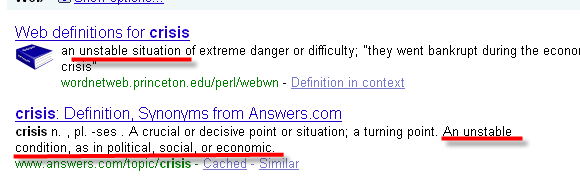
Yes, you did, the two are different concepts. Look, if I were locked in a room without food and told exactly what was going to happen to me throughout the next week, I’d consider it something of a crisis. But there’d be no uncertainty. Look, your example makes sense if you forget the uncertainty and focus on the crisis. But even then, you’re positing an exogenous change so it’s not a matter of pure theory anyway. What theory can tell us is that if individuals find it difficult to plan for a given period of time and provide resources for the future over that period of time, they won’t allocate resources further into the future.
No, I did get it thanks. But I guess nirgrahamUK is a priori correct cause he disagrees with me (and I’m presumably a statist).
I understand that the word “crisis” can imply uncertainty; however, I also understand that the word “crisis” can imply certainty.
From www.dictionary.reference.com:
-
a stage in a sequence of events at which the trend of all future events, esp. for better or for worse, is determined; turning point.
-
a condition of instability or danger, as in social, economic, political, or international affairs, leading to a decisive change.
The first and the second definition completely contradict each other with respect to the implication of the level of certainty. Therefore, I believe that the use of the word “crisis” in this situation is ambiguous because our argument concerns level of certainty and, with respect to level of certainty, the word “crisis” is equivocal.
The concept of “crisis” are “uncertainty” are two different concepts because, in accordance with the above definition, neither definition can precisely encompass the other definition.
I suggest that you attempt to re-advance your argument without the use of the ambiguous-in-this-situation word “crisis”.