The Ithaca Hour, like Bitcoin, is used by a very specific type of person. Reading their website is one big face-palm.

It has artificial scarcity. It was fiat’d as currency from the start. They want something to eliminate the double-coincidence of wants. And yet bitcoin is essentially no different from federal reserve notes in the sense that - ie. “This is money!”
ORLY? Says who?
“The need for a currency is enough in and of itself to be a legitimate demand that bitcoin will satisfy as nothing else can.”
This does not follow. There have historically been other currencies which worked well. But also that - given a free society, what are the arguments in favour of bitcoin - over other money which has already proven itself?
“Not close to existing [a free society] and yet it [ethics] is even more relevant [important] (in bringing in it’s existence) today.”
Different argument, same flawed principle.
It doesn’t hinge on it, it is one of the arguments. Bitcoins only have ‘legitimacy’ because of the state (legal tender laws prop up said fiat currencies), that of which bitcoin is essentially an extension. It tarnishes any claim it has of being a ‘free market money’.
Proposing the state collapses (or the US empire crumbles - or is it your position this is an impossible scenario?), legal tender laws are removed, fed ended etc. the monopoly over money is removed. A freemarket in money commences and in that of law… what is the use of bitcoin? Why would anyone use it anymore? What would give it value? (leaving aside it’s delusional acceptance now).
Lmao at “I haven’t got an argument against bitcoin in today’s world…” given the fact that the entire argument FOR bitcoin is essentially, OH BUT IT COULD BECOME MONEY YO! PROVE IT WON’T! Oh wait, no mann, it is MONEY right now I’m telling you! Hahah
Ithaca is known for being a reservoir of hippies. When you have that many burnouts that haven’t progressed mentally since the 70’s it’s not surprising that one of the IH “successes” is bringing a “Hometown Money Starter Kit” to a town in Russia to promote syndicalism.

How is it flawed? You mean you don’t have one?
Uh. K. So what are these other arguments that prove bitcoin is useless? (I really hope you don’t consider the things numbered off in that post actual valid arguments)
Yeah, you want bitcoin defended in a completely hypothetical, voluntary society scenario. We got that. A voluntary society doesn’t exist. So, I’m still waiting on your argument that bitcoin is useless in today’s non-voluntary society. And yet again, I’m also waiting on these “theoretical considerations” that prove “[bitcoin] is ultimately a doomed experiment”. Any time now.
Bitcoins are by construction useless. Hashcash - which Bitcoin is simply a modified form of - is useful but has no value in exchange. Useful data are things like software programs, media, anti-spam proof-of-work (Hashcash), encrypted data, and so on. Bitcoins are just proof-of-work for proof-of-work’s sake. The work done has no use. Bitcoins have no use as a consumption good. They have no use as a capital good. They are not money.
I designed my own digital currency system back in 2008, before Bitcoin was around. My system doesn’t use proof-of-work since it is concerned with proof of backing. The principle of operation after creation of a digital token between my system and Bitcoin is essentially the same though my system minimizes the use of public-key cryptography since I’m paranoid about the breakability of PK cryptography. My system requires extensive auditing of issuing digital reserves to verify that they are, in fact, maintaining full reserves. However, I eventually scrapped the whole idea once I realized that any system that requires the holder of the reserves to be known could be - and would be - raided and shut down. I call this the auditing-versus-anonymity problem.
I’ve got an idea of how to solve this problem. It’s not simple and it’s not elegant but I think it would work.
The system consists of two basic ideas. The first is to use a physical one-way function to track physical gold coins/bars. The way this would work is that you actually cast the bar or coin with the POWF embedded into it such that attempting to remove the POWF would result in its destruction. Anyone who has physically held the coin or bar could then take samples from the POWF to verify at any future time that a particular individual is, in fact, holding the coin or bar to which it is attached. The company that does this would be acting as a remote auditor. Using this idea, you could construct a network of anonymous gold reserves so long as the remote auditors were brick-and-mortar institutions that can be sued for fraud.
The second idea is to set up the system so that it is constantly experiencing a “bank run”, that is, where anonymous reserve holders are constantly required to satisfy “virtual withdrawals” to other reserve holders. Basically, the network would be constantly remapping the reserves so that 10% of Reserve A’s reserves are currently being held by Reserve B and must be physically transported from Reserve B to Reserve A, thereby proving that Reserve B actually had those reserves. I think of this as “cash Tor”. The minute a reserve fails to satisfy a virtual withdrawal - or a real withdrawal - it is ostracized from the network and the remote auditor which had vouched for its physical possession of the gold coin/bar in question can be sued for fraud.
Basically, the way it would work is this. Say I want to purchase a gold-coin-backed digital token from JohnnysDigitalGold.com. First, I request the ID of a POWF-embedded gold coin for sale. Once I receive the ID, I independently transmit the ID to the brick-and-mortar remote auditor - say TrustworthyAuditor.com - to verify that JohnnysDigitalGold.com is, in fact, holding that gold piece (which the remote auditor had to, at one time in the past, have physically held). If TrustworthyAuditor.com gives a thumbs-up, then I can be as confident that JohnnysDigitalGold.com is in fact holding a gold piece as I am that the remote auditor is not fraudulent.
The honesty of the auditors themselves is checked by the network. Basically, the core of the network would consist of generating random requests for ID checks to random auditors to detect double-counting and physical loss of coins/bars. Let’s say TrustworthyAuditor.com is colluding with JohnnysDigitalGold.com and says that they are holding a particular gold coin when they are, in fact, not holding it. If the coin is being held by someone else in the network, the lie will eventually be detected through random checks and the auditor sued. If the coin has simply been sold out into the regular gold market, then whenever JohnnysDigitalGold.com receives a command from the network to transfer that particular coin, it will be unable to do so. Failure to do so will result in presumption that the gold coin has been stolen. Since JohnnysDigitalGold.com is anonymous, there is no legal recourse. However, this isn’t the end of the story since TrustworthyAuditor.com has been saying all this time that JohnnysDigitalGold.com actually had the gold coin when they did not and so TrustworthyAuditor.com can be sued for fraud. Sooner or later, any fraud attempt will be discovered.
Now, there are still some remaining problems. First of all, this network would be capital intensive to bring online. Second, the integrity of the system rests on the ability to sue the auditors in national courts of law and have just outcomes to these lawsuits. Since the system would be explicitly competing with national fiat money systems, it is reasonable to expect that they may intentionally undermine the integrity of the system through unjust rulings in lawsuits against auditors.
Clayton -
Clayton, that is a fantastic and creative design. Thank you for sharing it. Are you involved in the DGC community?
The essential problem in digital currencies is storing the value in a way that minimizes the risk of seizure, fraud, or other type of loss. Your system addresses that in a very elegant way. Ultimately I’m not sure that as a practical matter and at the current time it would more secure than a centralized system such as Pecunix or GoldMoney, two systems which have weathered the storm and seem relatively secure from raids and seizures due to the jurisdictional arbitrage strategy they’ve employed. But it’s certainly a radical and interesting concept.
With additional brainstorming perhaps we can come up with something that would require less initial capital. Digital Gold Currencies have long been an interest of mine and I even was involved professionally for a while.
@HH: Thanks for the positive feedback. No, I have not actually participated or worked in a DGC, I prefer to maintain physical possession. I’ve thought that this idea (embedding POWFs in gold coins/bars or encasing them in POWF sealed containers) might be a technology that the existing gold assaying industry might take an interest in. I don’t think I’m the person to drive such a venture but I’m happy to share my ideas on it since any advancement in real monetary technology is a blow against the fiat money system which I loathe and despise. I can imagine a gold assayer performing an assay and then sealing the assayed bar in a container which cannot be opened without damaging the POWF and then taking a series of digital samples of the POWF. With this digital data, the original assayer could provide a measure of assurance that a gold bar is the very one which they assayed at a fraction of the cost of performing a new assay. This could reduce the premium on good delivery bars.
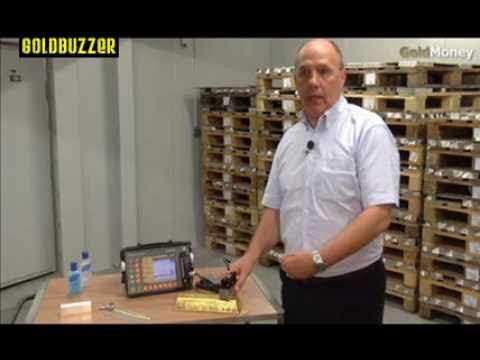
Combined with ultrasonics (which I understand is a relatively new tool in the assay business), gold assaying and certification of good delivery could become significantly less costly. Somebody posted this a while back:
Clayton -