“Do you think such a systemic collapse is now guaranteed not to happen in the future? Or do you think it’s been merely delayed by the bailouts and such?”
It is not inevitable, but it certainly can happen again. If it doesn’t happen, and current policy remains similar to what it currently is, then it will continually occur, or if it doesn’t, then it’s because the government boards up the hole, not because they fix the problem. This means that there’s literally a never-ending possibility of total collapse, but it will almost certainly be better to try to fend that off than have it actually occur, no matter what the means. It’s also very important to point out that the collapse is more likely for every reason so long as the debt crises keep up.
At any rate, the collapse is certainly not an inevitability as such because there’s still ways it could be dealt with. In fantasy land new, real, currencies would start to be introduced and then over time bank protections and the fractional reserve system would be weaned away. The best answer is a slow transition, but we all know how likely such a policy is to in the modern democratic system.
Not exactly. There was the Federal Reserve System but also a state-set gold standard. So kind of a mix. I’m not completely sure how this works but I think the Fed could still print money, but since other nations were on the gold standard, severe devaluations of the dollar would have consequences manifested in gold draining overseas (to Britain or France, etc.) And then FDR stole everyone’s gold.
“Was there fiat currency in the US before the Great Depression? I am also an ignoramus.”
There was not a fiat currency as such for most of U.S history (the greenbacks might have been but that was a passing phase, and there was paper money pre-constitution) but before the 1930’s what you had was banks issuing more notes than they had gold to back up, which is known in jargon around here as “Fiduciary Media”
OP, I would agree with your relative in that fiat currency isn’t necessary to perpetuate bubbles but focusing on the nature of the money misses the crux of the ABCT. Namely, that the entrepreneurial “cluster of error” that characterizes a bust can only be explained by the expansion and subsequent contraction of the supply of fiduciary media. This applies to the whole economy as much as it does individual sectors. Viewed in this light Tulip Mania, for example, is actually a textbook example of the Misesian trade cycle theory rather than an event requiring some alternate explanation. From http://www.go2cio.com/articles/index.php?id=2383:
In the early stages of the tulip mania, it was common to pay for bulbs in kind, bartering them for land, tools, and farm animals. But with the advent of forward markets, where bulbs that were not owned were sold and bulbs were purchased for future delivery, a natural outgrowth was that the claim to ownership did not require any capital outlay. Money changed hands only once the bulb was delivered. Most traders did not have even the remotest intention of actually holding onto their contract to delivery, so they could buy the bulbs forward without the capital necessary to effect their physical purchase. The colleges were informal markets, limited in infrastructure to a secretary who made note of the transactions; there were no credit departments or systems for the posting of collateral. Indeed, while Holland had repeatedly legislated restrictions for trading on margin, the informality of the tulip market seems to have allowed it to remain outside the regulatory purview. Thus, a trader could sell bulbs he did not own, and had no connections to secure, and buy bulbs with no capital to purchase. He operated on the assumption that he would sell off his forward commitments long before they came due, and do so at a profit.
In this instance the tulip futures contracts act as a form of fiduciary media. Dutch Tulip traders bought and sold more claims to the bulbs than the number of bulbs they actually held or had the ability to obtain. They were able to do this because trading was done outside of any kind of formal exchange or clearing house and a trader did not need to possess the bulbs, or indeed any capital to purchase them in the future, in order to sell a contract. This would be like a bank allowing margin traders to post zero collateral with no position limits and no oversight. It’s not hard to see how this would lead to an upward spiral of prices; the Dutch were effectively trading with infinite leverage, conjuring claims to a finite amount of underlying assets out of thin air.
**Edit: Also, they banned short selling:
Short selling was banned by an edict of 1610, which was reiterated or strengthened in 1621 and 1630, and again in 1636. Short sellers were not prosecuted under these edicts, but their contracts were deemed unenforceable.
Go back to my post. I pointed you to a perfect resource on this. If you can’t read the full thing (as short as it is), at least check out the introduction or one of the other articles in the links section.
Re: tulipmania: but can you explain how expansion of money supply contributed to this behavior?
I would say that the effect the expnding supply of fiduciary media had on the behaviour would be that it permitted the traders, whatever their motivations, to successfully make their futures bets while the expansion was still underway. This is a key point, because the growth (of the tulip futures bubble in this case) is only sustained by the continuing expansion of the supply of fiduciary media chasing goods. But if this contining chain of transactions stops for any reason leaving a significant portion of traders bound by the futures contracts they hold and they can’t either deliver or pay… Suddenly a lot of contracts get extremely worthless extremely quickly. In fact I’d say Tulip Mania is probably an example of failing to properly gauge counterparty risk rather than some parable about madness of the crowds.
I should also correct an error in my earlier post: they technically didn’t have infinite leverage, they paid %2.5 on each purchase. Which was still miniscule.
Either way, if participants had been conducting their trade on a legitimate exchange they would most certainly have had to put a significant chunk of capital up front to collateralize their levered investments which would have 1) reduced the number of participants to only those who could afford the margin collateral and 2) tied the maximum amount of leverage down to their initial investment. It falls to the exchange to decide the maximum amount of money they are willing to lend the trader relative to the collateral he/she put up. If they are prudent institutions they will not go beyond the maximum risk they can bear, effectively limiting the amount of credit that could be used to bid up prices of a given asset.
OK, I read the book’s introduction and the chapter on tulipmania. Correct me if I my understanding is wrong:
Some “fad” is started (through new discoveries, economic conditions, or the government’s policies), and a bubble happens when people over-invest in the fad. What makes it easier for people to over-invest is the presence of “easy money” – new currency that is pumped into the economy (by the government’s monetary policies, influx of gold and silver from new easy sources, etc.). Had new money not been pumped into the economy, the “craze” of over-investment would not have happened?
So, when my cousin says that “many different factors contribute to bubbles, from psychological to political and economic”, he means that there are many different kinds of “fads” – for instance, the current “fad” of the housing bubble was caused by the government’s politics (he admits that; he also says there was excessive leverage). The “fad” of tulipmania was caused by something else. But his mistake is that he does not realize that the fads are allowed to proliferate into over- (and mal-investment) through increase in money supply.
I have another question. I had a discussion with another relative of mine about politics and after a while she acquesced to the concept of malinvestment causing the boom and bust, but her argument was that Bush tax cuts made the problem of malinvestment worse. She further suggested that by taxation, one can “suck out” all the “easy money” out of the market.
Moral arguments aside, why is she wrong? Is it because the malinvestment in modern times happens in a form of investing in a wrong kind of industries: capital vs. consumer, as per Austrian theory?
What I am trying to figure out is qualitative vs. quantitive aspects of the malinvestment: i.e., investing in wrong industries vs. being able to over-invest too easily because of all the new “easy money”. Am I correct that both of these components exist nowadays? (While, for example, in the case of tulipmania, perhaps only the quantitative one existed? Otherwise, how did the qualitative component happen then?)
In other words, to reiterate my second question (re: second relative): what’s the difference between saying “there is too much new currency pumped in by the government/Cortez” and “the rich people are too rich”?
Obviously, there are ethical differences, and I understand that the rich people’s savings are backed up by real products and services that they traded for the money they saved up, but in terms of making over-investment easy, what is the difference? Why is it that “rich people who are too rich” won’t tend to over-invest their saved up money?
There is no explanation of causation in this quote. I have no idea what the rates of inflation and real rates of growth are for the 19th and 20th centuries, but even if they do correlate they do not necessarily cause one another. For example, technological innovation in the 20th century could lead to huge gains in real wealth that didn’t occur in the 19th century, but this happens with no causative connection to the inflation rate.
There is no such thing as “too much” or “too little”, in real economic analysis. We can determine that “This much will lead to result X” or that “result X does not align with the result desired by person Y”, but we cannot say too much or too little, if you hear someone saying that then it’s probably shorthand, as it were, for “increase in the money supply by X amount will lead to results which most people consider negative”.
"I understand that the rich people’s savings are backed up by real products and services that they traded for the money they saved up, but in terms of making over-investment easy, what is the difference? "
An increase in investment without an increase in the money supply means that the amount of real money which is really allocated towards investment is increased. Because investment takes on a ratio with consumption, then this means that total demand for consumer’s goods will decrease, leading to a fall in price of consumer’s goods, while at the same time the amount of money available for investment increases. This means that there’s a real change in the structure of production in favor of investment. The difference between this and credit expansion is that credit expansion is inherently unsustainable because leads to an over-estimation of the consumption to investment ratio, because the incomes of consumers will increase with the resulting inflation.
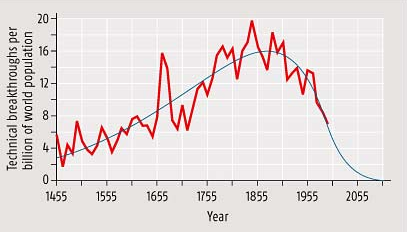
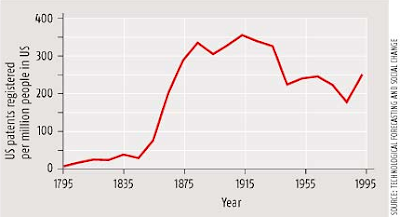
Of course, these statistics could be explained by saying that the population growth rate in the 20th century exceeded technology growth rate (and that relatively speaking, fewer people ended up in doing science and technological research), but at least it disproves the notion that government helped the advances in science and technology in the 20th century.
How the hell do you calculate “scientific breakthroughs”? This also tells us nothing about the gains that can be reaped from any of these inventions, or the speed with which they can be reaped, or were reaped. Anyways, there’s about a million and five different factors which affect economic growth in its various forms and even more ways which that number can be calculated in the way that it actually took place.
More or less. Have a look here for more on this. (In particular, this one and this one. The first one is a short summary. The second one is just excellent. I highly recommend taking the time to view it.)
For one thing, “excessive leverage” and overinvestment are two sides of the same coin…the inflation coin. (And of course by “inflation”, I mean inflation. Read what Mises had to say about how the word has been perverted.)
For a brief summary of how the current crisis went down, see here. For more info, see here.
I’m not sure what you mean by this. Ultimately the culprit of tulipmania was increases in the money supply.
I guess you could say that. It really depends on how you’re defining “fad”.
She is wrong. This is nothing more than a central planning argument that is somewhat in line with chartalism or Modern Monetary Theory. For more on this, see here, and here. (There are links provided in those threads as well.) Basically the notion is nonsense. It essentially says that an economy can be micromanaged into prosperity. Central planning doesn’t work, it has never worked, and until someone gets supernatural powers that allows him to know what people want better than they do themselves, it will never work.
As opposed to what? How would malinvestment in historical times be different?
I don’t know what you mean by this.
One is saying “the people in control of the money supply are stealing from everyone else, and as if that weren’t bad enough, the distortive effects it creates will lead to catastrophic consequences.” The other says “I’m jealous because other people have more stuff than I do. They should have less.”
Because they’re afraid of losing it. The only reason people made such bad bets during the boom was because they didn’t see a downside. Depending on which gambler we’re talking about, either they were under the impression their investment was more sound than it was (because the market was giving false signals thanks to government intervention and money creation), or they were under the impression it didn’t matter because the government had their back (again, thanks to government intervention and regulation).
I think you might be getting a bit lost in the terms “malinvestment” and “overinvestment”. Pay attention to this video and it will help you understand greatly.
I realize this is completely unworkable as a policy tool, not the least because income taxes don’t actually tax the very rich. But just as a theoretical exercise: if the state takes money from the rich that otherwise would have been invested in unsustainable projects, it would mean we get less of a bubble, right?
a) You’re assuming the government would put the money to a more proper (in terms of economic demand) use. If you’re assuming that, it means you’re assuming a few hundred bureaucrats in Washington know better about what an economy of 300 million people want and need, better than the millions of people who literally live and work in all the sectors…meaning that somehow, despite the fact that working in their industry is what these idividuals do for a living, day in, day out…despite the fact that they have countless hours of experience in their fields…and most of all, despite the fact that they are the people who make up the economy in the first place…you’re still assuming these politicians, the vast majority of whom have never even had a real job in their life (let alone created one) can make more economically sound investment decisions.
Quite a stretch to say the least.
b) What you’re literally saying is “hey, if the government took all this money — which was created out of thin air and then placed in the hands of people with close ties to government — if the government took all that money away, wouldn’t that make things a little better?”
This is basically the equivalent of saying “Hey, if that parent who fed her child nothing but donuts, Ding Dongs, and Pixie Sticks…if she just made him vomit all that stuff up, wouldn’t that make it better?”
Here’s an idea. Don’t hand it out in the first place.
P.S.
Just as with the vomiting fat kid, no, taking all the funny money away again would not help the situation. Think about it. The whole reason they were stimulating (read: printing money) in the first place was to artificially boost demand…as in, make the economy appear to be doing better than it really was…i.e. make everyone feel (and believe they were) wealthier and more prosperous than they actually were. Why the hell do you think they haven’t stopped printing? What did you think all that QE business was about? The minute they turn off the spigot, the party’s over. No one wants to be up for re-election when that happens.
They’re going to kick that can down the road as long as they can. They’re not about to try to take money out of the economy. Like I was saying here in this recent thread, the last time they did that was in the 80s when Paul Volker pushed the prime rate up to 21.5%. Take two seconds and think about what the U.S. debt service payment would be if rates were just half that. Check here if you need help.