Don't buy Bitcoins (video)

@Clayton: Is there any empirical evidence you can imagine that would overturn your belief (as far as I can tell) that BitCoin cannot be legitimate money?”

Empiricism? Austrian Economics is an a priori science, you do realise this right?

So the answer of “no”, doesn’t leave one open to the charge of being ‘unreasonable’ or ‘close minded’.

I’ll toss in my two cents here.

  1. Sure there can be an empirical proof that bitcoin is money. If for a solid twenty years [and absent a law imposing it as money] it becomes the accepted medium of exchange for all goods and services in, say, a community of 5 million people.

But don’t hold your breath.

  1. There is a huge flaw comparing the spread of bitcoins to the spread of language. Language is free. And it involves no risk.

When my fellow caveman starts saying “food” and pointing to his mouth, etc. what does it cost me to understand what he means and to start saying “food” to him when I want to call his attention to food? Answer: it costs me nothing. What risk am I taking by using his language? None.

Bitcoins, however, cost money. How are you going to convince a whole country to give away their hard earned money for nothing? I’ve already linked to my blog which explains this simple fact, and Neilsio quoted Doug Casey, who put it very well.

Also, bitcoins are risky. Why should I take a risk? Bird in the hand etc.

A tiny and totally unpredictable number of people believing that the items can be money is about the worst basis possible for people outside that group to base their medium of exchange on.

That doesn’t compare with the value that rare shells had to pre-industrial primitive people who believed in classes, status and many long-held superstitions.

@ribuck: That’s a novel argument. However, the bar to becoming money is much higher than just whether something can be a trinket that is popular with a specific sub-culture. Gold and silver were highly liquid commodites even before they began to be used as money. This means the waiting time required to get a reasonable market price for them was very low. Money must be a good but not just any good can become money… it is only the most highly marketable (liquid) goods which have the other desirable attributes of money that are even in the running. Dried tobacco, animal pelts and salt have been used as monies … it seems funny to the modern person to think of exchanging a bag of salt for a horse but it’s not just a random choice that resulted in these particular goods becoming money… these were the most or nearly the most marketable goods and, even though they lacked many of the other desirable attributes of money such as durability, this sufficed to propel them into use as monies.

Clayton -

Well, Bitcoin absolutely can become money if it is granted legal tender status, required for the payment of taxes, and initially exchangeable for dollars. This would be a precise analogue to how fiat paper money eventually displaced gold and silver coins. But, no, Bitcoin will never become a money through catallactic (voluntary exchange) means and empirical considerations are beside the point on this. I see that Bitcoins currently have a ridiculously high dollar price. I see that the market cap of Bitcoins has grown 1600% in the last year. But, then, so what? During the tech bubble, we saw the same thing happen with dot-com companies. As one article I read noted, this is evidence of the bubbliness of the economy… people are so desperate to escape paper, they’re willing to experiment with even very dangerous things like Bitcoin.

Clayton -

@Peter: I find the injection of “network effects” into the discussion to be confusing and unnecessary. The price of a monetary commodity (what it can be exchanged for) is higher the more widespread the use of that commodity as money becomes. I think this is what you mean by “network effects”.

Now, I understand you to be saying that “well, people can speculate that something which has no value except as a medium of exchange will become used as a medium of exchange (money) and, if enough people speculate in this way long enough, it will eventually become valuable in its own right, that is, not merely as a matter of speculation.” However, the problem with this is that, since the object of speculation has no non-exchange value (no value in direct exchange), those who initially accumulate it (buy up Bitcoins) must forego their self-interest since they are giving away things of value for something of no value in direct exchange. This is a denial of praxeology, that is, of the human inclination to achieve ends through the application of means.

What, instead, is happening is that “early adopters” of Bitcoin are doing one of two things. They are either speculating short-term (pyramid scheme) and they are trying to bring on as many late-adopters as possible to drive up the value of their early Bitcoins as high as possible so they can cash out at the peak before the house-of-cards collapses. Or, they are speculating long-term (fiat money) and are hoping that the government will be brough in to “regulate” Bitcoin and thereby secure a government-sanctioned status for Bitcoin and ensuring that Bitcoins will be used as a medium of exchange by virtue of its official or quasi-official status. Both of these forms of speculation are consistent with praxeology and fully explain the bubble in Bitcoins but neither form of speculation has anything to do with Bitcoin eventually becoming money in the same way that dried pelts, tobacco, salt, cowrie shells or gold, silver, copper or nickel coins came to be money.

Clayton -

Clayton, I know a lot of early Bitcoin adopters, none of whom fits either of your categories (short-term speculator, or someone hoping for government sanction). So I’m just going to exit this discussion. If ever we meet, I’ll buy you a beer with Bitcoins.

@Clayton

But, no, Bitcoin will never become a money through catallactic (voluntary exchange) means and empirical considerations are beside the point on this.

My question had a qualifier that I’m also intersted in hearing your answer to. Regarldess of what you understand money to be, if in X years Bitcoin was accepted in every shop, and everyone in the world used Bitcoin, (without being legal tender or otherwise required by law) would this not be empricial evidence that revealed that your criticism of Bitcoin had been at least irrelevant?

I’d say we need to go back and revise our assumptions about human nature. Why are people doing things that are not in their own interest, that is, why aren’t people pursuing their own ends and how is it possible for an organism to survive which does not seek to attain its own ends?

Clayton

You realise that this puts you at odds with lots of other people here? The most vehement critiques of Bitcoin were based on allegedly praxeological arguments, i.e. that it can be deduced that Bitcoin is not money and never will. You said things similar to this to me in another thread as well (although you may not explicitly phrased it this way). But now you are saying that it is not impossible, but only very unlikely. If anything is proof that the argument is invalid, it’s this. It clearly demonstrates the difference between deduction (impossible) and induction (very unlikely).

None of this of course means that Bitcoin is money or will become money. It merely means that it has not been deductively refuted. I have since beginning (also on Mises Blog threads) claimed that the success of Bitcoin is an empirical issue rather than praxeological (others have made similar arguments too). Now it looks like it’s finally getting through.

Language is free in the meaning that it’s an open standard, but that does not mean learning/using it is for free. It takes time to learn it, and because there are thousands of languages, there are opportunity costs (= risk) involved in them. People usually pick those that are spoken in their surroundings first and then based on their plans, might pick others. You are comparing a situation where language develops in a world without pre-existing language. That does not match the situation with Bitcoin. A more accurate analogy Bitcoin would be Esperanto. Esperanto has not managed to spread very much since it was created, but it still exists after 130 years. You certainly can’t call it a bubble or fraud.

Did you ever do international trading? I do it from time to time. I also used to work in an online payment processing company. There are multiple incompatible standards, high costs, slow speed, crappy service and all kinds of other practical problems. This is due to government regulation rather than legal tender laws themselves. Because it restricts competition, the encumbents have no motivation to improve their services. Bitcoin, due to its decentralised manner, has the ability to overcome these issues. Amir Taaki answered some questions recently on Slashdot, and told a story how he couldn’t transfer fiat money from UK to Poland for several days, so ended up sending Bitcoins. I’m in Ireland and I think the bank services here are comparably crappy (although my experience from other EU countries is not so bad).

Wait, I recalled another story. When I moved from Austria to Ireland, my old (Austrian) credit card company told me that I had to give them 10K EUR deposit if I wanted to keep the card. So I said no thanks and got an Irish credit card. I emailed my Austrian mobile phone operator (wanted to keep the SIM card for a while) and told them I need to change the card number. They said I need a credit card issued in Austria. I said I don’t have one, but I still have a bank account in Austria so I can transfer money from there. They said no, can’t do. In the end they still charged it from the cancelled credit card and the Austrian credit card company approved the payments. These are all reputable multinational companies, and they even can’t provide a meaningful way of facilitating payments. Imagine how a smaller business can be overwhelmed. Bitcoin can get rid of all of this, because it provides an open source standard upon which people can build services.

Oh for sure the future is uncertain and a lot of the user friendly features are still immature. Feel free to wait how it turns out.

You forgot to mention that while some went bankrupt, some survived.

Well, since gold failed to satisfy the needs of the people plagued by fiat, why does this surprise you, and why should it mean that it can’t succeed? Maybe you’re just jealous.

I see it exactly the other way around. The regression theorem is an unnecessary and flawed interpretation of the network effects.

Correct. However, network effects do not stretch to infinity. Furthermore, the encumbents (fiat and gold) are not able to satisfy all potential users.

You appear to be contradicting yourself. Clearly, if people trade Bitcoins even though the adoption has not reached critical mass, it means that it it does have non-monetary value. It’s a circular argument.

(emphasis added).

The quote from Wikipedia implies that there does not have to be a relationship between the utility of the network effects and the utlity of the pre-network effects. Besides negative influence by fiat, the outcome can also be influenced by positive influences. So, there is another way, which the regression theorem denies. This is an error, just like I said before, because it makes the arbitrary assumption that there is a connection between the two. That’s inductive reasoning.

Well, better than people who believe that things cannot be money.

BTW you still have not answered my objection, in that government interference created a gap, and if money cannot fill it, it will be filled by non-money. So the whole obsession by some Austrians to prove that Bitcoin is not money is equally pointless as would be an attempt to prove that Bitcoin is not bread. The success or demise of Bitcoin is an emprical, rather than praxeological question.

Aha! I finally get it. You do not comprehend the motivation of the people involved in Bitcoin, and therefore assume it’s irrational. I have made several attempts to show that there are valid reasons to look for something like Bitcoin.

I can, however, also turn the argument around to demonstrate its flaw. I can say that because gold was pushed out of circulation (significantly, not completely) by fiat, it is irrational to believe in it. Only a handful of irrational believers, therefore, spend their time with gold, right? Well, if someone said something like this, I would tell them that their argument is based on induction, so I don’t accept it. Same thing I’m telling the people who argue against Bitcoin.

You realise that this puts you at odds with lots of other people here? The most vehement critiques of Bitcoin were based on allegedly praxeological arguments, i.e. that it can be deduced that Bitcoin is not money and never will. You said things similar to this to me in another thread as well (although you may not explicitly phrased it this way). But now you are saying that it is not impossible, but only very unlikely. If anything is proof that the argument is invalid, it’s this. It clearly demonstrates the difference between deduction (impossible) and induction (very unlikely).

None of this of course means that Bitcoin is money or will become money. It merely means that it has not been deductively refuted. I have since beginning (also on Mises Blog threads) claimed that the success of Bitcoin is an empirical issue rather than praxeological (others have made similar arguments too). Now it looks like it’s finally getting through.

Let me explain. Pythagoras proved back in the day that a right triangle of sides 3 and 4 will have hypotenuse 5. He deduced it from axioms of math, ans claimed it must be true. Had some sceptic asked him what will ever disprove it, he might have answered, when you show me such a triangle of hypotenuse 6.

Would you then say to Pythagoras, “But now you are saying that it is not impossible, but only very unlikely. If anything is proof that the argument is invalid, it’s this. It clearly demonstrates the difference between deduction (impossible) and induction (very unlikely)”?

The thing is, humans aren’t perfect. There may always be subtle logical or other errors in what we think is irrefutable logical thinking. So of course it may be that reality will one day show us wrong. So that even when we think we have a perfect deductive proof, who knows? I mean, look how long the parallel postulate survived.

Especially in this case, when the initial hidden assumption is that people will not be stupid en masse for long periods of time.

Your stories about the hassles of international trade are interesting, and perhaps bitcoin will make things easier, but your writing about that tells me you miss the fatal flaw of bitcoin.

To explain what I mean, let us say someone would come up with a new invention, by simply renaming a bitcoin “Bit Clothes”. He will then extoll the virtues of his superior new clothing. Never needs washing, easily transported, one size fits all, etc etc. But you see the flaw. It has all those virtues, but it does not fulfill the first requirement of clothing. It doesn’t envelop your body.

Similarly, bitcoin has a lot of virtues, but it does not fulfill the first requirement for being money. It has to be worth something, other than the possibility to sell it off to another sucker.
First of all, let’s clear up the constant misconception that Austrians are “gold bugs”. I am not a gold bug. I simply believe in market money. That is, let the market (people, generally) choose what is to be money. We are necessarily in agreement on this point since Bitcoin is based on the idea of directly appealing to the public to choose an alternative money (in direct contravention of the laws adopted by nations prohibiting alternative monies).

That said, not just anything can become money. I’m not saying entrepreneurs cannot attempt to provide any particular thing as a money. And this is precisely what Bitcoin is - an attempt on the part of some open-source ‘entrepreneurs’ to provide an alternative money by direct appeal to the public, bypassing the legislation which currently makes such alternatives illegal. Noble endeavor, certainly. But I think we can and should predict that Bitcoin will fail, short of adoption by some government.

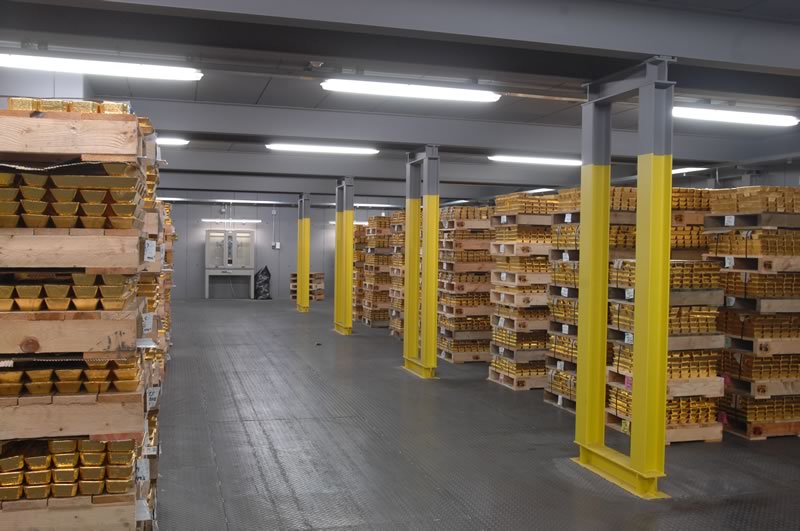
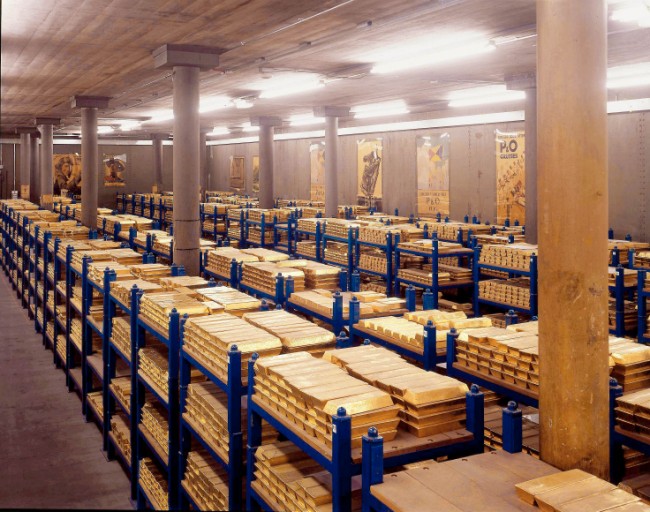
Now, as for gold not being money, this is actually not true. Even since 1971, gold is still used as money. Everywhere in the world except the West, gold is used in very large (inter-bank) transactions, especially between central banks. In the West, gold is still used but it is primarily held as “dead reserves” on central bank balance sheets or in private banking. No matter what Warren Buffet thinks of it, gold is big business. Take a look at the inside of the New York Fed Gold Vault, the outside of it or a London bank’s gold vault. The major gold centers are London, Zurich and New York but gold is exchanged worldwide. So, gold is still used as money even though no fiat money is directly or even indirectly redeemable in gold. This fact has led to the description of gold as a “shadow money” and this role is consistent with the regression theorem… the memory of the value of gold is so strong that even four decades of a global, irredeemable, fiat paper money system has been unable to shake it.

Finally, I don’t think Bitcoin users are irrational, I just think they’re incorrect and most of them are duped. I believe that the belief that an unbacked digital currency can arise is only possible because of the success of the world’s governments in brainwashing people into believing that little pieces of paper or electronic bits sent around on EFT wires are money, naturally. But the government is fighting gravity in suppressing natural money, so there’s nothing natural at all about fiat curencies. If the currency market were open to free market competition, fiat currencies would be rapidly marginalized into near oblivion.

Clayton -

I made a collection page:

http://vforvoluntary.com/bitcoin

To understand why you are wrong, you need to understand the genesis behind the idea of Bitcoin.

Interestingly enough, it started with the goal of stopping bulk spam. The reason why there aren’t dump trucks backing up to your mailbox each morning to unload massive amounts of spam is because there is a larger cost associated with sending postal mail versus email. There’s the cost of the ink, paper, envelope and stamp. This means that any spam that can’t recoup those costs simply doesn’t get sent. Contrast that with email which is orders of magnitudes cheaper, the price being whatever it costs to send a few bytes over an Internet connection.

So, the idea was to attach a higher cost to emails in much the same way that postal mail has a higher cost. There are several schemes. One of these is run by a company called “GoodMail”. They convinced a bunch of email providers to give certain emails a special icon in your inbox. These icons only display if you pay an extra fee to send the email. This prevents spammers from having such a huge economic incentive for sending spam, if they want the special icon. The service still exists but it really hasn’t caught on.

However, a precursor to this idea was called “HashCash”. Instead of charging money outright, it is based on a proof-of-work system. Under this system, you run a program and it starts generating tokens by using CPU resources. You attach a token to each email you send and the recipient can verify your token for relatively no cost. This makes it easy for the typical user to send and receive emails while making bulk spam prohibitively expensive.

After this system was proposed, someone came to the natural conclusion that there would be individuals that wouldn’t want to run the program but instead would rather buy the tokens outright. This gave rise to the idea of an entire market based on buying and selling tokens. Fast forward over a decade later and the creator of Bitcoin says, “Hey, who cares about email? Let’s use this stuff for money!” The rest is history.

So, what’s my point? My point is that Bitcoin is a proof-of-work system which has value as a good because people, even if not used as money, would still want to use Bitcoins to prevent bulk spam. I imagine that if/when Bitcoin becomes widespread, we will see an actual implementation of this where sending an email costs a tiny fraction of a BTC.

I really hope this will put to rest the myth that Bitcoin has no possible use aside from being a medium of exchange.

Why is everybody ignoring this argument?

So I need to buy lots of them and then maybe in the future they can become useful? And you think that’s a good medium of exchange?

They already are useful. Bitcoins were primairly a cross platform game currency before they gained value as a medium of exchange in real things. Bitcoins would revert back to that use if ever they lost all their exchange value again. But as a replacement for captcha, it definitely has another possible use besides a game currency.

This is your charge, that bitcoin is useless. That is not true. It matters not how much use value it has, so long as I can exchange 1 million times that value at the same cost. It’s a good medium of exchange for reasons other than this, e.g. fungibility, divisibility, high value to weight ratio. As to a deeper explaination of that, I’d point to this.

And fiat money has non-monetary use because people can use it for personal hygienics. You can also start a fire with it.

The bitcoin folk don’t even know what a commodity is, that’s why so many of them don’t even understand the criticisms towards bitcoins.

One more fishy detail about bitcoins: Around 5 people own half of all bitcoins in existence, the creator of the thing, obviously, being the biggest owner.