One last note, Azure. Even the great hypotheses don’t really get to the bottom of things, to the ultimate cause.
Take gravity. All things attract each other. Why? Who knows?
Or one of Newton’s laws, that every action produces a reaction. This one really boggles my mind every time I think about it. It says that when you push against a wall, the wall doesn’t just resist the push. IT PUSHES YOU BACK. Think about this. Why should it? How does it know to push back? There is no answer, and no one has even attempted to give one, as far as I know.
Not at all. Maybe you didn’t understand Rothbard? Praxeology encompasses more than economics and it is not a branch of mathematics. “Mainstream economics”, the scientistic, positivist approach to exchange is as much a science as alchemy was.
In other words, they formed a hypothesis. Correct me if I’m wrong, but that’s what a hypothesis is: A guess arrived at through inductive reasoning.
Of course the majority of physics knowledge is derived from hypotheses that have stood the test of experiment, in the same way the body of praxeological knowledge is more than the Action axiom. I sorry I worded my initial assertion badly: What I meant was, the “axioms” of physics are not absolutely true, but are hypotheses.
As for positivism, the way I see it, it’s crap dreamed up by biology majors with zero understanding of epistemology to laugh at the liberal arts department for lacking “rigor.” It’s a predictive statement that statements cannot be predictive.
It’s not the point of physics to get to the bottom of things. Physics has been successful because it’s been a discipline that has divided and conquered. Physical formulation is designed to explain a particular subset of the universe. The same is true for all disciplines involving mathematics.
Gravity was first formulated to understand planetary celestial mechanics & nothing more. It used the language of algebra, and it proved very successful in applications not involving objects traveling at the speed of light and large global structures. However, there is more to gravity than attraction. Much more!
Einstein’s breathtaking formulation of gravity is written in the language of geometry (differential geometry and topology to be exact). He single handedly proved that gravity was not a force but geometric waves propagating in space-time. No one ever conceived or thought the universe was constructed on a geometric landscape. It was an astonishing discovery no one saw coming. He also proved that absolute time was an illusion. All time is relative. If you feel that the laws of physics are limiting, just realize that Einstein’s Fields equations predicted the following (before anyone observed or pondered these ideas)
1.) The expansion of the universe. It was Hubble who ultimately verified & discovered the cosmic expansion. However, Einstein’s equations already predicted this process and it was ignored because it was thought as a mathematically anomaly in the field equations. His equations also explain the death of the universe.
2.) The prediction of black holes.
3.) When his equations are coupled with statistical mechanics and quantum mechanics they formulate the existence of white dwarfs, neutron stars, and other exotic stars.
4.) Space-time is a geometric entity that permeates all of existence. The reason you and I are unaware of its presence is because where to fully immersed in this geometric jungle. Think about a circle. If you pick a section of that circle and get closer to it- it will eventually resemble a straight line.
Thus, the laws of gravity (general relativity) tell us an abundance of information. They are not as limited as you think they are. If Einstein’s equations explain the dynamics of the universe itself how much more would you want?
The question on why matter attracts each other is not a question of classical-gravity but a question dealing with quantum mechanics. Hopefully, CERN (the large hadron collider will be able to elucidate what quantum-gravity is via SupperSymmetry [SUSY]). Either way, when and if it’s discovered on why gravity is attractive will have little to no changes on the formulation of gravity. Physics only has one last grand goal. Of the four forces of nature, three of them have been combined to a unified law (electromagnetism, weak nuclear force, and the strong nuclear force) forming the laws of quantum mechanics. Gravity has yet to be to be incorporated into this framework. But you have to realize that the laws of general relativity and quantum mechanics already explain the universe with absolute accuracy. Quantum gravity would only be useful for explaining what happens inside black holes and what happened at the moment of the big bang.
You’re statement on 's Second Law (for every reaction there is an opposite and equal reaction) seems to be taken too literally. There are two reasons that I think you’re overlooking.
1.) proposed this law because it makes the mathematics much easier when dealing with systems (i.e. vectors). When you push on a wall, it’s not that the wall is literally pushing you back with the same NET force is that the force that you’re applying is not strong enough to break the electromagnetic forces of the wall. The NET force and the electromotive forces holding the atoms of the wall together are the same thing.
2.) 's third law directly correlates to his second law (F=ma=mdp/dt). Think about what’s not happening when you push on the wall and how it relates to the second law.
Many of these hypotheses are laws that are unshakable (Ex. the laws of thermodynamics). There is a distinction between hypothesis and laws. Laws are unbreakable constructions of the universe itself. As a practitioner in physics, I’ve learned that I’ve under and over estimated the power of physics and mathematics. It takes a considerable amount of time to fully understand both the limits and depths of the physical sciences.
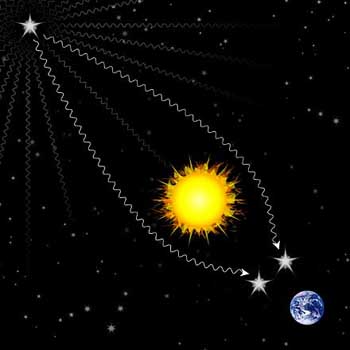
I’ve taken an astronomy course in which the professor was going for her Ph.D. in an effort to explain the bending of light from stars, nebulas, etc… around other stars so you get a mental image like this (couldn’t find a real image):
Yet I’m wondering. How are laws in physics and mathematics any different from for instance the axiom of human action in that causality is known without any formal logical deductions and therefore is a given. Does this make a difference in comparison between such an axiom and the laws of physics, etc…? Can one be said to be more certain than another?
Thank you for the wealth of fascinating information. I’m very pleased to have acess to someone so well versed in physics, a truly fascinating topic.
I have one or two minor points to raise about your post.
How do you know how limited I think they are?
There seems to be a missing phrase in the above that makes it unintelligble [to me]. Could you please post it again?
What makes them unshakable? What does unshakable even mean? Unable to be disproven? Proven beyond the shadow of a doubt? If so, what is the proof of, say, the laws of thermodynamics?
Another thing I’m not clear about is the last sentence.