Y = kI is derived from, and must give the same answer as, Y = C + I.
k = Y/I = (C +I)/I, so if you add 10 to I, you have to add to both the numerator and denominator. And you get a new k, which is no longer 100/25 but is now 110/35.
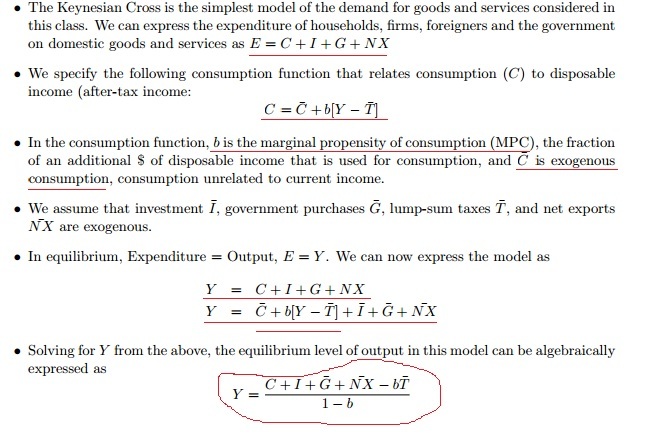
Now, show me how you get Keynes’ “multiplier” from “C=mpc(Y-T)”.
No. This is where you are going wrong. When you add 10 to I, C is no longer 75 because C is tied to output. Think of it this way: I am starting with C = 75 = .75(100). Now I add 10 to I, which adds 10 to Y as well. Now the new value of C is .75(110) = 82.5. Now Y = 82.5 + 35 = 117.5. But now Y is even higher so C increases again to .75(117.5) = 88.125. Now Y = 88.125+35 = 123.125. Continue this process to infinity and you find out that adding 10 to I adds 30 to consumption. Keynesian models assume this happens all at once.
So it’s not 110 = 75 + 25 +10, but actually 140 = 75 + 7.5 + 5.625 + … + 25 + 10.
Income is tied to consumption. When income goes up, consumption has to go up and in yours it stays the same.
In my final result I have C = 105 = 140(.75). Everything checks out.
You have C = 75 = 110(.75), which is clearly not right. That’s Three Stooges Math
“Friedman and the other economists at the Chicago school led attack after attack on concepts like the Keynesian multiplier and the damage of saving. Friedman took issue with the Keynesian multiplier because it gave any form of government spending - even debt spending - a superior rating over private investment.”
If they would just go back to Keynes’ “General Theory” multiplier chapter and actually look at what he said, what he did, and how he did it, they would find that it was bullshit. Very clever bullshit, but it’s bullshit.
A guy named Richard Feynman pointed out, that if you want to solve a problem, don’t start at point 17, or point 7, go back to point zero.
And I think there’s the problem pointed out by The Amazing Randi, a magician who turned to debunking various frauds. Academics are not very good at debunking fraud, because they never think of fraud. And they think the other guys are playing fair.
And I’ll bet if you look at their papers, they have probably used the Keynesian “multiplier” in them.
An article by an unnamed author where all he said was
If they would just go back to Keynes’ “General Theory” multiplier chapter and actually look at what he said, what he did, and how he did it, they would find that it was bullshit. Very clever bullshit, but it’s bullshit.
What do you mean “Without any evidence?” and “where all he said was”?
I have put my evidence in Parts 1 and 2 of “Fiscal Multiplier Debunked” on Tugwit.blogspot.com
Including:
“If the fiscal “multiplier” value exceeds principle plus interest, why do we have $16 trillion national debt? Why would we need to borrow in the first place?”
I have shown that the fiscal “multiplier” uses Three Stooge math.
Why do they disguise T, and (1-b)Yd?
Why do they do that jackass stupid substitution of Yt - T for Yd?
The marginal propensity to consume, does not apply to Yt and T.
And that nonsense about government spending being better than tax cuts, the balanced budget “multiplier”, and the proportional tax “multiplier”, relies on those disguises and that stupid substitution.
I have shown that there are 2 values for Keynes’ “multiplier” and that Keynes used the wrong value for the effect of spending on income.
So don’t tell me I didn’t give any evidence.
If they would just read Keynes chapter, they would find the evidence.
I’m simplifying C=mpc(Y-T) to just (mpc)(Y). In other words, assuming taxes are 0 just to keep it simple. In your example you have Y=11, C=9, and I=2. But, by definition, C=mpc(Y-T). T is 0, C=9, mpc=.9, and Y=11. So we get 9=.9(11). This is clearly false. Until you can reconcile that fact, you have no argument.
If they would just go back to Keynes’ “General Theory” multiplier chapter and actually look at what he said, what he did, and how he did it, they would find that it was bullshit. Very clever bullshit, but it’s bullshit.
The above is what I said. What the other guy said is in quotes.
And if the “multiplier” exceeds principle plus interest, we can’t have any national debt. Wouldn’t it make you a little suspicious that we have $16 Trillion in debt?
Wouldn’t it make you a little suspicious, to see the marginal propensity to consume retroactively applied to total income and tax, when it applies only to disposable income?
Wouldn’t it make you a little suspicious, to see how Keynesians made T, and (1-b)Yd, and -bT, “disappear”?
Are these Chicago guys just sitting around with their fingers up their noses?
You are doing what Keynesians do. They are impervious to logic because they claim to have math. Then they show bits and pieces of algebra, and make up stories. And then you see the equations, which don’t back up their stories, and contradict their stories. And some of their equations are complete nonsense, and include crap like C = mpc(Y-T).
If that’s supposed to be the consumption function, where is autonomous consumption, “a”?
What is Y?
Leave the T in, and show me the equations of how you get Keynes’ multiplier. The equations aren’t that hard.