“national minimum wage laws” = “purely free market”?
Something doesn’t add up here.
But to the heart of his question:
“On average, the jobs that were shipped over are paid $5/hour as opposed to $10/hour. Are you saying that workers should accept lower wages to combat the exporting of jobs. Is your definition of “competition” a lower standard of living for our country? That’s the problem in my eyes, is that we have raised our standard of living to the extent that people need a certain wage level to survive.”
His “problem” really comes from a lack of understanding of economics, history, and reality.
First of all, in a truly free market, it would be almost impossible for it to be cheaper to manufacture goods halfway across the world and ship them over here (save the invention of some kind of low cost teleportation device or some other form of speedy travel). Even if we assume China has a truly free market as well (which is a pretty darn big assumption), it would still be an enormous stretch to assume that there would be many products that would be more economical to manufactor overseas as opposed to domestically (especially in a country as resource-rich and climate/geographically diverse as the U.S.). But realistically, China would not have a completely free market, which would make it virtually a net loss when compared to conducting business in the purely free market in any sense. There are more economics to explain why this is, but that is the basic reality.
Second, look at the historical evidence. Peter Schiff lays out the case in a session before Congress…
(jump it to 12:46, or click here)
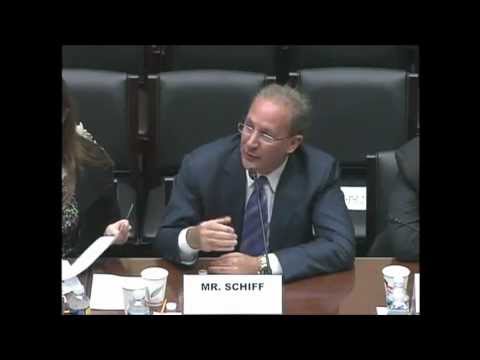
So just to recap…we were producing the best cars, and the cheapest price, there was no minimum wage and there were no unions…and the workers were making the highest wage in the world, (and paying no federal income taxes or payroll taxes, to boot.) Doesn’t exactly sound like his doomsday scenario lines up with history.
See, people tend to forget that the world didn’t begin in the 1930’s. We experienced the period of the greatest level of growth and relative prosperity the world has ever seen from roughly the 19th century to the early 20th century…before all of these government interventions that all these statists deem “necessary”. Funny, they never seem to offer any explanation as to how the world got on without them. How in the world did civilization survive without medicare?!
And finally, he doesn’t have a firm grasp on reality: “we have raised our standard of living to the extent that people need a certain wage level to survive.” Think about what he’s saying. He’s literally saying that we are so productive, so prosperous, that it actually costs us more to survive. In other words, we have such a huge supply of things, and are able to aquire them so cheaply, that it is actually more expensive to live. Now what sense does that make? That’s like saying my new electric blanket is so effective at keeping me warm, and produces so much heat, that I actually need more blankets than I did before, just to keep from freezing. It makes absolutely no sense.
What he’s doing there is conflating “expectations” with “survival”. The truth is, he doesn’t know a damn thing about “survival”. He is buying into the illusion that unless you have running water, 24/7 electricity, air conditioning, indoor plumbing, refrigerators, washing machines, cable television and high speed Internet, you’ll die. Yes, we have raised our overall standard of living to the extent that people expect a certain lifestyle. This does not mean that without this extreme comfort of living one would literally die…and it certainly doesn’t mean that one simply deserves or is entitled to such a lifestyle simply because he happened to be born within a certain arbitrary border as opposed to another.
If people couldn’t survive on a lower standard of living, how the hell are these Chinese he’s talking about doing it as he’s saying it’s not possible? How is it even called a standard of living?
If you want to argue that our living standard as evolved so greatly that most people lack the same rudamentary skills necessary to get by as well as many impoverished Chinese do, fine, that’s a decent argument. But this again does not automatically equal death to these people. Again our relative prosperity allows us to provide for these people through charitable acts. Think of all the charity that takes place now, when the government takes close to 50% of the population’s productive output. Look at how many people we are still able to care for, and the standard of living they are able to enjoy. Sure, your ignorant friend here may spit on the homeless American’s lifestyle, but there are literally hundreds of millions of Chinese who would kill to take his place. Imagine how much more charity could be provided if all of that productivity wasn’t siphoned off by the coercive State.
And this is not to even consider the quality of life to be rendered in general from such a more productive society. It would be difficult to imagine what the world would look like, how far along we would be, if a population this size (especially one that inhabits a resourceful geography as the U.S.) were completely free. Just think about how far ahead we are compared to the poorest countries in the world (and realize that what few advancements they do have are more than likely directly attributable to outside influences from the more developed nations). I imagine the difference between what the U.S. is economically and what it could be had it been a truly free market all along would absolutely dwarf that. (If nothing else other than the fact that technological advancement is exponential).
But the point is, a free-er society is a more productive, and therefore more prosperous one. And before someone goes around claiming that one needs some arbitrary “living wage” to survive because we are so prosperous in America, he needs to step back and really recognize what he has…

…and ask, What exactly is poverty?
No problem. Lower minimum wage = higher employment = more productivity = more stuff = lower prices = more prosperity.
That’s interesting. “Less money in the pockets of ‘the’ people”. “The people” meaning who? Union workers who benefit from minimum wage laws through an artificially inflated salary at the expense of lower skilled workers? Or just employed people in general? Sure, there may be less money in their hands…at first. But this would also mean that previously unemployed people would now be able to secure employment…and earn some income (aka “money in the pockets of people”)…but on top of that, they will now be doing something productive, thus helping to make a greater total of goods and services to go around…meaning more stuff, meaning lower prices, meaning a dollar buys more than before, meaning people are more prosperous.
The classic statist refrain. Yes, “ill effects” of the “free market”. He’s either operating under the assumption that Utopia on Earth is attainable, or he’s committing a non sequitur, simply stating that because the world isn’t perfect, it necessarily means coercive force must be used over market interaction.
Friedman spoke eloquently on this:
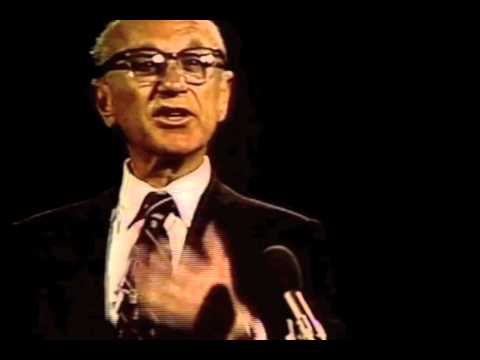
If he seriously believes that coercive international trade standards can be formulated, implememented, and maintained by a “grassroots” structure, he’s simply committing a wishful thinking fallacy.
But what’s more, why is there a need for coercive intervention in the market? Why can’t cooperation, regulation and order devolop organically (or “spontaneously”) from the bottom up, like so many other facets of life?
Again, anytime someone talks about “government being more accountable” and “working for the general public”, it basically boils down to wishful thinking. There is just no such thing.