What’s in a name? That which we call a rose…
There has been some discussion on the forum for the appropriate term to assign a compulsory based service. Should we call government services socialist or not? There are those, including portions of major Austrian Literature, which have summarized smaller compulsory based monopolies which exist in an economy as being socialist. Others contend however that it is an equivocation to call such organizations socialist, that socialism is only realized when a State assumes the authority of the entire market process and takes ownership of all means of production. The latter definition is one most commonly described by Mises, and is often considered impossible to accomplish, at least for any duration of time as the market process would be in an unguided perpetual state of chaos and be unable to sustain itself for any significant length of time.
There are those that argue that the word socialism should be assigned to a situation where the means of production of an entire market is owned and managed by the state. I contend, on the other hand, that various parts of government are socialist because they mimic the model of genuine socialism only at an isolated level. Due to their inability to calculate they operate at the expense of the market, via taxation.
If genuine socialism is the absolute state ownership of the means of production than it’s pinnacle flaw is economic calculation and the formation of meaningful prices. In a fully-fledged socialist state prices are incapable of forming and as such the state has no means of guiding resources and capital. I contend that this flaw also occurs in mixed economies but is isolated to programs inside of the state, and that those programs operate at the expense of the market as a whole. My argument should conclude that even isolated socialist programs operate without economic calculation and to remain solvent they leech resources from the existing market.
I think this discrepancy is very important because true genuine socialism is formed incrementally and that each new addition of the State and subsequent reduction of the market is one more stepping stone to that obtain point, genuine socialism. I would also contend, and I think Mises agrees though I cannot find the quote, that a genuine socialist state is next to impossible to be realized. It is impossible to remove the market. At some point the bloat of the state will consume such a large portion of the resources that people will stop operating through State means to do business. This is when black markets emerge as a more common attribute of the environment and observe little innovation and entreapaneurship. The general absence of full scale market activities will squelch the state of its resources ultimately causing it fall. Practically every failed communist and socialist state in our history was this way. They never reached full scale genuine socialism. The markets simply went underground and the state ran out of resources. Using my picture below you can see how I illustrate where a market is capable of operating without a state entirely; however a state is incapable of continuing its operation without a market. Therefore it is in the state’s best interest to keep market activity optimal so that it can continue to expropriate its fruits, due to ideological reasons it does not realize this.
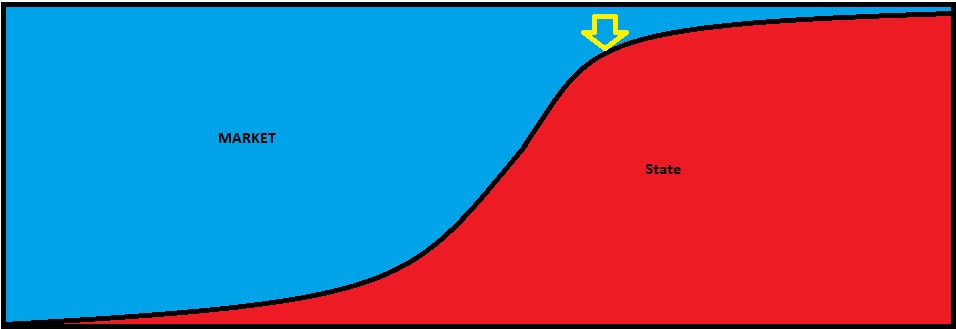
The yellow line indicates at some point in time when we should expect that specific state to fail.
The point of this paper however is to argue that even isolated sections of the market which have been annexed into the ownership of the state should still be considered socialist. That even those isolated segments of the market now owned by the state suffer from the similar economic calculation and pricing issues that full genuine socialism suffers from.
Since the fundamental flaw of genuine socialism is the inability of fabricating meaningful prices and as such a lack of economic calculation I will argue that smaller socialist organizations also have this same attribute. That government provided goods and services also do not formulate meaningful prices. To do so we need to have a quick recap of how prices are formed in the market as described by Mises; this plays a fundamental roll in the failure of isolated socialist organizations and full scale genuine socialism.
In Human Action Chapter 16, “Prices”, section two “Valuation and Appraisement”. Mises sums up the formation of prices.
The ultimate source of the determination of prices is the value judgments of the consumers. Prices are the outcome of the valuation preferring a to b. They are social phenomena as they are brought about by the interplay of the valuations of all individuals participating in the operation of the market. Each individual, in buying or not buying and in selling or not selling, contributes his share to the formation of the market prices. But the larger the market is, the smaller is the weight of each individual’s contribution. Thus the structure of market prices appears to the individual as a datum to which he must adjust his own conduct…
He continues later…
…It is ultimately always the subjective value judgments of individuals that determine the formation of prices. Catallactics in conceiving the pricing process necessarily reverts to the fundamental category of action, the preference given to a over b.
This to me is an excellent summary from which to build from a flow chart from. The formation of prices can be summarized in 4 easy steps.
-
Person feels uneasiness
-
Person evaluates his options and chooses his preferences.
a. In his subjective valuation he takes into consideration market prices. These prices are the result of this same process across all humans participating in the market. He derives his prices from step 4.
-
Person acts and chooses a specific option. The price he pays becomes historical data added to the collective data of the market.
-
Prices are adjusted
For illustration review the following diagram.
Genuine Socialism
Socialism due to lack of a functional pricing is incapable of addressing the following economic problems.
- What do we produce, XYor Z?
- How much of XY or Z do we produce?
- For whom do we produce XY and Z for?
- How can we produce XYZ more efficiently
- Why would we want to produce XYZ more efficiently?
- Which process should we improve efficiency for, XY or Z?
In genuine socialism, where all means of production are owned by the state, the formation of prices cannot occur meaningfully. As you will see for the same reasons isolated socialized services also cannot create meaningful prices, and they only operate at the expense of the market as a whole.
Using our summarized model we have taken an extremely complex system and summarized it into 4 steps. Steps 1 through 4 as described above. Some of these steps are more eloquently summarized in Lilburn’s Comic’s and other Austrian Literature. In genuine socialism we need to ask ourselves what parts of this process are broken and compare it to isolated socialized firms to find similarities. Let’s consider the action of a person in genuine Socialism based on the steps described.
- Actor has felt uneasiness.
- This process goes unchanged; It is a physiological and natural attribute of man to improve his surroundings. Man inherently seeks to improve his own situation for various reasons. It is not evident that the existence of socialism will mystically alter this behavior in man, and that somehow man will realize himself as an Ant colony.
- Man explores his options.
- Now here is where things begin to change. In genuine socialism his options are chosen for him. Man may think he is choosing to satisfy his ends, but through ignorance he does not realize that the means to these ends are limited and confined to options provided by the state. That option is ofcoarse the state.
- For various reasons that I will briefly describe later on, the State which is a compulsory based monopoly, cannot offer the most efficient market solutions. So to avoid getting offtopic let’s for now concede that whatever options provided will likely be of poor condition. Though the actor may not realize that conditions could be better. If the options provided by the state were not poor they would not need to force individuals to use it. He is in a state of ignorance.
- Preference Chosen. Historical price Data created
- In the market prices occur bottom up, from the consumer to the producer based on subjective valuation. In genuine socialism however this process is flipped, as the consumer is never given the option to subjectively evaluate his choices. Instead his choices are decided for him. Since the state assumes a top down approach to deciding the costs involved here the individual actor’s costs are also decided for him. So any exchange done is directed by the dictatorial hand of the state, and not by the concerted effort of a market. In other words, there is no historical pricing data in genuine socialism. There is only historical arbitrary data assigned by the state and their statician’s and accountants.
- Collection of steps 1-3 create market prices.
- This never occurs. The prices of goods and services are dictated by the state prior to exchange. There is no market, consequently no market data. All assumed costs that the state will attempt to analyze will be done entirely arbitrary. Prices are engineered based on the state’s costs of production, not based on consumer direction.
I will get into more detail on why the state fails in other aspects of providing services, but for now it’s important to realize that genuine socialism breaks on step 2. The subjective valuation of man, and subsequently his choices are removed from him. He is no longer able to add his valuation as data into the market system. Consumer sovereignty does not exist under genuine socialism.
I know I may not have been too clear on some of these points but I simply wanted to summarize the argument of economic calculation in genuine socialism. In the absence of the market prices are arbitrary and there is no clear guider of where resources/goods/services should be allocated.
To conclude, with the lack of pricing there is no economic calculation, and pricing cannot form without the subjective valuation of man which become data inputs into the market. Now I hope to show you that isolated organizations of the state who claim only a portion of the market also fundamentally break down in the same way at the same spot, step 2.
Isolated Socialism, or Segmented Socialism
What I mean by isolated socialism is a situation where the state has annexed a portion of the market under its own control. That this particular good or service is now provided in its entirety from the State. In order to function appropriately the state must assume the role of compulsory monopoly. Otherwise competition may undermine the whole purpose.
Any prices that are assigned by the state in socialist institutes, even if operated in the market, are still entirely arbitrary. The state assign’s it’s prices top down, not from consumer input as I’ll describe below. If we follow our summarized steps to the formation of prices we can see that the same result occurs as under genuine socialism accept that it is isolated only to a specific industry. Subjective valuation and preferences are not extended to the consumer but decided by the state for a particular good or service. The state will decide which which good is suitable for you in said industry. Now I can get into more detail on why state decisions breaks down typical market activities.
Problems of Isolated socialized institutes
State organizations or ‘isolated socialist institutes’ have no way of determining the following.
For this specific annexed industry
- Why we are providing X? Is it even needed?
- How much of X do we produce?
- For whom do we produce X for?
- How can we produce X more efficiently
- Why would we want to produce X more efficiently?
- Do we even need to improve efficiency for X?
Notice the similarities in problems that an isolated socialist industry has as compared to genuine socialism across all industries. Socialized programs suffer from the same issues as genuine socialism, only that their problems are isolated and can be perpetuated by extracting wealth from the functional part of the market via state tools like taxation.
Consumer Demand
A socialized service provided by the state is incapable of determining consumer demand. It simply cannot measure how much of a good or service is needed. As such it arbitrarily decides the quantity and what usually results are excessive shortages and surpluses. Note that surplus’s that do occur happen at the expense of productive industries. SO it cannot be said that the economy became wealthier because there is a surplus of goods that no one wants voluntarily.
Typically in a market the allocation of resources and capital are driven by consumer demand and entrepreneurship. If consumer demand is high than the entrepreneur will see this in the pricing schema of the market. Profits will naturally attract entrepreneurs and capitalists into those areas. Entrepreneurs decide where to expand operations based on consumer demand, where purchases are made. In other words the Entrepreneur looks at human preference and sees that man prefers B to C. So he invests his capital and risk into producing more of C. Or he sees that so much capital has been invested in C that those consumers who preferred B are being neglected, so he focuses on the niche market and capitalizes on it as such. In this way the quantity of consumers who want B get it, and those who want C get theirs, and the providers of those services have the opportunity to profit and generate new market wealth, raising the standard of living for everyone.
For the state however consumer demand is neither high nor low nor does it fluctuate. The state provides a service and consumers are compelled to pay whether they partake in this service or not. Due to this the state has no mechanism from which to determine how much to produce and for whom to produce it for. All consumers are already forced to participate. Individuals pay for this service by way of taxation, this ensures that all citizens are essentially consumers, whether they want to be or not, and also ensures that the state’s accounting is as obscure as it possibly can be, since payment for services are not direct.
To conclude, the state has no way of filtering out who needs their provided service, since all citizens are forced to participate in the service whether they like it or not. Because of this the state has no way of determining how much they should produce, and for whom they should produce it for. This is a fundamental flaw of state offered services/goods where the state owns a monopoly in that service or good.
Consumer Sovereignty
Thanks to the Mises forums I have also been able to understand various forms of sovereignty amongst consumers. In a profit oriented system consumers are sovereign. All businesses are at the mercy of the desires of the consumer. Those firms which produce goods and services which please the consumers benefit the most. In a not-for-profit business it is the donors who are sovereign. All not-for-profit business’s must operate in such a way so that their donors remain pleased. Charitable institutes are kept in line by the donors who have various strict beliefs on how their charities should be distributed. In either situation, profit or not-for-profit the sovereignty is still determined by voluntary participants in the market.
A compulsory based monopoly, the state, is sovereign in and of itself. So long as it wields the power of compulsion over the masses it can never be judged by its poor performance an inadequacies. The state does not need to produce a higher quality service to attract new customers; it already owns the right to all customers.
Consumer sovereignty gives business’s incentive to constantly strive to improve their services and goods. Lack of doing so could mean loss of business’s to a more efficient competitor. The state does not have this incentive; it already owns the rights to all consumers in this specific industry. It does not need to worry about losing or gaining customers. In addition, it also does not know when to improve its services. The state also does not compete with other goods or services on the market. It claims ownership over a percentage of the consumer’s income. So there can be no conflict from the competitive market.
In the market firms compete with each other technologically where their quality and production efficiency can be improved, as such they can undermine their competitors. The state does not live on this competitive plain. It has no one to compete against and is not concerned with loss of business, by law it cannot lose business. The state as such keeps their processes rudimentary. In some cases the opposite occurs however, the state over-invests in a new technology where consumers had not signaled that they were ready to pay for this new process. The state cannot measure this need or demand in consumers, it is already extracted from them automatically via taxes. The state does not know when to make objects more efficient or when to be conservative.
To conclude the state is not sovereign or dependent on consumers in any way. They are sovereign in and of themselves and by way of compulsion will have their serfs follow.
Consumer Preference, Breakdown of Step 2
Meaningful prices can form in the absence of a compulsory based monopoly. In the absence of coercion things function as normal. Consumers are given a choice and prices then form based on their participation.
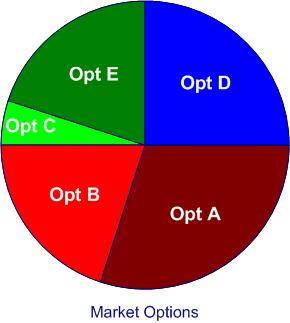
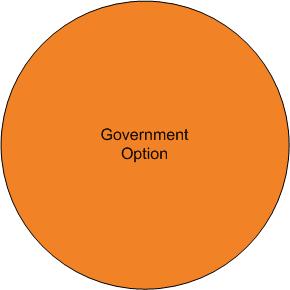
When there is only one single government option though we run into several issues. In a market monopoly consumers can still choose not to participate in the services of the monopoly. As such consumers are still sovereign over market monopolies and dollar for dollar market monopolies compete for all classes of goods. A compulsory based monopoly gets around this by forcing consumers to participate in its service whether they choose to or not.
The government can attempt some form of accounting based on the number of transactions it provided. Although the government cannot not know that if given another option would consumers continue to choose the government provided option? Or, if given other options would current consumers who do not participate in the service, but are forced to pay for it, would they choose an alternative route if one was given. Government typically falls into this fallacy caliming to prove its use by showing empirical evidence of where people have chosen to use its services. What we need to address however is would people use its services given another option, and even more so if consumers were given an option not to pay for a government provided service would they continue to do so.
It’s pretty apparent that government institutes fear private firms. Socialists themselves concede that in order for their alleged models to work they need absolute control and ownership of a specific industry. Any competition would distort things, or more correctly show how inadequate it’s services really. Though they contend that competition is ‘less efficient’.
So the point of this section is to show that the state has no meaningful way of determining whether or not their service is needed or wanted. We can easily refute the position that said service is needed, for if it were needed it would have been provided adequately on the market voluntarily. If people NEEDED said service you would not have to force them to partake in it.
The formation of prices in isolated socialist organizations
Since all consumers, by default, are already paying for the service government assigns its prices from the top down. In this way consumers do not determine the price of a good or service but the state does. The state will employ various algorithms and mathematical models in hopes of achieving a meaningful value but without the subjective valuation of the individual man its conclusions will always be arbitrary, I imagine based off production.
Even in the existence of a market the socialist institution will not know what the market price of its specific goods and services are suppose to be. In reality no organization can know what a price is supposed to be. Only a genuine market can create this. Government has no competing prices and already has sovereignty over all consumers in the market by way of compulsion. Therefore prices are created administratively and are designed to cover costs of production. Costs are spread socially across the entire populous. This is where the break fundamentally occurs. This is step two of our summarized model above. This is where genuine socialism breaks and isolated socialism breaks. Pricing is arbitrary, even in a market system a socialized service has arbitrary prices. Prices are not determined by the market or consumers in either case.
Conventional historical wisdom grants heavy weight to this argument. Due to the inability to calculate socialized services are almost always insolvent and their insolvency is represented in ever increasing tax rates, state national dept., and monetization of said dept. Had the state been able to calculate correctly its socialized services would return a profit, not a loss. Perhaps the most startling point of all is that even though the state owns a certain percentage of each individual’s personal property, taxation, they still canot return a profit. Therefore they prove to waste natural resources and like a cancer cell consumer a percentage of our economy. (Shoot maybe GDP should be calculated subtracting government’s portion, not adding)
Private firms in retrospect are capable of returning large profits while only extracting a percentage of the populous property by way of voluntary trade. This fundamental flaw of isolated socialized services is the economic calculation problem. The point of the economy is to address the needs and desires of individuals. If individuals must be forced to participate in a good/service than it is not addressing the individual’s needs. If the state was providing goods and services that people needed and wanted they would not need to apply force to provide it. They would be profitable as well.
Distortion of calculation in at the micro level
As the state continues to expand its operations in a market it alters the decisions of the individual and changes the activities that occur in step 2 of our summarized model. Consider the two diagrams.
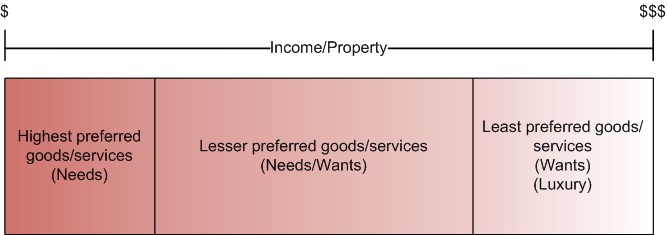
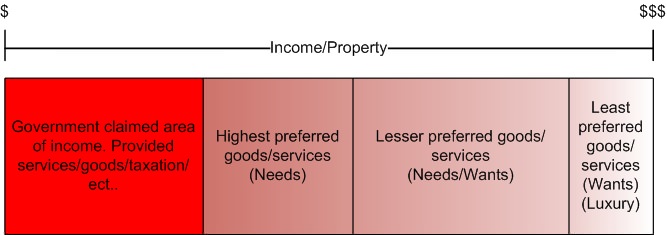
In the first diagram we see an individual who organizes their needs in an orderly fashion employing the marginal theory of value, and in it the subjective theory of value. In the second diagram we see where the state has claimed ownership over a percentage of the individual’s income and property. Understanding the marginal theory of value it should be obvious that the order of goods/services organized in the top diagram will likely be radically different than in the bottom diagram. We also see that the quality of living will shrinks and luxurious wants are pushed of the preference process. Individuals remove their desires from the top.
Now it may be that the government fills a percentage of the highest preferred list but we cannot tell whether or not the service provided is one that is most preferred as there is no market. It is typical that what is considered a ‘public good’ is entirely arbitrary.
The diagram which shows how government represents a percentage of someone’s ownership not only is seen in an individual’s income but also in their decision making process. Some of their preferences are chosen for them. If we continued this exercise and extended the portion that government claims up to 70% we can only imagine how this will radically change the preferences of the individual.
The point of this exercise is that while economic calculation s destroyed in internally to the government in each service it provides, economic calculation is also perverted in the market as a whole. Consumer’s decisions are perverted and altered to adjust to the new conditions. This comes back to my opening statements of how socialism grows incrementally. Government, inch by inch, continues to claim a certain portion of your life. All of this occurs at step 2 of my summarized model.
Consequences of my argument
My argument may be far reaching in that it re-defines genuine socialism to socialism in general. Under the new definition it becomes state directed compulsory based monopolies. Any compulsory based monopoly is socialist in this way. This applies also to fascistic models. Just because the state has outsourced a task to a single private firm does not change the facts outlined above. The single private firm is now simply the isolated socialized firm. Private firms that the government has outsourced to however are ultimately sovereign to the government, and the government is sovereign in and of itself.
Because of this it is a fallacy to consider private firms that the government outsources as being a part of the market in general. These are simply extensions of the government, the differences at this point in calling them private or public is pure semantics. The implications of this however is that fascism is just a form of socialism, one a little lest honest in their zeal to realize socialism.
True socialists are at least honest that they would prefer to see state owned and operated production of goods and services. Fascists pretend they get around it by hiring ‘private firms’. The two models are the same, the only difference is accountability and transparency on what occurs at government level. Fascist organizations however still operate outside of the market. They are not sovereign unto the consumers. The quantity and quality of the product they create is by the arbitrary requests of the government.
So I would conclude that all market activities directed by compulsory based monopolies, whether private or not, are socialist.
Conclusion
Isolated socialized services operate at the expense of the market as a whole. The more socialized industries the government adopts the smaller the private sector becomes. The state in this manner is a cancerous growth. Since it is incapable of calculation it feeds off the section of the market that can calculate correctly. Just as cancer cells feed off the healthy cells of a human body for sustenance and growth, so do the states.
If we are not supposed to call individual state programs socialized what do we call them? I’ll not accept bureaucracy as some have argued as even corporations can be bureaucratic but can calculate on the market correctly using prices. I would be willing to call them compulsory based monopolies but then I would have to argue to change the name of genuine socialism to something else. To me the application of calling individual programs provided by government socialist is entirely appropriate. It is also consistent with genuine socialism. Simply because a state has not yet achieved genuine socialism does not mean they do not offer socialized services. Those services suffer from the exact same flaws as genuine socialism but at an isolated level, the inability to calculate and create meaningful prices. The difference is isolated socialized services can continue to operate in the existence of a market, leeching from the markets fruit.
Please explain to me where I may be wrong, and how I may be misunderstanding economic calculation.
I realize this post is ridiculously long. I just feel that calling government programs socialists entirely appropriate and it helps people understand the link between genuine socialism and socialized services. I think it would be a step backwards and a victory for semantics to call it something else. Please critique my knowledge.