I suggest we should buy a private island, and then go from there?
Rothbard’s scenario is a theoretical test for if you really believe in your stuff. If you really think the state is evil and breaks people’s rights you should have no qualms about deleting it as much as possible (including all of it) at any given opportunity. Yes, there is the knowledge problem and the fact we can not know for sure how the immediate establishing of order in anarchy would look like, but everything we know tells us it would look better if it has the opportunity to raise itself up in total freedom, rather than in partial freedom where there is still some state intervention. Also everything we know tells us it would be miles better than even just a tiny piece of state. Confusing non-aggression is always better than predictable aggression, no matter how small.
Now for the tactical stuff:
Power corrupts ergo it is impossible to abolish power by or after gaining power. How freedom is accomplished is not by rising to the top of the statist order, but by seceeding from it.
You work toward a crisis of the state and when such a crisis arises you take advantage of it by breaking free.
The better comparison would be with a person who is host to a blood-sucking parasite. But anyways, at least it is possible to cure addiction by gradual steps, but it is not possible to abolish the state gradually from the top. A Ron Paul-like figure abolishing the USA from the Oval Office for us is a fantasy that is never going to come true. It is always going to come around in a messy and grimm situation, but neutralizing the power of the state is without doubt the cure for the messiness and the grimmnes, ergo it is best if it is done as soon as possible (ie immediately) so that stability may reemerge sooner, not later. You do not want to prolong a dangerous situation by needless stalling.
Also note that a strategy of secession does not aim to eradicate the state. It only aims for the overthrow of the state for yourself and fellow travellers. Thus those who can not concieve of a stateless society may continue to keep the state for themselves. This should go toward easing many of your withdrawal concerns, but only incidentally as the real reason this makes sense is not because we would fear for the health of pro-state people when saved from the state overnight, but for purely tactical reasons, because this would serve to minimize the opposition to the anti-state secession. If the people who can not concieve of life without a state feel our attempt to free ourselves threatens their goal of keeping the statu quo for themselves, we shall never be successful and will be crushed by them.
Possible, but expensive and small and also limited pickings (there’s none for sale off the California coast, for instance, which is my target beginning point). Perhaps as an anchoring point. For the cost of an island we could build a large amount of floating structures, and retain complete autonomy while having the ability to move as needed.
Rather than an Island, I suggest we pick a simple seamount, basically an underwater mountain that doesn’t quite breach the surface. It’s the closest thing you can get to having an island without actually having one  Basically, it provides easy anchor-points for a large-scale floating city. There’s a number of them off the west coast, such as the Taney seamount, or the Rodriguez seamount which is quite close to me near Los Angeles.
The next step is convince some major industry(-ies) to open a floating plant of some sort, so that we can begin creating some kind of economy. As I said, biodiesel would be perhaps ideal, but also fishing and various other sea-related industries.
With industry there, we’d get a couple who’d want to live there full time, meaning demand for food services, transporation back to the mainland periodically, more housing, entertainment. It’s just like an old western town with services cropping up while business boomed, turning into, hopefully, a major city.
Without jobs there won’t be mass population movement that we need for achieving critical mass. If biodiesel became economical when done on the sea, that would be the end. Guaranteed done, because the US would have an interest in making us as productive as possible, investment capital and workers would flow there faster than you could believe, and it would take us 20 years simply to scale to the point where we could meet demand for the world’s oil needs. But I’m getting ahead of myself
The seasteading society i’ve been building out theoretically has been called minarch, for it contains legal structures like a constitution, etc., yet contains no systematic aggression. If the existence of aggression is the problem, then are you prepared to accept a “state” structure that contains no aggression but is predicated on individualism and voluntaryism? Is such a system, were it to exist, still considered minarch? With that term, ‘minarch’, primarily being used as a smear for those whom would compromise–just a little–with the aggression of statism for whatever purpose.
Personally, I don’t think I’m building a state, but something other than known government, something for which we don’t have a word. Perhaps autonoment. No one’s being governed in the society I propose; you are to govern yourself and no one else.
Perhaps I’m building something then that the ancaps will embrace ultimately, even if it’s not what they had been imagining exactly. Well, the ancaps whom believe that all organization is evil inherently will never agree, but I think we all know they’re rather foolish.
It is not organization per se that we’re against, nor cooperation that we’re against, it is forced organization and forced cooperation that we oppose. All I’m doing then is building a particular system of voluntary cooperation, one designed to take the place of a state, if not to be a state, in order that, among other things, no one may try to build a state by claiming a certain region lacks one.
I agree.
What sort of crises, and how does one break free?
Agreed. It’s sad to say, but Paul wasted his life if change was his goal. He accomplished much in popularization and education perhaps, but that must surely be to him a bittersweet accomplishment when he looks himself in the mirror each night.
I agree that that’s important. Many would be thrown into a great heap of confusion and fear if they thought themselves ungoverned, so conditioned to accept its necessity are they. They wouldn’t know how to cope with their supposed new vulnerabilities. These are only one example of the withdrawal symptoms you rightly mentioned.
In the system I’m building, based on charter cities, people would be free to build, in voluntary fashion, enclaves which replicate quite closely the current US model of cities, where you pay as a society for certain services like police, fire, trash, etc. Such would be a familiar and welcome experience to those who grew up in such surroundings and are not yet enlightened enough in freedom philosophy to be able to emotionally deal with a freer experience.
Agreed. And that is why I feel the charter city strategy is the way to go. It gives the opposition complete freedom to institute their belief structure while keeping them from forcing it on myself. That’s the key that’s missing in democracy, we are unable to keep the masses from forcing themselves on us, meaning continual aggression.
We need only start a libertarian-influenced charter city of our own and keep them out to experience whatever degree of freedom our understanding of liberty makes us comfortable with.
This has another benefit of allowing the consequences of ideology to fall squarely and solely on the heads of those whom hold it.
In such a society, for instance, it would be possible to setup a statist charter city, one where welfare and taxes and all the familiar things we know exist, but it would be impossible to force others to submit to it, they would have to submit willingly.
They would be unable to institute wealth redistribution, because the wealthy would be able to escape all taxation schemes by simply leaving the charter city and repudiating its charter and thereby all stipulations and conditions of entry into that charter city.
Competition of governance results, without the problem of pitting groups or charter cities against each other.
Isn’t that a bit utilitarian? I’d rather begin from a property ethic and build from there.
The property ethic is indeed the foundation for all libertarian ethics, but what is the foundation of the property ethic? Why do we believe in the property ethic? Perhaps some folks believe in the property ethic because it accords with their intuitive sense of justice. But I believe in the property ethic because I know that its universal adoption would yield the best consequences: “best consequences” defined in terms of subjective valuations. Hence, as I say, ethics should begin with determining what it is that we value (with these valuations being prior to reason), and then using reason and our empirical knowledge of the world to determine which principles of human behavior (ethical principles) should be adopted in order to yield those results that we desire.
Everyone does have differing wants, because everyone has differing value scales.
Note that I said “if everyone had contradictory wants…” Having contradictory wants and having different wants are not the same. Everyone certainly has different wants, but most people don’t have contradictory wants: i.e. most people’s wants can all be satisfied without preventing the satisfaction of the wants of others. For example, if everyone wants freedom from aggression and prosperity, everyone can be satisfied. This does not apply with people whose wants include aggression against others: as obviously the satisfaction of their wants would prevent the satisfaction of the wants of others (namely, those who don’t want to be aggressed against).
We would have no grounds for that under the NAP unless and until all avenues of voluntary change are cut off; that is, the point where a totalitarian gov has taken over. As long as it remains possible to vote in change, you’ll have no moral case for violent revolution.
My argument against the path of violent revolution is a practical one: i.e. I don’t think it would work. I don’t see anything ethically wrong with a violent revolution, provided the violence is directed at aggressors: e.g. members of the State.
What do you mean by the term ‘counter-economics’?
Unfortunately the momentum towards statism was cast in stone with the writing of the constitution. No development has arrested this momentum in 230+ years, not even a civil war.
On the contrary, the civil war increased the momentum. I appreciate that political reform in the direction we libertarians would like is going to be very difficult. Call me an optimist, but I’m not yet willing to say that it’s impossible, or that it’s not worth the effort of an attempt.
But would they realize it in time? That’s going to be the great gamble. And, there are ways to game the system. For instance, I’m an American citizen. And I will be starting a seasteading nation in international waters off the California coast. I won’t initially publicize it as a new nation, we’ll need a certain critical mass first. It’ll be a curiosity to start, a way of “living in california cheaply”, paying no property tax, no sales tax, yet still having an ocean view.
Will the US see a small seasteading operation as such a threat that they’d do anything, considering there’s naught but American citizens and students with HB-1 visas living there? Doubt it.
Whether this historical epoch will be favorable is another factor. The USA grew up while Europe was embroiled in war with Napolean and the like. Napolean originally planned to conquer North American after he was done with Europe. That’s why he sold us the Louisiana territory, the most important acquisition of all, because he needed money for his wars and he believed that he would get the land back anyway through war.
Ideally, the US’s debt woes would distract them while such a nation grew. Ideally, enacting health care would not only drive people to a tax free society where you could still buy quality health-care, it’d drive the US to the brink of bankruptcy–which I’m convinced is a left-wing plan to subvert American militarism anyway.
I’m not opposed to seasteading, I just can’t envision it succeeding. Perhaps that’s only a lack of imagination on my part. But regardless, if I’m looking at things through the eyes of a investor, I think I’d be much more inclined to risk my money in Africa than on a seasteading project.
If you’re serious about it, then libertarians in the US should seek to collectively move to some major city
It’s my hope that during the period between the upcoming general election and the start of the Presidential campaign for 2016, libertarians will devote themselves to local and State politics with the same enthusiasm they had for Ron Paul: whether organized migrations are part of it or not.
Africa, most for geographical reasons, will probably never be an economic powerhouse. Read this incredibly interesting article from Stratfor for an explanation of that statement: “The Geopolitics of the United States, Part 1: The Inevitable Empire”
Geography is important, but social organization is by far the most important factor in determining how prosperous and powerful a society can become. Africa’s problem is not geography, it is the lack of security for property. And that is precisely what a “Congo Company” would aim to provide.
Don’t they have like blood-diamond-funded militias there?
Yes they do, but they are rabble. The same over most of Africa. These vicious “rebel groups” and so forth that we’re always hearing about are fearsome - if you’re an unarmed, malnourished African peasant. Whereas, they will melt away if confronted by disciplined soldiers. This has been proven over and over again.
So do the Russian steppes, but the access to shipping is poor at best in both places.
The Nile? Navigable? For somewhat short distances
Not the Nile, the Congo, which is the deepest river in the world, and the second largest (next to the Amazon) by volume. As you can see in the map below, there is enormous potential for inland trade. The only section of the river that isn’t navigable is the stretch between Kinshasha and Matadi: hence the road/railway running along the bank. That’s only about 300km (186miles): no great obstacle for ocean-going trade. Not to mention the possibility that, with sufficient capital investment, it may be possible to build a system of ship-locks, like on the St. Lawrence. Everything would depend on establishing law and order, and thereby drawing in foreign investment.
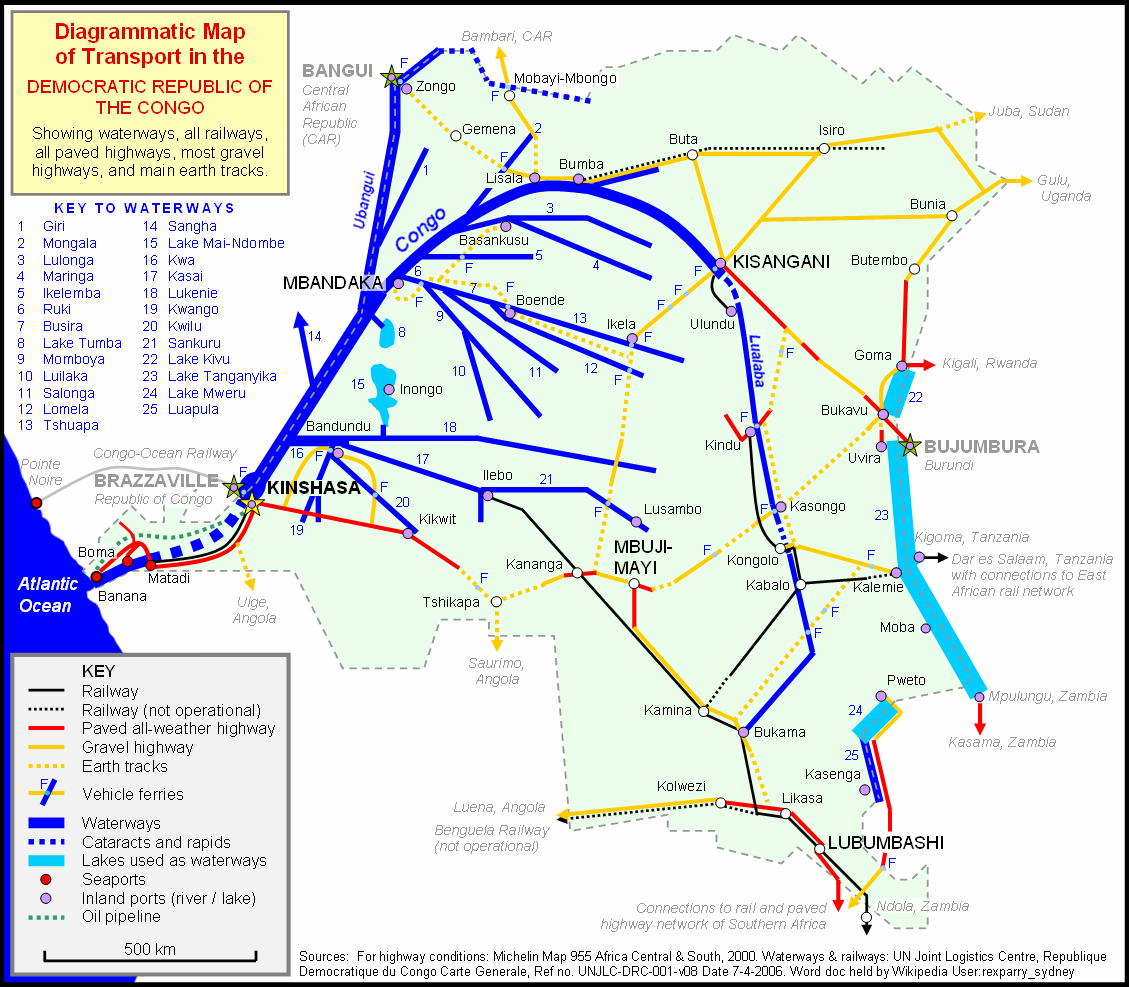

Plus, Africa is so poor that it’s very difficult to accumulate capital. Theft is rampant. Anything you can’t watch literally will be stolen.
Exactly. The missing ingredient, what prevents Africa from accumulating capital and growing richer, is the absence of security for property. That would be the function of the “Congo Company.” It would provide security for property, and fund itself from minarchist-type taxation. The better it provides security, the more the economy grows, the more tax revenue it collects, and so forth in a virtuous cycle.
EDIT: I forgot to address this point..
If you could get a people group to invite you in for help, maybe
Conquest is not the challenge. No one will miss the government is Kinshasha other than its own cronies. No one will object to its being eliminated. No one needs to invite us in: though we probably would have to come up with some politically-correct justification to placate the international community.
The real challenge is occupation after the government is removed. We would have to be careful not to incite a guerilla resistance. What might motivate such guerillas? Not loyalty to the old government, nor nationalism - there is none. The only conceivable resistance would be from the tribal groups. Traditionally, Europeans governed Africa by keeping the tribes divided, and elevating one of them to power over the rest. I think this was probably a mistake, as it makes sense to pit the tribes against one another only if you’re trying to prevent them from uniting against you. But the idea that “the Congolese” or “the Rwandans” might unite against a colonial government is based on fallacious thinking: “the Congolese” and “the Rwandans” only exist on paper. There’s no chance of “them” united against you, because there is no “them.” In cases where the Europeans left Africa under duress, the forces fighting to oust them were not “national” forces. They were fundamentally based around the tribal cores which the Europeans had themselves strengthened through their foolish divide and conquer strategy.
Rather, the Company should try to make the tribes as politically irrelevant as possible. Don’t align with some against the rest. Act as a genuinely disinterested arbitrator in tribal disputes, and otherwise manage the affairs of the country as if the tribes didn’t exist. Neither criticize nor honor traditional tribal customs. Don’t try to impose anything on them other than basic security for property (we’re no going to worry about relatively arcane doctrinal issues: just basic “life, liberty, and property.” Be “fair” in an intuitive sense. And, on the other hand, don’t try to create a national identity. Try only to create a sense of respect among the people for the “good deal” they’re all getting: peace and prosperity. No jingoistic bullcrap.
We want to be in that sweet-spot where there’s neither strong anti-colonial sentiment nor strong tribal tensions. The immediate concern would be the latter. Later, as the society matures, the former will become an issue, and the best way to combat that is to allow the natives full participation in government. I don’t mean voting, I mean allow them to hold all the same positions within the government (soldier, police, judge, etc) that the foreigners hold - and to own shares in the Company.
EDIT2: I might add, the simple fact that a “Congo Company” would actually have good intentions for the people of the Congo would make it a lot easier for them to rule than it was for the colonialists, who by and large did not have good intentions, and had to spend much time and energy obscuring that fact, and without success.
@Anemone
Re floating cities: I looked into prices of floating homes, and it does seem that you could house a large number of people for $500 million. The problem with all of this is that it is forcing the issue. It is not spontaneous order. There has to be some sort of profit in the area, at least when the floating cities are founded, in order for it to last. Otherwise the results will be like the Chinese ghost cities.
So, perhaps a floating city may be viable in terms of infrastructure, but there must be a strong reason for people to go there other than desiring liberty. These cities could start even as fishing communities near offshare oil drilling sites. Though many are rather far out, there are plenty of sites closer to shore, though these are currently illegal to drill.
So I guess these cities are not so far fetched. But as I said, the main problem is that there needs to be profit for the cities to be founded.
Considering how much the state has atrophied important aspects of the market, this may not be an entirely bad thing that immediate abolition isn’t politically possible. But we should always support immediate abolition if given the option.
My profession requires a large and wealthy population. So, things would have to be so incredibly bad here for me to move to a new, young, and small libertarian society.
Any one person may support the idea of property for consequentialist reasons, but the origin of property is not consequentialist. There are two origins:
-
Mutual respect for property. This is sufficient for the vast majority of a population, as the vast majority of people prefer social cooperation in their own life.
-
Law, or dispute resolution. This is necessary for the part of the population that engages in aggressive interactions with others. It is also necessary for when 2 parties have a dispute regarding some piece of property, but neither party considers himself to have acted criminally.
To say that you support your claim to own your bed for consequentialist reasons seems quite off to me. It’s your bed because you have claimed it as your own, and other people recognize this claim as legitimate. Why do you claim it as your own? Why not give it to your neighbor? Or to a homeless (and bedless) man?
Property originates from the 2 reasons I mentioned above. If you consider those two options to be compatible with your concept of consequentialism, then you can probably disregard most of this post. But considering how upset people get when stuff is stolen from them, I suspect that most people support property for more intuitive reasons than well though out consequentialist reasons. That and most people don’t think about this stuff, so it probably never crosses their mind.
Abolitionism vs. Gradualism…
I guess this assumes the person cares about changing the entire nation or world. Either way, the choice will be made for us soon enough. Abolitionism will win when one of these psychos in control of the nukes touches off an exchange.
One of my favorite things about Austrian Economics as laid out by Rothbard and Mises in their various books is the logical construction from a priori principles. Expanding on the idea of acting man into the full range of economic phenomena via logic.
We ought to be able to construct the same kind of logical understanding of Property from the same Acting Man in the same Environment (scarce resources and time) + other people. I’m still to this day a little disconcerted by Austrian Economists/Philosophers not attacking this problem with the same type of rigor that they were able to attack the more fundamental Economic issues.
So, what is this “Mutual Respect for Property”? I agree that it exists, but I think it’s hard thing to quantify. More specifically shouldn’t it make sense as an emergent phenomena from the nature of acting man in his environment? Since resources are scarce, as man works to convert resources into capital he would reasonably view it as an investment of time and energy that he expects to see a return from over time. That’s what motivates his time investment. In a wooded area, sticks aren’t really scarce, but long straight sticks with a sharp point are scarce. The work that one puts into making a spear doesn’t make sense if you won’t see some direct result from the investment of time and energy. Now if we’re sharing the results of the hunt in our tribe, it’s reasonable for one guy (perhaps older and slower and unable to participate in a hunt), to specialize in making these “spears”.
Anyway, a mutual respect for property would arise naturally out of the sheer fact that societies which respect, reward, and perhaps venerate productive effort would thrive and advance in comparison to other social groups. This doesn’t establish it as the “right” way. In fact, my issue with the way Natural Property Rights constructions work, is that they attempt to bridge the unbridgable IOP problem. The normative “right/wrong” dichotomy is a subjective phenomena.
To follow on, once you see this Mutual Respect of Property as you described it, I believe the second of your two scenarios for dispute resolution is the primary reason for it. We would all recognize theft and aggression as violations of this basic concept, but the real issue is for the edge conditions. Property rights become THE only way to resolve the issue. When two people have acted in ways that they each believe follows the Mutual Respect issue is to have an arbitration of the result, or to continue escalating the actions which spoils the productive efforts of each. The arbitrative solution will establish some form of a property right. The nature of that right will have a big impact on the society through it’s broader implications.
From this one can make sense of normalization, formalization, iteration of norms, laws,and the formation of the ideas of legal and illegal. To me it’s an obviously emergent phenomena. The key to understanding and analyzing the whole sphere of politics is in logical analysis of acting man, his environment, and how the right of way is derived and enacted. The ways in which this happens is part of the social ecosystem in which all of mans behaviors, art, economic, etc. happen, and the bottom line is there’s a darwinian survival of the fittest at the societal level, and at the “knowledge” level. Fitter memes will result in fitter social organizations.
So to bring this all to the gradualism vs. abolitionism. Abolition would leave a void, dispute resolution and aggression would still be problems. Some solution will slide into that vacuum. The solution will emerge out of the ideals and the memes that are present, and would most likely carry over some features of the previous system, since that’s “what we know.”
I think it boils down to advancing the social sciences. Even abolition would not be abolition. It would end up being a version of gradualism, unless it arises as a consequence of a fundamental change in the way we view economics and politics. The key to getting a real substantive change, is to change hearts and minds, and that’s the advancement of social science, particularly political theory. Economics is still a bit in the dark ages, Austrian Economics shows the way, but we still have junk economic theory that is being used to justify interference via political systems which are in and of themselves archaic remnants of tribal/patriarchal systems. I think we’re waiting on the equivalent of a copernican revolution in the social sciences and in political theory. Maybe it happened with Austrian Economics in the late 1800s through the late 1900s and now we’re just seeing the leading edge of the acceptance necessary to push it over the edge. Libertarian theory may also be the same thing. Time will tell. I’m not sure if we’ve reached that tipping point yet intellectually, and if we haven’t we’re going to get more of the same even if we do have systemic collapses.
The origin of property is a tricky area. You can’t apply the a priori method, and you can’t really rely on Crusoe meeting Friday to explain it either. It is important to realize that animals in general make claims to objects (usually just territorially claims). Even ants go to war against other ants. Bees will attack for the hive. I don’t know if ants or bees mark their territory, or if other animals just learn to stay away from bees (or ants to stay away from other colonies). But we do know that wolves mark their territory. Other wolves invade at their own risk. Chimpanzees do the same thing (though I don’t think they mark with urine, but they do go attack chimps of other groups).
Wolves and chimps have means of resolving disputes in their own group. Both have a hierarchy. In the case of wolves, we know that there is the alpha wolf, there are many beta wolves, and there are omega wolves (I believe there may be other ranks, but this isn’t an article on wolves). We know that wolves will settle their disputes, which are typically related to who is the alpha wolf, by either violent conflict or posturing.
Humans do not have to do this in order to resolve disputes. We can argue. While there are some other animals that have hierachies and “rules” (maybe they really are rules), none of these rules are even close to being as comphrensive as human norms and laws. But though we can create a vastly more complex system of resolving disputes, don’t let that fool you into thinking that the origin of property is any different for humans than the origin of territory for other animals.
I agree with much of this, but I just want to emphasize that the reason Mutual Respect (it does look good when capitalized, doesn’t it?) can only work is because the tendencies of humans is towards social cooperation. Even wolves prefer to posture most of the time instead of actually fighting, as many injuries are life threatening when in the wild. But for the most part, most people don’t have disputes with others that need to be raised to the realm of law. Norms in general are typically sufficient. But, people in general just prefer social cooperation. This isn’t something that can be discovered a priori. After all, even if humans tended towards violence a lot, we could still see how dispute resolution would counteract that tendency. But if the tendency towards violence was so strong that people could only resolve disputes through fights to the death, then we would have gone extinct a long time ago.
So, I don’t think that the a priori method is appropriate for the origin of property. It can be applied to law, as Clayton did so wonderfully in his posts on the subject. At best, the closest you can get to the origin of property through the a priori method is through law. But why do we have disputes? I don’t see how that is a priori. Maybe it is, but I don’t see it.
Yes, the state has atrophied many important sectors of the market. But I don’t think immediate abolition would turn to chaos. It would probably be worse than it is now until the market for law stabilizes. But America already has a pretty decent property ethic. It’s incredibly flawed in many ways, but the fundamental understanding is better here than in many other parts of the world. So, maybe you’ll see some teenagers trying to vandalize shops, but the shop owners would quickly arm themselves, and then they would start paying others for protection.
A common argument against the bailouts of the auto industry is, “Let them fail. Let more productive people buy up the capital so that it can be put to good use instead of letting the same people fail again.” Well, what do you think is going to happen to all the police stations, police cars, guns, police officers, and the rest of the capital. I mean, really, are we supposed to believe that all this capital is just going to disappear? Sure, maybe not all the cops will help and try to stop crime until they get their paycheck. But someone is going to want to put that capital to good use and get paid for it.
@ Minarchist
This sounds like a cool idea and appeals to me infinitely more than seasteading, which I imagine might be a dreadfully close-ended life despite the freedom. But it also seems like it would basically be a war: going over there, setting up camp and then waiting for some African taxman to come. Anyways if you have anything more to say on the subject I hope you’ll keep posting on it.
It’s simple, and it is a priori, IMO.
It’s scarcity. Scarcity creates conflict because you have intentional systems in play competing for the use of resources. As you point out throughtout the animal kingdom, there are a variety of emergent solutions to this scarcity issue that different organisms have evolved, to either a) help them beat out competitors, or b) help them cooperate with other organisms to their mutual benefit and, most likely, some other individuals or populations detriment.
In acting, man acts into the future to attain a state of reality that he prefers to the current one. Two people can have actions which are metaphysically incompatible: two cars in the same intersection at the same time, or the same car at two different locations at the same time. However, while both intended actions are incompatible, reality has no issue. Every dispute can be reduced to some version of this. Give me one that can’t, I’ll show how it is.
Therein lies the essence of dispute, it’s part of competition. And the solution we adopt, over and over and over, is to come up with what we call social norms, about which of two people has the right of way. There will be either a location or physical matter that is being contested, and it will contain a time component, and the conflict will be the result of 2 or more human actors objecting to each others intended uses (or past use which violates established norms and rules). That’s the essence of conflict. There are a variety of ways in which we can peacefully find ways to slightly alter each plan to enable us to both achieve our desired ends. When push comes to shove and the resources are sufficiently scarce, someone gets the right of way. This intersection of human mind, matter, time, and space is IMO the essential intersection that leads to a priori categories which I believe bring out the ideas of owner, property, and dispute. Now, in any society ownership has boundary conditions, in particular what constitutes a valid claim of ownership, time constraints for the duration of the claim, and transfer conditions which constitute a transfer of a valid claim which remains a valid claim.
All of this arises out of the essential components of human action.
And this phenomena of conflict or dispute is present as soon as you have two people. Because satisfying mans discomfort requires action, and in particular action that requires the use of matter, at some location, for some period of time! At minimum you start with the human body which lives for a specific duration of time, and must occupy some space in this world. We live peacably in that we resolve these incompatible intended realities in mutually beneficial ways the majority of the time. Societies which did not, would not survive. Individuals in societies that evolve norms which are destructive to the individuals and to production will end up marginalized, extinct, or swallowed by the ones that are more effective at this battle of the human mind to overcome the limitations imposed by reality that we perceive as scarcity.
In fact, I would argue that this same fundamental phenomena arises very early in biological evolution, cooperative mutually beneficial behaviors breed success for certain biological entities and thus the group is able to “win” the fight over scarce resources vs. other entities or populations.
I would argue that your examples point to the success of life generically at producing ever more complex and ever more effective organisms, which are able to thrive in the face of scarce resources. There was a time when organisms had nascent feedback mechanisms, these would eventually become more complex nervous systems, brains appear and become decision making engines with very rudimentary intelligence, and the process continues to grow as the plasticity and adaptability of the organisms grows.
We jumped the gap to become self-aware in a way no other organism on earth has done. One would expect to find emergent systems from our evolution which gave us huge advantages in the battle for survival. I doubt a non-social animal could develop the level of intelligence we have, simply because the communication and sharing of knowledge which forms the basis for all of our progress would not have given a selection advantage to animals which don’t have a heavily social existence. But inherent in communication and cooperation is this need to coordinate our plans. Plans which may or may not be compatible. Even in this most basic concept of coordinating a hunt, you find the need to search through the proposed behaviors of the individuals to find a way to coordinate the actions of the members of a group to achieve a result that the group has chosen to go after, like hunting a wild animal, or constructing a shelter. Members will propose behaviors for themselves and for others, even here you find the need to modify each others actions so that the emergent group action achieves the “group goal”. Yes cooperation is built in, and differences in the way each members sees the world and values the different goals they could pursue will lead to conflict at this most basic of levels. Survival will favor those who can coordinate and cooperate through communication. We’re just better than any other species on earth.
By jumping the gap, we’ve bootstrapped beyond he level of “accidental” design, and become slightly (only slightly) better at accumulating knowledge and improvements in our technology. Why do we have norms? We’re social, we find that all social groups (animal and human) have basic rulesets that are adhered to, and mechanisms for removing those that violate the rules.
But our rules while emergent, can also be reflected on and analyzed and modified. Ants and bees cannot simply change the ruleset and see what happens. They don’t know the rules, they simply follow the rules.
So, my counter question would be, are you sure conflict and dispute resolution aren’t an a priori basis for property as a concept? I think it’s blatantly obvious that they are a priori. They must occur as concepts, because intelligent acting man, will form the categories no matter what. If he doesn’t have some version of the category, he hasn’t encountered a scarcity issue to resolve.
…the origin of property is not consequentialist.
I want to firstly distinguish between the property ethic and what I’ll name the “gimme factor.” The “gimme factor” is the purely selfish desire to have the things one wants, and therefore to prevent others from having those things. Everyone, including aggressors, exhibit the “gimme factor.” The property ethic is something else entirely. If there were one man on Earth, he would exhibit the gimme factor, but not the property ethic: or any ethic for that matter. Ethics are by nature universalizable, they are rules for society. Why do people who are all essentially selfish (who exhibit the gimme factor) believe in the property ethic? Why does a man who wants, say, a car, recognize that he should not take the car because it belongs to someone else? It’s not because of altruism, or because of a dogmatic veneration of the property ethic, it is because he realizes that - ultimately - it is in his own best interest to respect the property of others (so then they will respect his). In other words, people believe in the property ethic for consequentialist reasons. The property ethic is not good in itself, it is good because of the good consequences its adoption yields.
If you say that respect for property is simply intuitive for most people, that they don’t reason out the consequences and therefore choose to respect property in any given instance, that is true, but only because such reasoning has become habit. By way of analogy, why do people look both ways before crossing the street? Obviously, to avoid being hit by cars. But, when people actually look both ways before crossing the street, do they reason things out (i.e. “well I better do this or I will probably be hit by a car…”) each time? No, they do it out of habit, unthinkingly. But the reason this habit exists is because of consequentialist reasoning. It didn’t just pop into man’s mind ready-made as an article of faith. The same is true of the property ethic (and, I would argue, all ethics).
Mutual respect for property. This is sufficient for the vast majority of a population, as the vast majority of people prefer social cooperation in their own life.
Isn’t mutual respect for property synonymous with the property ethic? So what does it mean to say that mutual respect for property is the origin of the property ethic?
Law, or dispute resolution. This is necessary for the part of the population that engages in aggressive interactions with others. It is also necessary for when 2 parties have a dispute regarding some piece of property, but neither party considers himself to have acted criminally.
Certainly the existence of disputes between individuals living in a society is a conditio sine qua non for the property ethic. But this goes to my point, that the property ethic has consequentialist origins. Namely, people believe in the property ethic in order to avoid conflict (or, more precisely, in order to avoid losing conflicts, i.e. to protect their own selfish interests) - not because of an innate intuition that property is just. Though as I said above, the consequentialist reasoning behind the property ethic has become superfluous in most cases, as adherence to the property ethic has become mindless habit.
(Tangentially, note that this “mindless habit” is not a bad thing. In fact, the ability of human beings to use their reasoning to reach conclusions and then forget the reasoning and just act in accordance with the conclusions is of great value. Can you imagine if people had to walk around reasoning out everything they did? Nothing would ever get done. Of course it has its drawbacks too. The initial reasoning can be incorrect, in which case you have incorrect conclusions which are held as dogma (people having forgotten the reasoning behind it), and of which it is difficult to dissuade people. Or the original reasoning and conclusion can be correct, but can become corrupted over time without people noticing [because they don’t remember the reasoning behind the conclusion], with the same result of having difficultly convincing people to abandon what has become dogma.)
Primarily a crisis of morale. When many people in the employ of the state start to have doubts they have the right to imprison and ultimately kill you simply for not cooperating with it. It is then when we can make a move at ignoring it.
David B,
I agree with much of what you said, but I’m still not convinced in one regard:
Suppose we have an alien observing Earth. First he looks at grass. Do grass have disputes? Certainly grass and trees compete with each other for nutrients. But do they have disputes? Next he looks at worms. Again, worms compete for food, but do worms have disputes with each other? Do birds have disputes with worms?
But the alien notices something funny, the bigger the brain on an animal, the more likely it is to get into disputes. He sees that rabbits generally don’t fight other rabbits. But he sees wolves posturing and fighting. And then he sees humans, and well, we know full well what humans are capable of regarding disputes.
So, not all life forms must have disputes, even if they compete with one another. Basically, we know why law emerges, and we can know this a priori. In other words, if there are disputes, we can see how a system of law emerges. But what happens if there are not disputes? It’s not like there must necessarily be a dispute just because something is scarce.
I’m not entirely sure of where I am going with this. Obviously, we know that people have disputes. It just doesn’t seem like something we can necessarily predict. “You, sir, are going to have a dispute regarding road rage.” “You, sir, are going to have a dispute regarding the terms of your divorce”. Obviously, many, if not all men and women who get divorced have disputes as to who gets what. But is this really a priori knowledge that they must necessarily have a dispute? After all, isn’t it possible that every so often we might have a man and woman who are able to just take their respective property and walk away?
I mean, I know this is incredibly rare (if it even happens at all). But I’m not disputing whether or not it occurs, just whether we can know that it will necessarily occur a priori.
If a man and woman get divorced without having a dispute as to who gets what, is it still a priori knowledge? It really just seems that we must observe that a dispute has occurred, and then we can reason out the conclusions.
Maybe I’m wrong.
In other threads I’ve been clarifying these points slightly. Competing for resources results in a might makes right or better action = better result, but in the natural world without brains, there’s not really intention so much as serendipity, and not a “gosh how lucky type” of a 50/50 coin flip, but (for example) if a slight variation of a specific protein that’s constructed by a slightly different strand of DNA on a chromosome in a grass leaf, means that the way it’s roots grow gives it a higher probability of reaching deeper into the soil for water, AND the blade is in an arid location means that specific grass instance will survive. There is a “contention” between different members of the population, but it’s not like ours.
I agree that as we get more advanced this “contention” between members takes on a more and more purposeful nature. I agree with all of this so far.
Actually that’s exactly what scarcity means at the human level. Scarcity of means to be used for ends. Meaning that if we have access to 5 gallons of water, and you need 4 for your productive endeavor, and I need 3 gallons, then we’ve got scarcity. You can’t introduce ownership, because we have no reason for it to pre-exist. I may not engage in some behavior that is intended to “get my way”, but there is a dispute. Avoidance is a mechanism for resolving a dispute. If I go off looking for my 3 gallons elsewhere, that might become part of the dispute or conflict resolution norms within our common social group, or in my social group, which may be separate from yours.
The point at which we’re physically or verbally contending over a single resource(either mano y mano, OR through an intermediary) we’ve at that point selected a solution path after discarding a variety of other options, like avoidance or modification of the plan internally. Each of us has gone through a series of “thresholds” where we discarded various alternative mechanisms to resolve the epistemological conflict that one or both of us recognized.
No the a priori fact is that individual human minds in a social group will have plans for the use of matter in reality that are incompatible with each other. When such an incompatability occurs, what actually happens? Well, humans recognize these incompatibilities and have adopted various mechanisms for resolving them, our norms encapsulate general rules of thumb as to what one or both of us should do. Think of changing lanes on a crowded highway
You misunderstand, and I think it’s because I’m using a term to represent a more abstract concept, than how that term (dispute or conflict) is traditionally used or defined. It’s not that those two people will enter into some type of formal dispute or conflict over the dissolution of the marriages shared assets, it’s that no matter what on a very regular basis, you will engage in actions or plan actions which will not be compatible with someone elses plans, and will have to adjust your plan and your actions in order to make your plan compatible with their plan. Keeping it as broad as possible, when I say conflict resolution I mean ANY means used by either or both of the parties to resolve this incompatibility. Even if it’s to simply keep my mouth shut because of cowardice and to completely modify or discard my plan.
I hope that helps clear things up. I appreciate the criticism.
It seems that we are using “dispute” differently. I do not consider conflict avoidance to be equivalent to dispute resolution. Conflict avoidance can occur without disputes. For example, if you see me build a house and claim it as my own, you would be avoiding conflict if you never contested that claim. So while there would be conflict avoidance, there would not have been a dispute. The dispute occurs when two or more people make a claim to the same object.
So, my question is: I know there is scarcity. I know that people do sometimes make claims to the same object. Is this really a priori knowledge that people sometimes make claims to the same object, or is this something that must be observed?
I suppose another way to put it: The knowledge that humans are omnivores is something that must be observed. Furthermore, there are some people who choose to not eat meat. This too must be observed. What is it about disputes that makes it that we know it without observation? Certainly I can imagine that people have disputes, just as I can imagine that pigs can fly. But these seem to be things that must be observed in order to know them.
To me, it seems that even with scarcity, we cannot know for certain that there will be a dispute. After all, parents will sometimes sacrifice themselves in order to save their children. But there could also be parents that don’t sacrifice their lives for the children. But this seems to just be a case where we can imagine different possibilities. I don’t quite see how this makes it a priori knowledge.
Great question, if I may I’ll break this out as it’s own discussion thread.