Homosexual Marriage

No, you may physically remove people from your own property who don’t abide by your terms. That is all Hoppe is referring to, with respect to properties governed by restrictive covenants.

hoppe’s writings are like plutonium. the more you’re exposed to them, the more you will want to throw up.

Funny, he has the opposite effect on me, but then again I am not blindsighted by such things, especially since he is referring to what property owners may do on their own property, and specifically mentioned ‘advocates of’.

state marraige for anyone is not good

if homosexual’s want to have a private marraige, they are free to do so.

indeed they are, in fact I am aware of some who have.

NonAnti,

Is the NAP really your biggest concern here? If Hoppe was saying that private property owners should remove advocates of homosexulity from their land to protect the libertarian order, you would be perfectly fine with that?

Oddly enough, I would find even that “watered down” statement disgusting. Though whether that is what he actually meant is questionable.In any case, if you need more context, I would suggest reading the book, if you are interested. Like I said, I just wanted to post this quote and leave it at that. If that is “careless”, I’m fine with that.

Student,

It is a very important concern. I see a big difference in advocating something like ostracism compared to aggressive violence. Do you?

I don’t know. It would depend on his reasoning. If you noticed, the quote was not specifically about homosexuals, but of those with particular sets of values. I see value in maintaining a stable, moderate culture based on what I beleive to be ‘good’ practices.

But more to the point, why is this a relavant question? Would you be asking me this if you actually knew and could explain what Hoppe meant? Because at this point you’re asking me to make judgements on incomplete information and hypotheticals, it seems, to save face from the actual point: you posted a quote out of context which you admittedly do not fully understand, and acted like it was something important to take note of.

I’d give you the benefit of the doubt and say you were earnestly trying to make others aware of something imporant that Hoppe said, but since you can’t even explain what the quote means, provided no context, and expressed obvious bias, I’d say your actions are more in line with trolling.

@Jon Irenicus,

what is your opinion on HHH’s proposition that, ceteris paribus, homosexuals have higher time preference than heterosexuals?

It is a thymological claim, and I have no idea how Hoppe would try to prove or test it. Does he intend on polling homosexuals from different cultures and classes and age groups?

Where does Hoppe say that, Malachi? I’d be interested in a source to see exactly what he says.

I believe it is in D:TGTF and it is a conclusion based on a rational actor who has no genetic offspring, and thus less primal motivation to leave wealth behind.

@gotlucky, its not testable because an individual’s homosexuality cannot be controlled for in a survey, as far as I can tell. I agree it needs to be examined in context, especially considering the statement could be applied to hets who have no legitimate offspring.

It’s not a praxeological claim, so it can be measured to see how accurate it is at the present time, though it suffers from the problem of finding a way to accurately measure it. You could hold a survey for open homosexuals or follow their lives for 50 years from their teens, and you could have a sample size of 10,000 homosexuals and 10,000 heterosexuals easily in a country as large as America. The major problem, in my opinion, would be in determining what constitutes low time preference versus high time preference and all the variations within them. For instance, does someone have small amounts of wealth in their 70s because he had high time preference or because of bad investments? And if the investments were bad, was it because he didn’t take the time to research or because of some factors that just couldn’t be accounted for?

Hoppe makes these grand thymological claims (the most well known is probably the claim about monarchs having a lower time preference than democratically elected officials), and since they are thymological they do not necessarily apply to all or even most of the particular class he is generalizing about. Hoppe has some interesting insights, but when they are not praxeological, it’s best to just take them as interesting insights into how to view the world, but they don’t necessarily apply.

I don’t think that the ceteris paribus condition is at all applicable condition in this instance, since the only variable here would have to be the sex of one’s spouse (if one has one), rather than the possibility of obtaining children. The assumption here is that because homosexuals cannot produce children on their own that they will therefore not care as much about the state of society in the future. Now this would only be true if

  1. The person could not/would not adopt a child

  2. The person would not/could not have someone else inseminated/be inseminated/would not inseminate or be inseminated by anone who wasn’t their partner

  3. Would not care about an offspring that was not biologically theirs

And on the other hand that the heterosexual version would have to either

  1. Be capable of inseminating/be inseminated

  2. Not have their values relevantly changed by the way society then viewed them (you could argue that this is implied within the condition)

And both would have to

  1. Want children

7.Care about the child’s wellbeing in the future

Therefore for Hoppes’ claim ARE NOT praxeologically true in an apriori manner because not one of these things can be determined to be true from the condition. The claim will only apply to a very exact sequence of preferences that this person holds, and none can be assumed from the conditions given.

Neodoxy,

I can’t tell if you are disagreeing with me or reinforcing what I said.

both of you gentlemen appear to be in accord.

It’s not careless, it’s trolling. If you’re as well-read on Hoppe as you claim then you would’ve known how disingenuous your quote was in advance.

Here’s the full paragraph from which that statement comes:

His point is about convenants that can be made in a libertarian order, and the extent to which those in the convenants would have to protect them to maintain their intended order. He’s not even making a blanket statement about homosexuals, only those who participate in the countercultural homosexual lifestyle and who live under a covenant established for purposes to which that lifestyle runs counter, which is why he classified as lifestyles ahead of time and lumped it with hedonism.

im glad you posted the complete quote from the article I linked to.

of course, i don’t see how any of the added text changes my (or walter block’s) interpretation. i wanted to avoid getting into this, since these kinds of arguments never change anyone’s minds, but let me spell out my opposition to Hoppe in detail.

#1 he is talking about expelling people that disagree within a particular covenant-based community (i agree with block that this is hardly a libertarian notion)

#2 he is still explicitly saying that advocating homosexuality is opposed to the family centered lifestyle (untrue) and on par with parasitism and hedonism in its opposition to that lifestyle (insane).

#3 if we combine 1 and 2 the result is a terrifying prospect. he is openly suggesting that a libertarian order cannot be maintained in this community unless everyone is in agreement with the goals of the community (that sounds like a pretty collectivist notion to me). since homosexuals (or their advocates whatever that means) can’t get with the program, they SHOULD BE evicted. like i said before this is plain disgusting, even if you don’t think it violates the NAP. let me explain further since apparently it isn’t obvious.

saying people have the right to discriminate is one thing. you can say “i don’t agree with them but i don’t think the government has the right to stop them”, fine. but Hoppe is saying something different. He is saying that this community cannot maintain a libertarian order UNLESS people discriminate!! discriminating against people that are not on board with the community’s goals is a requirement for maintaining order. doesn’t this strike anybody else as not only false (does order really break down when people disagree) but also repugnant? basically, hoppe is talking about people living in like-minded villages where they can’t be too different from one another for fear of getting booted out. in other words, ending the cosmopolitan lifestyle we currently enjoy. how is what Hoppe is advocating considered a libertarian order at all except that it doesn’t include a central government? i believe i am much more free now than i would be in the world hoppe describes.

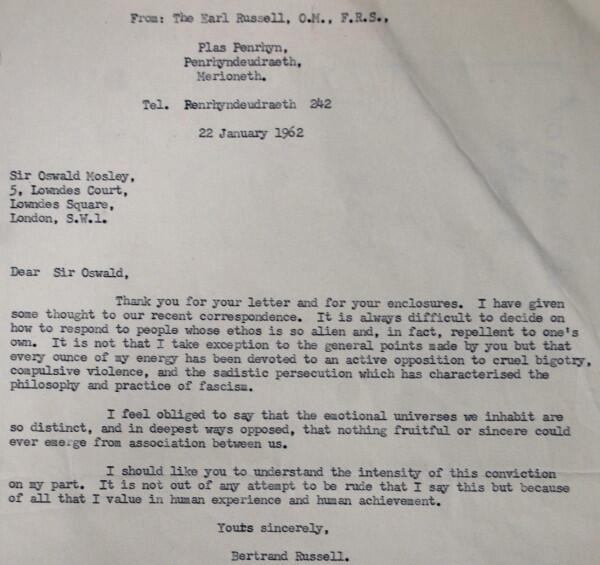
anyways, people should feel free to read the book and make up their own mind. like i said, i dont think Hoppe is woth arguing over (and somehow nonAnti keeps wondering why i refuse to elaborate myself on a topic i don’t think deserves discussion). a modified version of what bertrand russell says in a letter to oswald mosley sums up my feelings. “i feel obliged to say that the emotional univserses we inhabit are so distinct, and in deepest way opposed, that nothing fruitful or sincere could ever emerge from” such an argument.

in light of this can you see why it might not be a good idea for two given people to live in the same community and collectivize (to some extent) their decision processes? perhaps you dont agree with the particular characteristics hoppe identified, and thats fine, its puzzling to me as well, thats why the insistence on context and values.

I also think its odd that hoppe doesnt mention or envision a libertarian social order that caters to homosexuals.

Is the NAP really your biggest concern here? If Hoppe was saying that private property owners should remove advocates of homosexulity from their land to protect the libertarian order, you would be perfectly fine with that?

Considering he is writing for a conservative audience, they may well wish to do so. I see no problem with it, and I don’t really see a libertarian society without strong familial units going very far. Since no one will be forced to live there, I see no issue with it. He is simply making the point that a libertarian society will require functional family units, the same point exactly which Stephan Molyneux makes. Hoppe has conditioned his rhetoric for a different audience. How much of it he personally believes and how much of it was intended for conversion, I do not know, nor does it really bother me.

If you wish to treat this as ‘disgusting’, so be it, but there is nothing wrong with it from a libertarian perspective (insofar as the NAP is concerned.) The fact that used the phrase ‘advocate of’ also makes me wonder why people keep jumping on this quote. He seems to be referring to individuals who wish for the subsidisation or forced tolerance of ‘alternative’ lifestyles, as is certainly the case with all the “X rights” movements at present. Under a libertarian order, if you do not wish to live in the sort of society Hoppe envisions, you can simply pack up and go elsewhere, such as a city (although what will happen to these absent the state is another good question), which may not even be required in certain circumstances. No requirement for forced integration, and much cleaner than the current system, since no one can prevent this from occuring.

In my view, he is writing with individuals in mind who believe the only way to preserve their value systems (e.g. communitarians) is for the state to impose them on others. He is showing that the same can be achieved via covenants, which is correct, and I am going to agree with him to the extent that absent strong social units like the family, a libertarian society will have a harder time surviving. Personally I disagree with him that homosexuality cannot be reconciled with conventional familial structures, but again he used a particular phraseology, i.e. ‘advocates of alternative lifestyles’, so what he means precisely is open to interpretation.

I suppose the niggling bit is where he says it is required of a libertarian society - but in line with the above, one may ask what, specifically, is required for its continued existence? He seems to think a fairly patriarchal family structure is.

#1 he is talking about expelling people that disagree within a particular covenant-based community (i agree with block that this is hardly a libertarian notion)

I am going to interpret this in one of two ways. Block is rejecting this on account of the fact that that he is a thin libertarian, i.e. does not believe in values surplus to the NAP being required for one to be a libertarian. If, on the other hand, he is arguing that covenants violate the NAP somehow, he is simply wrong. They are ways of setting conditions under which an invitee, rentor etc may make use of the proprietor’s goods. If Block is making the assumption that tolerance (beyond the sort the NAP itself mandates, i.e. not harming others by initiating force against them) is required of libertarianism, he is then positing a thick version of libertarianism. In that case it becomes a question of what you think will be required for the long-run survival of a libertarian society, and if i were Block I would first seek clarification from Hoppe on how he meant the quote to be understood, as it isn’t one of his clearest pieces of writing.

I doubt Block has an issue with covenants per se, and if he thinks they cannot result in expulsion from the property if the covenant is violated, I wonder what role he thinks they serve, exactly? For instance, I see them as very useful means in effecting desirable social behaviours, e.g. limiting drug usage by prohibiting them within properties covered by a covenant.

@Malachi, that was an off the cuff statement he made, and it is a thymological question. I would disagree with him if the person in question did in fact intend upon creating a family, as it would expand their time horizons, but there are other things that do as well. I just think few of them are as powerful in influencing time preference as passing on wealth to secure the future well-being of your progeny. If he made the comment as a matter of praxeological law, I would disagree, but see below.

Therefore for Hoppes’ claim ARE NOT praxeologically true in an apriori manner because not one of these things can be determined to be true from the condition.

I can’t recall him ever making the argument that they are. He has written in DTGTF that TP is conditioned by a variety of biological and social factors. So why he would make such a statement as a statement of a praxeological nature, I do not know. I don’t believe he did. I think he used it as an illustration in one of his lectures to show how biological factors impact TP.

Hopefully that will clarify my position on the matter, though if Student would rather discuss Hoppe’s position another time, that is fine, and we can get back to the main theme in the OP, which isn’t Hoppe’s ideological predispositions.
thanks for the answers, Jon.

I also think its odd that hoppe doesnt mention or envision a libertarian social order that caters to homosexuals.

Depends on who the intended audience for that essay was. His book is a collection of self-contained essays, and as the full quote myhumangetsme provided illustrates, his quote is a lot more nuanced than the bit Student quoted. I personally wouldn’t want to live in a society catered as such. I’d prefer one simply where the NAP is adhered to. Naturally, I would not rock up on the doorstep of a rather conservative community and demand that they bend over backwards to accommodate me. I would simply opt for a more tolerant society. The problem with libertarians is that they tend to overreach in the opposite extreme, and that is what alienates some potential conservative proselytes, which is what I think Hoppe is going some way to correct.

Sure, if he is saying homosexuality is antithetical to the existence of such society, I would disagree with him, but that doesn’t appear to be the case. Bear in mind that some feminists etc. have argued that the family unit should be abolished for fostering patriarchy, bigotry etc., and I strongly suspect that it is this to which Hoppe is addressing his essay, particularly since he comes from a German background, where these ideas have had greater currency, given the country’s run in with communism and cultural Marxism.