The chain is implemented as Merkle tree, and the longest branch is always considered the chain. Briefly looking at the code, it looks like blocks have a 256bit identifier which makes the number of possible blocks about 10^77. This is comparable to the number of particles in the universe, which is estimated 10^82. From a practical point of view, the chain can indeed grow to be very big, and there is a bitcoin wiki page that discusses it. Based on my calculations (listed on the aforementioned wiki page talk subpage), data storage is a smaller problem from scalability point of view than network bandwidth.
We might be confusing terms here, there is a custody chain for bitcoins individually (sort of) but the actual blockchain is a single, massive, distributed ledger of all such transactions. So the custody of a particular set of bitcoins can be tracked from it’s initial issue, but only within the blockchain.
Threre is no practical length limit. The size of a single block, which appears and is linked to the blockchain roughly every ten minutes, is one megabyte at present, but that is an arbitrary limit that can be raised without trouble. It’s only there to limit the damage should someone figure out how to ‘spam’ the blockchain with transactions. This hasn’t happened as such yet, but it might yet. The blockchain is expected to grow quite large, and the blocksize limit raised or removed, in the not very distant future in order to uncap the number of transactions per second the bitcoin network can handle. At present, the transaction volume isn’t nearly as high as, for example, what Visa can manage. However, there isn’t a need for every user to keep the bulk of the data in the blockchain, and the protocol contains a method for ‘pruning’ a blockchain. The transactions contained within a block are organized into a merkle tree, with the merkle root as part of the header of the block. So if a coin has been transfered a number of times beyond the transaction contained in that block, the data of that old transaction can be removed from your local blockchain without compromising the client’s ability to prove to itself that those coins are valid later and without affecting either security nor the other transactions within that same block. In the future, a background pruning process could maintain the blockchain at a couple of gigs of the most recent transactions and still be incrediblely safe. Also, there is also a description of a ‘lightweight’ client, intended mostly for smartphones and the like, that uses only the blockchain headers plus the transactions directly related to it’s own coins, and neither downloads new blocks nor maintains any blockchain beyond the headers. Headers alone weigh in at about 4 megs per year, but such a client could only spend coins that it already has, so it would need a trusted full client to tell it about new coins for it’s spending addresses, such as a client on your PC at home.
So Pete and Moon Shadow are both experts about the geeky details of bitcoin.
Note that the ordinary person has never come out here, after losing 1- 4/33 = 88% of his money since bitocoin peaked this summer, and been probitcoin.
Quite the contrary. The people who lost big time have written anti bit coin threads.
Selfish of them , I guess.
Oh, I see now. Smiling Dave lost his wealth because he “invested” into Bitcoins at the wrong time, and now he’s following the strategy “if my goat dies, let my neighbor’s goat die too”. That explains why his posts are devoid of rational arguments.
No, Pete, I was lucky enough to understand Mises’ regression theorem, which told me bitcoin is doomed from the get go.
You can read my blog to educate yourself about the theorem, and its relation to bitcoin.
So I didn’t touch bitcoin with a ten foot pole. And never will.
You want the neighbor’s goat to die [=buy bitcoin], for reasons unclear to me.
And if you truly think my arguments are not rational, then you have my condolences.
Mises’ regression theorem is wrong.
The Economics Of Bitcoin – Challenging Mises’ Regression Theorem
The Economics Of Bitcoin – Challenging Mises’ Regression Theorem – Prof. George Selgin Responds
Stomping your feet and demanding that Bitcoin will not work, in the face of the market PROVING that it does work, seems beyond ridiculous to me.
Facts are facts.
Bitcoin is a market produced money and it is currently worth four times the value of the dollar on a per unit basis. Bitcoin currently has a market capitalization of 32 million USD. Bitcoin will not be going away anytime soon, and it will only gain more value as more users of the currency come online. Every day another vendor comes online who accepts Bitcoins as payment.
Michael, I will address your two articles at length soon.
The market hasn’t proved anything but that bitcoin is a total flop. I don’t see how losing 88% of it’s value in less than six months is proof something works.
Bitcoin is a market produced…
yes
…money…
no
and it is currently worth four times the value of the dollar on a per unit basis.
I hope people reading this know better than to think that statistic is meaningful. I mean, so what? Especially since in a few months that number will change to “one tenth the value of the dollar”, or less.
Bitcoin currently has a market capitalization of 32 million USD.
Which is a trivial sum. Even a company with that amount of money is a tiny player, certainly an alleged currency.
Bitcoin will not be going away anytime soon,…
Yes it will
and it will only gain more value as more users of the currency come online. Every day another vendor comes online who accepts Bitcoins as payment.
So how come it has lost 88% of its value in the six months droves of people started using this currency, and 182 vendors [=one a day, a piddling amount] came out of the closet to accept bitcoins? I guess one vendor a day just isn’t enough to stop bitcoin from losing 88% of its value.
Smiling Dave,
I read your blog. However, I also read dozens of books about money and emailed with about nine austrian economists about Bitcoin (in no particular order, Hoppe, Block, Gordon, Selgin, Schlichter, Klein, Murphy, Kinsella, Bagus). Your interpretation of the regression theorem is flawed. As I explained, MRT does not say that the evolution from a medium of exchange to money requires “other employments”. The most Bitcoin-averse Austrian position, that MRT means that Bitcoin cannot become a medium of exchange, is not even the dominant opinion of actual economists. Among others, Selgin, Bagus, Kinsella (and according to the last one, also Huelsmann), do not agree with this interpretation.
Once again, if your argument was correct, once Paypal and Western Union started trading their shares publicly, the companies would collapse. In fact, all service providers that do not sell goods would collapse, including barbers (unless they give you gel), dry cleaners, car repair shops (unless they replace components), lawyers, taxis, package deliver, and last but not least, all consultants. I already explained the flaw in your argument from a theoretical standpoint, this example just underscores the obvious absurdity of your position.
Bitcoin works because it decreases transaction costs. Since it eliminates the necessity for money substitutes, these lower transaction costs will be always present compared to either fiat or physical commodity system. The only thing Bitcoin needs to do to increase the market share is that these lower transaction costs must outweigh the network effect of fiat currency.
I made my own “money evolution theorem” to make MRT more general: if there is no money, it evolves when it decreases transaction costs. If there already is money, new money evolves when the transaction costs decreases outweigh the network effect of the old money. This not only explains how money substitutes and fiat money evolve, it also explains that the next step in evolution, if it ever comes, must be a something that decreases transaction costs even further. A new physical commodity does not do that. Bitcoin does it, among other things, because it eliminates the necessity for money substitutes. A system based on physical commodities and debt-instruments cannot compete on transaction costs with it, because these debt-instruments (money substitutes) have maintenance costs (for example, storage, redemption availability, risk assessment, interbank clearing) that need to be covered somehow and need to be reflected in the transaction costs.
Bitcoin is not competing with gold, but with fiat. Gold-based free banking models (whether Mises-Rothbard or White-Selgin) do not exist, and never existed. They can only evolve if there is a favourable legal framework (either directly, or due to fiat monetary collapse), and then maybe the development will follow one of these models (MR or WS). Bitcoin does not require any of this: it is already here and already works. If fiat collapses, for example, it won’t become magically cheaper to transfer gold: you’d still need that a banking system to evolve. The ATMs won’t magically start spitting out gold coins, banks won’t magically start giving you gold-denominated accounts, POS terminals won’t magically start processing cards issued by gold warehouses. In fact, all these services will probably stop working completely.
Just because you refuse to educate yourself and wish to remain in ignorance does not mean that you’re correct. In fact, it’s the opposite.
So how come it has lost 88% of its value in the six months droves of people started using this currency, and 182 vendors [=one a day, a piddling amount] came out of the closet to accept bitcoins? I guess one vendor a day just isn’t enough to stop bitcoin from losing 88% of its value.
What you are forgetting is that Bitcoin is still up over 300% since April.
Yeah, it was inflated into a bubble by over-eager investors, but as a currency, it is still outperforming State issued currencies by a country mile. Just looking at the short term bubble that inflated and popped means nothing in the long run.
How much value has the dollar lost since April?
Looking at the charts, it appears that the bubble has finished clearing itself and the market has bottomed.
On the contrary. The market proved that the Bitcoin detractors such as you are completely detached from reality. The impossibility of bubbles is not a prerequisite for money. That’s just another fairy tale made up by the likes of you. In fact, there was a gold bubble around 1979-1980.
What one needs to realise is that not all Bitcoins are traded on the exchanges. Based on the available data, I would estimate that the exchanges hold less than 10% of all Bitcoins. So a 90% drop on the exchanges represents only 9% from the perspective of the whole market.
There are other variables, such as the transaction volume or the number of merchants accepting Bitcoin, which have been continuously rising despite the bubble(s). The transaction velocity slightly decreased, by about 21%, from the top to bottom (Mid-June to Mid-November), but has been rising again.
You’re lacking both in your theoretical foundation as well as in empirical analysis.
Well, I would be a bit more cautious here. While the analyses that I performed cannot tell me if there is a bubble or not, and indeed the current trends are upwards, I think a new bubble is forming. I think that until Bitcoin has reached a much higher market penetration than now, we’ll probably see high price volatility. My worry is that amateur “investors” will burn during these bubbles and this will make bad publicity for Bitcoin.
“The market hasn’t proved anything but that bitcoin is a total flop. I don’t see how losing 88% of it’s value in less than six months is proof something works.”
I don’t see how lising 99% of its value in 100 years is proof that something works… and yet I was able to buy a cup of coffee with a USD (well, several of them) this morning.
I don’t have a stake in this race, but Smiling Dave, to me you are losing. Bitcoin is used by people. Not a lot, but there are plenty of national currencies for very small countries that still are used, so that doesn’t seem to be a litmus test. Bitcoins have lost value vs the USD in the last 6 months, but you’re simply cherrypicking a convenient window. Gold has lost value in the last month or two two: does that mean it “doesn’t work”? Bitcoins gained a lot of value in the time before the last 6 months, and it’s simply dishonest of you to continue to ignore that fact. You also continue to ignore the reverse: bitcoin has retained 12% of its value even in the last 6 months. It didn’t go down to nothing. You can still buy stuff with it. What is money if not “something you can buy stuff with”?
Mises MRT is not a theorem. It doesn’t meet the standards of a formal logical statement/reason proof. It is mostly an explanation of what happened in the past; it’s an insight, and a very useful one, but that’s all. Put simply: if people valued something as money yesterday, then there is reason for people to anticipate that it will be valued as money in the future and so they can value it as money today. Mises (and others of course, e.g. Menger) explained that in the case of gold, gold was “valued as money yesterday” because it emerged naturally from the market first as a commodity and it had many of the qualities that work well for money. But there’s nothing in the regression logic that says that that is the only way that something could be valued as money “yesterday”. In fact, with fiat currency, it was “valued as money yesterday” because the government decreed that it was. Bitcoin was “valued as money yesterday” because a bunch of people simply decided that they wanted an alternate currency and decided to do so. It doesn’t really matter why as far as the MRT logic goes; it just matters that some people valued it yesterday, so that other people today can have some confidence that they will continue to do so tomorrow. Once the “ball gets rolling”, the MRT just says that it can keep rolling. It doesn’t say that is has to: for that, all of the other market forces that come to bear in terms of the quality of money are in play. This includes all the classic things like divisibility and fungibility and reliability, as well as evolving market forces like transaction costs, untraceability (by the government in particular), transimittability, etc.
I don’t know that bitcoin is going to be successful in the market, but we’re past the point at which the MRT applies. Bitcoin is a money. It’s just not a particularly widespread or popular one yet. That’s a market choice, not a definitional issue.
OK, I posted a rebuttal to Mike’s links, hot off the presses. It summarizes Mike’s argument, accurately if sarcastically, then links to three previous articles on my blog which rebutt him.
Pete’s comments tell me he is blessed with a different logic than is commonly used in serious academic circles, so I won’t bother to reply. I mean, proving I’m wrong by saying you asked all your buddies and they disagree? Point out the flaw, my son. Appeal not to Authority.
Also, saying Western Union is just another bitcoin? And barbershops too? I leave this as an excercise for the reader. If a serious person wants to know the difference he can ask me.
As for bit coin being worth a dollar in April and $4 now, proving bitcoin is here to stay, no my son. Bitcoin came out of nowhere, worth close to zero at first. It then was pumped to $33, then dumped. The curve of it’s value is a perfect upside down V. Classical pump and dump of a useless stock. It’s still on the decline.
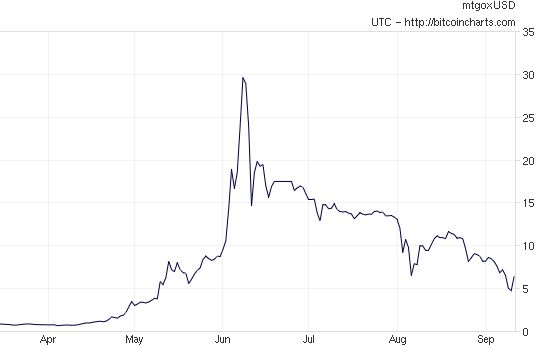
But hey, MAYBE I’m wrong and MAYBE you are right. Maybe. Dear readers, are you going to gamble away serious money, or any money, on that kind of maybe? At least Vegas gives you better odds, and free drinks.
This is wrong:
The very first businesses in the Bitcoin economy were exchangers (NewLibertyStandard, BitcoinMarket, BitcoinExchange,….). This is not an accident, but flows from the analysis above. In order for Bitcoins to serve as a medium of exchange without commodity value for uses besides indirect exchange, there must be a translated knowledge of money prices. Market exchangers fill this gap and give Bitcoin users access to this knowledge. Bitcoins may therefore currently serve as a money intermediary for paypal dollars\pecunix\euros. But why is there demand for Bitcoin over USD?? This is a subjective valuation arising from properties such as anonymity, decentralized system of clearance, cryptographic trust, predetermined and defined rate of growth, built in deflation, divisibility, low transaction fees, etc…. inherent to the Bitcoin system.
We know it is wrong because it doesn’t matter if Bitcoin’s prices are established in terms of dollars, gold, widgets, cars, oil, or any other tradible commodity. Because dollars represent real resources, the establishment of dollar prices for Bitcoins through exchanges is the same as if any of the things one can buy with dollars is being traded for Bitcoins themselves.
This is how prices come about for any new good or service, and since Bitcoin is a digital commodity, it is the same as if coffee is being introduced to a market that had no idea how valuable coffee was. Imagine trying to trade coffee beans with a society that had never experienced coffee before. At first, the market for coffee would be limited and not many people would be willing to trade for this unknown good, but once people grasped its value, its price will rise.
What the dollar price of bitcoins proves is that people ARE willing to trade real resources in exchange for Bitcoins. If MRT was to hold true, then dollar prices for Bitcoins never should have been established in the first place. Bitcoins are the incontrovertible proof that the market can see value in a medium of exchange for its own sake, unrelated to any prior use.
For those that have studied and been involved in Bitcoin a lot more than I have, I have a question:
If you were the CEO* of a giant online ecommerce website** (say, walmart.com***), what could you do to advance the adoption of bitcoin**** while still satisfying your investors and board of directors (that is, without just sucking up some giant loss… you have to make a case that it’s good for the business as well as for bitcoin)? Presumably the base concept would be to say that you accept bitcoin for all purchases on your site… but can you help me flesh that out a bit? How would that work for an existing site? If Walmart.com takes bitcoins, realistically, all of their accounting and systems are in USD. Would they then have to sell these immediately at an exchange? If so, does that really “help”. or does it only help if they keep them themselves (which seems hard to justify). What about 3rd party merchants that sell on your website (assuming you let them do so): would you take in bitcoins for their wares, but then exchange them and pay the merchants in dollars? Or would you try to incent merchants taking bitcoins somehow? Would there be some advantage to “branding” your own line of bitcoins (it is my understanding that there can be different “pools” of bitcoins)? I realize such a branding wouldn’t help those who already hold a different “pool”, but if this new branded pool was considerably more successful (because consumers knew it was “backed” by the ability to buy stuff on this website), supporters of bitcoin might still be happy. Just thinking out loud, but if prices on the website are expressed in dollars and thus the price in bitcoins fluctuates according to the exchange rate between bitcoins and USD, that isn’t really that much of a guarantee. Would the website have to promise relatively stable prices in terms of bitcoins directly for it to really promote the use of bitcoins? IOW, if I know that I can buy a pair of jeans with a bitcoin for 6 more months at least (because walmart.com has said that the price will stay the same for at least that long), then doesn’t that “stabilize” the value of the bitcoin? In essence, bitcoins would become “backed” currencies, only instead of being backed by a single commodity like gold, they would be backed by the entire marketplace of things for sale on walmart.com.
is there anything there, or is that not really all that helpful?
*: I am not a CEO.
**: I do work at a large ecommerce website
***: I don’t work at walmart.com
****: I do have input into new business ventures and I have seen mention of bitcoin, but only in passing at this point
I would immediately accept bitcoins because that would allow me to conduct international sales without any banking fee overhead.
If I was a multi-national, I would also use Bitcoin to move money between my overseas operations and my domestic operations.
Bitcoin allows small time players access to the inernational market as well without having to deal with hefty banking fees.
It also allows me to bypass the steep credit card fees, which allows me to discount products more so that if I just used credit cards.
Companies can reduce their risk of exposure by holding the coins for short periods, but there are also other ways of hedging market fluctuations.
I don’t see how lising 99% of its value in 100 years is proof that something works… and yet I was able to buy a cup of coffee with a USD (well, several of them) this morning.
-
On whom is the burden of proof? Mike asserted that the market “proved” bitcoin works. How does losing 90% in six months prove the value of bitcoin?
-
And indeed losing 99% in 99 years proves fiat money is a failure, too.
Bitcoin is used by people…national currencies for very small countries
But not by a lot of people. Economists use the phrase “generally accepted”. And national currencies have an exchange rate anyone can and does use, 99.99% of humanity will not accept a bitcoin for anything, except as an excuse to give the presenter a swift kick in the butt.
Bitcoins have lost value vs the USD in the last 6 months, but you’re simply cherrypicking a convenient window. Gold has lost value in the last month or two two: does that mean it “doesn’t work”? Bitcoins gained a lot of value in the time before the last 6 months, and it’s simply dishonest of you to continue to ignore that fact. You also continue to ignore the reverse: bitcoin has retained 12% of its value even in the last 6 months. It didn’t go down to nothing.
I’m not cherrypicking. I am talking about the the complete chart of bitcoin from day one. Look up to my previous post to see it. Gold has a different long term chart than bitcoin.
They gained at first, yes. Classical pump and dump. One ride only up the roller coaster, then straight down, forever. That is the history of bitcoin. Look at the chart. Even Pete admits, finally, that you can get burned buying it. He also admits it is “volatile”, which is partially correct. It has big down swings, but tiny up swings. I’m no expert, or even believer, in technical analysis, but look around. There is a bitcoin ENTHUSIAST out there who uses his charts to claim bitcoin will very soon, like in the next few months, drop to a buck. Prove him wrong. Buy bitcoins. Make money.
I never said it went down to nothing. No straw men, please. I said it lost 90% in six months, and shows every sign of falling off that cliff into the abyss.
You can still buy stuff with it. What is money if not “something you can buy stuff with”?
Read my blog. Mioney is not something you can buy stuff with, but something everyone is using to buy everything with.
Sadly, you misunderstand MRT. It meets the standards of a formal logical theorem. Summarize it in a fashion I will agree to, then show me the flaw, please. That is the accepted method of debate where thinking people gather.
I suggest you read my blog about MRT. The latest article has a link to where I explain it at length.
Also, it says more than you think it does. And fiat money is not a counterexample, as even Mike admitted and explained in his link about Mises being wrong.
We are not past the point where MRT applies. A not particularly widespread or popular money, is, by definition, not a money. Brush up on your economics.
On last thing, guys. If you are going to read my blog, make sure to read the enlightening comments, where the bitcoin enthusiasts try to blast me to pieces with every possible argument, and are left empty vessels by my replies.
This is wrong:
I think it’s wrong, too. It’s a quote from your article.
Bitcoin is not the same as coffee. You can drink coffee. You cannot to anything with bitcoin but pass it on to the next sucker. And yes, as people grasped the value of coffee, its price will rise, but no one will ever grasp the [intrinsic] value of bitcoin, because it has none.
If MRT was to hold true, then dollar prices for Bitcoins never should have been established in the first place.
No, my son. First of all, they were never “established”, in the sense that there was a large market for bitcoins. It was all a couple of guys who should have known better, but didn’t. The exact same crowd all fraudsters and pump and dumpers go after.
Second of all, let’s look at Beanie Babies. They were worth a lot of money at first. They were a popular fad. And it took ten years for the fad to fade, making them worth zero [besides their intrinsic value for use as insulation in housing].
Some people bought into bitcoin as a fad, thinking it’s a cool thing to have, and maybe it is. But like all fads, this one will fade, not grow. It’s fading as we speak. The last six months have seen it fade 90%.
Invoking references had twofold purpose. The first one was to show that medium of exchange having to evolve from a physical commodity is only a minority viewpoint of the Austrians. The second one was to show that your particular representation has no basis in Austrian writings. What you present is not Austrian economics, rather your own theory, which I previously labeled “Smiling Dave’s fairy tales”.
Your argument requires, among other prerequisites, that services have no value. This is clearly an absurd proposition. Without it being true however, your position collapses.
My argument is not that “bitcoin is here to stay”, rather that your line of arguing is erroneous. You make invalid assumptions, add some non-sequiturs and arbitrary data points.
I provided a point by point refutation of your claims. You retort with ridicule and incoherent ramblings.
Making random guesses is not the same as coherently arguing. Your arguments are erroneous and often also methodologically invalid. While that is of course inadequate to conclude that the future of Bitcoin will be bright, it unmasks the lack of fundaments in your position and makes it less likely to be taken seriously.
Bitcoin survived bubbles, trolls, media frenzy, failures of service providers, fraud, security compromises. Despite your failed prophecy a’la Harold Camping, the “zero price” has not appeared yet. Since you’re the one who claims it will fail, the burden of proof is on you.
Therefore, you refute your own argument.
However, the number of people using Bitcoin has been, according to the available data, rising regardless of the bubble. Unless you imagine that new money will magically gain significant market share like snapping fingers, your argument is at best incomplete.
Again, the number is rising. On meetings like the bitcoin conference or porcufest, Bitcoins are generally accepted. There is no fundamental problem here.
Gold has been used for thousands of years, Bitcoin only existed for about 3, and price data is only available for not even two. How can you compare those two charts baffles me. Your argument lacks any foundation.
Again, you arbitrarily select data that is convenient for you.
Unlike you, I have been very sparing in making future predictions about the price of Bitcoin, because I understand that it’s fundamentally an empirical issue, rather than a theoretical. However, you lack both empirical and theoretical foundation.
Apparently, technical analysis is not the only thing you’re weak at.
You provide no coherent explanation why your conclusion should be the correct one. Your attempts at providing arguments are erroneous, as explained several times.
This is incorrect. There are no absolutes, only relatives. Money is simply whatever has the highest liquidity rank. This all depends on context. In the right context, Bitcoin is money. Once again, based on the available data, its acceptance has been rising, and I explained that there are no fundamental obstacles to this continuing until economists recognise it as money. Only fools like you will even then refuse to acknowledge it.
I have one anecdote to underscore my point. When I went to Prague for the conference, I exchanged some euros to czech crowns at the Dublin airport so that I can pay for the taxi to the conference. The exchange office told me if I bring the receipt, they will replace the remaining crowns back to euros at no fee. At the conference I mostly used Bitcoins (and debit card where I couldn’t). Back at the airport, I gave the lady in the exchange booth the crowns I had, and she said “No coins, only banknotes”. So much for “accepted everywhere”.
Once again, unless you imagine that one day you go to sleep and when you wake up, market will have supplied new money, your argument is pointless.
Your blog is apparently not important enough to merit a reply there.