I feel awkward and strange reading Omnipotent Government.

Mises is right.

Some socialists unintenionally aided the National Socialists, in the same way pacifism always aid illiberal societies today or at any other time. Other socialists, furthermore, desired National Socialism, because it destroyed so-called “bourgeois morality”, by emphasizing so-called “arian cunning/pragmatism”, violence, and total government control of all life with willing participation of much of Germany.

Stalin, for instance, was in the later group. Pacifists were in the former group. Stalin thought that for every crime the National Socialists commit, they open the way for ‘liberation’ of Europe by Soviet socialism. USSR mobilized their forces months in advance, peacemeal, of Nazi invasion, and they were attacked while moving in trains and while marching, offericers in one place, tanks in trains on the way from elsewhere, soldiers coming to meet up from elsewhere, etc.; that was why the USSR in fact suffered such massive losses at the beginning.

Everyone essentially makes the assumption that the Nazi’s secretly plotted to conquer the world. Despite all evidence being to the contrary.

What alternate Universe are you living in?

Literally, one paragraph in;

Cooperation ended in 1933, as Hitler came to power and created Nazi Germany…

How can you not read something before you link it, Mr Senator? DId you not notice that was “german-soviet relations?”

Certainly the French communists resisted the German occupation. What is interesting is that even though those people believed that nations must dissolve, national governments protect a chauvinistic elite,.etc, even a communist felt his heart tearing when he saw his nation occupied and felt a strong patriotic stirring

Well, one would always be on the side of the people, not the nation itself.

The Soviets made a pact with the Nazis to keep them off. Their position was consistent. Why should communists rush to defend the capitalist world? Or rather do anything which protects or preserves them? Let the capitalists destroy each other, and let the inevitable quickly take its course. It was an ideological position, and as Mises says, not a practical or a patriotic one

Mises should do some more research, it was a practical position. The Soviet military at that time was in absolutely no position for full scale war against their obvious enemies in NAZI Germany. This can be seen through correspondents between Stalin and other beauracrats. Once it became clear that war with NAZI’s was imminent, they began actually working with the capitalist powers in the west against the NAZI’s. The idea that the Soviets ever took a “let capitalism destroy itself” approach would go against them needing to create themselves in the first place.

Omnipotent Government does later emphasise that true Marxism must allow for natural capitalism to fully take its course in order to eventually fall apart and give way to socialism. Wars, wartime powers, interventions, and the rest take away from natural capitalism. While these often result in inefficiencies and halted production (consistent Marxists are against regulation and state control of economy, on grounds of supporting efficiency and productivity), it is only worse that they temporarily deviate from the already ordained path of capitalism and slow down the whole cycle. Perhaps a consistent Marxist position should have been to side with and protect the capitalist nations to end the war early so that capitalism remains true and pure. However, Mises says that most Marxists are not consistent, have other doctrines or interests, and make many compromises

/boggle

So while the Soviet position on the Nazis was ideological, it was not pure Marxism either.

What is “pure marxism” or “pure capitalism?” Is this some unseen aristotelian “ideal” social/capitalism?

http://www.youtube.com/watch?v=GvSRnx7oVHQ&p=BA9AED19237592F5&playnext=1&index=26

Except that Stalin never had a single meeting with any of them. Minor detail.

I assume you are saying a pre-war meeting, or are you forgettting about the deal made where Roosevelt and Stalin pieced up the world for their ownership?

More like pre-1943 and even then nothing happened that could be called “cooperation”:

“I have just a hunch that Stalin doesn’t want anything but security
for his country, and I think that if I give him everything I possibly
can and ask nothing from him in return, noblesse oblige, he won’t
try to annex anything and will work for a world democracy and
peace.” F.D.R.

More like he took everything he could take and gave nothing in return.

Stalin did not one thing ever to benefit anyone else at his own expense.

Well, nobody ever said Roosevelt was a particularly intelligent guy.

But there is this;

In September 1934, the Soviet Union joined the League of Nations. After the Spanish Civil War broke out in 1936, the USSR actively supported the Republican forces against the Nationalists. The Nationalists were supported by Fascist Italy and Nazi Germany…

You mean like the Ribbentrop-Molotov Non-Agression pact between Nazi Germany under Hitler and the Soviet Union under Stalin? And the Communist activities in the USA to prevent US entry into the war, and calling for US to stop aggression? The Soviet Union and the Communists that were supported by the USSR did not oppose the Nazis and worked in support of the Nazis until Hitler violated the treaty and invaded the Soviet Union.

The socialist programs up to WWII were seen by many as all very similar, so that the socialists that FDR brought into create the New Deal supported and lauded the socialist programs under Hitler, Mussolini, Hitler and Stalin as being the wave of the future that would create prosperity for the world, and the New Deal was modeled after those same programs, all having a great deal in common with the New Deal.

Huh?

Look: socialist theory emphasises industrial efficiency, above all rest. Without industrial efficiency, workers can not be rich and gain all material gains that they could ever possibly want.

Orthodox Marxism sees capitalism as having one single flaw, but it needs capitalism to develop the full productive capacity of industry across the world. Once capitalism is as productive and efficient as it can possibly be, its one single flaw will cause it to wither away, and reach socialism. The socialist utopia can not be reached with inefficient means of production. Many Marxists read “bourgeois economics” closely, and pay attention to ideas like value of marginal product and its connection to wages. Many Marxists have joined Liberals in criticising price controls, regulations, and interventions. Karl Marx once wrote, “It is crackbrained meddling by government officials that aggravates an existing crisis”, in a letter.

In the view of strict Marxist theory, capitalism is a necessary precursor to socialism. However, other less orthodox Marxists in more short-term interests do advocate labour reform laws and controls, not because they will result in efficiency, but because they will result in inefficiency, and bring the collapse of a capitalist enterprise much quicker. It is the equivalent of a libertarian who wants a government to completely erect all barriers to international trade, so that the state falls apart quicker, although government officials know that they depend on international trade to boost their domestic industry.

The point is that the USSR had the same secret diplomatic position at all times vis a vis every state, including Germany. A quick glance at the territorial changes 1939-1945 tells what that position was.

I won’t disagree with that Caley. But to say the Soviets outright supported the NAZI’s is absolutely ridiculous.

When you look at a map of Britain’s pre-war holdings it is safe to say that they didn’t get where they were by being upholders of peace. Britain had no more an ambiguous position than USSR. Britons and French had no will to fight for Poland, yet the politicians were put in a lose-lose situation when Roosevelt threatened to block all aid to Europe in the event of a war if they did not guarantee Poland. That is the only reason they did it. But the decision to go ahead and keep the war going without compromise was an easy one with little dispute. There were no aggressors or defenders in WW2. Only mad sadists obsessed with world domination or pet interests, all around the table.

Im not a senator.

So you read the title and one paragraph.

Read the whole article. You do not need to be spoonfed, sharp cookie like you.

I await your thank you for enlightening you.

Ya know, this sub thread may be used to defame mises.org, showing how ignorant the forum members are. Course, it might be me who is pointed out as the ignorant one. Reading the whole article will tell.

You’ll be happy to know I did read the whole article… and it is about “German-Soviet relations.” It goes on later to say how as soon as Hitler took power both parties began massive propaganda campaigns against the other. The only pacts between NAZI Germany and Soviet Russia were tenous “stay off my land I’ll stay off yours” type pacts.

Are you saying that, had it not been for the WISE AND BRILLIANT MR. ROOSEVELT, World War II may have never happened?

FFFFFFFFFFFFFFFFFFFFFFFFFFFFFUUUUUUUUUUUUUUUUUUU–

I apologize. The article you read was in an alternate universe as, obviously, you are.

Here is what mine says [I emphasized the shockers, but it’s all good and added a comment or two in brackets. You’ll recognize them by the style]:

in 1935, at the 7th Congress of Soviets (in a study in contradiction), Molotov stressed the need for good relations with Berlin…

Economically, the Soviet Union made repeated efforts to reestablish closer contacts with Germany in the mid-1930s.[49] The Soviet Union chiefly sought to repay debts from earlier trade with raw materials, while Germany sought to rearm, and the countries signed a credit agreement in 1935.[50] By 1936, raw material and foodstuff crises forced Hitler to decree a Four Year Plan for rearmament “without regard to costs.”[51] However, even facing those issues, Hitler rebuffed the Soviet Union’s attempts to seek closer political ties to Germany along with an additional credit agreement.[

Further complicating matters, the purge of the People’s Commissariat for Foreign Affairs, forced the Soviet Union to close down quite a number of embassies abroad.[52][53] At the same time, those purges made the signing of an economic deal with Germany less likely by disrupting the already confused Soviet administrative structure necessary for negotiations and giving Hitler the belief that the Soviets’ were militarily weak.[

[So the ugly girl. Russia, throws herself at the vampire, Hitler, and the vampire says “Ugh, go away”. Of course the ugly girl’s family says she never wanted him in the first place.]

The Soviet Union also engaged in secret talks with Nazi Germany, while conducting official ones with United Kingdom and France.[61] From the beginning of the negotiations with France and Britain Soviet position demanded occupation of Latvia, Estonia and Lithuania [61][not in citation given]. Finland was to be included in Soviet sphere of influence as well.[62] While Britain refused to agree to occupation of the three buffer states by the Soviet Union, Nazi Germany accepted the proposal

[The ugly girl and the vampire agree to beat up the wimpie neighbor and steal his lunch money together. This is not considered mutual support by her family.]

Germany lacks oil, and could only supply 25 percent of its own needs, leaving Germany 2 million tons short a year and a staggering 10 millions tons below planned mobilization totals,[22] while the Soviet Union was required for numerous key other raw materials, such as ores (including iron and manganese), rubber and food fat and oils.[22][63][64][65] While Soviet imports into Germany had fallen to 52.8 million Reichsmarks in 1937,[37] massive armament production increases and critical raw material shortages caused Germany to turn to reverse their prior attitude, pushing forward economic talks in early 1939.[66] German planners in April and May 1939 feared that, without Russian supplies, Germany would fall critically short of manganese, oil and rubber,

Germany lacks oil, and could only supply 25 percent of its own needs, leaving Germany 2 million tons short a year and a staggering 10 millions tons below planned mobilization totals,[22] while the Soviet Union was required for numerous key other raw materials, such as ores (including iron and manganese), rubber and food fat and oils.[22][63][64][65] While Soviet imports into Germany had fallen to 52.8 million Reichsmarks in 1937,[37] massive armament production increases and critical raw material shortages caused Germany to turn to reverse their prior attitude, pushing forward economic talks in early 1939.[66] German planners in April and May 1939 feared that, without Russian supplies, Germany would fall critically short of manganese, oil and rubber,

[Without the ugly girl, the vampire copuld not have gone to war at all. He would have been brought to his knees from the very start. The girl gives him all the human blood he needs. This is not considered support, by her family].

There is more and more and more. Give a wise man a hint, and he’ll take it.
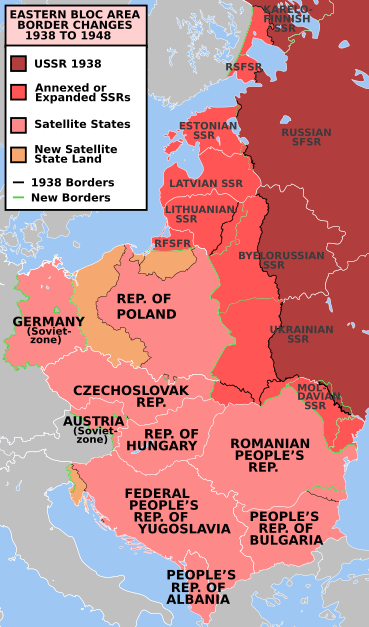
The only pacts between NAZI Germany and Soviet Russia were tenous “stay off my land I’ll stay off yours” type pacts.

Actually, the Soviet Union and the Germans cooperated heavily in military development until the later-1930s.

It turns out that you are right, as the book later reveals in its most amazing and entertaining part:

To a certain extent, von Mises is still with the rest of us in admitting much of modern nationalism to be fiction.