Somehow, additional government spending actually reduces employment
1. When the govt spends, say pays people to build houses, then there is an increase of employment in the housing industry. The moment they stop buying, off toddle the jobs. So we are talking about an eternal injection of govt money into the housing industry. This is in contrast to when private people decide thay want more houses. After all, there must be a reason they want more houses suddenly. Maybe prices of houses went down, or a new use has been found for houses. But there is a reason. And as long as the reason is there, the jobs will be there. When the reason stops, the workers will get laid off, AS THEY SHOULD BE.
2. Of course govt spending reduces employment. Because for every dollar they take away from us and use to hire someone, we have a dollar less of our own to spend. So people who used to work for us will lose their jobs.
3. Now one may say that it’s a trade off, gain one job here, lose one job there. So that the worst we can say about the gov is that it does not help. But why do we say there will be LESS jobs, not the same amount as before?
That’s a deep question. The answer is that there is a huge difference between a govt job and a regular job. The govt job is always to make soemthing nobody wants. After all, we are talking about the govt building houses because nobody is buying them. Which by definition means the govt is building houses nobody wants. A result of that is that resources like factory space, raw materials, and labor, have been wasted. They cannot be used to make things people really want, because they have been turned into houses.
When a country has less resources available, it is poorer. People cannot afford to hire others like they used to. So of course there will be more unemployment.
—even when the economy has huge amounts of spare capacity and unused labor desperate for work;
What does he mean by “spare capacity”? I assume he means that GM has this big factory for making SUVs and nobody is buying SUVs. So there is a spare capacity for SUV manufacture. And he proposes that the govt keep buying those SUVs to keep the factory open.
By this thinking, when cars were invented and the buggy factories had spare capacity, the govt should have given them money to keep on making buggys. Or when electricity was invented, the govt should have given money to the whaling ships to keep on bringing in blubber.
The point is, if a factory has “spare capacity”, there is a reason for it. Always. And just like the whaling ships and the buggy factories, if no one is buying, they have to shut down.
and unused labor desperate for work;
I guess he is saying the govt should get these people hired, by buying blubber and buggies. Is there not a flaw in this picture? There sure is. See 3 above.
Now in a sane economy the workers would stop working for GM and get jobs doing something else. No more blubber, no more bggies, but something else. And the reason they cannot find other jobs is because of govt regulations and taxes that prevent people from hiring new workers.
even when the central bank will prevent interest rates from rising to “crowd out” private spending.
So low interestrates ensure that private spending will keep on happening. So that whatever the private sector was spending until now it will keep on spending, plus we have the new govt spending, so the whalers will keep their jobs.
But if the private sector is spending the same amount, that means it has all its money to spend. No taxes are being imposed. In that case, where is the govt getting the money to spend? I guess they are borrowing it from someone outside the USA, since the Americans will have all their money to spend. Which means one day we will have to pay it all back with interest. I wonder where the money will come for doing that?
But we all know where the money will really come from. Hot off the printing press on the QE2. Which by the law of supply and demand applied to money, means inflation. Meaning the private sector will lose purchasing power. Which means the private sector will NOT keep on spending.
Really?
One current catchphrase is “job-killing spending.” Hmmm. How, exactly, does more spending kill jobs when there is idle capacity and no threat of rising interest rates? Stumped? So am I.
You are stumped because you did not read the above explanation. Interest rates have nothing to do with govt spending causing unemployment. It happens no matter what the interest rate.
The anti-Keynesian revival has been disheartening enough. But now the economic equivalent of the Flat Earth Society is turning its fury on Ben Bernanke and the Federal Reserve. Critics ranging from German Finance Minister Wolfgang Schauble to tea party favorite Sarah Palin—which is quite a range—have spoken as if Bernanke & Co. have lost their marbles and are embarking on a wild policy misadventure.
Idle name calling here, and in the next paragraph.
All in all, it looks like the nation and the world need an Economics 101 refresher. So let’s start with the basics.
The Fed’s plan is to purchase about $600 billion of additional U.S. government securities over about eight months, creating more bank reserves (“printing money”) to do so. This policy is one version of quantitative easing, or “QE” for short. And since the Fed has done QE before, this episode has been branded “QE2.”
Agreed.
Here’s the first Economics 101 question: When central banks seek to stimulate their economies, how do they normally do it? If you answered, “by lowering short-term interest rates,” you get half credit. For full credit, you must explain how: They create new bank reserves to purchase short-term government securities (in the U.S., that’s mostly Treasury bills). Yes, they print money.
View Full Image
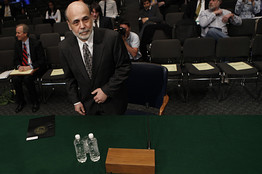
Ben Bernanke
But short-term rates are practically zero in the U.S. now, so the Fed wants to push down medium- and long-term interest rates instead. How? You guessed it: by creating new bank reserves to purchase medium- and long-term government securities.
OK, ze cat is out of ze bag. The Fed will make us all happy by printing oodles and oodles of money, then giving it to the govt to spend. Does this sound logical to you? Had the author studied Austrian Economics 101 he would know that printing money impoverishes the populace. That the govt giving itself money to spend also impoverishes everyone.
That sounds pretty similar to garden-variety monetary policy. Yet critics are branding QE2 a radical departure from past practices and a dangerous experiment.
Ah, we agree on something at last. QE2 is indeed the same ole money printing as always. Nothing new here at all. It’s been done many times, in Weimar Germany, in Argentina, in Zimbabwe, and many other places, always with the same result. The economy was destroyed.
The next charge is that QE2 will be inflationary. Partly true. The Fed actually wants a bit more inflation because, now and for the foreseeable future, inflation is running below its informal 1.5% to 2% target.
You will need to study Austrian economics 102 to know why a “target” of 1.5% to 2%, formal or informal, just means robbing the populace in an orderly fashion, stealing 1.5% to 2% of their money.
Not to mention that inflation is far far higher than a measly 2%. Go to Walmart. I’ve seen prices a good 10% higher than they used to be. Does anything know one thing that is cheaper than it used to be?
Austrian Economics 103 will teach you about how the govt figures for inflation have little to do with the real world. Aren’t you glad you came to this site? Do a search.
In fact, there’s some concern that inflation will dip below zero—into deflation.
Inflation is so high that it is absurd to say it may dip below zero anytime soon. Who is he kidding?
The Fed, thank goodness, is determined to stop that.
No it’s thank badness. Imagine if our purchasing power increased. Do you think that’s bad?
We don’t want to be the next Japan now, do we?
Japan got how it was by QE’s, one after the other. Search the site. I think Bob Murphy talks about it. But we certainly dont want to be the next Zimbabwe, do we? Which is where the Fed is taking us.
But might the Fed err and produce too much inflation? Yes, it might, leaving us with, say, 3% inflation instead of 2%. Or it might err in the opposite direction and produce only 1%. Neither outcome is desirable,
So we agree, sort of. Any inflation, 1,2,3 or more, is all bad, as explained above.
but each is quite tolerable.
To what purpose? It will not “create jobs”, nor “stimulate the economy” in a productive way [but for the blubber and buggy market, temporarily, as above].
To create the fearsome inflation rates envisioned by the more extreme critics, the Fed would have to be incredibly incompetent, which it is not.
So we are debating if the Fed is incompetent? If we do a youtube search for “Ben Bernanke was wrong” and watch the results, we will have our answer. I’ll let you have the joy of discovery and won’t give away the answer.
There is of course
The final major charge, levied especially by a number of foreign officials, is that the Fed’s new policy amounts to currency manipulation: deliberately lowering the international value of the dollar to gain competitive advantage for U.S. exporters. Is there any truth to this? Not if words have any meaning.
Oh boy, I am going to learn what words mean. Tell me, Swami.
Economics 101 teaches us that one standard side effect of a central bank reducing interest rates is a lower exchange rate.
So the Econ 101 you keep preaching to us says the foreign officals are right. So far so good.
Actually, things don’t always work out that way in the real world; sometimes the stronger growth pushes the currency up instead.
What stronger growth? The temporary rise of the whaling industry?
This contradictory evidence notwithstanding,
This I would like to see. Zimbabwe money printing pushed its currency up, did it? Oh, you mean it happened in some other country. When? Where? For how long? A day? A week?
it is commonly assumed that expansionary monetary policy depreciates the currency. That’s why some foreign governments, especially the more mercantilist ones, are apoplectic. What’s down for us is up for them.
Mercantilist? Germany is mercantilist, hey? At any rate this is just silly name calling on his part. If they are right they are right, right?
But calling QE2 “currency manipulation” is a grotesque abuse of language. After all, the U.S. dollar is a floating currency. Many factors, including but certainly not limited to monetary policy, influence the exchange rate, which changes every minute. But the Fed will not intervene to push the dollar down. If the dollar should rise instead of falling, c’est la vie.
Let me get this straight. Since monetary policy is only one of many factors that influence the exchange rate, then it is a grotesque abuse of language to say manipulating monetary policy is manipulating the exchange rate.
Ok. SO it is a grotesque abuse of language to say that stealing the signals from a baseball team is “cheating”. After all, many thing influence the outcome of a baseball game. Or that taking steroids is “cheating” in any sport. After all, many things influence the outcome of a game.
I guess the author is an economist, not an English professor. So he may be forgiven for his curious definition of “grotesque abuse of language”.
More important, the U.S. is a sovereign nation with a right to its own monetary policy. So I was stunned when a top aide to the Russian president suggested that the Fed should consult with other countries before making major policy decisions. Come again? An independent central bank doesn’t even consult with its own government.
1. Oh, I see. The US is a sovereign nation. And the Fed does not consult the elected officals of that sovereign nation, but does what it pleases. How sovereign are we, then, when a handful of unelected bankers make major policy decisions for us, whether we like it or not?
2. Let’s assume the Fed has the “right” to do what it wants. But the USA does not live on a desert island. There is a whole wide world out there which we trade with, or more precisely, which we owe trillions of dollars to. And whose products fill our shelves. We need them. It is the mark of the wise man to listen to his friends before taking steps that will harm them.
Finally, there’s that old hobgoblin: consistency. Critics tell us that QE2 won’t give the U.S. economy much of a boost but will lead to rampant inflation. Both? How does that work?
The two go hand in hand. Zimbabwe has rampant inflation, and its economy did not get much of a boost. Same with Weimar Germany. And Argentina. And Nixon’s USA.
How does it work? Very simple. The govt always prints money to give to itself and its friends. They thus impoverish most of the private sector, and take away resouces and squander them on themselves, and cause prices to skyrocket. All of it explained above.
If buying Treasurys is a weak policy tool, a view with which I have some sympathy, then it shouldn’t be very inflationary.
The inflation comes from the money printing. Giving the money to the govt [buying treasuries] is a weak policy tool. Well, ac=tually it is a powerfull tool of destruction, as explained above.
There is no magic link between growth of the central bank’s balance sheet and inflation.
No, it’s not magic. It is the law of supply and demand. The greater the supply of paper money, the less it is worth [=inflation].
People, businesses and banks have to take actions—like spending more, investing more, and lending more—to connect the two. If they don’t, we will get neither faster growth nor higher inflation, just more idle bank reserves.
Oh. I get it. If you print the money, but stuff it under your mattress, it’s OK. And that’s exactly what’s going to happen. The govt is going to get all the newly printed money from selling those T bills and will NEVER SPEND IT. And if it does spend it, don’t blame the Fed.
Similarly there is no magic link between a meth lab and drug use. People have to take actions–like injecting the drug, snorting the drug, and smoking the drug–to connect the two. If they don’t we will get neither meth addicts nor criminals, just more idle piles of meth lying there useless..
What the Fed proposes to do is neither foolproof nor perfect. Frankly, it’s not the policy I would choose.
Awww, go on, don’t be bashful. Spell it out. What the fed proposes is an unmitigated disaster.
As I’ve written on this page, I’d like the Fed to purchase private securities and to reduce the interest rate it pays on reserves, even turning it negative. The latter would blast reserves out of banks into some productive uses.
Print the money and give it to different friends.
But I don’t run the Fed. Maybe Chairman Bernanke’s ideas are better than mine and, in any case, the planned QE2 is far better than doing nothing.
Far better to do nothing, as explained above.
It is not a shot in the dark, not a radical departure from conventional monetary policy, and certainly not a form of currency manipulation.
True enough. It is standard operating procedure to reduce the purchasing power of the dollar. The same thing that has reduced it by 95% in the last 100 years.
I know Ben Bernanke. Ben Bernanke is a friend of mine. And critics ranging from Mr. Schauble to Ms. Palin are no Ben Bernankes.
Well why didn’t you say so in the first place. That would have clinched it right there.
Mr. Blinder, a professor of economics and public affairs at Princeton University and vice chairman of the Promontory Interfinancial Network, is a former vice chairman of the Federal Reserve.