If an insurance company decides to cover pre-existing conditions, why stop it? 
Because I ought not do so, I guess.
If an insurance company decides to cover pre-existing conditions, why stop it?
Because I ought not do so, I guess.
Okay, but more fundamentally we are talking about conditions which exist that are outside of human control, and how to attempt to mitigate the eventual effects of said conditions. I stand by my analogy. You seem to be trying to say that since the subjects with pre-existing conditions are humans and not trees, that a group of humans should steal from other humans to provide something that MIGHT mitigate the eventual effects of the pre-existing conditions (provide welfare through the apparatus of the State). This is evidenced by the following:
Here, you assert that the responsibility for taking care of someone with a pre-existing condition falls squarely on the shoulders of those without the pre-existing condition, and further assert that the means to maybe mitigate the eventual effects should be taken by violence or threat of violence, as you posit that government will provide these means.
How does the free market provide ANY good or service to any individual(s)? There must first be an entity that produced the good or service, i.e. there must be supply (there are doctors and hospitals that produce the service in question already); next the consumer must show demand (this is money, something that will be exchanged for the service or good); if supply and demand aren’t exactly equal, the price mechanism works its magic, moving to attempt to equalize supply and demand; and VIOLA! The free market provides a service or good that gets consumed which is valued by the consumer and which the producer is willing to provide at some compensation he deems appropriate.
Again, private charity did much to provide for the needy before the effects of legalized plunder had become so deeply rooted. People weren’t dying out in the streets in America before Medicaid or before the massive insurance bureaucracies of today. To say otherwise is dishonest or ignorant. Doctors do want to help people out. At least they did more so when their actions were completely devoid of coercion from the State.
What is your definition of a “properly-run welfare state?” Is it one in which government intervention into the market is thorough enough to distort prices and profits, or supply and demand until the population is worse off than before the government interference? Is it one in which the means to achieving large-scale welfare is forcing ever-increasing sums of debt onto the population until the currency has lost enough value so that even more subjects require State-assistance to live? Or is it some hypothetical that has yet to be demonstrated? If the latter, why exactly do you propose a system that has only shown a failure of ability to provide wealth and health to a population for a sustained period of time rather than move toward a system that does not fight the laws of economics and has been shown to allow for a healthier and wealthier population?
Then it s not insurance, its medical care.
A system that punishes and therefore arbitrarily suppresses output does not help the poor. A system that arbitrarily fixes the prices of medical goods and services (which is the inevitable result of such an entitlement program) neither increases the supply of doctors, nor the sophistication of its equipment nor the quality of care in general. A system that pays people to remain unemployed does not create employment and a system where banks can foreclose on delinquent homes will only reduce home ownership.
Well the system I describe is the one that my country (the UK) operated without significant problem for at least 30 years after WW2. That period saw the lowest ever unemployment, a rising level of output, slightly higher growth rates than in the subsequent 30 years, increased number of doctors, widened access to medical care, and a rising life-expectancy.
Nothing is a pre-existing condition if you go back enough in time. Just insure your newborn baby for life (at what will be the cheapest rate he could ever conceivably get) and you’re set.
Otherwise, pay from you own pocket, sell your house or car.
Otherwise, charity.
A child is a distinct human being, an individual. Why should I have to be deprived medical care if I was born with a condition that my parents did not insure? Why should I suffer the consequences of what my parents chose or were unable to do, when there are other options out there for how society is organised?
Not everyone can afford a house or a car. Chronic medical conditions are the major cause of poverty, and poverty prevents a person from aqcuiring such property in the first place.
I don’t believe that charity will be enough to ensure people get the help they need.
And so the answer is violence??
Youre looking for some sort of guarantee, some certainty that government, nor any man, cannot provide. It is just not possible. What is possible is sustaining your proposed system for some amount of time, but not indefinitely, a system where others live at the expense of others with the threat of violence against life, liberty, and property used to coerce.
If that is what you consider humanitarian or moral, fine, we are all entitled to believe what we want. But don’t masquerade it as something it is not; your proposed solution is violence.
You seem to be trying to say that since the subjects with pre-existing conditions are humans and not trees, that a group of humans should steal from other humans to provide something that MIGHT mitigate the eventual effects of the pre-existing conditions (provide welfare through the apparatus of the State).
Here, you assert that the responsibility for taking care of someone with a pre-existing condition falls squarely on the shoulders of those without the pre-existing condition, and further assert that the means to maybe mitigate the eventual effects should be taken by violence or threat of violence, as you posit that government will provide these means.
Yes, I am saying exactly that. And I don’t know why you emphasize the word ‘might’ so much; it’s not as if the welfare state is some fancy new theoretical construct that has never been tested. Welfare states have been implemented successfully in a number of countries over the past century.
How does the free market provide ANY good or service to any individual(s)? There must first be an entity that produced the good or service, i.e. there must be supply (there are doctors and hospitals that produce the service in question already); next the consumer must show demand (this is money, something that will be exchanged for the service or good); if supply and demand aren’t exactly equal, the price mechanism works its magic, moving to attempt to equalize supply and demand; and VIOLA! The free market provides a service or good that gets consumed which is valued by the consumer and which the producer is willing to provide at some compensation he deems appropriate.
But see this is the thing; medical providers/insurers would not provide care to people with pre-existing conditions unless it was for very high prices. High prices would often not be affordable to those with illnesses that cause poverty. Hense, privatised systems would leave many people with no access to healthcare whatsoever. Supply might very well coordinate with effective demand, i.e. desire to purchase that is also backed up by ability to pay; but it does not follow that supply will coordinate with medical demand, i.e. the needs of an individual in regards to their health.
Again, private charity did much to provide for the needy before the effects of legalized plunder had become so deeply rooted. People weren’t dying out in the streets in America before Medicaid or before the massive insurance bureaucracies of today. To say otherwise is dishonest or ignorant. Doctors do want to help people out. At least they did more so when their actions were completely devoid of coercion from the State.
There a few things here I agree with, and some that I don’t. It is plausable, and I would say likely, that charity would increase if taxes were reduced, but I would not trust that it would be enough. This leads onto the second point you make; maybe in America people were not dropping dead in the street back then, but I doubt that is the case considering people even today in the US die from curable diseases because they are not covered by insurance. My opinions, however, are formed from the experiences of my own country in the period before universal healthcare was introduced here. Victorian England was an awful time and place for the working class to live, and plenty of people died in the street. Whilst there were the Mutual and Friendly Societies etc, it was not enough to ameleorate the problems of that day, and this led to the introduction of the welfare/healthcare system.
What is your definition of a “properly-run welfare state?” Is it one in which government intervention into the market is thorough enough to distort prices and profits, or supply and demand until the population is worse off than before the government interference? Is it one in which the means to achieving large-scale welfare is forcing ever-increasing sums of debt onto the population until the currency has lost enough value so that even more subjects require State-assistance to live? Or is it some hypothetical that has yet to be demonstrated?
It is one in which all those who are in need of healthcare, education, housing, and food, get exactly those things at all times. As I say, it is not a hypothetical system ‘yet to be demonstrated’. It is a system that worked in my country very well for 30 years, and has even survived the subsequent 30 years of Neoliberal attempts to tear down those institutions.
Seraiah:
You make some very good points, and I agree with you about decentralised systems being fairer, less bureaucratic, and more efficient. However, all of these can be implemented within a system funded by tax. I like your idea of hospitals acquiring their funding according to how many people choose to walk through their doors, however, I do not believe it should be voluntary for a person to pay their tax or not. If it was completely voluntary, then the funds would not be enough to provide sufficient care to those that need it.
And so the answer is violence?
Youre looking for some sort of guarantee, some certainty that government, nor any man, cannot provide. It is just not possible. What is possible is sustaining your proposed system for some amount of time, but not indefinitely, a system where others live at the expense of others with the threat of violence against life, liberty, and property used to coerce.
If that is what you consider humanitarian or moral, fine, we are all entitled to believe what we want. But don’t masquerade it as something it is not; your proposed solution is violence.
I don’t know of anyone that has been shot or beaten up because they did not pay their National Insurance stamps. It is coersion for sure, but ‘violence’ is stretching it quite a bit.
As for me looking for certainty that cannot be provided, I will once again point you to the example of history. Welfare states have been implemented successfully for years in lots of different countries.
As regards to morals; yes, we clearly have a different set of them, but I am not masquerading as anything. I’ve stated exactly what I believe and have not hid a thing.
Alright, we are on the same page, in that you believe violence is the answer.
I say might as in, many medical treatments might save a patient’s life. Lots of cancer treatments are marginally beneficial at best. Not all, but many. Yes, some treatments are hugely successful. Just pointing out what I mean by might.
And the laws of economics demonstrates why those prices are high: subsidization, regulation, compulsory licensing, etc. In other words, government interference in the free market. If you have a treatise that can stand the critique of economists from the Austrian school that demonstrates how distortions in the market will tend to lower prices, raise quality, and bring about wider distribution of goods and services, let’s hear it.
“Many” is a subjective term. Seeing as we haven’t seen fully privatized markets for more than a century now, if ever, your speculation is just that: speculation, with again, no basis in the laws of economics.
You mean medical desire, or medical want. This is not equal to demand, as it is used to describe a market phenomenon.
Victorian England was not a place nor time with free markets. Quite far from it, actually. So I blame those ills on, again, government intervention and it’s threat and use of violence.
How is education a need? Will one die without it? What about healthcare? You think without a routine checkup, someone is automatically more likely to die? And housing… Will one die without a house deemed proper? Why not just provide a place big enough to hold a sleeping bag? That’s all the shelter that is required to survive the elements. And food? How much food? And who decides how much? Surely a human will not die with merely 1500 calories of food a day. Even the same food everyday. But none of these options are “dignified?” People like to say the poor should have even more choices of food, larger houses with more luxuries, use of doctors and medicines for more and more trivial matters, and education for decades, free, in even subjects and fields that aren’t highly valued by the market. This is the problem with the welfare state; enough can never be enough. This is the problem with using violence to move wealth to someone who didn’t earn it; why not just use more violence for more theft to get more wealth to more people that didn’t earn it? This is the problem with parasitism; it cares not for the well-being of the host, but cares only to achieve its goals regardless.
Parasitism differs vastly from mutualism. Voluntarism differs greatly from coercion. Liberty differs greatly from statism. The effects between these systems are different as well. You suggest that parasitism is the way to go. But the question is why do you get to force others to do what you want? Why should they not be free to live in peace, free from your chains? You look to make government out to be a god, and it is not.
It is not a stretch at all. If you don’t pay your taxes, what happens? I’m guessing government agents will come looking for you. And they likely will be carrying… a gun. And if you refuse to come with them, they will do what? Try to physically take you. This is violence. But let’s keep going. They put their hands on you and you defend yourself. They will then do what? Use stronger force against you. More violence. If you continue to be able to resist, and have hurt them in the process of defending yourself, they will (or at least can) do what? Shoot you. Coercion and the threat of coercion is violence and the threat of violence.
What is your definition of success? Volatile markets? Inflation of prices? Stagnating levels of poverty? Continual reductions of personal liberty? I guess we use different metrics to measure success…
Right; your set of morals allows the threat of and use of violence against unaggressive individuals who are no more responsible for a random calamity than anyone else, and mine does not.
Why not just legalize theft and extortion for those individuals that need welfare? As in, if someone is poor enough by government’s standards, make it legal for him to walk into a grocery store and take what he needs himself, and if the owner or the employees attempt to stop him, give the poor man the right to use force, deadly if necessary, to abscond with the food? If a woman has a disease that can be treated but cannot afford to pay for it, why not let her enter the hospital and demand, at gunpoint of necessary, that the doctor see and treat her? Just give all the needy identification, and a gun if they deem it necessary, and with the flash of the badge they can let producers of goods and services that their plunder is government sanctioned. After all, this would at least cut out a lot of paperwork and middlemen, thus saving the society time and money.
That’s awesome, if people were trying to fight for a welfare system like that then I’d be much less antagonistic about it.
Putting aside the moral issues I have with taxation, from a purely utilitarian perspective non-voluntary taxation is not the best method of funding.
There’s a linchpin to this whole story, and that is this: We are assuming that when people are forced to pay for welfare, they will put that money where the caretakers are providing the best care.
The incentive for the caretakers (Insurance companies, hospitals, assisted living, etc) is to return value to the taxpayers, and not to the patients.
So for example, a hospital might give a free video game to taxpayers that choose to fund them, spending perhaps a million dollars on this advertising campaign pulled directly from their budget for caring for welfare patients. This scenario and similar ones would be a constant problem.
How much advertising is excessive? When does cozying up to taxpayers cross the line? How do we enforce it? How much money should be taken from the welfare tax to fund enforcement of regulations? Who should decide and how much decision making power should they have?
This would be such a nightmare to try to fix that it would actually be more efficient to just let the hospitals waste money appealing to taxpayers than to try and fix it. (You’re probably not going to believe me here, but anywhere that regulation is tried, budgets get out of control, lobbyists get involved and the whole thing just gets messy. It’s just not worth it.)
So in this system of decentralized independent caretakers funded by a set portion of citizens income and directed by those citizens, we would eventually end up in the following scenario:
Markets would adjust with exacting precision to have budgets to cater to this proportion based on the desires of taxpayers.
Providing care : Providing extraneous fluff.
So let’s say 70% of the budget would be used to help welfare patients, and 30% is spent on the useless fluff to get the caretakers’ total budget. (The actual ratio is irrelevant)
So we aren’t gaining anything from the taxpayers that are paying more into the system than they want to, so by making the welfare tax voluntary we can cut out the nonsense and be left with 70% of the budget that was actually being used to help welfare patients.
So just doing this we would be spending less on IRS agents, accounting, and oversight, and allowing caretakers to focus on helping welfare patients rather than diverting resources into unrelated fields.
So now the elephant in the room is this: Would 70% of the budget still remain, or better, when it is coming completely voluntarily?
We can only really speculate at this point, but looking at the charity given in the United States, even in the presence of all of the welfare programs and tax burden, is pretty impressive. A completely voluntary system doesn’t require a third party (the government) to enforce so even if the budget is smaller it’s possible that it could be effectively larger.
http://www.charitychoices.com/chargive.asp
2.6% of incomes couldn’t possibly cover all of the serious issues people have in the United States, I’m certainly banking on the idea that if people were taxed less and the government wasn’t expected to take care of people we could see much larger voluntary donations and that private entrepreneurs are much better at motivating people than government bureaucrats.
Edit:
Also! It’s not the welfare patients that should decide what gets funded, but the taxpayers/donators, very simply because people have unlimited wants so if a patient decides what is getting paid for they will always choose the most expensive operation without regard to cost even if it has even slightly better results. If one operation costs 10 times more than another but yields 2% better results, a welfare patient would choose the higher cost nearly every time.
This is not only a cost consideration. We live in a world of limited resources so if we have welfare patients taking up all of the most expensive operations and medications then other people that might need that medication or operation more may not be able to get it or might end up at the back of a gigantic waiting list.
Without significant problem? This period is primarily characterized by the decade-long phenomena frequently referred to as “staglfation,” where there was simultaneous double-digit inflation and unemployment and which ultimately lead to the end of traditional neo-Keynesian analysis (at least, theoretically speaking). In fact, the stagflation crises was much worse in the U.K than it was here in the U.S (unemployment exceeded 20%), which is why labor lost and Thatcher won.
If you look at the data (from 1960-1980) you see that the U.K grew at an average of 2.32% (annual) with an inflation rate of 9.14% (annual). 9.14% inflation for 2.32% growth does not sound like the type of utopia you’re describing.
Seraiah. You seem to be proposing your own version of a healthcare system and then criticising it without me even having to enter the conversation. That’s all very well, but I’m quite happy with keeping the NHS as it is and gradually improving elements of it if needed. I don’t really know what else to say other than that, tbh.
Going by Google World Bank data here, UK GDP per capita, constant terms. Here’s an annualization calculator.
2.05% annualized growth from 1960 to 1980. (1980 was the start of a recession peaking at 12% unemployment.)
2.02% annualized growth from 1980 to present. (Start/middle? of a recession with 8% unemployment.)
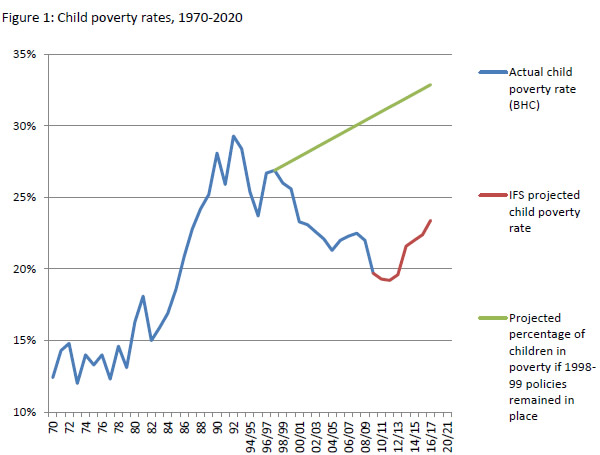
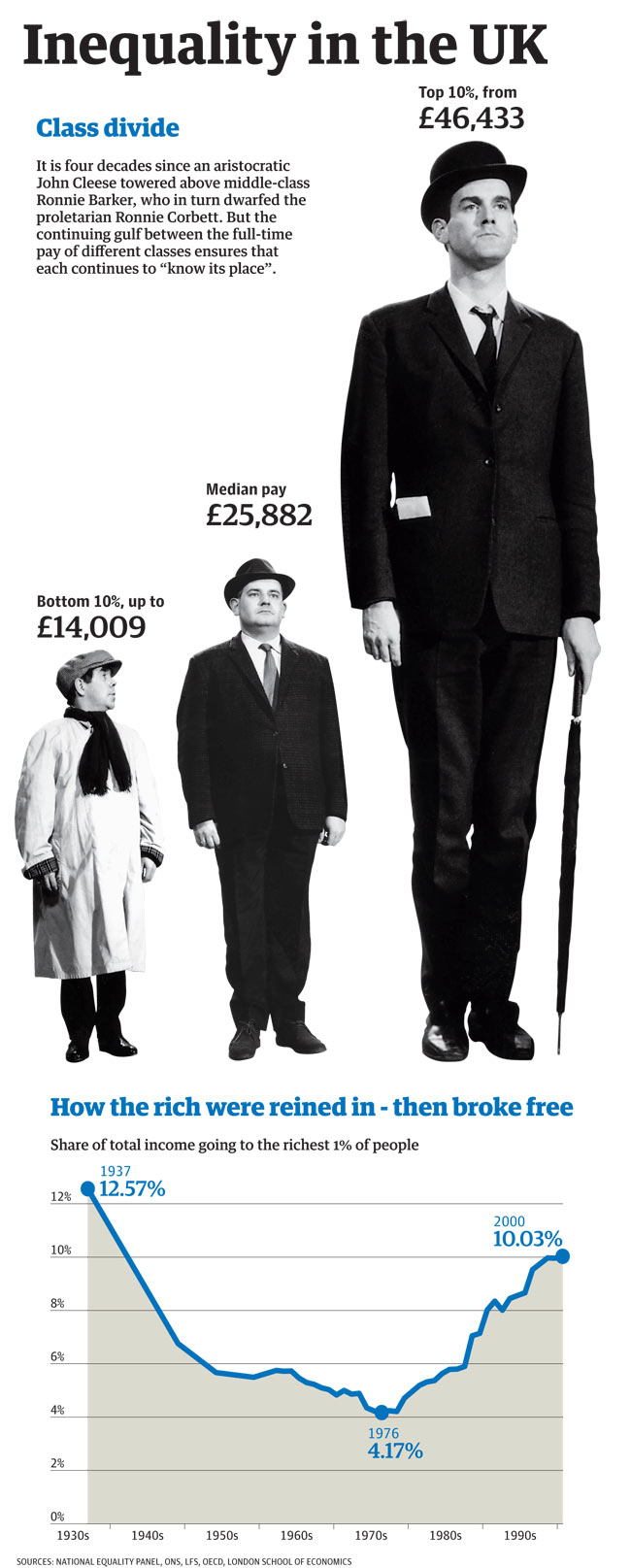
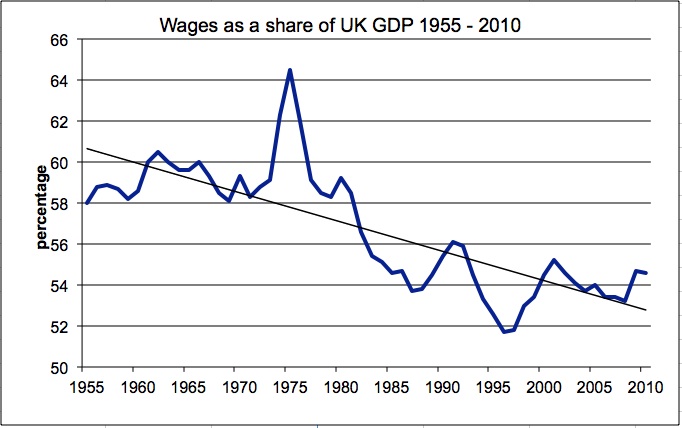
And this is just looking at GDP. Not poverty, wages, and inequality, which sucked after Thatcher.
UK child poverty rates:
Source: http://www.leftfootforward.org/2012/06/iain-duncan-smith-child-poverty-target-deficit/
Source: http://www.guardian.co.uk/news/datablog/2011/dec/05/oecd-ineqaulity-report-uk-us
Source: http://www.taxresearch.org.uk/Blog/2011/12/05/theres-plenty-of-money-its-just-been-put-out-of-reach/
Without significant problem? This period is primarily characterized by the decade-long phenomena frequently referred to as “staglfation,” where there was simultaneous double-digit inflation and unemployment and which ultimately lead to the end of traditional neo-Keynesian analysis (at least, theoretically speaking). In fact, the stagflation crises was much worse in the U.K than it was here in the U.S (unemployment exceeded 20%), which is why labor lost and Thatcher won.
If you look at the data (from 1960-1980) you see that the U.K grew at an average of 2.32% (annual) with an inflation rate of 9.14% (annual). 9.14% inflation for 2.32% does not sound like the type of utopia you’re describing.
Well lets have a look at the numbers in a bit more detail.
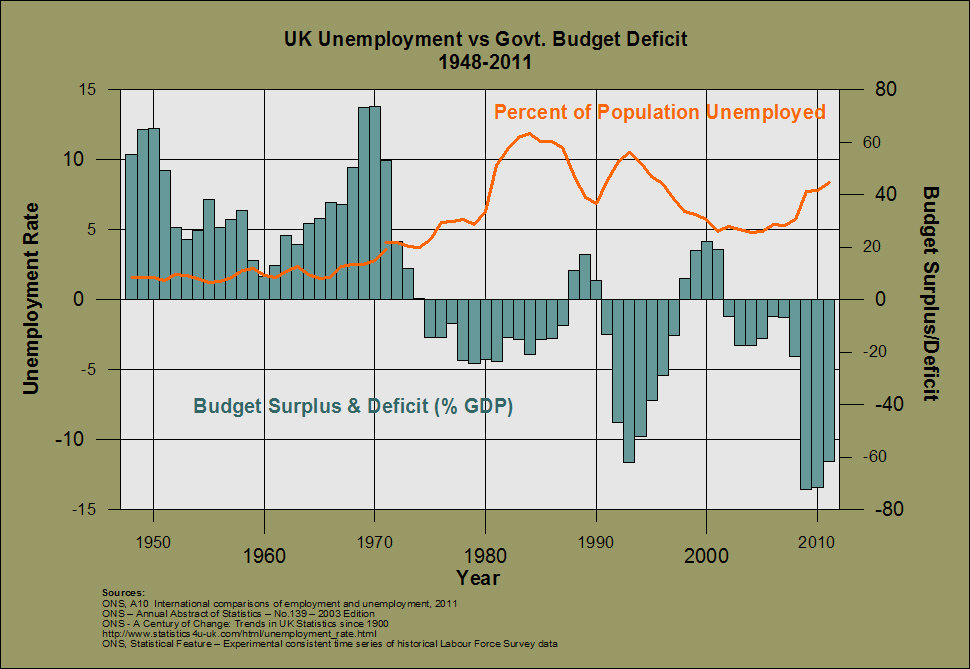
So in regards to unemployment, even throughout the 70’s it stayed at enviously low levels compared to what we expect these days; inflation was a significant problem particularly from 1974 onward, but this is down to the oil crisis and not the welfare state. If you disagree on this, please explain how the welfare state suddenly caused prices to skyrocket in 1974. Growth was actually slightly higher in the post war era than it was in the past 30 years.
I would also add that wages kept up with inflation throughout this time, and so the problem was not felt as harshly as it might first appear by looking at the inflation numbers only. I have a chart showing this in a book, but could not find an online picture of it. I will scan it if you like though.
Once again, I would be interested in hearing an explanation of why you believe the economic problems that existed in that era (problems that were different from, but by no means greater than, the ones we have faced since) were the result of the welfare state. I’m not being confrontational, btw. I’m honestly interested in hearing your thoughts.
Oh, and notice how we have been running deficits pretty much non-stop since we abandoned the policy goal of full employment. So the post-war consensus was also more sustainable for the budget.
Tough luck than. I value freedom form coercion above health care for some who couldn’t afford it.
Of course, in the long run a state-run or even state-subsidized heath scheme will stymie care development and everyone will be worse off, since a score of new, inexpensive treatments that would have been created in a free market will be lacking. Just think whether Mr. Fleming would have given the world penicillin if he’d been employed in a tedious government job.
Also, somewhat higher inflation can increase real wage growth by facilitating wage bargaining. So inflation is not always bad for real wages.