Works of art can be original to varying degrees and the same is true for industrial inventions. Saying that an invention is just a re-arrangement of old things is not particularly helpful, in my opinion.Of course, I don’t think that IP is justified since enforcing IP usually means violating physical property rights…
However, the line “ideas are not [physically] scarce” doesn’t seem like a good argument to me. It just so happens that there are a lot of problems to be solved and that the ‘ideas’ to solve those problems are not known. Technical solutions and knowledge are scarce in a sense.
Copyright is an exclusive right, a monopoly. It has roots in mercantilism. It’s not a contract.
Ideas are physical. They exist somewhere in one’s head. They’re scarce, taking the cost of the medium used to share them plus the labor of the person learning. An idea can exist independently in two different minds although they may be called one idea. I think they would be better described as two identical ideas. The original creator only has a right to the thought in his mind, not others’. One can’t sell an idea, only the means to learn it.
Copyright is ultimately a claim to profit from the labor of others. It’s practically slavery, and its enforced the same way.
So wait, the Austrian school doesn’t back intellectual property but it backs physical property? Why can the law be used to protect one and not another?
The problem here is that you’re recognizing the construct of IP. IP essentially gives a copyright holder the ability to tell others what they can’t do with their property. That is a violation of property rights.
Sorry for the derail, but your avatar brings back memories: I was in the Archie club when I was a kid, and I had my club card in my wallet up until the day I joined the Navy. I wish I hadn’t thrown it out.
Claiming that no one else can use an idea because I was the first to think it and write it down is like claiming that I was the first one to see something, so it is automatically mine. It just doesn’t logically follow. Someone can own a copy of an idea in their mind, but they can’t own a copy of an idea in someone else’s mind, because that idea belongs to someone else.
Also, I don’t think people put copyrights on things they just see, I’m pretty sure there are criteria for what can and cannot be trademarked or copyrighted or whatever. For instance, letters can’t be copyrighted. But the formula for Coca Cola can.
Also, copyright infringement is usually only charged when someone else tries to sell something that someone else has already copyrighted. Or if it’s very similar. Not if they think about the same thing but if they produce it and try to sell it.
The criteria is arbitrary. It doesn’t go anything past “I feel this should be IP, and I feel this shouldn’t be IP, and I’ll do whatever I can to rationalize why it can or can’t be”
Different people will have different rationales, leading to different beliefs what can and can’t be IP. Should everyone be subject to the enforcement of IP laws they don’t agree with? Especially when they can’t agree to the terms of what IP is or how long copyright should last, or how long a patent grants a monopoly?
So it is potentially illegal to reduce the scarcity of something? For 4 years? 5 years? 10 years? That doesn’t sound good for society.
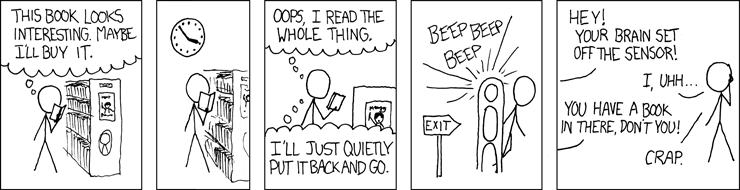
Yes. I don’t understand what your definition of property is. All I know is what you think it isn’t. That XKCD strip doesn’t tell me anything, since that isn’t any infringement in the first place. Nothing was being done with the read information. It should be assumed that people will and do read in bookstores. By selling a book in a bookstore a seller takes that risk, but that doesn’t give you the right to grab your laptop and transcribe it. Just like you have no right to claim the book is yours because you touched it. I have nothing else to say or post unless someone defines property for me. Obviously my definition is different.
Of course enforcing IP would be a violation of rights if you don’t think there is a such thing as IP. The same way enforcing property rights is a violation of rights if you don’t believe there is a such thing as property. IP is neither inferior nor superior to physical property.
Not just because I say so but because a lot of people say so. You may not think that’s a legitimate reason but that’s pretty much how democratic politics works. I dunno, I like 7 years.
Yeah, the criteria are arbitrary, but widely agreed upon. Yeah, if they’re gonna play the game, they gotta play by the rules of the game that everyone else comes up with, that’s the way it works.
This isn’t about society, this is about protecting inventors and companies from infringement. Just like I want to protect people from having their car stolen or their house broken into, I want to protect people from having their ideas stolen and used by someone else.
Democracy is mob rule. In case you haven’t noticed, the people here don’t really believe in democracy. Most people in the past thought the Earth was flat. Did that make it so? Most people thought slavery was ok. Did that make it so?
What infringement? There is only infringement if there is intellectual property. IP isn’t consistent or logically sound. It’s just as made up as garzzlebax.
Ideas can’t be stolen. They can only be copied. It can only be stolen if in the process of learning, another person forgets it.
I understand that people on this site aren’t for democracy but unfortunately, America still plays the democracy game. So for better or worse, that’s the context in which these rules have to be considered.
If you copyright garzzlebax then you have the right to that name or whatever. I can guarantee you you’d be glad of copyright laws if you sold a product called garzzlebax and then someone came out with a different product called garzzlebax. Because then the time and effort you’d put into your product wouldn’t have been for nothing. Ideas can definitely be stolen. If, for instance, I have a blueprint for a machine. Someone steals the blueprint and makes the machine. Well, I have first claim to the profits because I have first claim to the design. This is good for me bad for the thief. You take away the laws and suddenly everyone has a reason to just steal from someone else whenever they come up with something good. I don’t like that possibility.
I’m sure there’s a ton of rebuttal but I support all forms of private property, including IP and I think the state or non-governmental enforcer should have a role in protecting people’s property, whether it be physical or intellectual.
They have a claim to the physical property, but not the metaphysical. How do you contend of property, where there is no such thing as scarcity?
Copyright is bunk. What fraud? Why?
Just an additional utilitarian argument added in. So… it would be a complete waste of resources to try catch these non criminals?
And why is that?
Physical Invasion
The normative principle I am suggesting for the law is simply this: No action should be considered illicit or illegal unless it invades, or aggresses against, the person or just property of another. Only invasive actions should be declared illegal, and combated with the full power of the law. The invasion must be concrete and physical. There are degrees of seriousness of such invasion, and hence, different proper degrees of restitution or punishment. “Burglary,” simple invasion of property for purposes of theft, is less serious than “robbery,” where armed force is likely to be used against the victim. Here, however, we are not concerned with the questions of degrees of invasion or punishment, but simply with invasion per se.
If no man may invade another person’s “just” property, what is our criterion of justice to be?[11] There is no space here to elaborate on a theory of justice in property titles. Suffice it to say that the basic axiom of libertarian political theory holds that every man is a selfowner, having absolute jurisdiction over his own body. In effect, this means that no one else may justly invade, or aggress against, another’s person. It follows then that each person justly owns whatever previously unowned resources he appropriates or “mixes his labor with.” From these twin axioms — self-ownership and “homesteading” — stem the justification for the entire system of property rights titles in a free-market society. This system establishes the right of every man to his own person, the right of donation, of bequest (and, concomitantly, the right to receive the bequest or inheritance), and the right of contractual exchange of property titles.[12]
Legal and political theory have committed much mischief by failing to pinpoint physical invasion as the only human action that should be illegal and that justifies the use of physical violence to combat it. The vague concept of “harm” is substituted for the precise one of physical violence.[13] Consider the following two examples. Jim is courting Susan and is just about to win her hand in marriage, when suddenly Bob appears on the scene and wins her away. Surely Bob has done great “harm” to Jim. Once a nonphysical-invasion sense of harm is adopted, almost any outlaw act might be justified. Should Jim be able to “enjoin” Bob’s very existence?[14]
Similarly, A is a successful seller of razor blades. But then B comes along and sells a better blade, teflon-coated to prevent shaving cuts. The value of A’s property is greatly affected. Should he be able to collect damages from B, or, better yet, to enjoin B’s sale of a better blade? The correct answer is not that consumers would be hurt if they were forced to buy the inferior blade, although that is surely the case. Rather, no one has the right to legally prevent or retaliate against “harms” to his property unless it is an act of physical invasion. Everyone has the right to have the physical integrity of his property inviolate; no one has the right to protect the value of his property, for that value is purely the reflection of what people are willing to pay for it. That willingness solely depends on how they decide to use their money. No one can have a right to someone else’s money, unless that other person had previously contracted to transfer it to him.