Yes, more Mathew Simmons hysterics. I already covered this:
Crop Circles in the Desert: The Strange Controversy Over Saudi Oil Production (PDF) (Michael C. Lynch, President of Strategic Energy and Economic Research)
Yes, more Mathew Simmons hysterics. I already covered this:
Crop Circles in the Desert: The Strange Controversy Over Saudi Oil Production (PDF) (Michael C. Lynch, President of Strategic Energy and Economic Research)
Martenson says: “The exact peak of discovery? That was in 1964, 44 years ago, and that is another cold, hard, indisputable fact.”
I think he’s just stating facts just like I might say that the price of a stock reached a historical peak in 1967. Doesn’t mean it couldn’t go higher in the future.
Martenson seems to be putting out some interesting facts about how important oil is to us, and it’s discovery, and production. He leaves it up to the viewer to do whatever they want with that information. Of course, the stated facts ought to be verified, but I don’t think that is Poptech’s objection, is it?
I just realized that Martenson says that demand will outstrip available supply within 30 years and he doesn’t give any proof of that.
As Poptech said, you’d have to know the exact amount of fossil fuels the earth contains to for that claim to be valid.
As far as DPatty’s “facts” -
1) Oil discoveries peaked in 1964…we have been finding increasingly less and less oil each decade.
Fine, but since it’s not known how much oil is in the earth, we could see a new peak in the future.
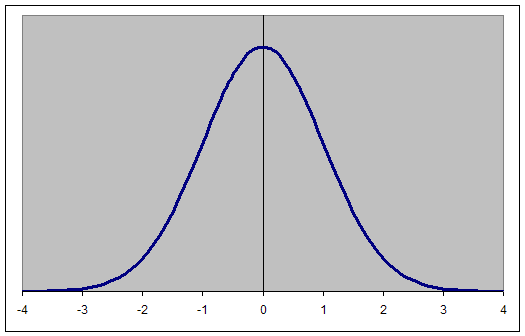
2) With individual oilfields the production profile (barrels produced in a year vs time) resembles a bell curve with production increasing each successive year until the half-way point whereby production decreases each year (this is a matter of physics and not economics)
Seams believable. I bet noone argues against that.
3) Because individual fields peak, and our oil discoveries have peaked, the overall production profile will also follow the bell curve shape
DPatty says, “…will follow …” but first you’d have to know the exact amount of fossil fuels on the planet and exactly how they are formed. Until then, we can’t know when or if we’ll run out.
4) Therefore we will peak in oil production at some point…most estimates range from already having peaked to as far as 30 years away.
I am in agreement with Poptech that this is an assumption. Actually, I think it might be a non-sequitur too because yeah, for a given oil field or collection of oil fields that have been drilled for all they’re worth, you get the bell shaped curve, but how does that mean “therefore” we will peak in oil production at some point?
Off Topic: Very cute avatar, Doug. 
Back on topic: The answer has been provided by all the smart people on this board.
However, I’d like to add another point regarding the “Peak Oil” Bogosity that I haven’t seen anyone touch on: Inflation. If I’m not mistaken, oil/gas prices In terms of gold and silver have stayed flat, and have actually fallen a bit late last year because of the drop in demand. If we were running out of oil (gas/oil becoming more scarce), we would see the price rising in terms of gold and other such commodities. This is because the scarcity would make them more valuable, and therefore raise their real prices, as opposed to their fiat/nominal prices.
Another thought I just remembered that compliments Poptech’s points is the extraction efficiency.
I’ve heard that (can’t remember my source) that if we got the rate to about 40% up from 35%, it would be the same as adding 6 Saudi Arabias to the Market in terms of oil.
I am no fan of the New York Times but they have an excellent article on this…
Oil Innovations Pump New Life Into Old Wells (The New York Times)
“Within the last decade, technology advances have made it possible to unlock more oil from old fields, and, at the same time, higher oil prices have made it economical for companies to go after reserves that are harder to reach. With plenty of oil still left in familiar locations, forecasts that the world’s reserves are drying out have given way to predictions that more oil can be found than ever before.”
These responses are painful to read. I feel like there is some kind of misguided Austrian critique trying to prove liberals wrong, but it’s losing the true answer in the process.
Peak Oil should be treated like a rational discussion on global warming. Rather than say it’s not real, scientist are liars, etc, etc. So what if we hit peak oil? Was there a problem when we hit peak horse and buggy? As the price of oil rises, extraction increases, and the use of alternatives increase. To quote the amount of total reserves in the world as some kind of roundabout justification to disprove peak oil is grasping at straws. The use of oil has been flat for 4 years, and the amount that can be pulled out of each field per day has been rapidly declining. Ever smaller, deeper, and more expensive fields are being discovered and tapped just to keep pace with losses. It’s entirely likely that our use of oil will be lower in 10 years. Who cares?
As a more interesting scientific exercise it’s important to point out that Oil is actually captured solar energy, and is also a renewable rescource. As a species we are only accessing the most easily used form of solar energy. Wind/Tidal power is most likely the next easiest source to use, and eventually Solar. By the time we’ve been able to capture the entire sun’s output striking earth we will be far beyond this planet, and using energy sources far more compact and powerful than Oil (fusion as an example).
As to the original question. If it’s impossible to overuse the rescource and prices are in place to limit it’s consumption based upon the realistic price of extraction then there is no “tragedy of the commons.”
It is important that you actually read the comments and not just claim to read them. No rational discussion about Peak Oil or Global Warming has gone on in the public sector and you are accussing us of not doing it? Unfortunately some scientists are liars. Just because you “believe” in something does not make it empirically proven. Talk about irony.
To make the claim of peak oil you need to establish to things:
1. What the exact amount of fossil fuels the earth contains.
2. How fossil fuels are made.
Neither can be answered. You also failed to account for the fact that we can make oil cost effectively out of garbage.
Thermal Depolymerization (Video) (7min)
Anything Into Oil at $80 a Barrel (Discover Magazine)
Next you make the horse and buggy analogy which I already made. Quoting known reserves is to show empirical evidence of what we know we have which is much, much more than Peak Oil alarmists will admit. It is total Peak Oil alarmists myth that the reserves are rapibly declining. Again I posted this multiple times but you failed to read it.
Crop Circles in the Desert: The Strange Controversy Over Saudi Oil Production (PDF) (Michael C. Lynch, President of Strategic Energy and Economic Research)
Apparently you did not even read my post right before this one! Here is another quote from the NYT article:
"The Kern River oil field, discovered in 1899, was revived when Chevron engineers here started injecting high-pressured steam to pump out more oil. The field, whose production had slumped to 10,000 barrels a day in the 1960s, now has a daily output of 85,000 barrels.
In Indonesia, Chevron has applied the same technology to the giant Duri oil field, discovered in 1941, boosting production there to more than 200,000 barrels a day, up from 65,000 barrels in the mid-1980s.
And in Texas, Exxon Mobil expects to double the amount of oil it extracts from its Means field, which dates back to the 1930s."
I do not know what else to do if people continue to fail to read.
All alternative energy usage will be market driven. We do not use Wind and Solar because they are astronomically more expensive than our current sources of energy. Wind is only used at all due to government subsidies. Nuclear is a much more practical source of power generation than either wind or solar. But all three have a problem as a transportation fuel, which is why we will continue to use oil especially for a very long time.
You have set up unanswerable conditions, and because they can not be answered precisely you give that as evidence of Peak Oil being false.
I am wholly unconvinced by your videos. Many people make many fantastic claims about what materials and how much energy they can produce at what price.
Of course the increasing price of Oil will encourage new technologies to extract Oil. This is not inherently a convincing critique of Peak Oil. The point is that the price of oil will keep world economies and force improvements in efficiency so that the use of oil will never break previous levels. There is nothing else to it. No conspiracy, just observation that the yearly findings of new Oil fields peaked in the 60’s and as with most resources the extraction peaks approximately 30-40 years later.
Even if we manage to make Oil out of trash it is still a confirmation of Peak Oil. Peak Oil will push the price of Oil high enough that making Oil out of trash is economically viable.
An article yesterday points out that oil fields a few years ago required one barrel of energy to extract 100 barrels of oil. Today it is closer to a 10:1 ratio. This will asymptotically approach 1, and most likely break it as using solar energy to remove oil for plastic and chemical production takes over it’s previous usage as a primary source of energy.
In just the same way, Global Warming is happening. How rapidly it is happening and how responsible humans are is absolutely up for debate. It appears to me there is virtually no stopping it, and any misguided attempt at doing so would cause far more harm than good.
It is a logical impossibility to claim something is peaking or when if you cannot answer those two fundamental questions.
Just because you have not found something does not mean it does not exist. There are enormous sources of energy locked up in oil sands and shale, enough for a very long time.
Oil out of trash is economically viable at $80 a barrel and we have already reached that point it was just not sustained long enough for the capital investment in the technology to seem viable at this time.
The amount of energy needed to extract oil in oil equivalent energy is irrelevant. This is an old logical fallacy, what matters is the cost of the energy used vs. the cost of the energy extracted.
Thermodynamics and Money (Peter Huber, Ph.D. Mechanical Engineering, MIT)
You can use Natural Gas, Coal or Nuclear to extract oil and still be profitable. The reason? The superiority of oil as a transportation fuel.
Yes, you can read my post. Thanks for restating the obvious.
Sorry without knowing how much of something exists or how it is created, you cannot predict any sort of “Peak”. The obvious is that it is a logical impossibility.
There will be a peak of natural oil eventually. The main threat is the state suppression of getting out of the ground whatever amount is left.
Sadly he is right. He has exposed the theory as a fairy tail. Don’t be upset by it. He doesn’t need to fabricate up a fairy tail to counter the argument of a fairy tail. The Peak oil theory seems to be nothing more then someone freaking out over a statistic. Besides, it should be far more obvious that any drop in oil discovery in the past century is not due to “Peak Oil” as a direct linear correlation in government regulation and involvement.
I’m late in coming to this, but often discussing it else where. I don’t think most people realize the import of the above statement. From estimates I’ve seen subsidies have taken the price of gas from 10-15 USD to its current price. Even allowing for the fact that no one really knows what the price ‘would be’ if no one was screwing with the industry, subsidies for roads and oil/gas more than anything else are laying the ground work of incentives to over invest in a petroleum based economy. That is oil based/dependent capital structure, everything from energy generation to synthetic fabrics and other materials to overly centralized production based on cheaper than otherwise land transportation costs. It is that over investment and subsequent loss of any fixed, unretrievable capital that’s going to cause us harm, not the natural switch over from oil to alternatives which will happen as even the government loses power over the prices. Most people don’t get that, the government is already Doing Something!, and as usual it’s screwing us.
In fact if the above figure for what the real price of gas should be are correct, biodiesel, ethanol, and hell maybe even hydrogen all get kicked much closer to being economically viable/profitable, if not already there. I wouldn’t be surprised if absent the government we would already be seeing wide adoption of ethanol and biodiesel in sectors where the switchfrom gas is easiest. Say like lawn mowers and such equipment, etc. Anything diesel based could be retrofit to accept biodiesel so long as adequate supply is there at the right price. Maybe even centralized power generation. I can only imagine what thermal depolymerization and the fuel/energy it can generate could be accomplishing if it didn’t have to compete with subsidized oil and politically favored corn farmers/ethanol.
Which goes to thermal depolymerization and abiotic theories. How much can be produced is not the same as how much exists, nor how much is economically usable/recoverable, nor how much is now and will be demanded in the future, etc., etc. Peak oil is based on assumptions galore. It assumed to know how much oil there is, how much oil is recoverable, how oil is produced, how much demand exists now and in the future, the viability of other forms of energy now and in the future, etc., etc., etc., etc. It’s kind of like the Drake equation; perhaps technically true and accurate, but the factors you plug in are a matter of serious debate.
The price of a resource that is running out would not just constantly rise. The adoption of alternatives would counteract that and eventually the last drops would be virtually free.
How are those articles legit at all? They seem pretty biased, and have little sources cited, and are from one organization. Not to mention, they hardly all qualify as a research article which has not been peer reviewed.
Peer-Reviewed:
Oil: Never Cry Wolf—Why the Petroleum Age Is Far from over (Science, Vol. 304, No. 5674)
Research:
Despite Popular Belief, The World is Not Running Out of Oil, Scientist Says (University of Washington)
No Evidence of Precipitous Fall on Horizon for World Oil Production (Cambridge Energy Research Associates)
Easier to find oil (Royal Institute of Technology, Sweden)
Hydrocarbons in Deep Earth? (Carnegie Institution)
New Evidence Supports 19th-Century Idea On Formation Of Oil And Gas (American Chemical Society)
Crop Circles in the Desert: The Strange Controversy Over Saudi Oil Production (PDF) (Michael C. Lynch, President of Strategic Energy and Economic Research)
Haaah actually I’m a petroleum engineer. I was discussing peak oil today in the context of primary recovery in reservoir engineering.
In a reservoir, production increases quickly to some peak level and then begins exponential decline (its exp^(-time factor), so exponential doesn’t mean “really fast”. Wells can also undergo hyperbolic decline). But basically you produce a lot all at the beginning and then rate bleeds off. Some gas reservoirs level off at 200mcf/day and just stay that way for decades.
Anyway, so obviously peak oil graphs are not representative of just one big reservoir, but the point is that production is skewed towards later in the well’s life. So when we see peak oil, its because a majority of the world’s fields are peaking themselves, and will not decline at the same rate they grew. Also, the decline period of wells is exponential, so the decline of the sum of wells has to be exponential.
For those of you who are more sight oriented, here is a normal dist curve:
Here is a typical exponential decline curve. I’d say these reserves are on about 8% decline, which is a little faster than average.