What about all of the people who heard of Austrian economics from him and ended up here?
If he were to have never been there, would things be better or worse?
The Tea Partiers might not be chanting “End the Fed”.
I would not say that Paul has had a great effect on the course of US National or International Policy over the last 30 years.
That being said, if he has opened the eyes of a few people to true liberalism, then I think he has had a positive influence.
One can begin by reading Paul and then go to the original sources.
For instance, he does have an excellent reading list in the back of “The Revolution: A Manifesto”
What if you were to have a very young kid who one day were to try to walk into oncoming traffic, you were to pull him back, but then he were to try again? Would you feel justified imposing your will on him?
No. I might want him not to do it, but if you want to inject gasoline into your wang and pee fire, that’s your business. Just not in my house.
That being said, if he has opened the eyes of a few people to true liberalism, then I think he has had a positive influence.
Despite the vast waste of resources put towards it and the corruption of liberalism it has spread to vastly larger numbers of people? I would not say it balances out at all.
What about all of the people who heard of Austrian economics from him and ended up here?
Just imagine if all those millions were spent promoting Austrian economics instead of some petty would-be benevolent despot?
Well, I don’t know what to say.
Too bad that isn’t a realistic alternative.
If he weren’t there, somebody else would be.
Too bad that isn’t a realistic alternative.
Neither is using political tyrants to spread liberal theory and practice.
If he weren’t there, somebody else would be
Someone else I would jeer and oppose supporting. If it wasn’t Office John arresting you it might be Officer Paul. Well, screw both of them.
Let’s go back to the beginning:
Why not?
I think of him as a double agent.
Sorry, but I would prefer Officer Paul, because he wouldn’t arrest me in the first place.
Why not?
Because I’m a liberal. There are various jurisprudential, sociological, economic, existential and eudaemonic reasons why I think this. Naturally someone can differ. Then they’re not a liberal. To Hell with them.
I think of him as a double agent.
I think of him as a false flag.
Sorry, but I would prefer Officer Paul, because he wouldn’t arrest me in the first place.
Unless you were from the wrong side of the border, or his State outlawed your religion, or you tried to get an aborition, or burn a flag in a county where it was prohibited.
I prefer kindly to cruel slave masters. But I will only advocate that all slave masters either quit their jobs or end up on a gibbet.
I’m not a voluntaryist, so I do not hold volition to be the ultimate value. While analysis of aggression/coercion in human affairs is a wonderfully useful tool in understanding how the political class abuses the productive class, it is only a first-order approximation. It’s silly to say that all acts that constitute aggression between peer adults would constitute aggression when performed by a parent towards his or her child. Would a forcible enema be aggression against a peer adult who does not consent to receive it? Of course. How about a forcible enema on a 6 month old baby that hasn’t had a bowel movement in a couple weeks, as approved by the child’s parents and doctor?
They also do not choose their place or time of birth or any of a million other dispositional factors. Shall we make relocation a fundamental human right?
Well, the word “need” is a weasel-word. It implies that there is a bright-line demarcation between “need”, on the one hand, and “imposition” on the other hand. Do children need to be taught table manners or not? I would say that most children do need to be taught table manners and their parents have a perfectly legitimate interest in “coercing” their children to learn whether they like it or not. Whether some particular action constitutes abuse or the ordinary un-pleasantry of childhood is too complex an issue to be sorted out with “simple logic.” Simple logic is bad logic where it is too simple to solve the complex problem.
The evolution of human culture has already invent a method for sorting out these issues… it’s called extended family and religion. Western monopolistic courts have interjected themselves into family affairs that have long been the domain of extended family and religious organizations, to the great detriment of Western culture. Look at Western culture today. This is the product of hyper-legalized parenting. It’s not working so great, is it?
Parental abuse is a serious problem but it’s also seriously exaggerated by certain special interests. Government courts, however, are not the solution and neither are the simplistic platitudes of ‘rationalists’ like Molyneux. I’ll put it this way: If Molyneux is so right about parenting, let him start his own for-profit (perhaps through donations, whatever) parental guidance service and see how it competes in the market of such services. The children of the parents who partake in his services should be much better adjusted and, therefore, much more productive and higher earners. Word will get around that Molyneux’s system really works. His ideas will spread and we will see a Renaissance in human parenting.
The reality is that humans have been trying to solve these problems for millenia. How do you raise your children in such a way that they are prepared for the real world when they get out there, yet show sufficient respect for their own ignorant choices so that they can have a long-lasting, mutually respectful relationship with their parents and have a chance to learn their own lessons for themselves? Parents want to impart the lessons they’ve learned in the School of Hard Knocks to their children so that their children do not have to repeat those particular lessons for themselves. Yet, it seems that some lessons are best remembered when directly administered by reality, in the School of Hard Knocks.
My children are still very young. My rule is that I absolutely prohibit anything which can lead to permanent, serious harm - that’s a hard and fast rule and strictly enforced. They are not permitted to decide for themselves whether to walk on the sidewalk or the street. I make that decision for them and enforce it. But “learning how to learn” is so important, so I try to ensure that I’m leaving latitude for them to make their own mistakes. Is it a good idea to run through woodchips in the playground barefoot? I’ll warn them but, if they think they know better, I’ll let them figure that out and judge for themselves (and pull any resulting splinters).
I hardly think that Molyneux holds a patent on the message of self-responsibility.
Clayton -
Then I guess that I’m not even close to being a “liberal”.
Can you explain them?
What if being a double agent slave master would be the best way to pull that off?
What if you could substitute yourself for one of the slave masters, and slowly educate the slaves, and the other slavemasters, as to their alternatives?
Can you explain them?
The presumption of innocence as an epistemic norm for arbitration (otherwise one is demanded to prove a universal negative); finders-keepers and first-come-first-serve as the only coherent basis for initial dispute over spheres of influence (otherwise no one would ever be the legit. owner to begin with); the economic and social progress issues Mises has so amply demonstrated; the self-selection and epistemic blindness of political orders; a rejection of reification and social wholism as philosophical nonsense; a belief in eudaemonic stability of all non-antisocial interests; a rejection of domination games as personally and socially unproductive byproducts of a Jungle past; the Narveson-style argument for Contractarian liberalism as the optimal solution for Hobbesian scenarios; the belief that ideology mongering, idol worship and pandering to the masses as something beneath the intellectual person; the view that customary and voluntarist norms are selected to best reflect the interest of individuals involved; and a rejection of the hubris of pretending to know what is better for people than they themselves do. Off the top of my head.
What if being a double agent slave master would be the best way to pull that off?
This has been tried for hundreds and hundreds of years to no avail. Look at those liberal elites and their Revolution. What comes next? A centralized authoritarian state which, within years, violently suppresses opposition to an illegal tax and imposes coercion on anyone critical of its ‘liberal’ despots.
It is not only ineffectual and often counter-productive (by massaging away and disguising the naked tyranny of all state power) it corrupts the ‘liberals’ who engage in it and subverts their reason and independence.
My children are still very young. My rule is that I absolutely prohibit anything which can lead to permanent, serious harm - that’s a hard and fast rule and strictly enforced. They are not permitted to decide for themselves whether to walk on the sidewalk or the street. I make that decision for them and enforce it. But “learning how to learn” is so important, so I try to ensure that I’m leaving latitude for them to make their own mistakes. Is it a good idea to run through woodchips in the playground barefoot? I’ll warn them but, if they think they know better, I’ll let them figure that out and judge for themselves (and pull any resulting splinters).
I have young children as well - and I agree with this paragraph whole heartedly - a 2 and 4 year old are not aware enough of their surroundings to be able to make rational decisions taking into account the consequences of their actions - such as running across the street to the park.
However a 12 year old is more than capable of makig those decisions.
I think that reposibility for ones actions is a concept that needs to be learned as well - it takes time for children to learn that their actions do have impacts on those around them, and they need to think about the long term repurcussions as well - they don’t always do that.
Of course the idea of a “Permanent Record” in grade or high school never made me think twice about my actions.
Look at Western culture today. This is the product of hyper-legalized parenting. It’s not working so great, is it?
I would rather live in Canada than Saudi Arabia. How does the Wahabbi faith work in terms of creating a society?
I would say that most children do need to be taught table manners and their parents have a perfectly legitimate interest in “coercing” their children to learn whether they like it or not.
I think most children do need to be taught table manners - or else they will eat in a completely undignified manner. The truth of the matter is that you are judged on your table manners on a regular basis.
Jeff Tucker has some good posts on this subject.
And this.
http://blog.mises.org/8223/good-kids-bad-kids/
Also we need to define coercion - not giving my kid dessert because he was eating with his hands, or spitting at his sister at the dinner table does not constitute coercion.
Punching a child does.
I have young children as well - and I agree with this paragraph whole heartedly - a 2 and 4 year old are not aware enough of their surroundings to be able to make rational decisions taking into account the consequences of their actions - such as running across the street to the park.
This is like animals. Once they are able to coherently assert themselves, they can do as they like.
However a 12 year old is more than capable of makig those decisions.
Such as, historically, raising a family, marrying, working on a farm. If modern Americans are incapable of raising such responsible and mature children maybe the very problem is their nanny micromanagement of thinking, choosing human beings; just as the welfare state reduces 30 year old adults to helpless dependents.
What is “an epistemic norm for arbitration”?
What is “a universal negative”?
What is a “legitimate owner”?
And would we need to carry the idea of “first-come-first-serve” past the “initial dispute for spheres of influence”?
Which of them supports your idea that it isn’t “justified” to impose your will on somebody to prevent them from making stupid decisions?
What does “self-selection” mean in this context?
What does “the epistemic blindness” of political orders mean?
How does methodological individualism support your idea?
What does “eudaemonic stability of all non-antisocial interests” mean?
What is a “domination game”? Can you give me an example?
And how are they “personally and socially unproductive byproducts of a Jungle past”?
Huh?
What does it mean to be “beneach the intellectual person”?
And how does that support your idea? How it is even relevent to this?
What about the individuals who prefer oppressing people, having power, and so on to having more stuff and whatever else? Would “customary and voluntarist norms[…] best reflect the interest” of those individuals? Or are they not “involved”?
Weird, that seems to be exactly what you are trying to do.
We don’t have your “customary and voluntarist norms” in place, yet you think that they would “best reflect the interest of the individuals involved”. If that isn’t “pretending to know what is better for people than they themselves do”, I don’t know what is.
Check out my post here.
(Also check out the post that I link to at the end of that post.)
I think that it will ultimately be a market process which will tear down the state, but I think that people like Ron Paul have a useful place in diverting the state resources that he has influence over away from worse uses to educating the would-be entrepreneurs who will lead the revolution that I’m referring to.
I have no idea what you are trying to refer to here.
How do people like Ron Pail “massag[e] away and disguis[e] the naked tyranny of all state power”?
How exactly does it “corrupt” them, and “subvert[…] their reason and independence”? What does that even mean?
12 years olds raising their own family. The truly free society!
Who decides when somebody could “coherently assert themselves”? Who gets that power?
What is “an epistemic norm for arbitration”?
The basic conceptual framework of jurisprudence. One can accept ‘to each, his own’ or ‘for each according to…’. If the former, you need a method of rationally identifying and proving one’s own, which must exclude the logically impossible. If the latter it is completely arbitrary, it is strictly speaking not arbitration but reallocation of properties.
What is a “legitimate owner”?
Someone who whose claims are in line with the law. As Hoppe has pointed out, if the first person doesn’t legit. own it then who ‘owns’ it is not something one can argue by jurisprudence or history, but is rather arbitrary reallocation.
Which of them supports your idea that it isn’t “justified” to impose your will on somebody to prevent them from making stupid decisions?
As Mises points out, again and again, value is subjective. Saying ‘I know better than you!’ is hubristic nonsense.
What does “self-selection” mean in this context?
People who don’t believe in managerial, allocative approaches to social order generally will not become politicians.
the epistemic blindness of political orders
Political orders have no test by which to examine their ideologies.
How does methodological individualism support your idea?
Ontological or existential individualism. Making claims about ‘the group’s’ interest, or the ‘nation’s’ will are ridiculous gibberish.
What does “eudaemonic stability of all non-antisocial interests” mean?
Interest which are not contrary to social order itself, i.e., the market economy.
What is a “domination game”? Can you give me an example?
Status climbing bureaucracies to demonstrate your superiority. I do think this also happens in voluntary circumstances. I think it’s also pathetic here, though not actionable.
Huh?
I suggest you read Narveson and de Jasay.
What does it mean to be “beneach the intellectual person”?
And how does that support your idea? How it is even relevent to this?
Because illiberal and collectivist doctrines all revolve around managing people and orders that are not worth the attention of a person.
What about the individuals who prefer oppressing people, having power, and so on to having more stuff and whatever else?
Shoot them. I’m not interested in anti-social types.
Would “customary and voluntarist norms[…] best reflect the interest” of those individuals? Or are they not “involved”?
A person outside of voluntarist norms is by de facto outside of the system. Don’t accept social order, nothing compels you to, but then you are an outlaw in the traditional, literal sense. You have no logical basis for opposing someone’s stabbing you and taking your things.
Weird, that seems to be exactly what you are trying to do.
Not at all. I favor social order and believe this is the only framework within which liberties and torts make any logical, consistent sense. I am fine with shooting robbers not because of some abstract, detached rule that robbery is bad but because these people have no claim to protection.
Lon L. Fuller is also worth reading on customary law.
Such as, historically, raising a family, marrying, working on a farm. If modern Americans are incapable of raising such responsible and mature children maybe the very problem is their nanny micromanagement of thinking, choosing human beings; just as the welfare state reduces 30 year old adults to helpless dependents.
Exactly the Nanny state/Welfare state is almost certainly to blame for this - people are raised as “wards” of the state. It is no wonder that the average birth rate in the welfare states of the wolrd is decreasing, the residents have never become fully fledged adults.
As I pointed out, today, it is widely accepted that you require 25 years in school to get the minimum amount of “Education” needed to enter the labour market.
Organised, state run education was created in order to train people to become productive members/Citizens of society much of our compulsory universal state run education system was adopted from the prussian model.
Certainly when you are raised within the state education system, you are very rarely taught to question it, there is very little in the way of understanding the tools of our liberties(what we have left) and absolutley no economics.
At this point you have numerous people graduating from high school with very little in the way of critical thinking skills…
People see themselves as CITIZENS first individuals second.
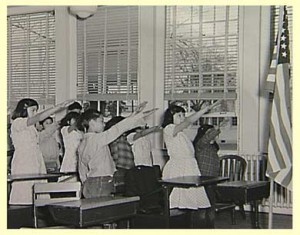
Think of the pledge of Allegiance - required in every public school.
The United States Pledge of Allegiance was written in 1892 by an American socialist named Francis Julius Bellamy, who was also a Baptist minister, and whose cousin Edward Bellamy is the semi-famous author of two socialist utopian novels: Looking Backward (1888) and Equality (1897).
Francis Bellamy was born in Rome, New York, May 18, 1855. He died August 28, 1931. His original Pledge of Allegiance was first published in a magazine called Youth’s Companion, a nationally circulated publication written for youngsters.
In 1888, Youth’s Companion began its campaign to sell American flags to public schools. For Francis Bellamy, this was more than a mere money-maker: it was an opportunity for him to spread his statist propaganda, and in the end Youth’s Companion became a supporter of the Schoolhouse Flag Project, which, under Bellamy’s watchful eye, aimed to place a flag above every public school in America.
Francis Bellamy’s original Pledge of Allegiance, the recitation of which he intended to take no more than 15 seconds, went like so:
I pledge allegiance to my Flag and to the Republic for which it stands, one nation indivisible, with liberty and justice for all.
Here, in Bellamy’s own words, is why he chose the specific language that he chose for his Pledge:
It began as an intensive communing with salient points of our national history, from the Declaration of Independence onwards; with the makings of the Constitution … with the meaning of the Civil War; with the aspiration of the people…
The true reason for allegiance to the Flag is the ‘republic for which it stands’. …And what does that vast thing, the Republic mean? It is the concise political word for the Nation – the One Nation which the Civil War was fought to prove. To make that One Nation idea clear, we must specify that it is indivisible, as Webster and Lincoln used to repeat in their great speeches. And its future?
Just here arose the temptation of the historic slogan of the French Revolution which meant so much to Jefferson and his friends, ‘Liberty, equality, fraternity’. No, that would be too fanciful, too many thousands of years off in realization. But we as a nation do stand square on the doctrine of liberty and justice for all…
Few people knw this but the original Bellamy Salute to the flag was identical to the National Socialist Salute of the Nazi Party.