Language and technological development

China has been using its pictographic orthography for thousands of years. If it wasn’t a problem before the 15th century, I don’t see why it would be after.

Aside from government standardization attempts, language evolves spontaneously to meet the needs of everyday people, scholars, etc. Westerners tend to think, “How can they possibly learn such abstruse-looking characters?” But if individual Chinese people were thinking the same thing, they would have started writing in shorthand, leading to an ever-simpler language. Every language is simple and complex along different dimensions, but in total I think they are all about as difficult as each other. Mind you, that doesn’t mean they will be of equal difficulty for the native English speaker!

As an example of varying simplicity along different axes, to master Chinese I hear you need to know about 5,000-6,000 characters. To master Japanese, you need about 3,000 (you need to know 1,500 inside and out, and be able to read another 1,000-2,000), plus less than 100 simple alphabet-like characters called kana. So the Chinese writing system is twice as hard as Japanese’s, right?

Not at all. The vast majority of Chinese characters only have one possible pronunciation (in a given dialect), they are all one syllable, and not many of them are exact homophones. A single Japanese kanji, on the other hand, can have up to 12 different common pronunciations (in the case of the extremely common kanji 生), and for any given syllabic sound there could be up to around 80 common characters that can be pronounced that way. For instance, there are at least 60 common characters that are all pronounced KOU (all exactly the same!) in certain normal usage situations.

In addition, a single Japanese character in some situations could have one syllable, and in other situations it could have up to five or six: 志 (ambition) is variously pronounced shi or kokorozashi depending on the situation. Because of that, Chinese kanji are relatively easy to learn. One syllable, one pronunciation, and not many homophones. In Japanese the homophones can reach ridiculous proportions: 貴社の記者が汽車で帰社しました(kisha no kisha ga kisha de kisha shimasita) means “Your reporter returned to your office by train” and is actually intelligible to a Japanese native in the right situation.

Chinese (especially the traditional orthography before the simplification a few years ago) is high on the “crazy jumbles of lines” factor, but low on the “acres of homophones” and “how in blazes do I pronounce this!?” factor. English has its own daunting and seemingly pointless complications for learners from entirely unrelated language groups, as I’m sure some here can attest. The 13 or so different vowel sounds versus only 5 in Japanese, or the boatload of tenses, persons, cases, differentiation of singular and plural, etc. that one has to keep meticulous track of in long sentences.

To restate my main point, languages are spontaneously evolved tools for communication. Provided there has a need to communicate ideas efficiently in the history of a culture, the language should reflect that. And even if I am somehow mistaken and there are any languages deficient in that arena, Chinese would be one of my very last guesses as to which it might be.

Since Japanese is my specialty and not Chinese, here’s the guy from the videos in the other thread (Khatzumoto):

English translation: “The art of war is of vital importance to the State. It is a matter of life and death, a road either to safety or to ruin. Hence it is a subject of inquiry which can on no account be neglected.”

Two points of note: 1) Look at how much more succinct the Chinese is, even taking total number of strokes into account. 2) Although I don’t speak or read Chinese, I can more or less get the gist of that because all those characters are also used in Japanese,* which by the way is in a completely distinct language family from Chinese. This gives a clue to how many different languages and dialects the singular Chinese writing system united: Mandarin, Cantonese, Hakka, Wu, Xiang, etc. Even Korean uses a few of those nifty pictograms.

*Here’s a translation in old-style Japanese, which is a little more succinct than modern J: 兵とは国の大事。死生の地、存亡の道、察せざるべからざる。
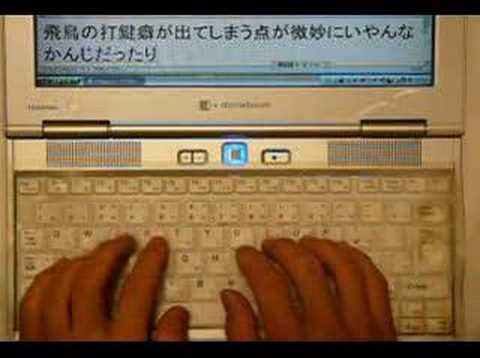
Same as Japanese input. You type in the sounds and hit the space bar, and it brings up candidates for the characters to choose from. I’m using it right now. For instance if I type きこう (the sound symbols pronounced kikou) and hit the space bar, a drop-down list appears

1 機構

2 気候

3 起工

4 聴こう

etc. (29 different character combinations that all are pronounced kikou!) and you select one of the 29, although they are arranged in order of common usage so usually you want one of the first few. For words that don’t have that many homophones, the conversion will be automatic, as in this video:

Agreed, that was my understanding.

Certainly, English (I am told) is difficult to learn because it has components from several different languages that create many exceptions to rules.

But that is the issue I am concerned with. Each symbol, over 8000, is associated with a different sound. While there are only 20 - 30 symbols in western language associated with a sound. From that small group of unique letters a person can communicate every idea and word. While in chinese, people would have to be familiar with literally thousands of symbols and thier related sounds.

The movement of ideas from paper to person, person to person, person to paper is all smoothly connected with an alphabet.

I feel like I am not explaining the idea well and I am just repeating myself without making any improvement to my presentation. My appologies if this is the case.

For any one who cares, especially for Southern, I want to note that every language does this, just some do it with logographs, others with morphemes.

For example, “sunglasses” is composed of the morphemes “sun” and “glasses”. So if you know what “sun” means and what “glasses” mean but have yet to see the combination “sunglasses”, you have a vague idea of what it means.

Thank you for taking the time to post AJ.

I agree completely. From the little that I have read about the evolution of both Japanese and Chinese there have been periods of official reforms of the language in order to simplify. As well the use of short hand. That would seem to indicate that there was a need to change the language to deal with the sheer volume of new ideas, technology, goods, and services that have come into being particularly in the past 200 years or so.

Again, I understand that english is very difficult language to learn due in part to all the exceptions to what is otherwise fairly systematic.

Is there a disconnect between the spoken language and written language or am I simply not understanding the relationship between the two?

On the other hand, Chinese and Japanese frequently complain that when they see a new English word they have no earthly idea what it could possibly mean, whereas when they see a new word in pictograms they already have a good idea.

  • Example 1: What’s a hawser?

Don’t know? OK, what’s a 大綱? Hint:

大 = big

綱 = rope

.

.

.

Any guesses? Yup, a hawser is a big rope!

  • Example 2: What’s are homophones?

What are 同音異義語?

同 = same

音 = sound

異 = different

義 = definition

語 = word(s)

Yup, “same-sound, different-definition words,” i.e., words with the same sound but different definitions (e.g., two, to, and too).

Of course these examples are cherry-picked to some extent, and most words aren’t quite as obvious as these, but generally the characters will give you at least an inkling about the meaning, like “It has something to do with with water, soap, and machinery…dishwasher? Oh no it’s actually an machine tool cleaner.”

Sure, the combination of the two ideas into one related idea. Whos meaning is derived from its components. I get that. Maybe Im coming off as dense or argumentative. I think maybe I am lacking in communication skills.

In your example how do you pronounce the symbol for “man” and “word” in chinese. You demonstrate that when written you just combine the two symbols. When spoken do you combine the two sounds in the same way that is done in english?

As I mentioned earlier, I think that, in Chinese, each character has one or at most a few fixed pronunciations. But I am not sure.

that took up a lot more space than ‘homophone’

homo- same

phone- sound

and what about other big ropes that are not Hawsers? would they have the same characters?

Yes, there’s a disconnect as Khatzumoto explains. The disconnect in Japanese is getting smaller, and is probably smaller than for Chinese, but it is still there. I’ve often made the mistake of using some words in my speech that are almost always used only in writing. Of course, in specialized fields what would normally be a writing-only might be incorporated into speech because everyone understands the context. In fact, there’s a lot more of “coining words on the fly” at least in Japanese, and I suspect in Chinese as well.

If you are interested, Asian languages are full of fascinating surprises because there is almost no single aspect that it not in some way different from English, even things you’d never think to wonder if they were the same or different in the first place.

This is true for Chinese characters (one pronunciation per character, with few exceptions) and many of the less-common Japanese kanji, but many Japanese kanji have a @#$%-ton of possible pronunciations.

Japanese 行 can be read as kou, gyou, an, yuku, iku and okonau. The first three are from Chinese (different dialects or different times in history, or different mis-transliterations by Buddhist missionaries), the last three are from original Japanese spoken language. 生 is possibly the worst because it can be read as sei, shou, ikiru, ikasu, ikeru, umareru, umu, ou, haeru, hayasu, ki or nama. All but perhaps two of these are in very common use by the way, and have different but related meanings related to “life” - living, being born, giving birth, growing, raw, fresh, draft beer, etc.

Interesting. Thanks. (And “draft beer”? Haha.)

That is not so different from english.

if they know what “exo” means and what “genous” means

exo = outside

genous = production/source

exogenous = from an outside source

These are similarities of the languages. Im trying to get at the differences.

Yet the English carries less meaning, only “same sound,” nothing about words or different definitions. But anyway there is also a shorter way to say homophone in Japanese: simply 同音 (“same-sound”). Compact and carries the same information as the English.

Well, yes and no. Hawser (big rope used on ships) is 大綱 but just “big rope” is 大きな綱. Those alphabet-like characters (called hiragana) added in the middle make “big” into a separate adjective, rather than a word element in a standalone single word.

Although you can point to many examples in English as well (although note that the one you gave requires knowledge of an entirely different language), there’s a vast difference between “here are some examples in English” and “all words in Chinese are written in meaning-symbols rather than sound symbols.”

You gave an example from Latin, which is useful if you know Latin. We could give examples of the myriad English words of French origin, useful if you know French. Or the many words of German origin useful if you know German, Dutch, etc. And how many words do you really know the origin of, and how often will that give you even an inkling of the meaning? Random sample:

frugal careful economical
fulmination bitter protest
fulsome disgusting offensive due to excessiveness
gainsay to deny to oppose
garble make unfair selection from facts
garner to gather and save to store up
garrulity talkativeness
garrulous too talkative
gaucherie socially awkward tactless behavior
germane relevant pertinent to
gist the point general sense
glean gather facts in small quantities
glib ready and smooth but not sincere
glimmer weak/unsteady light
gloat over look at with selfish delight
glut supply to much fill to excess
gnaw waste away bite steadily
goad something urging a person to action
gorge eat greedily/narrow opening with a stream
gossamer soft light delicate material

AJ

You initially stated that languages serve a purpose and evolve over time to better serve the needs of those who use the language. Would, in your opinion, the changes in the japanese language that are narrowing the gap between spoken and written language demonstrate that the gap was a problem?

Just to be clear my intent here is to not bash anyone, just to better understand the relationship between language, learning, and advancement. After all a written language would be a precursor to almost all other advancement. And it maybe possible that different systems of spoken and written languages could affect the effectiveness of communicating knowledge.

No doubt, but no one needs to speak latin or even need to be all that familiar with latin. That would be the equivalent of saying that you would have to know chineses because a significant portion of Japanese written language has its roots in Chineses written language. Again wouldnt this be a similarity?

You are right though. English is difficult because it has its roots in several different languages. Unlike Japanese which, from what I have read, has its roots in one language (chineses).

Again I most certainly agree with you that every language has its complex, illogical aspects. My main concern was the gulf between written and spoken. I felt it could be a slight hinderance in communicating ideas over time. But It seems that most feel it is insignificant. But I do appreciate the responses.

Not that the gap between written and spoken Japanese was a problem (it was a solution, or it wouldn’t have been adopted!) but that it is becoming a problem, or perhaps that the problem the gap solved is not a problem anymore. Realistically speaking, I believe the gap took advantage of the fact that written pictograms can be much more succinct than the equivalent spoken words all written out, because the pictograms convey more meaning than the sounds alone - hence relatively less need to elaborate in writing, relatively more need to elaborate in speech. In the case of Japanese, an additional factor is that Japanese is hyper-succinct, whereas English is (relatively) hyper-robust/redundant.

English: “It sure is cold out here, isn’t it?”

Japanese: “Samii naa!” (Emphatic distortion of “Cold!” + agreement-seeking noise)

English: “Do you want to get some food?”

Japanese: “Tabeyou?” (“Eat?” in the consultative form)

Cross my heart, these are very typical Japanese phrases, even in email. All the complexity and seemingly unnecessary frills you see in one part of the language are balanced out by simplicity in another part, and/or born out of the unique cultural situation and communication challenges faced by the speakers themselves. For instance, Japanese language frequently omits person, subject, and object (as shown above) where as English almost never does.

Why? Because Japan has historically been a very homogeneous society of extremely close-knit relations brimming with shared context. The inferential distance that their words had to cross was relatively lower than in the melting-pot situation that English was born out of.

Since you seem intent to get to the bottom of this conundrum, here is something else that informed the conclusions I’ve been eluding to throughout this thread. Instead of “rights” think of the parallels with language and how and why it forms the way it does.

Instead of “state of nature” think “inferential distance and unique cultural/historical situation”. Instead of “rights” think “language.” The facets of language are solved problems as well, unique to that particular cultural milieu and time in history. I don’t really have time to make the argument in full, as it is fairly subtle, but for the general argument made in the case of common law, these two articles are excellent: The Obviousness of Anarchy and The Depoliticization* of Law, which are in turn largely informed by Hayek’s book The Spontaneous Order. The parallels with language are nearly constant.

*Note that this isn’t a word, but the author is coining it anew to serve his purposes. If such “depoliticization” becomes a common subject of discourse, the word will take on more legitimacy and be added to dictionaries, used in major news articles, etc. This is an example of what I mean: a spontaneous evolutionary process of language formation, just like the spontaneous evolutionary process of markets or that of common law.

Similar in kind, but vastly different in magnitude. If English’s roots were like Japanese kanji’s Chinese roots, it would be like every person you meet knowing most or all the meanings and nuances of every single piece of Latin/German/French/Dutch-originated word component of nearly all of the words in this thread. They would know that Thursday is “Thor’s day” (from old Norse), that set is just the causative form of sit, and that bless is just another form of the word blood. More practically, they would know almost every last Latin root by heart and automatically, as well as almost every Germanic root, etc. They would be linguist-o-nauts of epic proportions, able to discern meanings of the words in the list I posted above far more easily than the average person (further aided, in the case of Japanese and Chinese, by not having to guess which language is the root language).

So the difference in magnitude is virtually flipped around, from a (not-educated-in-Latin) average English speaker being able to point to a fairly small number of words that he can guess the meaning of, to an average Japanese being able to point to a fairly small number of (kanji) words that he can’t guess the meaning of (and a vanishingly small number that he can’t guess at least to some degree).

Now I’ve overstated the case somewhat, because Japanese has more than just kanji words, and the meaning of the non-kanji words cannot usually be guessed, so I’d honestly rather defend Chinese on that front (but someone else can probably do that better). There is indeed a “problem” right now with Japan’s adoption of scads of loan words from English - so many that even scholars have a hard time keeping up. In fact, there is some argument that Japanese is morphing into English, because sentences like the following are not uncommon:

そのサラリーマンがパンチアウトしてマイカーでストアに行ってミックスナッツとビールをゲットした。

Sono salaryman ga punch-out shite my-car de store ni itte mix nuts to beer wo get shita.” (“The salary man punched out, drove his car to the store and got some beer and mixed nuts.”) Of course, the pronunciation of the English loan words is all Japanized.

Although some of this influx of English words is to satisfy the “consumer demand” of each speaker to sound cooler or more cosmopolitan, some of it is also to keep up with technology, especially Internet terms. Notably, China doesn’t do it that way, and they actually coin new original Chinese words for new tech stuff. I don’t think this is a problem, any more than letting Lehman Bros. fail was a problem, or letting interest rates return to their free market level would be a problem. The natural order will adjust to satisfy consumer demand - in this case the users of the language. If all the new words really become unwieldy they simply won’t be used. I think the reason they are tolerated is that they sound so different from any Japanese word that they are easy to distinguish, and Japan in general seems a lot more comfortable with having a flexible language. As another example, I’ve never found anything akin to The Elements of Style in Japanese, nor grammar standardization committees and such, except of course for editorial “house style” in certain newspapers and magazines. This is in vast contrast to English. Different culture, different milieu, etc.

AJ,

how about posting some Austro-libertarian words and phrases in Japanese with the breakdown of their symbols?