^
Hahaha Win!
^
Hahaha Win!
well first off, you would need to know how we get to the law of supply and demand using praxeology… Tom Woods explains praxeology and uses the S+D graph to illustrate.
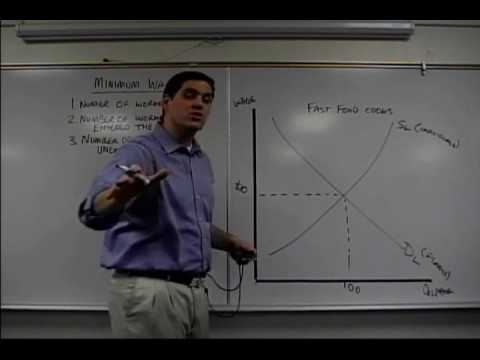
Then afterwards… we can get into the minimum wage… which is a price floor. Thus, when it is enforced, the demand of workers will fall due to an automatic higher wage. If you want a graphical example check this guy out. but this is basic econ 101
In case anyone missed this post, I really suggest clicking the link and reading it the pages I mentioned (very quick read). First Gordon explains deductive logic, explains the action axiom and the assumptions, then starts syllogizing. There is then a chapter on price controls and also a chapter on minimum wage policies.
1. Starting with self evident axioms and accepted rules of deduction, one arrives at a conclusion. It might be, for example, that minimum wage, all other things being equal, will get people fired.
2. Someone replies with, “It might be look true, but the real world shows the opposite, say in the UK.”
3. Obviously, chains of deduction cannot refute a historical reality. Thus step 2 seems to say that step 1 reached an incorrect conclusion.
4. However, if investigation shows that, on the contrary, the reality agrees with the conclusion of step 1, then step 1 rises out fo the ashes. Praxeology is vindicated. It is once again assumed right, not because reality confirms it, but on its own merits.
Your final sentance seems to contradict the rest of what you said. What you seem to be describing here is something similar to the hypothetico-deductive method. I was under the impression that Praxeologists claimed a degree of authority above methods that resort to empirical testing - in other words, the proof is in the axiom and it just needs to be teased out like in geometry or algebra.
What I have seen so far just looks like the standard scientific practice of producing models with built in assumptions, and yet Austrians keep making this claim that checking against reality is not needed. Well if it isn’t needed, Austrians should stop doing it, and if a historical counter-example is produced then explain what disturbance variables have caused reality to diverge from theory.
Then the decreased consumption of up-market good will get people fired who make those upmarket goods. Somethings gotta give somewhere**.**
Why would this necessarily lead to people getting sacked as opposed to wages being decreased of workers involved in the production of up-market goods (in other words a redistribution of wealth from one sector of the workforce to another)? I emphasise the word ‘necessarily’ because this links back to my doubts about Praxeology being purely deductive from axioms - more than an axiom is required to make the conclusions of Austrian economics true; a whole tonne of assumptions and caveats are required.
The point is that minimum wage means that the minimum wage workers are being paid nore than they are worth [=what they will get in the free market].
What someone is paid on the market does not always tally with the societally generated conceptions of what is fair or just. I know this gets into the murky area of ethics, and I am not willing to get into a philosophical debate in that subject. It suffices to say, however, that these conceptions exist and are debated heavily all the time - objective truths and ‘correct’ positions are hard to come by.
Which means the employer is losing money.
Not necessarily. See my first point in this post.
Did you look at that Samoa video?
Sorry, no I didn’t. Will do so now and try to respond in another post though.
I’ve always been a little bit averse to the term “action axiom” and the misleading connotations it might imply. I think it’s more correct to view Mises’ method as proceeding by consideration of the elements involved and the meaning implied by action, and deduction based on conditional enviornmental conditions therefrom.
I believe Menger himself provides one of the best examples of a rigorous application of praxeology, and one that might be more to your liking. For instance from his Principles in chapter 1 he lays out the 4 properties necessary for something to be considered a good:
"1. A human need.
Such properties as render the thing capable of being brought
into a causal connection with the satisfaction of this need.
Human knowledge of this causal connection.
Command of the thing sufficient to direct it to the satisfaction
of the need."
Then:
“Hence a thing loses its goods-character: (1) if, owing to a change in human needs, the particular needs disappear that the thing is capable of satisfying, (2) whenever the capacity of the thing to be placed in a causal connection with the satisfaction of human needs is lost as the result of a change in its own properties, (3) if knowledge of the causal connection between the thing and the satisfaction of human needs disappears, or (4) if men lose command of it so completely that they can no longer apply it directly to the satisfaction of their needs and have no means of reestablishing their power to do so.”
He then uses these propositions to derive theorems regarding the goods character of higher order goods and lower order goods, as well as their causal demand and supply interdependencies. Reading it gave me a taste of how much more I think we can still draw from Menger.
Once you admit that minimum wage is just a reshuffling, I think it becomes much harder to defend morally. Taking X’s money to give to Y, when X is sometimes totally unrelated to what’s going on, like the upmarket goods worker, is not the same as “defending” someone.
This gets into the area of ethics. Not to seem like I’m avoiding the question, but it is too big an area to enter without the thread being sidelined. There’s so many people and points to respond to already - I’m hoping the tipping point of thread-information overload doesn’t defeat me again.
The hypothesis chosen are ones that are clearly true, as reading up will show. Did you see any flaw in the assumptions in this thread?
I’ve always thought of a hypothesis to be the result of assumptions, with the assumptions being assumed to be true (after re-reading that last line it seems rather redundant - oh well, it’s in there now). and the empirical testing to be used as a feedback mechanism to test the assumptions. The assumptions I am doubting I have addressed in my last post.
A careful examination of the truth of the hypotheses assumed, and careful examonation of the validity of the chain of reasoning. I mean, isn’t your whole argument usable word for word to attack Geometry? or Newtonian Physics?
It isn’t the method of deduction per se that I am attacking, it is the claim that Austrian Economics is deductive ce that I am doubting. There are far too many arbitrary assumptions required to make the claim that Austrianism is a-prioris deductive. Geometry and the like do not suffer these road-blacks.
Empirical observation is of course vital. You have to get out into the real world, look around, and then, if you are a genius, come up with the underlying fruitful and clearly true assumptions to make. How do you think Euclid got his geometry going, or Newton his physics
Maybe we just have different understanding of what an a-priori science is. Is not the action axiom provable without resort to empirical observation? Does not deduction necessetate the truth of conclusions? If both of these are true, then AE should not require empirical validation or secondary assumptions. Yet both of these are being put forward by yourself as part of the process of AE.
If a counterexample happens, that leads us to re-examine our assumptions, and to either uncover the flaw in our reasoning, or else shed light on what did cause it to be a counterexample. After all, all the theorems of praxeology assume ceteris parebis.
I think this is where we re-converge on common ground. I agree it is all about keeping in mind ceteris parebis. One thing that bugs me is the criteria by which a theorists decides to keep certain variable ‘the same’. Or more importantly, which variables to include and why. For example, I point you back to my question regarding the sacking of employees. An alternative assumption could be made that prices are raised, or wages are reduced. It is arbitrary to assume one response by a firm than another. The claim ‘minimum-wage causes unemployment’ is only valid if the first of these responses is followed by firms.
In debates hardcore Austrians use evidence because that’s what people respect, not because they necessarily believe that it really adds validity to what they are saying
It sounds to me like hardcore Austrians are trying to have their cake and eat it.
well first off, you would need to know how we get to the law of supply and demand using praxeology… Tom Woods explains praxeology and uses the S+D graph to illustrate.
Thus far I agree with what has been said (or at least I am unable to see any flaws in this reasoning at this point).
Then afterwards… we can get into the minimum wage… which is a price floor. Thus, when it is enforced, the demand of workers will fall due to an automatic higher wage. If you want a graphical example check this guy out. but this is basic econ 101
At the risk of repeating my posts to smiling dave, this is where hidden assumptions start to creep in. The conclusions of the video are only true if firms decide to sack people as a result of lower profits. They could, as an alternative, cut costs elsewhere such as by reducing the wages of their higher-earners. If this behaviour was consistant across all firms then they would not see a migration of their higher-paid workers to their competitors because their competitors would also now be offering a lower wage.
In case anyone missed this post, I really suggest clicking the link and reading it the pages I mentioned (very quick read). First Gordon explains deductive logic, explains the action axiom and the assumptions, then starts syllogizing. There is then a chapter on price controls and also a chapter on minimum wage policies.
I will do so as soon as I get the time I promise.
I wasn’t clear enough, it seems.
OK. step 1 is the praxeological method. This would be like Hardy proving on paper that one cannot, with ruler and compass, square the circle.
Step 2 is what happens when Hardy reads a headline in the newspaper that someone claims to have done it. If he’s totally sure of his chain of reasoning and cares not what people think about math, he laughs it off.
But he might not laugh it off. He might get to the nitty gritty of reading the article in detail and seeing where it’s flawed. He might do that because the theorem is recently discovered and so not yet examined for many years by the math community for flaws in the reasoning, or and/or very surprising, or whatever. If he ran the theorem through one of today’s proof checker programs he won’t bother reading the newspaper article for the above reasons.
He might go through the newspaper article for flaws for another reason completely. He might do it because there is a heavily funded anti Math movement in the universities, and he wants to educate the public.
Because the ceteris parebis assumption is that the up market workers being paid higher wages have their rates set by the market. Meaning if their wages are lowered they will quit.
Yes, it is true that a debate can be had about whether the wage someone gets in the free market is fair or just. When I wrote that they are getting paid “more than they are worth” I meant from the point of view of the one actually paying them. He will only be making money if he pays them not more than they are worth to him. Meaning that he is considering things from a profit and loss point of view, ceteris parebis. He is not taking moral or ethical factors into consideration when he concludes he will be paying them more than they are worth. And the price the free market comes up with is not more [because he won’t agree] nor less [because they won’t agree] than they are worth to him, ceteris parebis.
But this is an unrealistic assumption, definately not the ceteris parebis one of competitors wanting to, you know, compete.
Bottom line, of course you can make all kinds of changes in the background picture. God may come out from Heaven and command everyone to accept the minimum wage and not fire anyone, lest a bolt of lightning gets them.
And indeed in the messy real world there may very well be all kinds of things changing in the background But that does not disprove the praxeology.
I wasn’t clear enough, it seems…
…He might go through the newspaper article for flaws for another reason completely. He might do it because there is a heavily funded anti Math movement in the universities, and he wants to educate the public.
Ok, I think I understand your position more now. Although I still fail to understand why this distinguishes Praxeology in practice from the hypothetico-deductive method. The claims to a-priorism seem overstated when we move beyond proving the laws of supply and demand into other arenas.
But this is an unrealistic assumption, definately not the ceteris parebis one of competitors wanting to, you know, compete.
It is not unrealistic at all. Lets look at it this way. There are four ways in which cost-saving measures can be found by a firm in this scenario.
Sacking those workers who were previously earning below the new MW.
Raising the price of the goods produced
Cutting wages of higher income employees
Reducing the quality of the goods produced by using inferior raw material.
Numbers 2 and 4 are the options easiest to change in a short notice. However, they are also the changes that are most subject to competitive pressures. A rise in price charged will put off consumers imediately, a lowering of quality will be noticed shortly after.
That leaves numbers 1 and 3. The number of workers required is surely dictated by the required level of production. A firm knows that if it sacks employees it will lower production and bring in less money. So that leaves number 3 as the most sensible course of action.
With all firms applying this line of reasoning, it seems likely to me that the MW will cause wages to be cut of higher earners. If the MW is applied across the board then all firms need to find cost saving measures. So, assuming that firms prefer to lower the wages of their higher-paid workers than to sack the lower paid ones, those disgruntled workers that quit after getting the pay cut will fail to find higher wages elsewhere. In essence, the increase in MW has changed the equilibrium point of higher-waged employees. The Austrian analysis of MW fails because it does not take into account the interaction between wage sectors.
And indeed in the messy real world there may very well be all kinds of things changing in the background But that does not disprove the praxeology.
It disproves Praxeologies claims to being a-priori because it shows how an aritrary assumption (the assumption that firms will make response number 1 over the others) is inserted into the background. An assumption that is not in itself derived from the action axiom.
In support of this theory I put forward the following study;
http://www.lowpay.gov.uk/lowpay/research/pdf/grim.pdf
"This report presents the findings of a 9-month investigation into the range of actions
taken by small firms in response to the National Minimum Wage. Through qualitative
case-study research, the aim was to explore not only the way firms have made
adjustments to pay structures and to numbers employed, but also the way the
National Minimum Wage has shaped firms’ product market strategies, employment
policies and practices and overall business performance"
"Overall, the qualitative research data reported here shows that while most small
firms have adjusted pay structures in direct response to the NMW and few have cut
numbers employed, there are limited signs of substantive transformations associated
with indirect adjustments in product market strategy or employment policy."
Not really, they’re just catering to their audience, like an atheist who is trying to convince a group of christians to join him in something and cites an excerpt from the bible
Consumeriat, if any of the above were options then they would almost certainly have already been done. Firms already have every incentive to bid down the price of any inputs they are using, and not to overpay their higher up employees, that is the competative process that works on all of these areas. If wages could have been bid up to the minimum wage levels this would have been done anyway because labor is that productive. If you overprice something then it will not be employed.
Could someone please deduce the austrian business cycle theory from the action axiom?
Well, just because a firm decides to cut their wages to keep the amount of employees constant, it still does not change the fact that the demand for workers have decreased due to the minimum wage . So even if they cut wages, they would still have the incentive to hire less than they would have before the minimum wage. I think you fail to see that when trying to explain Econ law, you have to keep everything else constant.
Thanks for that link but I was wondering if someone would like to do step-by-step deduction in the same manner that some users tried to deduce that the minium wage causes unemployment.
I’m looking for something like this:
Premise 1.
Premise 2.
Premise 3.
etc.
That is… The article starts from the basic notion that there is scarcity and the fact that humans act because of it, etc.