Madame Blavatsky... the Universe as an acting being

I don’t believe that the hunter-gatherer could successfully ply his daily activities if he was tripping all the time. Clearly, we need our ego, our awake consciousness. It evolved for a reason. I wasn’t trying to say that intentionality is suspended while high - I’ll take your word that it is not. But you’re not in a proper state of mind to perform the kinds of calculations that you can perform when you’re sober and which constitute the majority of what we mean when we talk about human action.

The awake consciousness (perhaps we can call it the “id”) is not an artifact of culture, it’s the real operating state of the mind when it is not in an altered state such as sleep, psychosis, hallucination, etc. The ego you are referring to is a secondary effect that is layered on top of the awake consciousness and has “hooks” down into your subconscious. It’s the reason you feel bad about cutting in line or running a stop sign, regardless of the reasonableness of such feelings.

This secondary effect is definitely an artifact of culture but it’s not clear to me that TM was right that “culture is not your friend”. I think there is a love-hate relationship between the individual and the culture. In some ways, the culture is the only reason you are alive. You would be a babe in the woods without culture, without all the things that other human beings do that constitute the preconditions of your own life (think food, clothing, shelter, etc.) But at the same time, the culture has a regularizing and parasitic effect - it’s the chute down which the cattle proceed on their way (unwittingly) to the slaughter. It breaks you down into just another “cog in the machine”, dampens your natural desire to self-express and fritters away your inherent creative potential.

I think that psychedelics will (one day) have a role to play but in the short-term I think there are bigger fish to fry. Namely, we need a revolution in ideas about morality, right and wrong. We need Ron Paul to succeed, we need people to start questioning the dogmas about society and morality that have been shoved down our throats for a century (at least since the founding of the Fed in 1913). I don’t think we need to work out all the answers right away, either - what really matters is that people need to start questioning. The answers will come, they always do… so long as people question.

Clayton -

If you know something about how neurohormones and re-uptake inhibitors work this all seems rather like lightning as the wrath of Thor. It’s all a matter of intensity. Recreational drugs don’t do anything biochemically that doesn’t already happen to some extent normally. I would use the metaphor of equalizer controls on audio. With different settings you might notice some things that you didn’t before and not notice things that you did before.

No, but the hunter-gatherer (per TM’s theory anyway) was more successful at plying his daily activities because of the effects of low-dose psilocybin (enhanced sensory acuity), and that higher-doses possibly led to the invention of language and thus everything that followed.

I’m certainly not suggesting that we should be tripping all the time. They tried that in the 60s; it was a disaster. As TM suggested, psychedelic drugs should be used shamanistically, alone, as a instrument for the kinds of intense self-reflection that most people’s every-day consciousness (culturally conditioned ego) disallows because it’s impossible to function normally if it doesn’t, but that is necessary to act as a fully actualized (ie, not ego-dominated) human being. What we learn in those trips should then be brought back into the world and used to improve on our every-day consciousness. Psychedelics are or can be the catalyst for personal revolutions in ideas about morality, and whatever else, which, (as we know that only individuals act, not groups), will then hopefully lead to a greater revolution amongst the larger population.

We definitely need Ron Paul to succeed, though, because the current fascist attitude towards these naturally-occurring substances needs to be eradicated if we are to truly see what their potential can be. The current situation is as if the Vatican decided to ban the telescope after Galileo’s pronouncements to prevent people from seeing what he saw. Where would we be if we were denied access to such an essential tool for understanding ourselves and the world around us? Exactly where we are now: on the brink of self-destruction.

@crashproof: We pretty much agree. There is no doubt that drugs have been widely available and regularly used throughout human history. I think drug use used to be treated as something to be done with respect. I think this answers the objections of Buddhists who feel it is “cheating” - it’s only cheating if done without an attitude of respect and seeking of awareness. The Shamanic traditions are clearly built on respect for the drug and its powers to reveal and heal.

Clayton -

I posted this in another thread, re-posting here for reference.

Every acting being has a morality, that is, has preferences and acts on those preferences. The ultimate end which lies behind every action is that end which is never a means to any other end - this ultimate end can be called satisfaction, happiness or pleasure. It must not be misunderstood that the ultimate end is a particular kind of pleasure (such as of eating delicious food). The correlation is formal - what we mean by satisfaction is that end which every acting being is always seeking. It is a tautology.

The problem of morality is reduced to a technical problem: what is the correct means to the attainment of one’s ultimate end (satisfaction)? Mises avoided discussing the ultimate end (there is one section where he mentions Epicurean ataraxia in passing but that’s as close as he gets) because he didn’t need it but praxeological theory is perfectly consistent with this form of analysis.

People confuse social order (norms) with morality. This is forgivable because, by far, the majority of the problems associated with attaining one’s satisfaction are social in nature. It’s an easy thing to build a shelter in order to get relief from the elements (satisfaction) - the branches of a tree will never retaliate against you. But it’s a lot more difficult to attain satisfaction by means of social relations - just think of parents, friends, spouses, employers, employees, bill-collectors, police, judges, Presidents, etc. These are all people and they are all imposing their will upon you and resisting the imposition of your will upon them. Unlike tree branches, they have a memory, they can connive and they retaliate or even aggress.

Just like there are right and wrong ways to build a shelter, there are right and wrong ways to interact with other human beings. The end in either case is always the same: my satisfaction. The majority of what people mean when they talk about “right and wrong” or “morality” is precisely this question of right and wrong ways to interact with other human beings. The key difference is that most discussion of morality leaves out the question to what end? The end is my satisfaction and rightness/wrongness of course of action is to be judged with respect to its suitability for bringing about my satisfaction. How should I treat others? In whatever way brings about my satisfaction.

And almost every thing in life which is a means to your ultimate end (satisfaction) is entangled with the social order. If you want to cook yourself a meal, you will need groceries, to get the groceries, you will need money, to get money you will need to sell something you have (perhaps your labor) and to sell something, you will need to find a buyer (human being, a social entity). Suddenly, just cooking yourself a simple meal involves people and is now a complicated matter of social interactions.

Some people might object that this moral principle is simple-minded and would justify murder if you’re someone who gets a kick out of killing, for example. But this objection (falsely) imagines that the only thing stopping people from going on murderous rampages is the will to do so. The fact is that people push back on us depending on how we behave (reciprocation, retaliation, etc.). They obstruct our choices (deadbolts, security guards) and impose costs on us (lawsuits, bill collectors) depeding on how we act. Of course, these are only the gross means by which people push and pull against one another, the most sublte and pervasive forms of push and pull are invisible: guilt, fear, love, shame, etc. The internal wiring in our brain permits us to impose intangible penalties on one another and it is these intangible penalties that are the warp and weave of the social order.

Clayton -

Even though I am still extremely skeptical of his theories of consciousness, in this lecture, he talks about a lot of the things I’ve touched on in this thread with perspicuity. He argues that at the lowest levels, there are “cycles” and these cycles don’t change much but by virtue of constantly occurring and reoccurring, they fundamentally alter the probability of something “completely new” happening.

He places persistence and reproduction on a continuum, which is much like what I argued on the first page of this thread. I think we may be able to go even further than Dennett does here and argue that reproduction is the only conceivable form of persistence and that, therefore, even “blind physical” cycles are themselves manifestations of some kind of underlying “life” or reproductive principle (perhaps composed of software or bits or algorithms, who knows).

I remember reading somewhere about the idea that the Darwinian algorithm is the only algorithm. I think we can give serious merit to this idea - from a genetic perspective it is absolutely true since every algorithm we have ever devised has been devised with our human brain which was, in turn, devised by natural selection (the Darwinian algorithm). In particular, what we mean by the phrase “to explain” is to posit the least complex mechanism which accounts for the phenomena in question, including the least complex history by which the mechanism could have arisen.

We can view the entire history of the planet as a kind of vast “science experiment” conducted by Nature herself and Nature is very thrifty with the information that has been derived from this vast science experiment. When we contrast “foresight” or “purpose” with “blind action” or “atelic phenomena” what do we really mean? I think what we are talking about is action which is predicated on a prior history versus action which is predicated only by the prior moment (and the laws of physics). In other words, what makes the purposeful action of an animal different from the aimless drift of a twig along the surface of a stream is that the structure of the animal is informed by the vast science experiment that went before it. To use a term from computer science, the animal’s DNA is a kind of memory. Not conscious memory, but a “record” or “storage”. That it records the history of all the prior experiments is incidental - Nature does not intend to conduct this science experiment nor does the DNA intend to record the results. But that is, nevertheless, what it does.

This brings us right back to what the Darwinian algorithm is - it is simply the observation that purposeful behavior arises from persistence (life) which makes possible action predicated on a prior history, or memory, which is encoded in the very structure or form of the acting object. If we apply this insight “all the way down”, then we can speculate that the physical world itself is non-random precisely because it is undergoing exactly the same process - persistence (life) making possible action predicated on prior history.

This is not the kind of explanation which “explains everything”. Rather, it is a meta-explanation, an attempt to circumscribe the limits of just how much explaining there is to be done. If I am correct that the Darwinian algorithm is the only algorithm all the way down to the substrate of reality, then this gives us a “stopping point” when we know we are done explaining something. Once you’ve translated the phenomena into an account based on the Darwinian algorithm, you’re done. There’s no more work left to be done because you’ve explained it as far as it can conceivably be explained.

Clayton -

Some thoughts on theology.

I have been thinking about epistemology (see here, many of my ideas originate in Mises, cf Ultimate Foundations of Economic Science).

One of the topics that Mises touches on is that of the Absolute versus finality. I think this is a very powerful epistemological paradigm. We can categorize our knowledge, not on the basis of its trueness, but on the basis of its uncertainty. Final knowledge is knowledge which is least uncertain not among all possible knowledge but among all my knowledge. From a less “individualistic” point-of-view, we could say, among all human knowledge.

Absolute knowledge, on the other hand, is a purely hypothetical kind of knowledge, something which human beings could never possess. Such knowledge would consist of zero uncertainty, that is, it is the least uncertain knowledge among all possible knowledge.

I’m of the opinion that theology is mostly useless but I think there is some potential for usefulness in the study of the Absolute as a kind of “exercise in humility”. What use could such humility have? Well, it could have a use in helping to maintain a proper amount of open-mindedness. For example, a false humility is submitting one’s mind to the Ancient Near East creation myths, the most famous being that Elohim and Jehovah created the Universe 6,000 years ago.

But a less ridiculous idea is to posit the following - imagine an alien race that has incredibly long lifespans or perhaps effectively immortal (unless destroyed) - and further imagine that something like the Kardashev scale is actually meaningful. Further, imagine that the ideas of Hannes Alfven, Nikolai Tesla and Kristian Birkeland regarding the electro-active nature of planets, stars, the solar system and even galaxies are correct. If you have really, really long lifespan (perhaps immortal) and could “harness the power of a solar system” and you could turn that power into sending the correct frequencies along the plasma currents connecting the stars, etc. you could actually influence the evolution of astronomical objects, that is, you might even be able to “create” planets, stars, solar systems, maybe even galaxies. It is far-fetched, of course, but it’s a very serious kind of far-fetched, it is not ridiculous and offensive to reason like the Genesis creation myth.

If this were the case, then it is conceivable that the planet we live on actually exists as part of a telic design. And that’s really the key issue. Is there any telos above that of human action or not? As far as science so far is concerned, there is not. And I think it’s crucial to underscore that as far the political analysis goes, it does not matter in the slightest, that is, right and wrong remain the same either way*.

Of course, it’s a long leap from “conceivable” to there being any reason to believe it or even expend effort thinking about it. So, this is where a scientific theology** comes in, that is, an a priori study of the Absolute, to whatever extent we can say anything about it at all.

I think there actually are some things we can say about the Absolute using some ideas from a branch of mathematics called computability theory, specifically, algorithmic information theory (this guy has been hugely influential on my thinking in this regard). The arguments are not scientific but metaphorical. Basically, if we imagine that the world is, at root, some kind of discrete state machine, then it can be described in terms of formal computation theory (we can approximate a continuous space arbitrarily closely or we can posit a computation device based on smooth functions which is entirely possible because any discrete system can be represented by smooth functions operating according to some convention… that’s actually what is going on inside your computer right now).

It turns out that there are limits on the problems that can be solved by any discrete state machine. For any machine you construct, however well designed, however deeply thought out, however arbitrarily large the time and space resources it has, there will always be problems that it cannot solve. So, if we can say anything about the Absolute, we can say that it cannot be described by any such machine.

Going further, it turns out that for any formal axiomatic system sufficiently complex to express elementary arithmetic, there are true statements that are unprovable in that system (it’s not complete). Most notably, the statement “This formal axiomatic system is consistent” is not provable if the system is consistent! In other words, there’s never anway to be sure that your formal axiomatic system has no hidden contradictions. What this means in terms of our metaphor of the Universe as a formal axiomatic system is that unless the Universe is the Absolute, it is always possible that its evolution could encounter an existential catastrophe! At any moment, the entire Universe could just go “lights out” because it basically crashed.

An argument I made earlier in this thread is basically an inversion of the anthropic principle: By virtue of the fact that the Universe exists, we can conclude that the Universe must exist. But if it’s the case that the Universe must exist and it’s the case that an inconsistent Universe has a non-zero probability of going lights-out due to some unresolvable contradition in the laws of its evolution, then we can conclude from this that the Universe is the Absolute*** and that, therefore, the Absolute must exist. Of course, this is a very ad hoc kind of conclusion, it is not at all a Cosmological Argument even though it could be mistaken for one.

I was also thinking about the necessity of the laws of logic to human comprehension. I have until recently been of the view that the laws of logic are merely lingual conventions but the more I think about the Misesean view of epistemology, the more convinced I am that the laws of logic have a more necessary relationship with what it means to be consciously aware at all. Not only does black not mean the same thing as white, you really cannot experience seeing black and white at the very same moment (I mean of the same thing, not of separate things). This goes back to the theory of conscious awareness I give in my above-linked article to the effect that the “picture” of awareness consists of all those facts of perception which are consistent with each other. But then the very fact that we are capable of “connecting the dots”, so to speak, regarding the information in our sense perception of the physical world implies that logicality inheres in the very structure of the Universe itself, for whatever reason. Not only can I not experience seeing black and white at the very same moment of the very same thing but the Universe itself is never actually black and white at the very same moment of the very same thing.

What is particularly interesting is that the laws of pure logic are too “weak” to express the laws of arithmetic and, therefore, the laws of pure logic are not subject to the kind of conundrums that the laws of arithmetic are. That is, the laws of logic are complete (every true logical statement can be proven) and can be proven to be consistent. But their very weakness means that they cannot describe the physical world. So we are left with a conundrum. If you start with a consistent system, you can’t deduce every true fact about the real world because that consistent system is too weak. But if you add enough axioms to where you can, in principle, deduce every true fact about the real world, then you have a perpetual risk of contradiction until you reach the Absolute (which would require an infinite number of axioms to express).

Clayton -

*I point this out because I believe TPTB try to leverage UFO paranoia to stoke the feeling of “something out there” that is “more powerful than us all” which is actually just a psychological stand-in for the government.

**Yes, I know this term has all kinds of baggage associated with it, just bear with me

***Here, I’m assuming that the Universe is arbitrarily old and, therefore, over an arbitrarily large period of time, if there is a non-zero probability that the Universe will self-destruct, then it will necessarily self-destruct. The fact that it has not self-destructed suggests that either the Universe is younger than the amount of time required for an unresolvable contradition in the laws of its evolution to have been encountered or - if the Universe is infinitely old (and idea to which I’m partial) - that the Universe must have zero probability of encountering an unresolvable contradiction in the laws of its evolution, that is, the Universe is the Absolute.
Make of it what you will:

http://en.wikipedia.org/wiki/From_the_Earth_to_the_Moon

http://www.technovelgy.com/ct/content.asp?Bnum=1086

http://www.youtube.com/watch?v=wdMvQTNLaUE&list=PL73A944ACF4B8D7D6&feature=mh_lolz

Clayton -

A nice pdf on the subject of Moon fakery:

http://www.checktheevidence.com/pdf/apollo-removingtruthsprotectivelayers-booklet.pdf

The author of the PDF presents some random ideas on why the Moon landings might have been faked. I agree with most of these ideas but I’m of an even more conspiratorial bent and I think Bill Cooper is one of the few people to ever get it right:

http://www.youtube.com/watch?v=lEebVsIae6c

He was killed by the government which lends him credibility in this department.

WWI, WWII, League of Nations, United Nations, nuclear weapons (yes, I said it!), the Moon landings, 9/11. These are preparatory events for the Biggest Grand-Daddy of All Lies Ever Told: ET. Only an extra-terrestrial threat - as Reagan noted - will be sufficient to make us “unite” under one government.

HG Wells wrote of a world government and an atom bomb while both were still sci-fi. Both would be come un-fictional during his lifetime. The purpose the atom bomb serves in Wells’s book is to teach men that they need a world government! Wells also famously wrote of an extra-terrestrial threat. Wells says in the epilogue,

The nuclear “bomb” is the crown jewel of whatever organization or alliance is behind the creation of these Big Lies. It is at once the most unquestionable truth (think of all those people that died in Hiroshima and Nagasaki) and the most fiercely guarded secret (studying nuclear technology is strictly verboten). Of all the conspiracy theories one might care to look up on the Internet, it is the one least written about. But even cursory reflections shows that it is the one about which we have the least substantial information.

The nuclear security apparatus provides a global Labyrinth through which those who are in “the Club” can move freely from one place to another, without possibility of investigation or scrutiny. This permits the orchestration of events without any possibility that the orchestration can be detected or proved and is, ultimately, what made the staging of events like 9/11 or the Moon landings (or “nuclear” tests), for example, possible. The long-term goal is to bring about world government by whatever means. If they have to stage a UFO invasion, they will.

I mentioned this because I have been puzzled by the bizarre ostracization of plasma cosmology from the sciences. Why has this been going on? The influence of the electro-magnetic field in the heavens is treated as “decimal dust” by mainstream astrophysics and cosmology but this is absurd. What is providing the impetus for this? I have come to the firm belief that mass-energy equivalence is a lie, at least, it is at best a metaphysically botched conception of causality (energy is not a thing), and it is not a sufficient explanation of radioactive phenomena. I suspect that radioactivity is actually an electro-magnetic phenomena, not a “relativistic” phenomenon. But if this were widely known, it would cast doubt on the entire idea that an atomic bomb is possible. Where the hell is all the energy coming from? If radioactivity is actually an EM phenomenon, then radioactive elements aren’t “converting mass into energy” at some rate mystically connected to the speed of light. Rather, they are converting icident energy in the environment from one form to another and being chemically altered in the process (hence, radioactive decay). The hunks of plutonium in the tipes of nuclear missiles that are supposed to nearly spell the end of the world are harmless beyond their powerful ionizing effects which causes cancer or even immediate death.

So how does that have anything to do with plasma cosmology? This is how. Being an EM phenomenon, radioactivity is influenced by the Sun, being a highly electro-magnetically active body. In other words, denying the EM influence of the heavenly bodies in general is a blind to prevent further investigation of the matter which would lead to the realization that heavenly bodies influence radioactive elements here on Earth (oops, the cat’s out of the bag anwyay, now!), which would lead to questioning Einstein, which would lead to questioning atomic energy, which would lead to questioning atomic bombs. And we can’t have people questioning that because it’s part of the Big Lie being foisted for purposes of bringing about World Government.

Clayton -

I’m so glad to see such an interest in this topic here. I haven’t seen this thread until now, and I don’t have much to add at the moment, except I’m fairly new to the concepts of plasma cosmology, but they make lots of sense to me and fits nicely with my personal theory on the nature of the the universe that has been evolving over the last 4-5 years. I will say that I believe deeply in the concept of an “acting universe” with intelligence all throughout all levels. I am looking into some of the links you have provided, Clayton. Just adding that I am very skeptical of the obsessive God-like status mainstream puts upon Einstein’s ideas. Have you read any books on plasma cosmology, and if so, do you have any personal recommendations?

This is a habit in Western thought. At every point, always trying to promote what is merely our “best understanding so far” into Absolute status. And it’s a difficult situation to combat because the more intuitive people who tend to realize something is wrong here are often less technically apt, so they don’t have the mathematical/technical horsepower to respond. You have to be someone who is both comfortable with the technical arguments and has an intuitive stance that gives perspective on what is “askew” with the whole modern scientific mindset. My adage regarding this issue is, “Scientists usually make really bad metaphysicists.”

A great example of this is the “many universe” interpretation of Quantum Mechanics which is, today, the dominant “interpretation” among quantum physicists. Metaphysically speaking, it’s just awful! It’s really horrible! We exist in this Universe and we are studying cause-and-effect in the phenomena in this Universe. If there are other Universes that are not contributing to cause-and-effect in this Universe, then - metaphysically speaking - they don’t exist. Talking about there being “other Universes” is staggeringly bad metaphysics, yet quantum scientists are happy to go on and on about their supposedly “counter-intuitive” insights into the “true structure” of the Universe. What hogwash.

And that makes me think of something. “Counter-intuitive” has become a haven for metaphysical quackery. Every science, nowadays, has some “counter-intuitive” insight or other. It is true that careful, rigorous, systematic study of things frequently leads to conclusions that contradict the naive notions that a person might have held prior to study. But way too much is made of this, nowadays; it’s just a psychological fact that your uninformed intuition about something can turn out to have been wrong after careful study. Big deal.

Another one (this is popular on YT) is “there is no matter” or “reality is an illusion” or “the universe is made of consciousness/spirit.” What nonsense! Matter is a macroscopic phenomenon of consciousness. We don’t even know what it means for something to be or not be matter in any other sense than direct experience of solidity versus gaseousness/liquidity. Max Weber discusses this issue in his treatise Definition of Sociology (what he terms Verstehen). Saying that there is no matter is metaphysical gibberish. If you mean “there is no solidity”, well duh, that’s like saying “there is no color”. Of course not, color is just the way our brain translates the visible light spectrum into conscious experience.

I haven’t read any books, yet. I’ve read as many internet articles as I can get hold of and watched a bunch of YT vids. I’m probably not going to buy any books on it for now because I get the general gist of it and there’s not enough detailed research to really go any deeper. There needs to be wider attention brought to this subject so it can be studied more thoroughly.

Clayton -

On the “multi-verse” theory, matter/reality is an illusion, and other nonsense: I think that (mostly) one of two things is happening (or a combination). People are attributing terms that do not (and cannot) describe what is actually going on to a phenomenon that is going on and in a manner that seems to convey the idea that they know what is going on. That is, saying something is an illusion does not in any way describe what is actually happening, but people say, “Reality is an illusion!” as if they mean to describe what’s actually happening. It may be unintentional in many instances, where the person is ignorant of what they are actually doing/saying. The other thing that is going on is people have invented a way (in their head) to make sense of something that they actually have not (yet) made sense of. I think that’s what Einstein’s relativity is a case of. Gravity isn’t actually “bending” something referred to as space-time, but visually, the concept helps to see it happen. But then to apply mathematics and formulas in an attempt to make this absolute is where trouble begins. We wind up with more and more nonsense that doesn’t make any sense, and often times, leads to contradictions. But as you said, since most of this occurs with formulas too complex for ordinary people, they just accept that these “scientists” are correct at all times, as if they are prophets not to be questioned. The sheer complexity of the equations should be reason enough to question their work. Add to the fact that it is doubtful that a large proportion of these scientists can TRULY explain and comprehend what is happening and why (beyond their ability to speak mathematically) and we should be left questioning everything they say. There’s nothing wrong with “cosmetic” models used to try to understand what’s happening; the issue I have is then finding a mathematical formula that can be manipulated to mirror this “model” and pretending that it is absolute truth to go unquestioned, especially by those without Ph.D’s!

Precisely. Well, on the solidity debate I think that what has happened is very instructive. First, you have scientists operating from a metaphysical idea of atomism. Well enough. Atomism is a perfectly agreeable metaphysical idea. But then they express shock and disbelief when Rutherford and Bohr find that the atom is not actually a really, really tiny marble as they had imagined it in their minds. Should it really be that shocking? Just discard your initial metaphysical intuition and choose a more agreeable one. That’s the beauty of metaphysics, there’s no need to die on every hill.

Then, they make matters even worse by absolutizing a metaphysical intuition that we know is suboptimal. Quantum particles are modeled as “point particles” in accord with the atomistic metaphysics. These particles are imagined to be solid in some sense, that is, they are the root source of our conscious experience of solidity in the physical world by virtue of their indestructibility. Nevermind that point particles lead directly to infinite physical magnitudes, which is absurd.

But the “reality is an illusion” response is no better. It’s basically still assuming the atomistic metaphysics - since point particles are nonsense and since we know that fundamental particles are not “tiny, tiny marbles”, then there must be no solidity at all. Hence, there is not actually anything, that is, reality is an illusion. But this is a category error - we’re not talking about existence in the very same sense anymore. Consciously, we experience the world as having “solidity” but there is no a priori reason why existence in the causal sense should be “solid” any more than that a piece of green cloth should be made of “green atoms”.

The correct answer is to wholly dispense with atomism and not attempt to assign macroscopic conscious qualities onto microscopic phenomena that can only be observed indirectly by means of a measurement apparatus.

Clayton -

Speaking of infinite magnitudes, I think a great source of error in human interpretation of nature (so far) is an inability to understand what we mean when we say infinity, or speak of infinitesimals, or infinite magnitudes, etc. Sure, we can say, “Well, infinity just goes on forever and ever and ever,” and pretend that is a definition, but again, this is merely making a mental model to (with errors in our understanding) attempt to describe something. That is, if something goes on forever and ever, we don’t actual understand where it is going because, while it still necessarily exists in what is called the universe, where it is (or the size, depending on how we are using “infinity”) is beyond our current scope of detection. This applies, in my opinion, to the idea of point-particles. Within our currents set of mathematics, these can exist. But it’s not really describing something. We must be able to come to a better conception of what infinity really is, which may lead to more advanced (or would it simple) mathematics, which can explain more, metaphorically expanding our detection and understanding deeper into infinity.

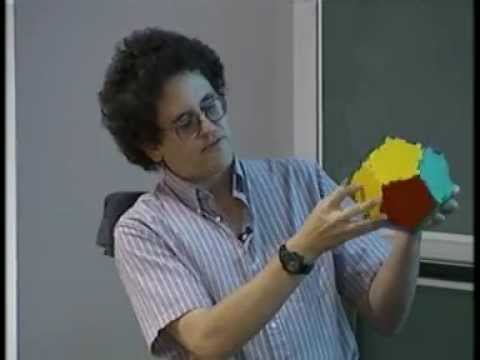
Awesome lecture by mathematician John Baez - Phi, you will find this lecture particularly interesting.

Clayton -

Dan Lathrop has built a model of the Earth’s core:

Clayton -

I thoroughly enjoyed the lecture by John Baez. It is funny that you posted that because I was just pondering if I could think of a new way (or new to me, at least) to define and visualize further dimensions. Of course, I particularly love seeing phi shown in geometry and nature. It amazes me how often it shows up, and almost always, if not always, fractally. Sacred geometry holds a dear place in my heart. I am certain there are many secrets of the universe to be unlocked or discovered using and utilizing the golden ratio and the raw power of the vortex. Although there isn’t much left of the technical aspects of his work, that I’ve found at least, have you read of Viktor Schaueberger and the machines he worked on using only the power of water and it’s naturally fondness of moving in a spiral motion? It’s some fascinating stuff, for sure.

Wow, this guy kicks ass. His economics are a bit wobbly, as usual, but on everything else he’s right down the line:

Clayton -

Executive summary?

Basically a lot of the same stuff as Santos Bonacci but a slightly more organized presentation and fewer factual mistakes.

He explains a lot of the ways that the Establishment suppresses dissent and maintains control.

The most interesting (and fantastical) section is where he discusses how the world’s major religions act as a kind of “binding” of the underlying astro-theological religions buried behind the veil. Even the esoteric traditions, he argues, are still bindings of the underlying astro-theology.

When you strip the veil away completely, what you find are three sects of astrological worship - the Solar, the Lunar and the Planetary/stellar. He then goes on to claim that the Solar (Christian) tradition originates from worship of Ra, the Planetary/stellar (Judaism) in worship of El, and the Lunar (Islam) in worship of Isis. Combined, these form the name Is-Ra-El, that is, Israel. The State of Israel is the expression of the united agenda of all three of the pure astrotheological cults.

I think that’s about 99% bullshit, but it’s very beautiful and fascinating bullshit! Nevertheless, he does have a great deal of good insights. As with all these kinds of vids, I find you have to sift through a lot of nonsense to find a few gems.

Clayton -