Hmmm, I don’t know Stirner, but I completely understand “uniqueness”. This is actually getting interesting.[:)]
This is where I think you, Vichy, are not taking note for conventional use, there is an “I”.
Yes, but we have to remember that this is a consequentialist use for a complex technological/ontological entity. And if we are going to be precise about what ‘we’ are supposed to do, or what sort of things are relevant to ‘individuals’ we will need some greater clarity of the implications of ‘being a person’ to begin with.
IOW: Vichy’s post-modernist garbage has been sussed and found wanting and merely the tired bleatings of the poseur who is currently in a philosophy of mind class but has no idea what it’s really all about. With careful schooling, it’s possible this one could be turned to the good side, though.
And that is the ‘pursuit of happiness’… Cool. Natural property and Vichy have now crossed paths.
Vichy, do you know the metaphysics of quality (MoQ)? You mention of “they use dialectical reasoning”. This is well understood by me and the MoQ. hmmm… you’re putting up all the signs that you may have heard of this.
Knight of BAAWA… I hope you let Vichy keep going. I really think Vichy is saying something very significant and I understand her (if her symbol is correct).
i do find it amusing that the qoute is explicitly dualist and the opposite of reductionist or it would have been ‘the whole chap, the bodily man’
I may actually be of similar mind except I don’t think the world is only inorganic and biological, do you?
I am actually a bit more ‘extreme’ than this - I think the entire world is reducible to the interactions between the individual ‘minimal units’ of reality (whatever those might be - I don’t pretend to know physics a priori). I do not think there are ‘higher levels’ of reality, or ‘emergent properties’. So-called ‘emergent properties’ are in fact the activities of complex arrangements of particular particles; these particles in themselves are the entire explanation and fact of the system.
I also think the world involves social and intellectual patterns as long as humans and other animals (some have social patterns, I’m not ready to say whether other animals have intellect yet).
What we have for a consciousness is patterns-of-patterns, we operate in imagination, analysis, memory etc. by a kind of ‘virtual reality’. It recreates, at a low-intensity, impressions of reality we have had as well as the ability to ‘fill in some blanks’ and leave out what seems ‘irrelevant’. I don’t want to go into any more detail, because I’m not a neurophysicist. But I think we can probably agree that consciousness is something like this - there is analytic and semantic content to our existence, and that semantic content can easily be described as a mixture of ‘reality’ and ‘virtual reality’. Think about what a peach tastes like, for example.
The systematic activity of large-scale objects is explained by the systematic behavior of the materials that make them up. If a general systematic trait is exerted (hardness), it will react in specific ways with other systematically regular objects. Human beings are pattern-VR sort of entities, so we have highly coordinated information-based behaviour; which means information-based interaction will tend to normalize along the rules that govern information, motivation and their nexus in physical reality.
I also find the world to be dynamic.
All this systematic regularity combined with a wide variety of circumstances produces a very ‘dynamic’ sort of impression though, I mean the Universe is really unimaginably complicated even if we know all the particular rules of physics.
Well I’m not a “consequentialist”, meaning, I don’t think in terms of A cause B. I think A values B and B values A. If that’s what you mean.
And I agree that, “we will need some greater clarity of the implications of ‘being a person’ to begin with”. very curious…
or it would have been ‘the whole chap, the bodily man’
Not necessarily*,* since Stirner is not denying the existence of an internal perspective - far from it. What he is saying is that he is his body and spirit, and he has neither without the other. At other points he makes it clear that the ‘bodily, individual you’ is the only real you - this is why being valued by a humanist is worthless, since he, "only esteems what is human in you, but has no interest in you for yourself, the bodily you.’ Other examples would be that he says that while the Christian says we can be in chains we can yet be “free in spirit” he says, “But free in spirit is not really free.”
i think you might need to put in enough hardwork to coin your own language in which statements like these could possibly have meaning.
The ‘monadal you’ is just the collectivist fallacy. There is no such ‘you’. Thus to say there is no such thing as ‘America’ or ‘America’s interests’ doesn’t mean that there is no ‘America’, no ‘Americans’ and does not deny that interests exists.
There is no ‘person’ who ‘has’ interests’, there are interests that exist in a variously integrated fashion which constitutes ‘you’. You are various properties of your machina, not vice-versa.
no, america as territory is understandable,
yes, as a thing with interests it is false, since it contradicts Methodological Individualism, but you are trying to eradicate the individual.
are you putting contradictary sentances together to try to achieve some kind of hegelian synthethis? or just to bait us into burning or beating you?
obviously talk of the spirit is anti-reductionist since according to reductionists there is only body.
One wonders why you keep tilting at that windmill, Don Quixote. Is there some reason you (the system) can’t grasp that you (the system) are attacking something that no one is talking about?
Hmmm, you are a “bit more ‘extreme’” I do think the particulars, “minimal units”, interact. I myself think electrons value. I do think there are inorganic, biological, social, and intellectual distinctions in the overall value pattern though. I don’t know if these distinguishable patterns are “emergent” or not. The emergence as I see it would be a distinguishable possibility in how these patterns converge into these differing patterns, but I’m not sure if emergence is accurate enough or not. These differing patterns, inorganic, biological, etc… are analogies though in the metaphysical sense. I think these static patterns (the standards) are analogies of a dynamic, ultimately undefined reality. Some analogies are better than others. And this level analogy of inorganic to intellectual has its’ flaws. It’s not always a good analogy for sure.
Yeah, sometimes we do “fill in the blanks”. Gestalt patterns: http://www.cres.org/star/RubinGestalt.gif
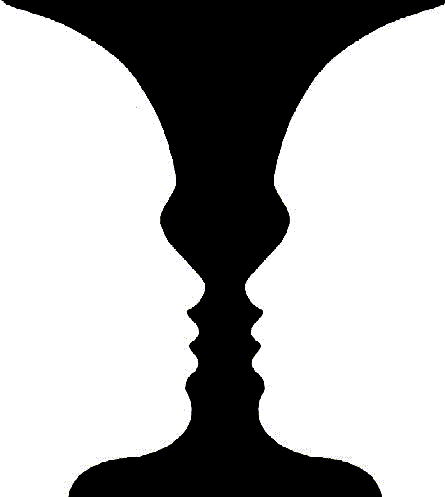
This is what I call… it’s in their nature. Nature is a flux and full of processes, but as the “behavior of the materials” coalesce into a conventional entity to be distinguishable (even if only virtual) the nature of those materials is similar to their “behavior”.
Well, that’s why I find this universe to be so beautiful! And in the virtual world, so to speak, I find natural property to be very helpful to harmonize patterns. It is a good intellectual tool so to speak. I think their are some patterns that coalesce called Keynesian and they don’t work very well. Austrian patterns are more reasonable I think, even if it’s only my virtual understanding on the various patterns coming and going.
You are thinking that my making statements is somehow contradictory. But it is not, at all - I am an information-regulaity bounded set of interactive impressions and interests. One of which happens to be transforming ontological-existential content into symbolic-semantic language. Some parts of me put the information together, some other parts want to express the information. The other parts listen to this second set because - that is what they do. It’s in their mechanics. They have no choice. I have no choice. But I am choice.
Yeah, I already accepted the basic idea of the individual being in fact very “dividual,” before Stirner; but Stirnerite egoism gives one a reason to rejoice in this curious happenstance. Funny thing this is, despite being raised Christian I actually was more terrified of the idea of a non-discrete, non dualist self than the idea of hell since the former seemed much more plausible than the latter.
Btw, this is TEM from LiMi. Good to see you on here. I’ve argued some of the same points before but you’re much better at expressing thought in text than I am so maybe some of these whole chaps, bodily men, the spirits will be more persuaded.
Pleased to re-meet you, ehehe.
There might be hope for a half dozen of them, but I suspect many can not stop the grinding away of their ‘wheels in the head’.
yes, thats what you are!
yes, you do that too!
yes, you have different parts!
ummmmm, you were doing so well, !
yes, thats what you are!
In a functional sense, yes. In a particular instant, yes. But in a technical sense, over time - no. There is nothing but a physical tendency of congruity - that is to say, a regularity in material behaviour. I am not objecting to existential experience. I am objecting to indetifying any sort of normative or existential supremacy or necessary continuity of these states.
Any convincing you do of me, will be of what your talking about. I’ve already been down the road you’re on in places, but others not, for we each are unique. I think there is an intellectual value to natural property. You can speak on the meta-level, but you do also have this conventional life to live as well.
Vichy, don’t confuse the pointing finger for the Moon.
this is the tinting at windmills Knight talked about
and this is the absurd contradiction of your prior concessions. if there is no necessary continuity of these states there can not be a functional sense. if there is no necessary continuity of these states there is not a physical tendency of congruity.(and you said there was)