Many of the areas you mention were sparsely populated. Why make a farm when you there’s enough food to go around from hunting and gathering? I think a lack of scarcity is what held many people back.
Yes but is it the kind of harshness that can be overcome by a clever caveman? If the harshness is brought on by winter then you can become really good at sewing - problem solved. But if the harshness is brought on by malaria then you are out of luck. A caveman isn’t going to be inventing quinine. Nobody could, without having access to hunreds of years worth of accumulation of knowledge.
Some sort of sources would go further than simply bolding.
“Many of the areas you mention were sparsely populated. Why make a farm when you there’s enough food to go around from hunting and gathering? I think a lack of scarcity is what held many people back.”
Your being disingenuous, How about in the Americas? Where they Sparse in population? I doubt it. The Incas were cultivating crops on top of mountains.
I’ll second Marko’s comment that its a clever hypothesis, but it doesn’t fit the facts.
Harsh enviroments are not populated by ubermench, they are settled by underclasses. The people who move to the mountains, marshes, tundra, etc are those people incapable of defending or conquering fertile valleys.
Its the fertile areas of the world that gave birth to civilization because its these areas where competition is the most fierce. That is why the “civilization” of Europe began at the mediterranean and moved north, not the other way around.
Europe’s recent dominance in the world is a break from the historical norm, that is why it is so remarkable. To suggest Europe’s achievements are the result of a steady, natural process is historically wrong, but more importantly it fails to grasp the lesson that needs to be learned.
As a Lithuanian American I find this theory very flattering.
However this whole notion that we can assign values to the many variables that come into play is absurd.
How can anyone claim to know what caused this?
On what grounds does someone say that their explanation is more compelling then other explanations?
The number of variables approaches infinity and we cannot possibly know how big of a role any particular variable plays.
In order to be convinced by any kind of “empirical” evidence I would need to see an exact copy of the universe where everything was the same except a particular variable and this would need to be repeated multiple times.
However anyone attempting to answer this question using empirical evidence would be intellectually dishonest to dismiss this for being racist.
It would seem to me that although Hoppe’s analysis is somewhat incomplete it attempts give an alternative explaination than property rights were more secure in Europe at the beginning of the industrial revolution than, say, the renaissaince. I suspect the determinate factor is essentially man’s worldview: animistic, manichaen, atheistic, Christian theistic etc. I need to do a lot more thinking in the area but it seems the most plausible. For example if you believe the material world to be evil you aren’t going to spend much time accumulating capital.
But then if you believe that you are probably not going to have a great deal of respect for property rights either. For example you could conclude that those who do dedicate themselves to accumulating capital are the quintessential servants of evil and that thus there is no reason why you can not robb from them.
Yes but is it the kind of harshness that can be overcome by a clever caveman? If the harshness is brought on by winter then you can become really good at sewing - problem solved. But if the harshness is brought on by malaria then you are out of luck. A caveman isn’t going to be inventing quinine. Nobody could, without having access to hundreds of years worth of accumulation of knowledge.
Humans living in Africa have developed a genetic resistance to malaria. That gene that makes them more resistant to malaria also causes sickle cell anemia. No a clever caveman is not capable of overcoming this particular problem with technology. Just as later on clever people could not overcome the bubonic plague with technology. European populations have developed a resistance to the plague that is carried in their genes.
As far as Africa being a harsh environment. No its not. We are physically adapted to living in Africa with minimal technology. Put anyone of us on island with a tropical climate we will survive.
We are physically incapable of living in subtropical, temperate, and arctic environments without our technology. Put us on an island with a temperate climate we would die the first winter.
The point of the theory is this the populations that moved out of Africa into colder climates made a few minor physical adaptations. But these physical changes do not allow us to survive there. Northern populations did not grow thick coats of fur to deal with the cold weather. The adaptation was a mental one. It allowed us to create the technology to overcome our physical deficiencies.
On a side note most of the mainstream objections to a theory like this is the idea of gene flow. Most it would seem accept the theory as plausible, except that interbreeding would prevent such radical divergence of populations.
Also I don’t think anyone one would suggest that higher intelligence caused by climate is the only reason certain regions of the world have historically been advanced. It is complex and has much to do with other natural phenomena.
Well, looks like I have a lot of things I need to point out, so I will first take on people who might be (kind of) on my side, then move on:
No, there ARE differences between races, but they would either be regional or physical. For example, most black people in the USA would be stronger (or possibly smarter, under certain circumstances) then white people due to the fact that the blacks in the States came in mostly from slavery (The weaker would have died on the ships, leaving mostly the strongest and most fit to be slaves). Also, the skin of black people means they don’t get sun burns (at least, I think that is the case, though please tell me if I am wrong). That is related to melanin distribution (once again, I might be wrong), which helps in sunny places but is bad in not-so-sunny places (Vitamin D and such come in smaller quantities per amount of sunlight as a sort of rationing).
But on the other side, intelligence doesn’t come into it. The example is wrong, anyway. First, England, France, Spain, Italy, etc all have rather pleasant climates compared to, say, the deserts the Navajo lived in, Tibet, or the Andes mountains. Were climate the main factor, the current nation states in charge would be places like the Congo, Tibet, and various Native American countries. Second, that doesn’t explain the closer, regional differences (Why would England be more influential than Sweden, or why would China not dominate due to its own cold areas?).
At any rate, I would say the biggest thing is specific geographical factors, followed by “Great Men” and luck.
For example, Europe had reasonably good farmland, lots of domestic animals, and quite a bit of geographical and ethnic diversity. Africa had some good farmland and lots of ethnic/geographical diversity, but not as many domestic animals. China had very little geographical (and, by extension, ethnic) diversity. The Europeans were effectively forced into growing fast. If you ruled a little nation-state somewhere in Europe and you refused to accept progress, your neighbors would accept instead and probably conquer you. That meant that the competition kept things moving. The Africans were actually quite powerful throughout the Medieval Ages and up to maybe the 18th century, but they were perhaps too ethnically diverse and often had bad farmland. China was far ahead of Europe, but the lack of diversity meant that when a dumbass took over, the entire country was effected. The same applied to Japan (Japan once produced the very best in guns, but a Shogun decided that the Japanese should stick to swords, banned gun making, and pushed Japan a couple hundred years behind Europe).
Beyond that, Great Men mattered too. Western Civilization (the predecessor of which was Greek civilization) spread quite a lot due to Alexander the Great’s conquests. Were it not for him, we would probably have ended up emulating, say, Persia or some Celtic country instead. Scipio, Caeser, and so on stopped Rome (which was the flame to Alexander’s spark) from being crushed by Carthage, creating a huge empire (which later fell, though the little gangs that took over emulated the Romans constantly). Don’t get me wrong, their conquests didn’t create civilization, they simply spread it well enough for it to continue in various ways up until today.
It would seem to me that although Hoppe’s analysis is somewhat incomplete it attempts give an alternative explaination than property rights were more secure in Europe at the beginning of the industrial revolution than, say, the renaissaince. I suspect the determinate factor is essentially man’s worldview: animistic, manichaen, atheistic, Christian theistic etc. I need to do a lot more thinking in the area but it seems the most plausible. For example if you believe the material world to be evil you aren’t going to spend much time accumulating capital.
We all started from the same point. Some populations deviated from others which lead to these different world veiws. Thus creating the conditions for property rights. Why?
The Chinese have higher intelligence on average than Europeans.
I’m not sure if China really qualifies as “cold” in the aggregate,
of course it depeneds on the area.
Also, Ashkenazi Jews have higher intelligence levels than whites.
Yet they are a mixture of European genes and genes from the warm Middle Eastern region. So how is this explained.
Overall I am not too impressed by this explanation.
Tropics are not our natural environment. It is the savannah, which counts as sub-tropical. Pygmies are adapted to tropics not us. Remember that during the Ice Ages the tropics would have covered an even smaller area than today so we would have been particularly screwed.
Also humans can compare with animals in one aspect only: endurance running. Our trot (being bipedals we are incapable of gallop) is totally respectable compared with trots of other animals from the savannah. (Source.) Now, long distance running is useful in the savannah, but near useless in the jungle where the plants gets in the way and the fastest way to travel is through the tree tops.
Are there caves on the island?
Thats where I’m at, that the answer lies in the study of ideas. But I believe you need to trace it back much farther than the Enlightment, Reformation, or Renaissaince. All these movements purposely sought to distance themselves from the middle ages, so its no wonder that the picture we have of the middle ages is distorted. The West has misinterpreted its past, so I think its no coincidence that it is in decline.
In a way, Austrian Economics is a testament to that.
As for property rights. I mostly agree with what Hoppe said, that respect for property rights is a neccessary condition for progress but not a sufficient one.
He seems to suggest that since property rights were previously more respected, the industrial revolution should have occured then if property actually was the key; but I don’t see that as neccesarily true. Those previous time were in likelyhood times of capital accumulation and technological advancement, ultimately leading to the industrial revolution.
Who says they measure intelligence? All we know is that they measure how good people are at IQ tests. Calling that a measure of intelligence is merely defining intelligence as being good at IQ tests.
It is the savannah, which counts as sub-tropical.
Not true. They are simply grasslands. They can be tropical, subtropical, temprate. http://en.wikipedia.org/wiki/Savanna
Pygmies are adapted to tropics not us.
Those populations that moved out of africa lost some of thier hot weather adaptations. But even so any human can survive in tropical regions without thier technology. It is an impossibility in temprate regions.
Remember that during the Ice Ages the tropics would have covered an even smaller area than today so we would have been particularly screwed
Also remember that the human race nearly became extinct at one point during the ice ages. We did not have the technological sophisitcation to cope. So yes we were. This only bolsters the arguement that colder climates are deadly to humans while tropical climates are not.
Also humans can compare with animals in one aspect only: endurance running. Our trot (being bipedals we are incapable of gallop) is totally respectable compared with trots of other animals from the savannah. (Source.) Now, long distance running is useful in the savannah, but near useless in the jungle where the plants gets in the way and the fastest way to travel is through the tree tops.
You lost me here. Are you saying that we did not evolve to live in the tropics because the tropics are only jungle? If so the tropics are not limited to jungle.
Are there caves on the island?
Absolutely there are. Ill even give you the technology to build a fire to keep yourself warm during the winter. Now how do you eat during that long cold winter?
Anywhere inside those bands, technology is 100% neccessary to survive. We are not physically capable of living there. This is why we hairless apes evolved in Africa.
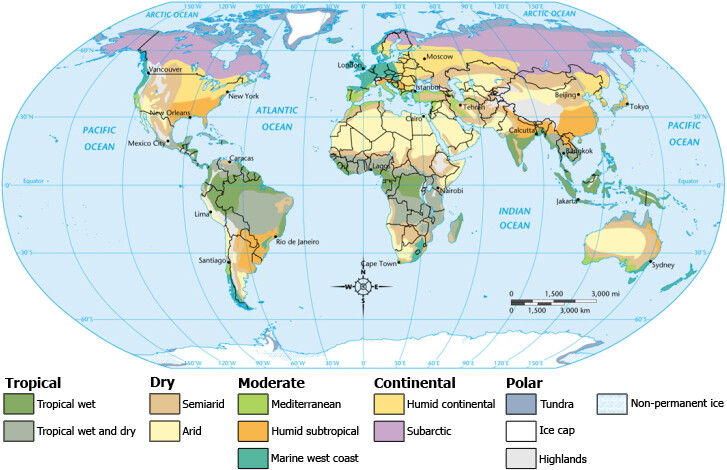
China, Japan, Korea are all outside of the tropics. So yes they do fit into the theory.
Keep in mind that during most of human evolution that the world was significantly colder. So most of china would have been temprate not subtropical. And the tropics would have been a much narrower band than it is today.
Its interesting that humans left africa between 70 and 50 thousand years ago. Then there was “the great leap forward” where the sophistication of technology and behavior began to advance more rapidly starting about 50 thousand years ago.
Who says they measure intelligence? All we know is that they measure how good people are at IQ tests. Calling that a measure of intelligence is merely defining intelligence as being good at IQ tests.
So we have no way of knowing if someone is intellegent or not? Of course we do. We cannot test someones ability to learn? Of course we can. Are all humans as smart as all others? Of course not.
If your objection is just IQ tests. I understand. They are not perfect. But to dismiss them completely is a mistake. they do measure something more than just how good you are at taking tests. IQ tests are just one piece of information that to be put into context with other information.
Thats where I’m at, that the answer lies in the study of ideas.
And the source of ideas are human intellegence. The two cannot be separated.
Those previous time were in likelyhood times of capital accumulation and technological advancement, ultimately leading to the industrial revolution.
Human populations in africa have had more time to accumulate capital than any other group of humans, yet they have accumulated less than any other group. While economic analysis might provide some insight, it will ultimately regress back to why some groups changed thier behaviour and did the right things, while other did things the way they have always been done and progressed little.
Another interesting thought on capital accumulation. It is 100% neccessity in cold climates. If everything you need to survive the winter is not collected during the spring, summer, and fall you will die. If you dont store enough food, death. If you dont gather enough wood, death. If you dont repair your shelter, death.
In warm climates food is available year round. No need to stock pile (accumulate consumable goods). Fire is only used for cooking and you can gather all the wood you need year round. No need to store it up. Really all raw materials for anything you do during the winter have to be gathered during the summer.
I catch fish and have loads of nuts stored from the fall?
Read The Bell Curve.
I catch fish and have loads of nuts stored from the fall?
Is this different behavior than if food was available year round? Yes. So you would have to modify you behavior in order to survive. What if you you didnt plan correctly or did not ration properly? You would die. Those who were able to plan for the future were the ones who survived year after year.
What if you had access to clothing that could keep you warm during the winter. Now you could leave your cave and augment your diet with meat. If you had some unforeseen problem (spoilage of food) you could now survive by hunting. But without the proper clothing you are confined to the cave and have little room for error.
Technology is the only reason people were able to leave africa. If we had to rely on physical adaptaions alone humans would still be confined to africa. Some other type of humaniod like neanderthals would have populated the colder climates. They were much better physically adapted for cold climates. But thier physical adaptations were not as big advantage to our mental adaptations.
Another thought on the storage of fish and nuts. This creates pressures of its own that would allow the clever to be more surviveable. Food rots. In ice age Europe and Asia winter would last 6 - 8 months. Those who figured out ways to preserve thier food the longest now have an edge in survival. This is not an issue in warm climates where food is havested year round. So no need to be as clever.
If there is no need for adaptation it does not occur.