i still don’t understand how all this relates to how commodity prices are decided. after all whats the point of business if you dont make a profit?
Don’t feel bad about being confused. It’s stupid, needlessly complicated, and boring to boot! I’ll let them speak for themselves by quoting their lame FAQ:
The term “profit” is often used simply, but incorrectly, to mean an excess over costs. However, this ignores the key issue, namely how a workplace is organised. In a co-operative, for example, while there is a surplus over costs, “there is no profit, only income to be divided among members. Without employees the labour-managed firm does not have a wage bill, and labour costs are not counted among the expenses to be extracted from profit, as they are in the capitalist firm.” This means that the “economic category of profit does not exist in the labour-managed firm, as it does in the capitalist firm where wages are a cost to be subtracted from gross income before a residual profit is determined . . . Income shared among all producers is net income generated by the firm: the total of value added by human labour applied to the means of production, less payment of all costs of production and any reserves for depreciation of plant and equipment.” [Christopher Eaton Gunn, Workers’ Self-Management in the United States, p. 41 and p. 45] Gunn, it should be noted, follows both Proudhon and Marx in his analysis (“Let us suppose the workers are themselves in possession of their respective means of production and exchange their commodities with one another. These commodities would not be products of capital.” [Marx, Capital, vol. 3, p. 276]).
Feel even more confused after reading it? I don’t blame you.
The word “profit” is used by mutualists in a different way than by Austrians. The Austrian conception of profit ultimately rests on the concept of psychic profit, the increase in satisfaction or well-being that one feels after exchanging one state of affairs for another. The mutualist idea of profit, on the other hand, is more a creature of political economy than economics: the excess income that an employer is able to obtain at the expense of his employee’s “natural wage” (here’s where the LTV comes in), via the state (Tucker’s four monopolies, etc.). So, when an Austrian and a mutualist say the word “profit”, they are really talking about two different things (I believe that Carson tries to clear this up a little in Mutualist Political Economy); unfortunately, there is often the conflation of one meaning of the term with another on both sides, which leads to all sorts of confusion.
On a side note, the LTV isn’t really necessary to a conception of exploitative profit. If it is true that the state enables capital and land at the expense of labor via various subsidies, then wages would tend to be higher absent the state and its interventions.
Here’s a comment Carson left on my (old) blog. It really helped clarify the mutualist position for me.
As a Rothbardian, Cork should understand the difference between profit in the sense of the originary rate of interest (i.e., on capital as such), and entrepreneurial profit. Most non-Austrians who talk about profit (including Tucker and the individualists) take the term primarily in the first sense. On the other hand, neither Tucker nor I object to entrepreneurial profit. The belief that profits on capital as such would fall to near zero even in wage employment is fully compatible with the belief that the employer’s return would include amortization costs of his investment, plus a “profit” equivalent to his wages of superintendence.
(I would respond that profits on capital could also be considered “entrepreneurial profit” etc, but I digress.)
I am a rabid anti-statist, but the state doesn’t enable property at the expense of labour. It undermines property at the expense of labour.
In order to have a class conciousness, it can’t be as simple as wealthy versus not wealthy. Anyone can become wealthy, how one becomes wealthy in a society is a reflection on his character and his acumen. The question has always been, “Who is a parasite, and who is a host”? And unfortunatly for soft hearted and soft minded folks, poor people can be just as parasititc on the rich under a state, as the rich can be on the poor. It is a race to the bottom that has little to do with property, and everything to do with force.
Well…I agree that the LTV isn’t necessary for their ideas about exploitation, but then neither is state intervention. They’re just against profit-making activities, period. If it was still happening in the absence of state intervention, they would oppose it just the same.
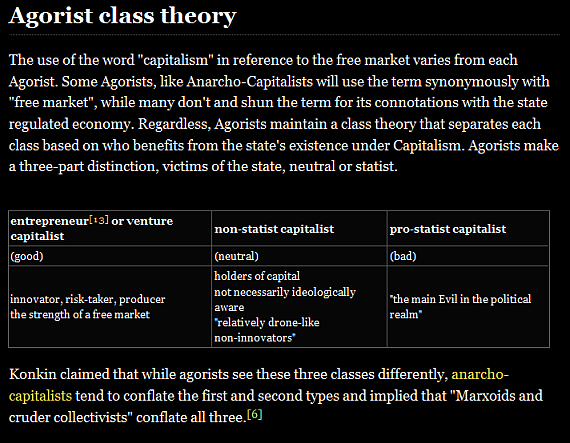
(Forgive the image, I couldn’t seem to get a direct URL to the anrchor link in the wikipedia entry. It’s a useful shorthand image for anyone wanting to spread an image around for agorism though. It’s also in a nifty market-anarchist terminal-like color scheme )
Lately, I’ve been snacking on Mutualist literature (mostly Carson, obviously), & thus far while it’s mainly for the purposes of making my arguments sharper & more effective (an Obama supporter I know has recently been getting disillusioned with politics, & thought the Marxist & Austrian Synthesist pamphlet cover sitting on my desk looked very interesting…), from what I understand so far, I don’t see how whatever alterations Carson makes to the LTV couldn’t co-exist with the more STV influences of anarcho-capitalism.
And I’m pointing out that they haven’t been able to separate the two, despite the claims otherwise. They just handwave away the problem. There’s simply no way to have exploitation based upon the worker’s labor (which is what they use) without using the LTV. Not possible.
Someone had best inform them that labour costs are not extracted(?)/subtracted from profit… Reisman actually has argued that pre-wage systems were systems whereby all income was profit. Funny, how wrong the mutualists are…
but the mutualists and anarchocommunists routinely shift the goal posts on this one. pressure them on this point, and they’ll revert to some variant of “the state enables property” or “property enables the state enables exploitation of labor” etc. Obviously neither of these are axiomatic.
so to sum up there is no “cost principle” in mutualism economics. lets say a co-op can buy their carrots for 5 and sell it for 5.30. my question is not over who gets the profits (lets say its the workers, because only they contributed labor hours), but whether profit is legitimate. let’s go back to francois’ blog post for a second, he says that the profit motive is the problem- then he says that a worker owned company wouldnt make profits the number one goal. what??? just because workers own the capital then they wouldnt want profits??[*-)]. he essentially changes the meaning of profit from exess over cost to surplus value in three paragraphs.
he’s new to the movement which means hes repeating what the others say. im probably thinking its peacott or carson. so i need a textbook answer. what does “cost the limit of price” mean? how is the labor cost determined? as i said above, i can charge a million dollars for a loaf of bread claiming that the labor costs a million dollars
I still don’t understand the annoying “cost principle” BS. (despite all the stuff I’ve read about mutualism). To be honest, I don’t care either. Ancap pwns mutualism and all its convoluted ideas.
I have yet to see a single left-anarchist explain how their so-called “workplace democracy” will work when the division of labor is inherently undemocratic.
Francois just makes me laugh these days. I stopped taking him seriously long ago. There couldn’t be a more perfect example of Rothbard’s “modal libertarian.”
LOL. Yes… Franc came on my blog recently and threw a fit because I quoted one of his posts from a few months ago (when apparently, he was not yet a full-fledged mutualist) as if I should’ve known exactly when he “became” a mutualist (like he “became” an anarchist, like he “became” an objectivist in the past, etc.) and then, when I called him out for being an immature dickhead, he said something to the effect of “You know me, I don’t fight fair.”
Pot: kettle. Right? I mean, he got all pissed off at what he presumed to be a “low blow” and then after I had explained myself and apologized for the perceived slight, he contributed pretty much nothing but ad hominems.
 )
)