And I won’t point out your snotty little attitude. Nor will I point out that Stringham is associated with the LvMI, given that he spoke at the 2007 ASC, autographed my copy of Anarchy and the Law, and had Walter Block as a professor at Loyola.
But I know such things because I have experience. Kinda helps.
Why are you even here, Giles? You clearly have nothing but derision for this institution and the people associated with it. You have no interest in “advancing the scholarship of liberty”. And for all your bluster, you don’t even really contribute much. Your posts are 75% name-dropping (of authors and texts), 10% meta-discussion about the field of economics, 10% insults, and only about 5% actually making use of your learning in explaining or discussing economic theory. So why not spend your time on Marginal Revolution or the Austrian Economists blog?
Come on, that’s not what I said? It’s actually Fed Theft 101. You’re either missing or misunderstanding my point entirely, which is that the value of savings is being artificially lowered by a “printing press”. Surely you’ve read something by Rothbard or Schiff or someone where they said the government/Fed do everything they can to discourage savings?
I didn’t say the value of money and savings can’t change at all, of course it can if it’s based on market conditions, I’m saying central banks are manipulating it in a way that is not in a savers interest. You’re basically defending the Federal Reserve’s policy of inflation and the inflation tax. Come on now, this stuff is probably in almost every book in the mises.org store! You must have completely misunderstood what I wrote, unless you’re a Fed apologist.
You seem to think that I believe deposit insurance = good banking. I just think it’s one “patch” to improve upon crappy and dishonest banking. And you’re forgetting a major problem with these credit expansion schemes as well–explained in the Austrian Theory of the Trade Cycle, if that’s not a massive flaw that could be fixed, what is?
Not what I’m getting at–the problem is when that “good” can be reproduced at will for free: fiat paper/electronic currency. I’ve already explained what I’m talking about in an above post.
What? You’re serious? No, all that investment can’t be sustained based on credit, it has to be based on savings. Again, brush up on the Austrian Theory of the Trade Cycle, you’ve forgotten how it works and all of the reasoning behind it.
Medieval life style on the gold standard… One of the most prosperous periods of American history was during the gold standard–and it wasn’t constant inflation like we have now. Honest money that can’t be counterfeited vs. fiat money controlled by a central authority, yeah I know honest money is an old idea–it built civilization after all. [:P]
Fair enough, but plenty of economists and investors thought things were great. And there’s much more to a strong economy than simple employment–this is Keynesianism rearing it’s ugly head isn’t it?
That’s a valid concept in investment, but it doesn’t apply to insurance. If it did then insurance companies would charge the same rate in all cases and offer plans to everyone equally to “diversify”. Diversification isn’t in an insurance company’s interest, they survive best by being picky, the exact opposite. Insurance only works when you specifically single out differences or “classes” and set the insurance cost based on that.
Besides–the insurance itself isn’t even honest. It’s backed by money looted from completely unrelated taxpayers. It has to be: it couldn’t function as a true insurance company because of the problems pointed out. Even if it could be, it would probably be far too expensive–even the massive US government isn’t able to effectively “bail out” these banks because of the massive amount of money they don’t have (due to FRB). If the FDIC offers “insurance” in the true sense of the word, why aren’t there private competitors? Because private competitors would have to do it honestly.
Great! What the hell happened? Dust off those freaking books man! I’m serious. I can tell you’ve completely forgotten the specific details within them, because I’ve read recently on these very topics. It happens, this stuff isn’t trivial and if you don’t keep up on it, it gradually fades away and gets replaced. Sounds like you let the university propaganda get to you, they’re very good at it. I’m not trying to insult or condescend; you’re obviously not stupid but I honestly think your memory has faded.
You’re going way off course and its already going to go way longer than it should - because I collapsed into the pier pressure of doing this cut and paste argumentation.
As for your first point, I do not believe you think deposit insurance = good banking. I believe that lack of necessity for deposit insurance with fractional reserve banks is a huge point against the thoughts of Mises, as far as inadequacies in fractional reserve banks.
No, you were talking about the value of money increased and how you have a right to it.
So you didn’t benefit at all from the period between the 1980’s and 2000? Again, I’m not advocating for central banks, I’m simply showing that improved monetary policy that provides for continuous, though prudent, credit is a huge part of economic prosperity.
Antebellum banking seems more similar to quasi-free banking than the gold standard. These banks were largely fractional reserves, perhaps more prudent but still fractional.
This wasn’t really about insurance companies diversifying, though I think you might be mistaken about it. It was about banks diversifying so they don’t need to rely on deposit insurance when they operate as fractional reserves.
I never said none of those authors were associated with the LvMI, because that would be false. Yeager is a fellow traveler and has been published in journals associated with the LvMI, for one thing. In fact, same goes to some extent or another for White, Selgin and Boettke. So I can only assume you misunderstood what I was saying.
Clearly, I only have derision for the LvMI, which I why I happen to be a huge fan of economists such as Thornton, Salerno, Klein and others associated with the LvMI. I also happen to think Ludwig von Mises was the greatest economist of the 20th C, with Hayek (one of the founding members of the Institute) being close behind Mises. I also appreciate the LvMI’s stance on religion and other such issues, so if you wish to tell me that I have something against the LvMI, you’re going to have to substantiate it.
You see, it really depends on what you mean by “the scholarship of liberty”, because I’m all for advancing Austrian economics as a branch of economic science. I just happen to take issue with authors like Hoppe, Block, the later Rothbard and some others. Who seem to think that angry rhetoric replete with italics, exclamation marks and caps make them correct. It doesn’t, and it reflects poorly on the academic enteprise that Austrian economics is.
I don’t really care what you think about the content of my posts, but make sure that when you question my credentials you remember that I’m the real one with the interest in pushing Austrian economics forwards and promoting it to academia, however many years in grad school I have to spend to do so. So make sure you get your facts in place before you go questioning my pureness, got that Comrade?
Yes, you did. You said they were associated with GMU over LvMI (meaning they’ve chosen to associate themselves with GMU rather than LvMI). I can quote you, so please do not lie, Giles. I can only assume that you’re trying to backpedal because you know that you said something in error.
And you seem to be doing a bang-up job with your own angry rhetoric. I think it reflects poorly on you. Maybe you shouldn’t be here, as you clearly don’t have any interest in promoting Austrian economics. You just want to be all whiny and emo. Change your attitude.
Or perhaps all I meant was that they’re foremost associated with GMU and then with the LvMI. Or do you wish to speculate that you know what I meant better than I do?
I don’t have any interest in promoting Austrian economics? That’s new to somebody who has invested quite a bit of time and money in learning economics over the past year. Perhaps you’re correct, I don’t care much for Austrian economics, I just care about good and bad economics. As for me being whiny and emo? You guys are the ones whining about how the state doesn’t let you smoke pot and society doesn’t let you paint your nails black and pink or whatever else you guys like to do. I’m sorry if I take pleasure from winding up a few Rothbard worshipping loners.
You would have phrased it differently had you meant that. So no: you didn’t mean that.
No, all you care about is whining and attempting to troll. You’re the one with all the complaints, little boy. Now I neither know nor care what caused your problem, but I suggest you solve it right now. Do I make myself clear? Because yes: you will be treated as a petulant child so long as you continue your tantrum. Fix it please.
Not sure why you seem to want to misconstrue what I’m saying about a basic concept. I’ve said nothing about the market value of money, perhaps I implied that it would tend to raise in value in a good economy with honest money, as shown by history, but that’s it. That’s not my point at all–I’m trying to point out the problem of a government forcing people to use their money, and then proceeding to artificially devalue that money by creating more of it. Were it not for legal tender laws and the dollar’s reserve currency status, the dollar would have been abandoned long ago and the American “empire” wouldn’t exist as it does today.
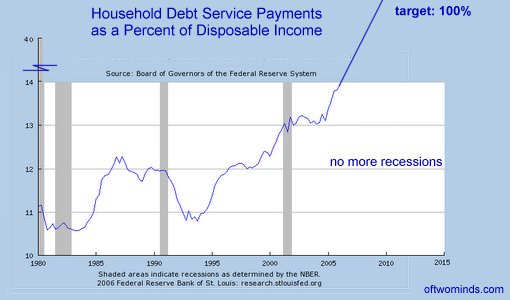
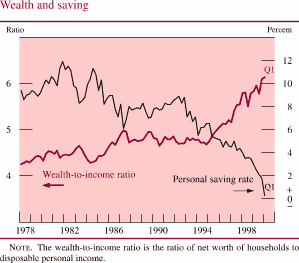
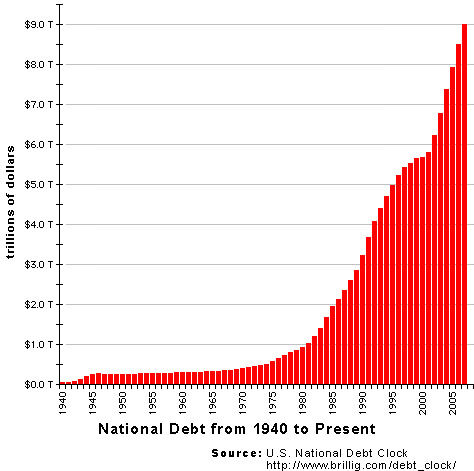
1980-2000, a “prosperous” period certainly, but at what cost and is it sustainable? Not at all–so it was only borrowed prosperity funded by this “improved monetary policy” you speak of, surely you’re not saying this is a good thing that we should repeat? Of course people lived well back then:
This “prosperity” may be nice for the generations directly benefitting in this case, but the next generation will be footing their bill. Surely there must be a better way than pludering the wealth of future generations. We’ve branched off to a different subject here but it’s another product of central banking. If you’re not advocating for central banks, well, your arguments sure do. And FRB banks didn’t fight to create the Federal Reserve just for the hell of it…
I know, you went to the re-education center to learn about the mainstream propaganda messages. As Hazlitt would probably say, you have to make an attempt to find the hidden and secondary problems buried under the surface. If you really believe those schools don’t have deep rooted biases and that they will give you an objective and balanced education on economics (when most don’t even mention the Austrian school), I don’t know what else I can say.
How is the government forcing people to use anything through giving the Federal Reserve central bank status and allowing it to increase the supply of money, all things remaining equal?
And again, you can only prove that money is devalued relative to other goods. You haven’t taken into account the externalities that accompany it. You’re creating a framed photo, which is nice for your talking points, but dismissive of other points of view that are just as valid.
Again, you’re framing a photo that agrees with your talking points, ones I’m not necessarily disagreeing with (at least in the case of saying that there are negative effects to central banks and central bank policy), but you aren’t taking into account the externalities or the other arguments.
Is your point that banks wanted to use the government to socialize their costs while keeping their gains private with the institution of the central bank? Well, I’m not going to disagree with that, but I’ll say that this isn’t all that rare for any business, is it? Look at GM and Chrysler.
I agree that businesses want to get rid of as many costs as possible in sometimes really ugly ways, but that’s not something anyone is going to fix - it’s a rational act and businesses are rational entities. The thing I think we can fix is the access to the use of governments to socialize costs.
Yes, because the Mises Institute is the standard for unbiased and objective - which was originally my point.
You know, I might agree with you, if it weren’t for the fact that I’ve been on both sides so I’m not biased or completely unobjective at all. Out of this forum, I’m probably one of the few people who have actively exposed myself to the other side for anything other than an attempt to “refute” their arguments - with a slew of Mises articles in hand.
How are we forced? Already said how- legal tender laws. Try creating a competing currency like the Liberty Dollar and see how long it takes until the Secret Service is knocking on the door.
Look, there isn’t room here to explain (nor have I the time) the multitude of fundamental problems that central banking and FRB cause. See this:
Pointing out that car companies (of course there are many more) are looting us just like the banks is pretty pointless, isn’t it? The government shouldn’t have the power of wealth redistribution and theft in the first place. Bank special interests are simply the most deeply rooted of them all. If you think such fundamental problems can ever be “fixed” by a few simple tweaks to our current systems (as people like Obama or mainstream economists think), I’d like to make you an offer to sell you a bridge in NYC…
So your one complaint has always just been that it’s legal tender? You do realize that you could survive on not using the federal reserve notes though, right - obviously not very well, but you could do it.
In any case, I’m not arguing for a central bank, for the one millionth time so much of what you’re talking about is moot to me. Yes, the central bank makes mistakes, it’s not really a market actor so I don’t expect it to be as efficient as one. However, it has acted better in the past few decades - before the early 2000’s, that is - and that shouldn’t simply be scoffed at.
Also, I’m a pessimist as far as the future goes. I agree that a few tweaks here and there will not make any substantive difference for the world as a better, but that’s really all anyone has. The nation state is here and it’s staying. I don’t like it, you don’t like it, the Mises Institute doesn’t like it, but it’s an apparent fact.
As an aside, so the producers of tanks and missiles are less tied up with the government than banks?
All things aren’t equal, though. If you try to use anything other than federally-approved “money” and you get caught, you get thrown in jail/fined/both.
Plus you have to intergrate the non-neutrality of money. So here is a money that an individual has to use or be thrown in jail and those with connects to the government and are in favor automatically get this money first.