That also doesn’t explain to me what you mean by “free market”. Try again.
Don’t expect me to get tired of responding to you, either.
That also doesn’t explain to me what you mean by “free market”. Try again.
Don’t expect me to get tired of responding to you, either.
You didn’t offer evidence to contradict the claim that public R&D raised income or that it didn’t crowd in private R&D. You attempted to cast doubt on empirical evidence in general.
No, Mustang19 made it clear in that post I linked that he’s here primarily to sow discord per se and secondarily to rack up forum bans per se. So I don’t think ideology has much to do with it. I remain convinced that he’s a troll.
You mean I refuse to be confined by a methodology that, as I pointed out, is flawed.
If the process of collecting and analyzing empirical data is a flawed methodology, that may be true in your opinion. It doesn’t reverse the preponderance of evidence.
tl;dr There’s more evidence that I was right, and almost zero in your favor.
tl;dr The above is another strawman.
So now you don’t think empiricism is a flawed methodology?
False dilemma.
I agree that I didn’t prove that government was perfect. You didn’t disprove that it was nice.
So now you’re going around in circles. Why am I not surprised?
It’s becoming clearer to me that you reeeaaally want to add another ban screenshot to your “scrapbook”.
Because you didn’t deny that I had presented more facts and evidence during the argument, and offer no way to disprove my point.
Are you now saying that you made a deductive argument?
Yup. Are you saying that you win by default? What is your position, even?
Where exactly did you make a deductive (instead of an inductive) argument? All I can see is you making inductive arguments, which are by definition not deductively valid.
Yeah, what you said.
I asked you a question. Are you afraid to answer it? Or what?
My answer is: “Yes.”
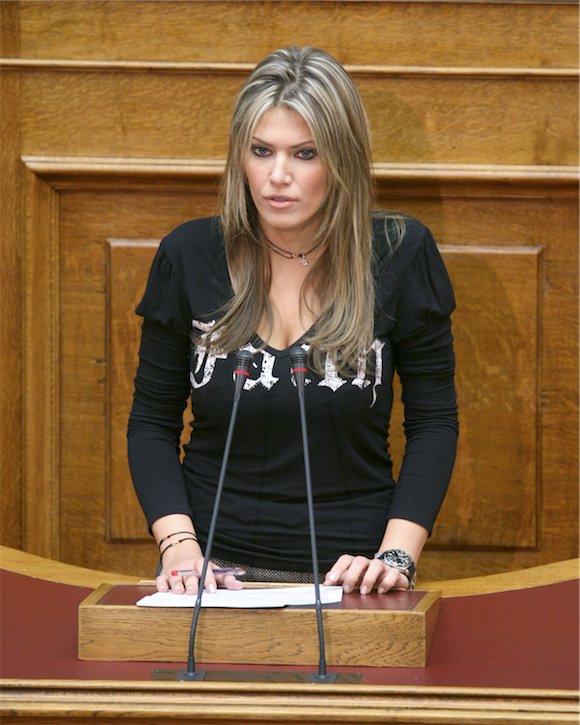
By the way, this is what a Greek socialist congresswoman looks like.
That’s all the DD-ductive reasoning I’ll ever need!
No one has yet mentioned the role of the entrepreneur. Hedge funds are not run by economists, they are run by entrepreneurs. The entrepreneur might use a combination of Tarot-card reading, Voodoo and rain dancing as his “investment strategy”. If it works, he will make a profit even if no one can figure out why it worked, including he himself. We never hear about the entrepreneurs who hire people to make big spreadsheets and look at “technicals” all day - that is, investing “by the book” - but go bankrupt anyway. They simply disappear out of the market and go back to selling used cars or whatever it was they were doing before they duped some people into letting them fritter their money away in the world’s biggest casino, Wall Street.
That other entrepreneurs who superficially appear to be following the “spreadsheet strategy” are not going bankrupt is not, in itself, evidence that spreadsheet/technical investing actually works. It could be evidence that their board members are big insiders, that is, insiders who generally operate beyond the reach of the SEC. Who knows.
The point is that entrepreneurialism is a kind of speculation - it is speculation on business models. The entrepreneur chooses a business model to try, rolls it out into the market and then he either makes a profit or goes bankrupt. It is the market that selects which business models survive and which fail. Understanding why the market selected Windows rather than Mac or QWERTY rather than Dvorak is always an ex post facto 20/20 exercise. Predicting which the market will select is, in fact, impossible. An entrepreneur with the right insight might make the correct prediction and he might even make that prediction based on the true reasons that the market will select his business model and become a wealthy man but there is not necessarily anything generalizable in his insight.
And that’s the mistake of a lot of thinking about the role of economics. People tend to think that economics is the study of “what successful businessmen did right.” It’s not. It’s something more fundamental than that. Organizational behavior is probably a field more in line with what people think of as the role of economics.
Economists don’t predict things. They explain the inevitable consequences of voluntary human behavior.
Clayton -
“Yes” doesn’t tell me where exactly you made a deductive argument. Try again.