You’re dad is just lost in performative contradiction. He doesn’t believe what he says because if he would, the logical conclusion would be simple starving to death. So yeah…introduce him to logic first, then Argumentation Ethics.
So you’re saying that land is non-scarce only when it’s unwanted? If so, then why bother making a distinction between scarce and non-scarce land in your ethical analysis?
Like I said, it’s simply a presumption. Everything is assumed to be unowned to begin with. Something then becomes owned by someone “mixing his labor with it”. That is to say, the initial control that someone exerts over something is assumed to be legitimate. As to why not the second, that’s because it’s already been appropriated by someone else. As to how much “mixing” is needed to establish ownership, I don’t think there’s a clear-cut answer for immovable property. But presumably one aquires land in order to use it, even if that use involves employing others to use it on his behalf.
I don’t think my question is akin to that common defense of God. You were the one declaring that homesteading is an irrelevant event, and I was asking you to elaborate on that declaration.
I don’t know where you get this notion of property as “asserting a relevant condition”. I’m not even sure what that’s supposed to mean. Can you help me understand?
Excuse me, but where do you get off calling me a statist?
Now then, I’m fully aware that you didn’t explicitly say anything about objective value. That’s why I used the word “presuppose”. My point was that adhering to the cost-for-cost principle requires belief in some sort of objective value. No explicit statement to that effect is needed.
In that case, with private ownership of land, symmetry is also preserved because no single unsymmetric source prevails (unless all land is owned by a single person). But may I don’t fully understand the context that you have allegedly already established - if so, I ask you to please clarify.
Created form can be scarce, can’t it? Human bodies are scarce, aren’t they? What other qualifiers do you think I’ve left out?
Really now? How exactly is it dishonest?
With all due respect, quoting a person and then refusing to explain what you think he meant when asked is a cop-out. Since you’re refusing to explain what you take “enough” and “good” to mean in the Lockean proviso, that is now removed from our universe of discourse. Any future appeal you make to the Lockean proviso in this discussion will be met by me with a reminder of the cop-out you gave when I asked you to elaborate.
Where I’ve disputed your points, the fallacy I’ve implicitly accused you of making is the non sequitur. Does that help?
The proof shows that harm and force are far more prevalent then standard confused property concepts conceed. Recognizing this is a step toward freedom and against statist force, because the carefully constructed and dominate fallacies conceal the force and harm. That the truth is upseting is in no way an arguement against it being true. Despite the implied meaning of at least two of these responses.
There is no need to jump to conclusions at this point in the arguement. There will be a way to turn away annoying Jehovah’s Witnesses without violating the foundations of equal freedom. The point of any discussion which furthers freedom will of necessity strengthen legitimate property rights.
I would think you guys would be happy that I have proved Lockes assertion on homestead without resort to vague metaphore. That it comes with the qualifiers intact will upset the statists, but thats just a price of honoring liberty.
Attention all libertarians - you thought you had the right to kick people off your property? You thought wrong! Why, we must do everything we can to preserve the freedom of everybody to enter your bathroom while you’re using it. Anything else would clearly be statist force. Can’t go with others watching? Too bad! That’s the price of honoring liberty. Now you’re truly free!
“So you’re saying that land is non-scarce only when it’s unwanted? If so, then why bother making a distinction between scarce and non-scarce land in your ethical analysis?”
Unwanted land is a case of unscarce land. You asked for a case. Land that is only wanted by one is also unscarce. Locke’ proviso is specifically the unscarce land. But scarcity is the problem as it implies conflicting wants, so directing the response to the problem is logical. If there is a problem of relevence as you suggest it comes from Locke’s conditions for homestead. Which I am also wondering what the relevence is. Because the class of land that Locke qualifies for homestead, “leaving as much and good”, is vanishingly small if any at all.
" As to how much “mixing” is needed to establish ownership, I don’t think there’s a clear-cut answer for immovable property. But presumably one aquires land in order to use it, even if that use involves employing others to use it on his behalf."
How can a principle be incomplete? Either it establishes ownership or it doesn’t. SInce you conceed that there is a class of immovables where homestead and ownership is not clear and thus not established, I assert that it does not establish any ownership because labor itself is the qualifier for the mystical mixing. But no principle exists to say how much. The original “principle” offers no guidence that is complete. If you read the side comments to the logical essay you will see how this Rothbardian legerdemain (pretend principle) is fully consistant with an attack on equal liberty instead of in suppport.
“I don’t think my question is akin to that common defense of God. You were the one declaring that homesteading is an irrelevant event, and I was asking you to elaborate on that declaration.”
The specific analogy drawn is that you ask me to prove a negative. I say there is no relevence. That is akin to saying there is no god. You say " “What makes the event necesarily irrelevent”. Which is the same as asking to prove non relevence.
I don’t know where you get this notion of property as “asserting a relevant condition”. I’m not even sure what that’s supposed to mean. Can you help me understand?"
There is a stick, something makes it “yours” and not “mine”. That something is the relevent condition. In this case its “homestead”. You may take it for granted that its relevent. But thats where Georgists differ, they don’t take that for granted. Because the actual conditions and constraints of property that are consistant with equal freedom are clearly inconsistant with homestead. At this point I have only proven homestead is inconsistant with absolute freedom. “Equal freedom” is, as you are eagre to point out, problematic. I offer no guarentee that once the real questions and compromises are considered that your answers will match Henry George. Most Goergists do not march in lock step. You may find a way to preserve the wonderful subjective valuation. That would be truly dandy, as I would advance my own position. But prior to getting there it really has to be that mystical thinking and bald assumptions are exposed. Not trying to be snippy, just part of the process.
“Excuse me, but where do you get off calling me a statist?”
Somewhat insulting I must confess and appoligize, But the effect I want is to show the stakes of the arguement, and that we are really on the same side.
The cost for cost principle is not principle but actually a compromise. It has all the flaws you point out. If I ever get there it means I am going to have to support “why compromise”. Homestead is also not a principle but instead “compromise”, and a terrible one at that.
Given a choice between being the earlier born with the oppertunity to homestead, and the later with no oppertunity, all else equal I would take the earlier. My prefence is made on the exact point of unsymmetry. Homestead is not symetric.
"I quote Locke. If you want to know what he ment you should read Locke. I believe he is the source of the metaphore on “mixed labor”, so using that and jettisoning the conditions he is attaching is at some level dishonest.
Really now? How exactly is it dishonest?"
With all due respect, quoting a person and then refusing to explain what you think he meant when asked is a cop-out. Since you’re refusing to explain what you take “enough” and “good” to mean in the Lockean proviso, that is now removed from our universe of discourse. Any future appeal you make to the Lockean proviso in this discussion will be met by me with a reminder of the cop-out you gave when I asked you to elaborate.
The dishonesty is only in the means of communication. My side point is that the “professionals” who back homestead are not answering to the highest standards. If he is quoted without the qualifier then he is misquoted. His prestige is borrowed but his meaning vandalized.
I wasn’t really going for a cop out, merely trying to avoid the presumption of speaking for a dead man. But what “as good and as much remains” means to me is the condition of legitimate homestead does not foreclose any valued options to others. Or in short: abridge others absolute freedom. You should note that the logical steps do not rest in any way on Locke, I only point out the similar result, to help those fetished to homestead. This side point also exposes how the current regime of property is not even consistant with Locke. With all the emotional attachment to homestead, pointing out additional flaws seemed worth while to help shake loose irrational attachments.
Washing your hands killing billions of micro-organisms. So does every breath you take–your lungs kill things instantly. Walking kills many things. Scratching an itch.
The NAP doesn’t apply to animals, much less plants, because force is the only way we can deal with animals. They cannot reason. And he’s got some wacky ideas of moral equivalency. He should be reminded that human beings are a part of nature, not innate destroyers of it.
His ideas about using resources for human utility and consumption as a violation of the nap are utopian, especially when you consider the 6 billion people on the planet. We would also lose all technology. This is all very unlikely to happen and a pointless position to hold, because the reality is that living entities use the planet to survive and improve their experience.
The native americans and other early tribal people from around the planet that were not exposed to european and asian technology until later on, definitely had a different way of living. Although it was primitive by modern standards, some people think that it was more advanced in terms of sustainability etc. But then we get in to discussions of resource scarcity and those are always debatable.
The idea that property is only a piece of paper, the paper is only used as information to prove ownership in the event of a property dispute. Your real property is protected by a fence. If you think there is a threat that someone is going to take it, then you put a gate with a lock and you secure your property. Some people secure their property even though it is unlikely that someone is going to try and take it away. In the uk it is not uncommon for people to go away on holiday and their home has been seized by a romanian family who claims that they own the property. Under British law they have squatting rights and if they can not prove they broke in to the house then they are unable to remove them. It is a ridiculous law in the UK that they are trying to get changed that has been abused by people trying to steal other peoples homes.
With a state they say that you never own land any way, you just lease it from the state who actually owns it. As you are always paying property tax, if you do not pay the property tax they can take your property away. If you want to build something on the property you have to get permission. If you want to sell it you have to pay taxes. This does not sound like an ownership contract.
Is your father really that naive to believe that american natives were some kind of pure, maliceless, peaceful folks?
His father’s been reading too much Nietszche most likely 
Civilization itself violates the NAP. Human beings were way more peaceful before civ and ag. Take a look at wild animals: they never kill unless they have to.
http://farm6.staticflickr.com/5047/5236745623_0f698673ef_z.jpg
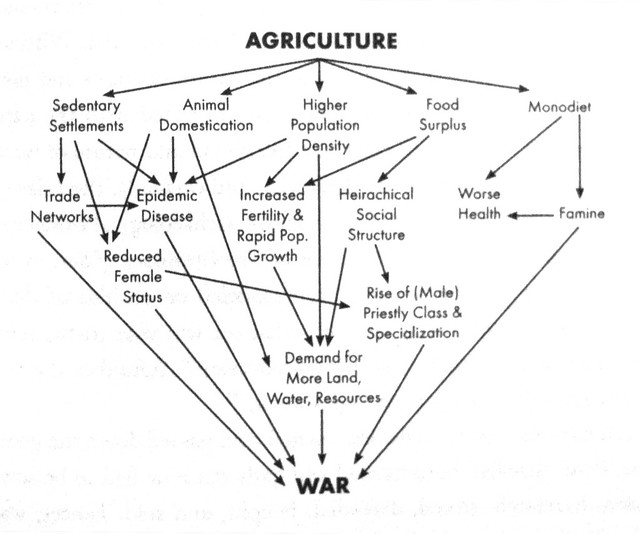
He seems to really fixate on The Native Americans saying that they were the only ones who ever lived at peace with the earth and took only what they needed. I tried to break his theory down to the smallest level so that I could better understand his argument.
Not the Native Americans w/ ag. The ones which remained hunter-gatherers were extremely non-aggressive.
Hardly. If that were so, you’d be claiming that any form of civilization violates the NAP as an essential characteristic from which it cannot be separated. Clearly not so. If even one human relationship can be maintained without a violation of the NAP–which is what happens on a widespread basis–than civilization itself can do the same, since it is an aggregate of all human relationships. In fact, a small minority of people violate the NAP, they’re called criminals.
Or politicians
That’s a joke. You’ve never watched much animal planet or w/e. I’ve seen lions kill hyenas and cheetahs simply because they compete for the same animals. There’s no ‘have to’ in that, it’s only ‘want to’. In any case, that wouldn’t prove anything about prehistory of man even if it were true.
The Native Americans are also the likely cause of the disappearance of the North American elephants, the giant sloth, and probably many more animals driven to extinction. gasp the native americans caused animals to go extinct? Yep.
As for hunter gatherers being non-aggressive, haha, you’d be non-aggressive too if your normal experience were eating once out of every three days. You don’t have the energy to be aggressive. Go read some Cabeza de Vaca.
Hardly. If that were so, you’d be claiming that any form of civilization violates the NAP as an essential characteristic from which it cannot be separated. Clearly not so. If even one human relationship can be maintained without a violation of the NAP–which is what happens on a widespread basis–than civilization itself can do the same, since it is an aggregate of all human relationships. In fact, a small minority of people violate the NAP, they’re called criminals.
Or politicians
http://en.wikipedia.org/wiki/Anarcho-primitivism#Civilization_and_violence
That’s a joke. You’ve never watched much animal planet or w/e. I’ve seen lions kill hyenas and cheetahs simply because they compete for the same animals. There’s no ‘have to’ in that, it’s only ‘want to’. In any case, that wouldn’t prove anything about prehistory of man even if it were true.
Animals only kill each other for food or to prevent competing species from getting the food they want. They don’t kill each other the way civilized man does.
The Native Americans are also the likely cause of the disappearance of the North American elephants, the giant sloth, and probably many more animals driven to extinction. gasp the native americans caused animals to go extinct? Yep.
As for hunter gatherers being non-aggressive, haha, you’d be non-aggressive too if your normal experience were eating once out of every three days. You don’t have the energy to be aggressive. Go read some Cabeza de Vaca.
That doesn’t mean anything. All evidence shows H/Gs were much less aggressive then man living in civ.
They don’t kill each other the way civilized man does.
The would if they could.
They don’t kill each other the way civilized man does.
The would if they could.
I thought I would correct this ridiculous notion that animals only kill to survive. If anyone would like it in a funny form:
The 6 Biggest Assholes in the Animal Kingdom
And then the other two links:
Infanticide (zoology)
Scientists Confirm That Chimps Go to War Too
And of course, don’t forget the nature of the alpha/beta male relationship. Animals will fight to the death to become the alpha male.
His fundamental assertions are the following and I will address them in this order:
- Property rights do not exist.
- The NAP is valid.
- Flora/Fauna have rights.
- The Native Americans lived most consistent with the NAP.
This may not make you popular with him, but you can tell your father that he has contradicted himself several times and that these contradictions make his arguments illogical for ethical reasons. I will take these assertions and show how the propositional content contradicts the presupposed ethic when forming them.
First, I will describe property rights, how they are formed, and how he contradicts himself with regard to property rights by examining the ethics involved in argumentation.
Argumentation itself is an a priori true axiom. One cannot argue that one cannot argue (without, at least, arguing the opposite to be true).The a priori of argumentation (cf. K Apel) states that actors are capable of argument and therefore understand the importance of validity claims (one cannot claim that this is invalid without, at least, claiming the opposite to be valid). Indeed, a logical implication of argument is that there are certain criteria that an argument must meet in order for it to be accepted as true. The criteria by which an argument may be justified -norms- constitutes the logic of justifying argument, ethics.
The first criteria an argument must meet for even formal acceptance as a norm is Kant’s, the golden rule of ethics, categorical imperative. The first test of Kant’s Categorical Imperative being the test of universalization: a norm must be something that can be done by everyone at once without generating logical contradiction and it must be capable of being accepted by everyone. If someone were to argue that “Everyone with a certain hair style must perform 100 jumping jacks every Sunday,” then this norm would be not capable of being accepted by everyone and would fail to be a general law for simply formal reasons.
But further realize that if argumentation is true a priori, then ethics must necessarily be valid a priori as without ethics there would be no argumentation- how else would anyone know what is valid or not? It is likewise important that the argument one makes is not contradicted by the ethic by which he makes it. Such an action would constitute a performative contradiction.
Performative contradictions are not the formal contradictions known to logic. Contradictions in this manner are in the form that one proposes Q, but the ethic by which one makes such proposal presupposes the legitimacy of not-Q. As such, one cannot argue that “No one ever argues” as this would obviously be refuted by the fact that this one person “justified” this proposition through argument. Performative contradictions nonetheless could be considered as a formal contradiction if one were to understand the significance that ethics bears on argument by detailing the necessary presuppositions of argument as in the beginning of a geometrical proof (e.g. Two perpendicular lines form a right angle can be “assumed” as a matter of definition). So if one were to write down or state all necessary assumptions, then it could qualify as a formal contradiction.
Through understanding argumentation and ethics, we can see the legitimacy of not only the NAP, but also of property rights; indeed, one cannot be conceived of, and be justifiable, without the other at least implicitly.
Regardless of the propositional content of one’s argument, the ethic by which such argument is made informs us of knowledge that exists in reality to an even greater degree, as it is ethics (the logic of justifying argument) by which argument can ever be valid. As such, by making arguments one must necessarily presuppose the validity of the first use first ownership theory of property: that because one owns scarce means in his body he is assumed to have the ability of forming property in other likewise scarce means- if this were not so, then everyone would cease to exist and the conflict of justifying arguments would no longer apply. The question of who owns what cannot be anything else than the natural theory of property as every other possible ethic (for instance a latecomer ethic, addressed below) fails upon proposition. Because we have argumentation and property rights, we must also, by implication of argument and property rights, hold the NAP to be a priori a valid norm.
Property rights are recognized claims of exclusive ownership over scarce resources. The first property right, the one from which all others follow, is the right to self-ownership. I own my body; no one else has the exclusive control over my body. This cannot even be argumentatively refuted without first presupposing the property rights one has in himself (I must first assert exclusive control over myself in order to even argue that I cannot assert exclusive control over myself). A further implication of property rights one has in himself, one must have the ability to hold property in other, likewise, scarce goods. As the body is a scarce good, so, too, are other means of removing discomfort (this delves into the realm of praxeology but, for this, one can be referred elsewhere). The question of how property is appropriated will now follow. If a good is not owned and is appropriated by someone, then we must ask if the good is appropriated in such a manner as to violate the rights of another to that good. Inevitably, the only way someone can have a right to that good is if he first appropriated it. From this, we obtain Locke’s first-appropriated-first-owned rule of property rights. It is a first comer ethic which states that the first person who mixes his labor to appropriate a good is the rightful owner of that good; if the good is unowned in the first place, then its appropriation by someone does not constitute any aggression.
Some say that there is legitimacy to the so called late-comer ethic. This ethic states that, essentially, no one may do anything with anything without the prior consent of all possible late comers. That is to say, one may not even argue for such an ethic without the prior consent of all other late comers for that person to use his/her capacity of speech. And in order for those late comers to give such consent, they must first seek consent to ask for such consent. And so on ad infinitum; clearly, if this ethic was adopted by all, we would all die out and the problem of establishing norms would cease to be necessary. Indeed, one is able to claim someone else as one’s own property under this ethic as a latecomer to that body- obviously this ethic would justify aggression which is a further contradiction of adopting the ethic. We can see how this scenario in particular shows the absurdity in proposing a latecomer ethic as, in doing so, it presupposes the validity of the first comer ethic as one cannot claim ownership over another without first having ownership over himself.
Others say that no one may own anything. This is a perversion of the Georgist political theory which states that no one may own land as it is everybody’s property and that, because no one can own property in land, no one may own the fruit which such land bears. Of course we cannot even imagine a world in which no one had the right to own anything. Performatively, the proposal is defeated by its formation by the proponent as this presupposes the validity of self-ownership by even forming the proposition. Further, if this contradiction could be ignored for the moment, a world in which no one owned anything would be a world in which everyone ceased to exist, as argumentation presupposes that one is living, and the problem of developing norms would likewise cease to exist as no one would have the right to appropriate foodstuffs and eat them, much less argue.
The NAP (Non-Aggression Principle) claims that anyone may do anything with whatever property he has so long as he does not aggress (or better understood, perform an invasive act; forcibly physically alter someone else’s justly acquired property without consent). Argumentation implies this to be valid as we cannot conceive of argument without a mutual recognition of private property rights between two parties arguing. If this condition were not met, then the argument would either be someone talking to oneself or an act of aggression and cannot in either case be recognized as argument between two independent decision making units (as the definition of argument establishes). As there is no conflict (an attempt made by someone to use a scarce good in incompatible manners) present argument presupposes the legitimacy of the NAP (there is always the possibility for both parties involved to agree that there is a disagreement). Further, ethics composes the logic of justifying (through argument) the validity of arguments; inherently, aggression cannot be valid as an ethic as it is contradictory to the meaning of ethics.
Now considered is as to whether flora and fauna have “rights.” Rights are formed by reason, by recognition of conflict and these rights, as a normative construct, and are formed to limit conflict as far as possible. Rights are derived not empirically, but as a matter of a priori recognition that because man is capable of rational thought he has rights. Flora and Fauna are incapable of rational thought and as such cannot be said to have rights qua property rights. One cannot argue with a gorilla; the only actions a gorilla, for example, is capable of is of grunts and physical interactions with humans. Because the only solution of conflicts that arise in nature is that of violence, animals cannot be said to have property rights (a normative concept designed to limit conflict). One may certainly see something immoral in aggressing against flora and/or fauna, but such moral concepts cannot be argumentatively justified, as they rest instead on value judgments, which are outside the realm of rationality and are more appropriately dealt with in the realm of psychology.
His last assertion is far from the truth. Native Americans did not live according to your fathers’ ideals, far from them. The Natives weren’t scavengers; they hunted animals for food, so he cannot still assert that Native Americans lived in consistency with his contention that flora/fauna have rights. Further, his idea that the Native Americans only took “what they needed” is up to logical scrutiny. There is no logically deducible upper limit on what property one is able to possess; there are only arbitrarily defined upper limits asserted by aggression. I would ask him here for specific details as to:
- What exactly the Native Americans “took.”
- What upper limit on what could be taken was met and respected consciously by the Native Americans.
- From whom these “needs” were “[taken].”
- Why taking did not violate the rights of anyone else in the case of the Native Americans.
The Native Americans were human: they had discomforts that they remedied through means; they ate animals that they killed, and; they fought wars with each other over disputes. There is nothing that holds Native Americans above another group of people.
Regarding Round 2,
He has still yet to prove that there is such thing as an “earth life force.” How is this life force found? Is it infinite (Clearly this can’t be the case if he wishes to concurrently assert that your way would destroy the earth)? Do we find it by adding all the life forces of each individual living thing on earth (good luck with that)? This is a value judgment until he provides any proof for it and, as an assertion, this should be pointed out to him as such and ignored as long as he claims it to be a legitimate point for which he has no argument. Furthermore, if his world was adhered to, the problem of resolving conflicts qua property rights would not be apparent because everyone would long be dead, before they had a chance for enough trees to fall by nature such that a shelter could be built, by exposure to the elements or by poor nutrition because a lack of rotten food falling off of trees or decaying meat from long since dead animals; that is, if people could find any food at all that they could eat according to his standards. His world would look something like a crash between naked hunter-gatherers and the bubonic plague- truly, it is his world that would result to the destruction of humans.
And, on the contrary, private property rights have been the norm –aggression being the exception– by which wealth has been appropriated, preserved and distributed to everyone in voluntary activity. It is this activity which results from goods that have the most value to being allocated to where they have the most value. Anything beyond this would have to resort to economic theory, specifically theory with a praxeological base, from Mises, Rothbard, Hoppe, etc. Tell him that your argument isn’t a mere writing on paper –that’s his silly position if he has it written anywhere– it is a reflective understanding of human action as it pertains to economic activity, justice and logic. This behavior is apparent throughout the temporal record of human action, history- there’s a reason why your argument is based on what are called “natural rights.” And his assertion that one cannot own land because the earth is here “forever” (scientifically false) and we are only here temporarily (relative) is a non-sequitur that says nothing over the validity of his “theory” or the natural theory of property rights. It’s a blank assertion and should be ignored as such.
I hope this helps.
I thought I would correct this ridiculous notion that animals only kill to survive. If anyone would like it in a funny form:
How the hell is cracked.com a credible source?
Cracked was only one of the links I provided. So, are you ignoring the other two links? Also, Cracked did provide their sources for much of the article, though some of those links do not work properly any more. However, one of the working links is a link to Stanford University on Brood Parasitism. Are you saying that Stanford University is not a credible source?
Cracked was only one of the links I provided. So, are you ignoring the other two links? Also, Cracked did provide their sources for much of the article, though some of those links do not work properly any more. However, one of the working links is a link to Stanford University on Brood Parasitism. Are you saying that Stanford University is not a credible source?
That doesn’t disprove anything I said. Civilization was founded on violence. As long as we live in civ we will have aggression.
You could simply ask what’s for dinner if the options are you, the family pet or the (hopefully non-poisonous) houseplant or nothing. If all are equal he has no basis to make a decision (he shouldn’t be eating anyway). True harmony indeed. Or you could ask him to justify his continued existence according to his premise. Also, ask for his wallet and don’t give it back.
Please forgive me if this is not in line with the forum.