It would if everyone theoretically subscribed. Point made, thanks. Sheesh.
Because that’s what it means. If you are the only producer of gadget X then you have 100% market share of gadget X. If I can buy gadget X from someone else then you don’t have 100% market share. If I can build gadget X at home, then you don’t have 100% market share either.
We’re mostly saying the same thing. I would still object to the category of ‘natural’ monopoly though.
That’s just historical fantasy and nonsense. And is off topic as you pointed out, but it’s related to the (flawed) idea of ‘natural’ providers of justice.
Hey guys, since I am not as well informed and deeply curious to learn, I must ask something very pertinent.
David Friedman is marked for being strictly value-free in his anarcho-capitalist theory, and not including any natural rights theory in it, or giving any deontological theory on which to base his strictly consequentialist ideas.
But he is an economist. Economics is a value-free science. He is simply talking about the possible efficiency and the net benefit of complete privatisation, by just comparing people’s desired ends and their scarce means like any honest economist.
Let’s go back to the past 200-400 years, and see that while it was John Locke who proposed a natural rights theory, solely on the grounds of the self-evident nature of natural rights, it was Adam Smith who showed how resources are allocated in a free society with property rights. Both their works were completely different and for different purposes. Locke wanted good governance. Smith wanted to compare the ends and means of people’s commonly accepted utilitarian values through a strictly scientific approach. It was only Herbert Spencer who reconciled natural rights with the economics of free society, and gave two sides of a coin to explain the justification for a completely free society.
Economics can’t give values, but only compare between them. Smith only showed the consequences of values, but his work could not dictate what values should be chosen, because values come from within. Only Herbert Spencer could justify the free society through the existing categorical imperative of natural rights. Now, with that settled, we still can’t keep mingling over both these ideas, because you’d only end up stumbling first over categorical imperative and then over utilitarianism and then over categorical imperative and then over utilitarianism. It only creates more confusion and less coherence.
Friedman does the right thing by sticking to traditional utilitarian economics.
I just wrote that because Sage called it one of his ethical positions. I don’t see how it’s an ethical position either, but I didn’t want to argue with him on that.
My point is that you seem to be equivocating between consequentialist notions and ethical notions. Or if not, how is opposition to a (de facto) monopoly on force an ethical position? I think you’ll say it obviously has bad consequences, that is, it will likely result in unethical occurrences. But by the same reasoning, every consequentialist position would be an ethical position, and we are back to “ethics = consequentialism,” which I think you’ve indicated you don’t agree with.
How can you call it opposition? It’s your personal preference. You offer no “political” ethical (the proper role of violence, the sphere of rights, or the definitions of criminality and aggression) opposition what so ever.
“Moreover, the avoidance of explicit ethical judgments leads political scientists to one overriding implicit value judgment-that in favor of the political status quo as it happens to prevail in any given society.”
For who? Not everyone, that’s for sure. And what if the parasites openly acknowledge the consequences of imposing a monopoly on force? Still value free eh?
Tell it to Sage. Mine is just a personal preference and recommendation to others (based on the consequences). If that doesn’t qualify as “opposition,” so be it.
You missed the questions..
And if they benefit from those consequences, i.e stealing / theft… so be it?
And so it is.
Yes, my arguments surely will not succeed in guilt-tripping agents of the State into giving up the racket.
What racket?
Define racket.
Better yet, we can take it down to the individual level …
“And if the individual criminal benefits from those consequences, i.e stealing / theft… so be it?”
… same deal. Why should an individual behave ethically? As far as I’m aware, you and utilitarianism have no answer.
That seems to be problematic. You believe X but for some reason you say that you believe Y. Is there a name for that, uh, contextual misrepresentation of your own position ?
Anyways, the important point which you seem to constantly miss, is that “no monopoly on force” is not the same thing as a free, libertarian society. As a matter of fact, right now, no state has a monopoly on force.
very insightful
I just want to go back to this, because I think it’s touching on an important point. As libertarian anarchists, we have two goals:
- Anarchy - i.e. free entry into the field of producing legal codes (by legal codes I mean the principles under which property rights are to be assigned).
- Libertarianism - i.e. property rights being assigned according to the principles of homesteading, abandonment and voluntary exchange.
I think what AJ is getting at is that to persuade people to become libertarian anarchists, we should focus more on goal 1, because once we have acheived anarchy, people will quickly become libertarians, when the superiority of a libertarian legal code becomes apparent (i.e. libertarian legal codes will win out in competition).
Consider this diagram:
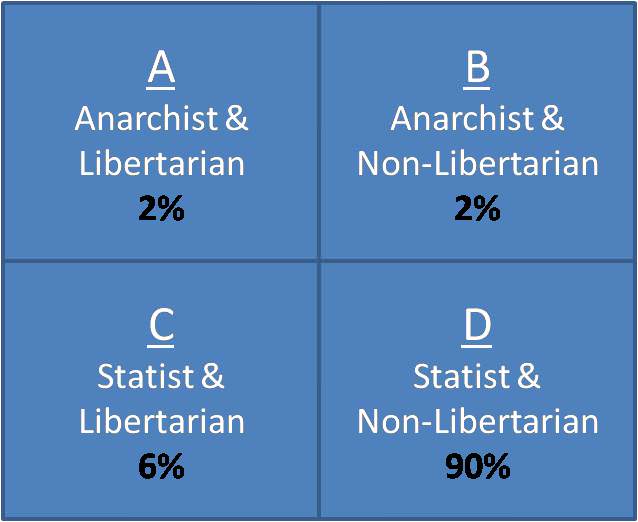
The numbers here are purely illustrative; I don’t want to get into a debate over them.
The point is that most people hold position D, and we want as many people as possible to hold position A, like us. But getting someone to jump straight from D to A is a tall order. I went from D to C (thanks to Ron Paul), and then from C to A (thanks to mises.org). I suspect many of us took this route.
Those in position B are our adversaries if we are trying to convert people to libertarianism, but they are our allies if we are trying to acheive anarchy. To acheive anarchy, we don’t need people to accept the whole of libertarianism - they must merely accept free entry to set up competing legal systems. One can imagine a threshold, say 10%, that must be reached in order to acheive anarchy. So if we manage to get 20% of the 90% in position D to position B, we will have anarchy. Once we have acheived anarchy, many people will become libertarians because it will be cheaper to buy libertarian legal codes, and they will be more effective. This may be the best strategy for getting people the whole way from position D to position A and thus acheiving our ultimate goal. Anarchy first, then the market will give us libertarianism.
The opposite strategy, the “Ron Paul strategy” of getting people from D to C and then getting them to this website (the job of LRC and C4L), is working well. It doesn’t usually take people too long after they find mises.org to see the contradictions in position C and move to position A. But a lot people remain in position C: the constitutionalists/minarchists. What use are these people? Suppose we managed to get 20% of the 90% in position D to position C. Will we acheive our goal? I don’t think so; governments grow, they do not shrink. We would still have a long way to go to get to our ultimate goal of libertarian anarchy.
Furthermore, it may actually be easier to get people in position D to go to position B rather than to position C, i.e. easier to convince people of anarchy than to convince them of libertarianism. The argument for anarchy is the relatively simple question of monopoly vs. competition. The argument for libertarianism is relatively more complicated and nuanced, and people may object to the whole philosophy because they feel particularly strongly about one issue, such as the libertarian stance on abortion, capital punishment, welfare, etc. It may be easier to convince these people of anarchy than to convince them of libertarianism.
How can one be statist and libertarian at the same time?
Goal 1 is nonsense, and is what we have now. You are ‘free’ to propose any sort of deranged ‘legal code’ and other deranged people with more guns than you are ‘free’ to deem your ‘legal’ code ‘illegal’ and jail you, execute you or whatever.
People can be inconsistent and self-contradictory.
Today, the chances of a small community seceeding are low; the deranged people with more guns will come. But if more people were anarchists, maybe this wouldn’t be the case. Anarchists, whether libertarian or not, will say to the government ‘let them go’, and the government may be forced into doing so.
The way I see it, (1) is a constitutive means to (2). That is, anarchy is a means to bringing about a libertarian society, but it’s also a part of a libertarian society, because a society must be anarchic to count as libertarian.
Hence I’m confused that you write “Anarchist & Libertarian” in your diagram. I don’t see anarchism and libertarianism as separate things; rather, I see the former as a constitutive part of the latter.
Have you seen Patri Friedman’s meta-institution or ecosystem approach?
I hear that brother.