@Dan, welcome to the Mises forum, glad you joined.
…
The geoists will deny that the LVT hampers economic calculation or the efficiency of land use. In fact, they will say that land would be used more efficiently with the LVT than without it. I’m hoping someone will make that case so we can have the debate here.
Thanks, Graham. As there are people who have already put forward the case far better than I could, I will just quickly summarize some of the simplest reasons here. I should also mention that although I use the word “tax” below, I consider this to be a misnomer as LVT is a tax in form but not in function.
Firstly, LVT should not be considered in isolation. As much as we may be hoping for the idealistic stateless society, at least for now we are stuck with taxes. And the unfortunate fact of the matter is that if you don’t have LVT you will have something far worse, such as an income tax or sales tax. Why is an income tax or sales tax worse? Because it distorts prices, causing deadweight loss. How? Because prices are a function of supply and demand and by increasing the cost to produce the particular good or service, the quantity supplied is reduced. Why doesn’t LVT distort prices? Because the quantity of land available is fixed, so supply and demand are unaffected. (Land in the economic sense used here refers to natural resources only, including not merely valuable physical material but also things such as valuable physical locations and phenomena such as the electromagnetic spectrum - we are not talking about anything produced by industry here, such as the man-made islands of Dubai.)
Secondly, the rental value of land is not a function of the labour, capital investment, entrepreneurial ingenuity or other such human input into the process of production. Instead, the rental value of land is solely a function of the margin of production. This is known to classical economists as Ricardo’s law, which, briefly and simply stated, says that the rental value of a particular parcel of land is equal to the advantage gained using that particular parcel relative to the best available free land, all other factors considered equal (such as inputs of labour and capital). Under present economic arrangements, the owner of land is granted entitlement to the economic rent of their land. Since the cost of owning land is relatively low (unlike capital assets it does not usually depreciate in value; instead it usually appreciates), while the rewards are relatively high, and since the function of owning land does not of itself result in production (though geoists agree that private posession of land is often necessary and beneficial to production), what we see as a consequence is that unproductive investment (known to economists as rent-seeking) is encouraged at the expense of productive investment. Land rent, therefore, is not information that serves the purpose of economic calculation; instead it is misinformation that distorts allocation. LVT removes this misinformation, and as a result the market has undistorted information with which to calculate prices and efficiently allocate.
Thirdly, the assessment of land values is much simpler, cheaper and less invasive of privacy than that required by any other form of taxation.
Fourthly, LVT encourages land owners to put land to the best possible use. As I mentioned above, the costs are low and the rewards are high for owning land. The individual incentive to maximise profits does not necessarily result in land being put to best use since above a certain threshold there are diminishing returns to productive investment and one’s available capital is more profitably invested in further land acquisition (which in itself is a non-productive activity). This is one of the reasons why we see what to most folks is perplexing (though I don’t deny that there have been attempts to rationalise the phenomenon) - homes and shops that remain vacant and boarded up for years while others struggle to afford to pay rent on properties they need to start a business or family, or what Jefferson referred to as “uncultivated lands and unemployed poor”. But such uncultivated yet productive lands do not merely represent an opportunity cost: they also present the problem of urban sprawl. Urban sprawl is economically costly as a result of many factors: additional commuting time, additional infrastructure costs, reduced synergistic effects, lower efficiency of public transport, increased environmental pollution and more.
As I can’t hope to do full justice to the arguments here, I will also recommend the following resources to those interested in looking further:
It’s often suggested by Georgists that land is different because it has a fixed supply. This analysis is flawed on a number of levels. First of all, the supply is not fixed; as with any other commodity, its utility is a factor in the supply. The supply of oil, to use a consistent example, is subject to the technology available to extract it. The supply of oil has vastly increased over several decades as new sources were discovered and new extraction technologies were employed. This would be true even if the physical presence of oil had changed not in the slightest. A road, for example, can specifically increase the supply of land – and roads can be built privately and completely without action of a “social” nature. Likewise, beyond the constant bombardment from space increasing the earth’s mass (about 270 tons per day) and the eventuality of living space on other planets/moons (thanks to the great “anarcho-capitalist” Newt Gingrich!), the supply of land can be increased by building islands, et cetera. The response to this is usually the fallacious definition of land discussed earlier – that building an island (land) comes at the expense of sea (land). From an economic perspective supply never includes that which has no utility because it is inaccessible or unavailable, so until airspace, for example, is made accessible by building, it is not part of the supply.
Moreover, there are countless other goods that actually are in fixed supply: masterpieces; collectibles; tickets to a given event. These goods are fixed, but do the laws of supply and demand somehow not apply to these scarce goods, which have alternative uses?
This is begging the question and a value input, not an argument.
Value theory has been basic to economic thought for as long as there have been discussions of political economy. A number of theories, mostly input related, were explored and rejected going all the way back to the ancient Greeks. The physiocrats were among the first to consider a departure from input based valuations nearly a generation before Adam Smith published “An Inquiry into the Nature and Causes of the Wealth of Nations”. Smith, himself, struggled with value understanding that simple monetary assessments were inadequate. He proposed that either corn or labor might be better measures of value not in the input sense,but in the sense of what one must give up to obtain something of value. This latter suggestion was distorted by Ricardo and then distorted still further by Marx, who misread the concept entirely to return to the failed input-based valuation theories of the past.
Today, economists are pretty much unanimous in their acceptance that value is entirely subjective and expressed via marginal utility. It matters not whether you are talking to a Keynesian or a Chicagoan or an Austrian or a Neo-Classicalist, it is recognized that value (as opposed to price; except when it is exactly equal to market equilibrium) is based on the wants and needs of the individual members of the society rather than being inherent in any given object and is expressed through marginal rates of substitution/transformation as determined by the subjective determinations of actors in the marketplace.
The move to the marginal theory of value was so overwhelming that it became known as the 19th century’s “Marginal Revolution.” Only the Marxists, uninterested in economics, chose to cling to labor and other similar input based valuation theories that, ultimately, do not survive logical scrutiny. Marginal utility valuations are universal. That is, they explain the valuations of any and all commodities in the marketplace and determine how market values come into being as those individual valuations influence the supply and demand functions for any given commodity in the economy.
While this may or may not be a valid historical fact, either assessment says nothing of the justification of such a tax. All taxes are argumentatively unjustifiable.
In argument, there must be a set of certain norms that are implied by the very act of argument such as the acceptance of intersubjectively ascertainable truths (one cannot deny that this is so without affirming its negation to be true). These are norms and they constitute the logic of justifying arguments, ethics. So in resorting to argument, as must again be assumed to exist given the a priori of argumentation (that is, because one has the capacity to argue, he is able to understand what it means to make a validity claim- one cannot argue that one cannot argue), ethics must be assumed to exist as well as all arguments to the contrary would be to assert contradictions.
Contradictions in this manner are not the formal contradictions of logic (where one argues both P and not P, for example) but are made performatively. Statements such as “No one ever does anything”, “I don’t breathe”, “I never argue”, “There is no truth” et al would thus be logically absurd if one were ever to propose them in the course of argument because, performatively, these propositions must be assumed to be valid. On the other hand, these arguments could qualify as formal contradictions if one were to write down all the minutiae of what is to be assumed in the course of argument (as in, stating “two perpendicular lines constitute a right angle” is “assumed” as in a geometrical proof).
In arguing, one must assume the private property rights that one has in himself as well as the private property rights the other person has in himself- otherwise, such activity cannot be recognized as argument. As long as there is argument, there is respect for property rights as a matter of ethics irrespective of what one says in their argument (the ability to agree that there is a disagreement is present). So, argument presupposes:
the NAP to be valid;
the natural (first use, first owned) theory of property rights to be valid. [Any argument to the contrary (one that favors the inititiation of violence- e.g. rape, murder, theft, assault, et cetera) must be unjustifiable since these propositions are contradictory to the ethic by which they are proposed.]
Furthermore, the very concept of justifying one’s arguments implies persuading others to accept the plausibility of one’s argument without resorting to initiating violence. It is not only contradictory as a matter of action, to assert aggression, but it is also contrary to the science of justifying arguments.
The part in bold is contrary to what economic laws and the laws of human action tell us. I’ve addressed this claim above, in an earlier post of mine, but will readdress it as an application to your specific response to the OP. Taxes are always and everywhere an added cost to production that otherwise would not be present in the absence of the tax. Costs, implied in action, are economic resources that are used up in production and redistribute economic production to what they would not be in conditions absent the costs. Costs are, at the most basic levels, a reflection of scarcity. So costs, and therefore taxes, necessarily affect economic action. Whether this affects production in a postive manner or a negative manner is purely a value judgement and says nothing of the justifiabilty of taxes (which I addressed in critique of your third contention).
The individual incentive to maximize profits necessarily leads to the most economical use of scarce resources, which have alternative uses, provided that such production and distribution is consistent with property rights. Intrinsic in human action is the desire remove felt uneasiness (this cannot be denied without a performative contradiction being made). Also implied in human action is the concept of values, which is to say that people have values and act based on them (my pausing this typing to drink a glass of water shows that, at one time and in this place, I valued drinking water more than typing). So one cannot claim that humans do not act based on values without encountering a performative contradiction. Values can either be negative (cost) or positive (profit) and, while cost and profit also apply to economic transactions, values are manifested psychology. By drinking a glass of water in the midst of my typing, many inferences can be drawn:
I had a felt uneasiness- thirst.
I imagined conditions without uneasiness- not-thirst.
I imagined the means to relieve this uneasiness- a glass of water.
I imagined the costs that would be incurred in order to relieve this uneasiness- finding a glass, walking to the sink, time, patience, et cetera.
I determined that the benefits outweighed the costs.
I acted- I got the glass of water and drank it.
Now, while I may have used this means (glass of water) to the end of removing a felt uneasiness (thirst), in no way can we infer that I benefitted from taking this course of action. It may be that there was some variable of cost for which I didn’t calculate (e.g. dirty water, more time than anticipated, still thirsty after this glass et cetera). This, however, in no way, shape or form proves that I am irrational. Action is always rational as it is always rational to use means to acheive ends; however, this flatly does not imply that actors are infallible. Actors can, and often, err in forming causal relations. Similarly, land may sometimes not be put to best use by an underestimation of potential costs incurred, an overestimation of potential profits, or some other mitigating psychic factor. This does not call for a rectification by adding taxes (costs) to the operation in question, as doing so would only further overestimate potential profits, further underestimate potential costs, than would otherwise be prevalent in natural conditions (a theoretical base denoting a situation in which the NAP, and therefore property rights, are adhered; I use this condition in comparison to the theoretical one you use in which neither are adhered due to the imposition of an LVT). Given the added cost that an LVT poses to a prospective producer, it is not unlikely that producers will produce less in favor different action- but what action?
Taxes are not arbitrary costs. If I pay a tax, it is not as if the money is being burned when the tax is due. The tax, in the form of produced means of further production or economic goods, is seized from me and given to someone who has no rights to it- a nonproducer or noncontractor. I’ve established the necessity of values in human action, and given that there are greater costs in production and greater benefits in nonproduction, there is more incentive to act in nonproduction than there would be in natural conditions. Since production is hindered, consumption is hindered as well as one cannot take place in the absence of the other, by definition.
Diminishing marginal returns don’t refute the concept of value maximization but are instead derived from profit maximization even under ideal conditions. It can be deduced praxeologically: because actions are directed at one’s most urgent ends, the means used in the process of relieving an end are necessarily valued highest initially and lower in additional quantities. Let’s say from above, I finished my glass of water (it wasn’t dirty or anything) above and am still thirsty. Assuming that the causal relation I perceived before acting is correct, that water reduces thirst, I may still be thirsty, but it is less than it was before using these means. As a result of diminished felt uneasiness (thirst) I value the means of remedying this felt uneasiness less (additional glasses of water). While the perceived value has declined, the costs have increased (spending more time at the sink, greater exertion of myself physically, et cetera). At a certain point, psychological profit and psychological cost will intersect and cost will be greater than profit. At this point, I will stop drinking water. And since this realization is implied by action, the concept of dimishing returns is valid a priori. This point is where total profits are maximized which further proves that the profit motive is at the very pith of all human action and that diminishing marginal returns, also implied by human action, are in no way a refutation of the profit motive.
Investment and capitalization are flatly not non-productive activities; on the contrary, they are at the very starting point of acquiring economic goods. Acquiring economic goods and concepts such as living standards cannot be imagined without production, which in turn cannot be imagined without investment.
There is nothing inefficient in urban sprawl, so long as property rights are observed. On the contrary, if property rights are observed, then sprawl demonstrates the most valued use of economic resources by consumers concerned at given times. All other examples could be traced to inefficient “zoning laws,” and public property that aggress against natural conditions and impose undesired effects to producers. Opportunity costs are inherent in all economic transactions are not unique in the case of urban sprawl. Pollution is the effect of a poor enforcement of property rights.
@ThatOldGuy Thanks for your contribution - I do not have time to respond to every point in your post here but I will try to respond to what I think are the most substantial objections.
1. On the fixed supply of land
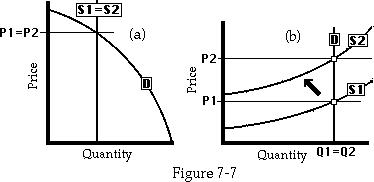
First, technology does not increase the supply of oil any more than an efficient motor increases the supply of calories in a gallon of fuel. Second, this is not a consistent example since oil produced by technology such as biofuels is not land in an economic sense.
A road does not increase the supply of land, it merely alters the use of land that was already supplied.
As I mentioned in my previous post, man-made islands do not fall under the economic definition of land. In economic terms, man-made islands are capital.
This is question-begging, since prior to the existence of humans, all land had no utility yet was still supplied. By asserting that land cannot be supplied unless it has utility, you have assumed your own conclusion: that the supply of land is a result of human action.
2. On the effect of perfectly inelastic supply
Indeed, the laws of supply and demand do apply to such items, just as they apply to land. And the laws of supply and demand state that a tax on such items in perfectly inelastic supply will not affect their price, as shown in figure (a) of the following diagram:
I agree, which is why I consider LVT to be a misnomer (as I stated in my previous post). Unfortunately, much of the language of the discipline of economics was formed during its infancy, when the implications of that language were not always fully understood. But since it’s the meaning of words, rather than the words themselves which are important, it’s probably not helpful to invent new terminology when people already understand what is referred to by “LVT”.
3. On premises
I accept this premise.
That is obviously question-begging, since the point of contention is precisely whether or not “first use, first owned” is in fact valid.
4. On incentives
This is not the case for land, which has no cost of production, because it is not something that can be produced by humans (by definition).
The Fundamental Welfare Theorem is only provable on the assumtion that perfect information is available. As I have argued previously, the collection of rent by extra-economic means is a source of misinformation and prevents efficient allocation of resources.
Geoists do not accept that the collection of economic rent by extra-economic means is respectful of property rights.
“when they say “land monopolization” they mean what we would call private ownership of land, or a free market in land.” Not so. Land is a monopoly because:
The supply cannot expand, so landowners all together have a monopoly; to get land, one must transter land from a previous title holder. This is the same concept as the monopoly of taxi permits when a city only allows a fixed number of permits. There are several taxi companies, but together they form a monopoly in that there is no entry to expand the number of permits.
Each plot of land is a monopoly on that particular location. If you want to visit the Statue of Liberty, you must go to that location.
The Georgist use of the term “monopoly” was also used by economists of the classical school, and has nothing to do with who has title to land and whether there is a free market. There is today no free market in land or anything else.
Graham Wright claims that Georgists believe that land belongs to the community. Not quite. Georgists believe that the economic rent of land belongs to some relevant community in equal shares, but the possession of land may well be individual. Indeed, Georgism would provide greater rights of individual possession than now exist by abolishing zoning, eminent domain, asset forfeiture, and building codes.
Graham Wright claims that Georgism collects 100% of the income from land. Georgist policy collects only the economic rent of land, which by definition is that rent not needed to put land to its best use. Thus any income due to entrepreneurship and improvements by the title holder would not be taxed. Henry Geroge wrote that in taxing land value, some rent and land value would be left with the title holder; that facilitates the market for transfering title, hence is not part of the economic rent.
And the laws of supply and demand state that a tax on such items in perfectly inelastic supply will not affect their price
Who said that land is in perfectly inelastic supply? I have an impression that constant total stock (even if we assume it) has nothing to do with supply being inelastic. In a way, this is similar to the usual confusion of needs and demand. In fact, perfectly inelastic supply means the current owner is willing to part with his property no matter what he gets in return - I just do not see that applicable to land (or rental of land).
I hope ThatOldGuy will respond to your post, and that more Austrians will get involved in this thread, but I just want to make a comment about the statement “the land supply is fixed”. I don’t entirely accept this, which is to say that I don’t think the definitions of supply and land you are using when you make that statement are useful for economic analysis. But putting that to one side for a moment, consider a good whose supply which is truly fixed… the one Rothbard chose: Rembrandts. What would be the effect of taxing the rental value (or rental price) of Rembrandts? How would it change how Rembrandts are allocated, that is, who gets to enjoy them?
Is your position that it would improve the allocation of Rembrandts if they were taxed at, say, 80% of their rental value?
Land is a monopoly the way you define it, sure, but the point of my note was to clarify to my fellow Austrians that you Georgists use a different definition of monopoly. I prefer the Austrian definition because I believe it’s more useful. With your definition, each plot of land cannot NOT be a monopoly on that particular location, and this makes the term useless.
As for your first point, I would say it’s a bad analogy, because if there were no permit system for taxi drivers, supply could easily be expanded. Whereas the way you define it, land supply can never be increased. Further, you say that to get land, one must transfer land from a previous title holder, but this is only the case if you consider the verbal decrees by States today that they own all land as legitimate, which none of us here do. If this restriction were removed, then it would be possible to get land without acquiring it from anyone else. One could just homestead any of the land which has not been homesteaded by anyone else, and there is, thankfully, a lot of un-homesteaded land out there.
We libertarians also oppose zoning, eminent domain, asset forfeiture and building codes, so that’s a moot point. The relevant comparison here is libertarian anarchy and geolibertarian anarchy.
If all government-held lands were released for homesteading, at no charge, most likely all land would quickly be claimed. Why not? There would be almost no carrying cost.
Getting a synopsis on Henry George from a non georgist, runs the same risk as getting advice on how to pleasure women from a priest. For example many of the qualifiers critical to understanding Georgism are absent from Graham’s description.
My experiance on those that debate Georgism matches that expressed by Tolstoy :
“People do not argue with the teaching of George: they simply do not know it. The teaching of George is irresistibly convincing in its simplicity and clearness. He who becomes acquainted with it cannot but agree.”
The summary of Georgism is “keep all you make, pay for all you take.” Simple and yet people want to argue.
You are right about there being no such thing as “the community”. However the people whose freedom is abridged by exclusion from natural resource do constitute a class.
But in explaining Georgism I believe that Georgists are making a big mistake. Georgism is simple, and in the absence of a confusing framework would be self evident to any who are steered past the rocks. The georigsts are continuously tasked to defend that 1 =1 from people who deny it. So I would rather take a different tack. Which is to explain away all those rocks and then just show what is left.
A major rock is the concept of possesion by homestead. If this is the principle which confers ownership of nature, then its fundemental that it be fully examined. Because all of life all of freedom’s practice is the accessing of nature and changing its form. Thats all we humans do. So if nature is to be sequestored, even before many are born, there s/b a good explanation of why the total amount of available freedom must forever decline with each homestead.
For any one interested in learning Georgism I think the following question most appropriate.
So given the choice of George III and those rebelious not just to his rule but to his right to rule, you would favor George III and his property rights over the fictituous concept of collective self rule? I have often thought of Hamilton as a poser, but Jefferson too?
BTW the snarky tone is purely for broad humor and not directed at anyone in particular. Seriuously, I don’t even take myself serious.
Ok so the guy who stands on your lawn, says its his lawn and you should get off. Now its property rights vs property rights. Why are yours superiour to his?
“The supply of oil, to use a consistent example, is subject to the technology available to extract it. The supply of oil has vastly increased over several decades as new sources were discovered and new extraction technologies were employed.”
This denies the Georgist premise of deferentiating natural oil (before extraction) and extracted oil. Instead of refuting, you are slashing at inadvertant strawmen. On top of that, I don’t think a clear thinking Goergist would use the term “the supply of oil”. Its not clearly defined in a relevent way. I have often seen the words “oil in the ground”, and if its supposed that technology increases this, then any increase so created is not what georgists would call a natural resource. But that oil created by natural means, and whose sole source of scarcity is the force used to exclude, then that would still need recompense for the appropriated freedom. Or at the very least the negation of the return to aggression.
For your collection, a blog post I remember reading here at LvMI some time ago about points against LVT that don’t necessarily rely on Rothbard’s arguments:
Would the allocation of rembrandts imporve the allocation if they were taxed at 80%.?
Yes. Because the return to speculators, who by definition are not using the Rembrandts would drop. They having less potential profits would spend less to appropriate Rembrandts from the pool of actual users. I define actual use as an improvement over mere ownership.