The fact of the matter is that the government and the FED (who couldn’t even control short-term interest rates at the time) did very little, if anything at all, and our economy recovered from the sharpest one year decline in history. There were no bailouts, the FED didn’t flood the markets with liquidity, and no stimulus packages/work programs were created. Instead, there was a deflationary contraction, and a sharp liquidation which purged the economy of malinvestments–completely contradicts monetarism and supports ABCT. The FED wouldn’t even lend to banks unless they had adequate collateral (Industrial commercial loans, “real bills”); this changed after the great depression.
These are a list of memos that were scanned. Look at the successive discount rate cuts (search the page for “discount rate”)–basically verifies the wikipedia entry about that.
While agree with all that, the fed DID do something, which was not what Tom Woods and Bob Murphy said.
And while we’re on the subject, where can I find more info about what a discount rate is and why it isn’t effective?
I think you are oversimplifying the issue - I would recommend that you directly email Bob Murphy and ask him about this (and publish his response here) because Mr. Murphy is very careful about the claims he writes down, so I attach a great deal of weight to anything that he says. His email address is murphy@mises.com.
Clayton -
But they do if they want to prove their own argument right, actually. Their state-worship needs justification.
Assume less, ask more. Murphy is very quick to answer emails.
Thanks! I’ll do that
You shouldn’t feel “cheated.” Joseph Schumpeter, in addition to Benjamin Anderson, attributes no significance to this; are you feeling cheated by Schumpeter? The point here is that very often we cannot draw sensible conclusions about monetary policy from interest rates alone. The Fed is merely following the markets in this case. During that depression, inflationary expectations were of course falling dramatically, hence interest rates in general would tend to come down. You see?
Thank you for your reply, I appreciate you taking the time to clear this up.
I understand that interest rates tend to fall when inflationary expectations fall. However, this is interest rate–the Federal Reserve discount rate–is an artificially determined number that is inversely related to the amount of money printed by the Fed (monetary stimulus). The Fed was likely indeed “following the markets”, but their interest rate was backed by a printing press, whereas the rest of the market was not.
Though I’m comforted by you, Schumpeter, and Anderson all agreeing that this has “no significance” in this case, I’d really like to see some evidence of this. Why was dramatically lowering (from 7 to 4.5%) the discount rate “of no significance” in 1921 but would be of extreme significance today?
To paraphrase Mises: it’s impossible to quantify the impact a particular monetary stimulus could have. Couldn’t a Monetarist therefore just assume the lowering of the discount rate made all the difference in 1921? Why or why not?
The Fed jacked the discount rate up in the first place to deal with the postwar inflation. Thus if any pushback in the discount rate from that moment on would be considered “stimulus,” then how could the discount rate ever be brought back down to normal levels?
What matters are the monetary aggregates, and it looks to me as if the Fed didn’t reverse its policy vis-a-vis the monetary base until 1922.
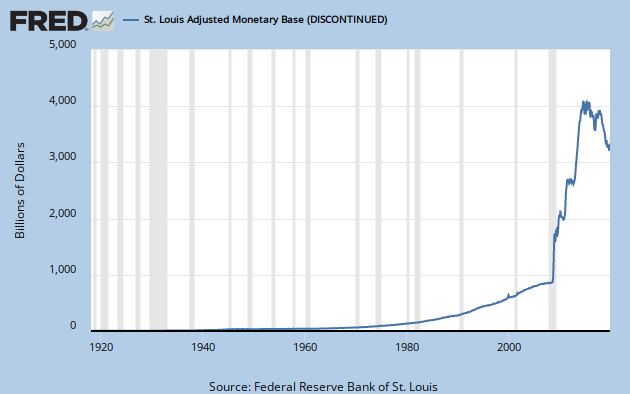
There it is! thanks.