What makes a libertarian: ideas or actions?

*sigh - 100 million people flouting the State’s dictates in minor ways is flouting the State’s dictates in a major way!

100 million people secretly running redlights is just 100 million people secretly running redlights. It’s not eliminating income tax, it’s not ending central banking, its not ending the wars, its not protecting people from the police state. Now, if those 100 million voted, they might change something. Or if they refused to comply in some meaningful way, but as it is, this is just some kind of national joke.

To refine my point into a general formula:

It requires a majority of public opinion of all adults to get away with openly flouting the law. It only takes a majority (or less if the system favors minorities, as ours does) of the electorate to succeed politically. A majority of the electorate is always smaller than a majority of the total adult population, usually much smaller, and so it takes fewer people to succeed politically than it does to succeed through civil disobedience. Since the cost of voting is less than the cost of civil disobedience, it is also easier to gather a given number of folks to vote for a cause than to gather than same number of folks to refuse compliance with some law.

Running stop signs is an illustration of the point - time is money, by saving yourself time on the basis of prudential violation of State dictates, you are saving yourself money. Not paying taxes on cash transactions is an obvious one. Engaging in more cash transactions (i.e. buying/selling used goods on Craigslist or through other channels) is another. Taking steps to protect your wealth, such as investing in commodities during times of high inflation, is another. Educating your neighbors on the same, is another.

What you are neglecting is that the State’s power is the cumulation of a million tiny violations of individual rights. Inflation is just a few percent per year. But a few percent of a $15 trillion economy is hundreds of billions of dollars - you can wage a lot of war and impose a lot of tyranny with that kind of cash.

But that blade cuts both directions. If even a significant minority of the public starts engaging in more cash transactions, starts protecting their wealth from the Fed, and so on, the pinch will be felt in DC. In fact, this is why they’re bitching so much about the hedge funds because they’ve done precisely this - they’ve enabled upper middle class people who were supposed to “eat it” with the rest of the public to escape a lot of the inflationary devaluation and even turn some spectacular profits by predicting the predictable bullshit coming out of DC and Wall Street.

In the same way that the hedge funds have gotten the attention of the Establishment, a significant minority of the public engaging in whatever form of non-compliance they judge to be in their interest will also get the Establishment’s attention. But, unlike hedge funds, they won’t have a single target to go after and make an example of, such as poor Raj Rajaratnam.

Also, once people start the ball rolling, the market for non-compliance will grow. Following Say’s law, black market suppliers create demand for black market goods and services. In this way, a distributed, leaderless (and, thus, targetless) “revolution” can grow from small roots of non-compliance to a ballooning monstrosity of black economy that escapes the reach of the authorities. The key is to free people’s consciences from the false idol of the State and open them to the freedom to disobey whenever they judge that it suits their purposes.

The State fears this eventuality more than anything else. This is why they deploy disinfo agents into Internet debate forums to spew random crap or fanatical extremism or even occasionally attempts at rational counter-arguments to the truth. This is the Poison Pill approach to disinfo.

The fact that this is what the State fears the most is evidence that it is what we should desire most. And reason agrees on this account. The Revolution - if it comes - will be leaderless, distributed and based on a reformation of the public conscience regarding the legitimacy of the State. I hope that Ron Paul is our generation’s Martin Luther.

Clayton -
Running stop signs is an illustration of the point - time is money, by saving yourself time on the basis of prudential violation of State dictates, you are saving yourself money. Not paying taxes on cash transactions is an obvious one. Engaging in more cash transactions (i.e. buying/selling used goods on Craigslist or through other channels) is another. Taking steps to protect your wealth, such as investing in commodities during times of high inflation, is another. Educating your neighbors on the same, is another.

The State has a way of trying to close escape routes, like cash transactions and precious metals. As the power of the State grows, more and more of those legal escape routes are either closed (e.g. by the State cooperating with the cartel banks and corporations to push a cashless economy) or made illegal (e.g. with outright prohibition on the sale of precious metals). Eventually you will have to choose between violating the law in ways that aren’t so risk-free and obeying them.

Also, once people start the ball rolling, the market for non-compliance will grow. Following Say’s law, black market suppliers create demand for black market goods and services.

That’s right. However, my idea of liberty is not conducting illicit transactions in back alleys. That doesn’t strike me as victory. That strikes me as making the best of the bad situation - I’d prefer to change the situation so I don’t have to deal in a black market.

No, it isn’t, because you made a gnomic statement, which transcends empirical observations. In order to be intellectually honest here, you’ll need to either edit the statement to match its empirical meaning, or back down from the claim that it represents an empirical observation and instead claim that it’s either a statement of belief or an assertion of general truth.

I’m very sorry to hear that.

No, it isn’t, because you made a gnomic statement, which transcends empirical observations. In order to be intellectually honest here, you’ll need to either edit the statement to match its empirical meaning, or back down from the claim that it represents an empirical observation and instead claim that it’s either a statement of belief or an assertion of general truth.

I said:

the masses of voters will never understand the ideas [of libertarianism]

This could be interpreted literally as a gnomic statement, or considering everything else I’ve said, perhaps it would make more sense to interpret it as a prediction based on empirical observation: the observation being that the masses have never in the past understood any political ideology (from which one might infer that they never shall in the future). I’ll leave it to you to figure out which interpretation makes more sense…

So don’t. You were asking about strategy - how do we get from here to there? Obviously, we can’t just click our heels and leave the Land of Oz. There will be some kind of process or change that will take time. Perhaps a short amount of time but if history is any guide, it will be a long time coming.

I am not opposed to political action. Feel free to join Cato, join the Mont Pelerin Society, join the John Birch Society, or start your own or even run for office. I just don’t think it’s going to work for the simple reason pointed out above: the State is a Mafia… how do you “change the Mafia from within”? It doesn’t make any sense. But feel free to try. I even hope I’m wrong and your approach works!

But if you want my view on strategy: start small, start building a foundation in the hearts and minds of the people, a foundation of truth and virtue discovered by right reason and sound science. This foundation may take a generation or two to build but once its laid, the superstructure of liberty can be quickly raised on it. Yes, I care about a generation or two from now because I want my children and grandchildren to grow up in a freer, happier, more prosperous world than we have today.

If you’re too impatient, well, too bad. Move to Singapore. Move to Zurich. Move to Argentina. Open a bank account in Andorra. I really don’t see a lot of hope in the short-term except for Ron Paul’s spectacular successes that have still not been spectacular enough for him to win a single popular vote in the Republican primary.

Clayton -

I’d have to completely disagree with this idea of the woman holding all the power in the bedroom. Sorry to side-track the thread by replying to your side-track. But it didn’t make much sense to me.

Lots of people already take the risk, and they are not necessarily libertarians: anybody who hires an illegel alien, a teenager to mow the lawn, conducts in illicit drug exchange (or any illicit activity), teaches piano lessons on the side, etc. People who do this are not necessarily libertarians, and I’d wager that most aren’t. Other ways people can “cheat” on their taxes is by putting down more write-offs than they are supposed to (or any other kind of loophole). They don’t have to necessarily under report their income in order to evade taxes.

So I don’t really see why I have to run around convincing people to do this when they already are.

This is my goal too.

As demonstrated by the Amish, this is not true. Political action coupled with civil disobedience would be far more effective than simply relying on either political action or civil disobedience. But political action is not necessary.

This is true. There needs to be more than just lots of people evading taxes. The way to get past just a lot of people evading taxes is through education. The more people who disobey, the weaker the state becomes. The weaker the state becomes, the easier it is to disobey. Entire laws have gone into the dustbin just because so many people stopped obeying them, and so the police stopped enforcing them.

These taxes will be on the books until people don’t tolerate them any longer. The sign that people are not tolerating them is when people stop obeying them. Voting them out would be helpful, but this doesn’t happen very often.

If you would like an example that doesn’t have to do with taxes, just look at alcohol prohibition. The government banned it outright, yet people still drank alcohol! They risked fines and imprisonment over their right to drink alcohol! So many people disobeyed the law that the government just gave up. Sure, the government “repealed” the law. They repealed it because of civil disobedience. If everyone just followed the law and tried to get it repealed through political action, we’d have a dry America today. Thank God that people back then didn’t take your advice and not risk imprisonment!

I am not opposed to political action. Feel free to join Cato, join the Mont Pelerin Society, join the John Birch Society, or start your own or even run for office. I just don’t think it’s going to work for the simple reason pointed out above: the State is a Mafia… how do you “change the Mafia from within”? It doesn’t make any sense.

The State is not the mafia. The mafia does not hold elections, the State does. You can change the State from within by winning elections, you cannot do so with respect to the mafia.

But if you want my view on strategy: start small, start building a foundation in the hearts and minds of the people, a foundation of truth and virtue discovered by right reason and sound science.

And what does that actually mean?

This foundation may take a generation or two to build but once its laid, the superstructure of liberty can be quickly raised on it.

Raised how? And what superstructure?

If you’re too impatient, well, too bad. Move to Singapore. Move to Zurich. Move to Argentina. Open a bank account in Andorra. I really don’t see a lot of hope in the short-term except for Ron Paul’s spectacular successes that have still not been spectacular enough for him to win a single popular vote in the Republican primary.

I’m for freedom sooner rather than later, yes, and why not? Is there some special virtue in waiting? I don’t follow. Seems to me that time is running out. Once the State reaches a certain degree of control (e.g. control over breeding and childhood development) the game’s over. We lose, forever. Tick tock.

As for Ron Paul, I’d say he’s done more to advance the ideas of libertarianism (which seems to be your entire strategy) than any one other person in history. He has done this through political action. But it’s not just educational. We are winning delegates. We are taking over local and state party organizations. We are building a political machine that will win elections in the not-so-distant future. Meanwhile, those who reject political action are doing…I have no idea, because I never hear anything about them. Hmmm.

Theoretically, you are supposed to have the ability to fix things through elections. But whoever is in charge will still be operating a mafia-styled organization. They still claim the authority to come for your money and steal it and throw you in a cage if you resist. Sounds awfully like an extortion racket no matter who is in charge. At any rate, you don’t honestly believe you have much of a choice no matter how many people you convince, do you? The people that will infiltrate any sort of anti-establishment movement will turn the moment you elect them. Power corrupts and all that jazz. The whole thing is a charade really. Paul is getting shafted at the local level in vote counting (I’m usually anti-conspiracy, but this stuff seems pretty realistic) so he can’t gain any momentum.

The government is limited in what it can get away with, but this hearkens back to Clayton’s point: The government only gets away with what it can due to the attitudes of the people. Ideology is the key factor. If they were to break a revolutionary threshold, people would revolt. The government doesn’t want that on their plate, so they aren’t completely unrestrained. But they can fool the population pretty easily to get what they want and it’ll be like that for a long time.

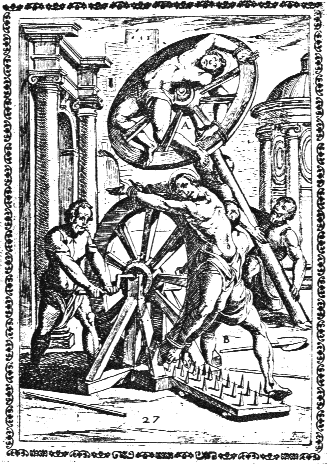
Um, that’s an appalling lack of historical perspective. For expressing the kinds of “Fuck the State!” opinions that I regularly express on this site, 500 years ago, the State might have had something like this waiting for me:

So, while I don’t believe in progress per se, I think that it’s not true that the State is a ratchet. It wants to be a ratchet. But the State doesn’t always get what it wants. And that’s exactly what I want to see more of: the State not getting what it wants.

Clayton -

@Clayton

Well, I would say it’s an appalling lack of historical perspective to not understand that the State today is fundamentally different from the State at any time in the past. “Scientific dictatorship” is not an empty phrase. The art of rulership has become a science. Never in the history of the world has so much thought and wealth gone into developing and implementing that science - and never has such technology been at the disposal of the State. Most importantly, the State has never been consciously directing its own evolution (as opposed to just reacting to events) as it has for the last, let’s call it 150 years. As a consequence, the State has never been stronger. Sure, the State has become less overtly violent: but that is not a sign of weakness, that is a sign of increased strength. Read Nietzsche, the greater the power of the ruler the more generous and less brutal he can afford to be. The State is less violent because people are more obedient. The best State (from the perspective of the rulers) is not an Orwellian/Stalinist world where dissent is brutally crushed, it’s a Brave New World where the masses are bred and conditioned so as to never even be capable of conceiving of dissent in the first place. This is why eugenics is so important to the ruling class. It’s not mindless racism, it’s about taming humanity: creating perfect slaves who cannot rebel. I personally believe that we are approaching a point where the State will have such control that resistance will become impossible, primarily because it will become unthinkable, literally. Consider that we are only ever a few generations away from permanent tyranny, because, once the entire existing population is tamed, and once the State has control of breeding and “education,” where exactly is resistance going to come from? Better hope for some libertarian aliens!

…Hence I say time is running out. Call this melodramatic if you please, and I hope you’re right.

Theoretically, you are supposed to have the ability to fix things through elections. But whoever is in charge will still be operating a mafia-styled organization. They still claim the authority to come for your money and steal it and throw you in a cage if you resist. Sounds awfully like an extortion racket no matter who is in charge. At any rate, you don’t honestly believe you have much of a choice no matter how many people you convince, do you? The people that will infiltrate any sort of anti-establishment movement will turn the moment you elect them. Power corrupts and all that jazz. The whole thing is a charade really. Paul is getting shafted at the local level in vote counting (I’m usually anti-conspiracy, but this stuff seems pretty realistic) so he can’t gain any momentum.

The government is limited in what it can get away with, but this hearkens back to Clayton’s point: The government only gets away with what it can due to the attitudes of the people. Ideology is the key factor. If they were to break a revolutionary threshold, people would revolt. The government doesn’t want that on their plate, so they aren’t completely unrestrained. But they can fool the population pretty easily to get what they want and it’ll be like that for a long time.

I don’t think I follow your point. The people are too stupid to pick honest politicians, but the solution is to educate these same stupid people? Huh?

@Minarchist: Well, there’s a lot we disagree on. I read history exactly backwards from what you’re saying. In my view, the State has always been “consciously directing its own evolution”. It has long been predicted that humanity would split into two distinct groups, elites and subhumans (cf Verne’s Time Machine). Human breeding has always been going on, just look at slave breeding in the South prior to the war.

It is the State that is fighting gravity, not free society. Free society is what happens unless somebody moves heaven and earth to keep it from happening. And while the State has expanded its tentacles into every part of life, I think that the plight of the average individual today is much better than any time before about 200 years ago. I have argued that the State’s insertion into every part of our lives is actually evidence of the breakdown in the moral case for the State, which is really a precursor to the State’s loss of power.

I’m happy to debate any of these particular issues because I’m sure I have plenty to learn but, as it stands, we just don’t see eye-to-eye on a lot of things.

Clayton -

@Clayton

Well, there’s a lot we disagree on. I read history exactly backwards from what you’re saying. In my view, the State has always been “consciously directing its own evolution”.

I agree that the State has always been self-conscious to some extent, but something very dramatically changed during the 19th century. By way of analogy, it’s like a farmer who has been unintentionally breeding better plants for years when he suddenly discovers the science of plant breeding and starts applying it deliberately. Read Auguste Comte, the introduction to “The Positive Philosophy of August Comte” (1853) for an archetypical example of the new concept of rulership that arose at that time.

It has long been predicted that humanity would split into two distinct groups, elites and subhumans (cf Verne’s Time Machine). Human breeding has always been going on, just look at slave breeding in the South prior to the war.

Yes, it is an old dream, but only recently has the technology emerged to realize it. The eugenics of the early 20th century and before was bunkum or took an impractically long time. Now they can actually do it with genetics - it’s just a question of bringing the public along to accepting it.

Incidentally, the dream lives:

It is the State that is fighting gravity, not free society.

Yes, but it’s winning that fight.

…Anyway, this is perhaps not the place to get into this long discussion - another time though, as it is very interesting.

To me, the only interpretations that make sense given the context are 1) it expresses a gnomic statement, and 2) it expresses a statement of belief. I will continue to stand by that.

That said, how much empirical observation have you personally made here? You certainly haven’t been around for all time. So I also challenge your assertion that “the masses” have never understood any political ideology in the past.

This conversation is interesting to me because you guys talk about “the state” like it’s some amorphous blob or something. Like a monster lurking out there sending people bills for building roads. You talk about “the state” like it has a single consciousness, a single will.

But what is “the state” in reality?

What comprises “the state?”

Am I “the state?”

I think so. Or at least part of it. Because the state is just made up of people. Lots of people who all accept similar ideas. We work together to achieve common ends.

You’re right, of course, that the state isn’t some mystical non-human or extra-human entity. The state is an idea. That means it exists only within people’s minds. But on an operative level, the state is also an organization.

Do I think I’m part of the state. No. Do I think you’re part of the state? Unless you work for some government agency, no. I’m not sure why you think otherwise.

“The state” is an organization of people. There are buildings and committees and so on and so forth but they are all filled with human beings.

Well this is just another semantic issue. The label really doesn’t matter, what matters is that I support the ideas.

EDIT: I would be willing to work for the government if I could but I’m probably horribly underqualified. I also don’t need the money right now.