What's your beef with Roderick Long and "left-libertarianism"?

No, I know you’re not asserting that the left-libertarian position is correct. I guess what I’m trying to say is that I still don’t quite understand what the premises of left-libertarianism are. Do you know whether Kevin Carson, Roderick Long, or any other self-described left-libertarian provided his definition for “justice” anywhere on the internet?

No, and in fact whether God exists is moot to that issue, if you ask me. But I think your analogy illustrates that this is largely a semantic issue. If one defines “Christian” in a way that includes believing in the trinity, then Gnostics aren’t “Christians” under this definition. If one instead defines “Christian” in a way that doesn’t include believing in the trinity, but does include certain beliefs about God, then Gnostics are “Christians” under this other definition.

In any case, I’d really like an example of a left-libertarian definition of “justice” so that I can investigate its implications. For me, the jury is still out as to whether any statist implications can be drawn from such a definition.

Well, you said “capitalism” was being coopted by socialists and changed its meaning to the opposite of its true definition. Now, let me make it clear for you:

  • Socialists invented the word
  • Most people consider the current system to be capitalism.

Therefore,

  • The purist, laissez faire definition of capitalism is not the largely held one. Socialists did not coopt the term “capitalism.”

I fail to see how any of that is not relevant (let alone refutative) to what you said.

Autolykos,

http://praxeology.net/whyjust.htm - This is a lecture by Long regarding justice. It isn’t necessarily “left” as much as it is Aristotelian. Its a little heavy, but it addresses both Rawls and Nozick.

Part of the problem with what you’re asking for is that the definition of “justice” doesn’t necessarily bring us any closer to understanding what we’re talking about. Long defines justice as “the moral system of rights, or more precisely, the virtue concerned with respecting such rights.” This is a fine definition, but it won’t give you any real answers.

And I think as an Aristotelian, Long would probably say that we can’t fully grasp the virtue of justice (especially in regards to its application) without practical wisdom (phronesis), and we don’t gain phronesis without actually practicing and living all of the virtues.

In other words, “justice” doesn’t lend itself to the kind of armchair philosophizing that we are doing.

Thanks, I’ll check that out.

Well the question then is, what does Long mean by “moral”, “rights”, and “virtue”? Is that what you mean by saying that his definition won’t give me any real answers?

How do we know whether we’re practicing and living all of the virtues if we don’t know what the virtues are to begin with?

I didn’t think there was any other kind of philosophizing.

Please show me where I said any of that.

And?

Not really. They’re more like Larry King on this subject.

If you press them on it, no one will try to claim what we have is “pure capitalism” (hence the adjective qualifier to ensure one understands). They’ll admit what we have now “isn’t really ‘real’ full-on capitalism”…They just allege that the capitalist aspects of our current order are the cause of all our problems. When they say “capitalism is the problem” they do not mean that our current system in its entirety is the problem. Obviously these people (again we’re talking about the majority…not communists) do not want to get rid of social security, medicaid, and things of that sort.

So to allege (as you do) that “Most people consider the current system to be capitalism” is just plain wrong.

Again, just ask anyone. “In a truly capitalist system, woudl there be Social Security and Medicare”? If they’re intellectually honest and consistent, they’ll admit “no”…as indeed, they often attempt to use such a fact against free-marketeers, calling such plans “socialist” or “socialistic”.

You/they can’t have it both ways. Either the system we have now is “capitalism” (period), and they’re against it, or there are only parts of the economy that have capitalist aspects, and they’re against those.

Then why when you ask about government bailouts of banks, takeovers of industry, a government-created/sanctioned Federal Reserve printing money, and government sponsored enterprises buying up mortgages, does virtually every one of the people you’re talking about admit those things are not part of “capitalism”?

One more time: if “Most people consider the current system to be capitalism”, as you claim, then why do they say “no, that’s not capitalism” when you ask them about various aspects of our current system?

Again, who said they did?

Well sure, when you introduce straw man arguments and put words in one’s mouth, I suppose you could make anything you say relevant and refutative to what (you claim) someone else said.

Read the article. Use contextual clues. How do you normally learn what someone means when they use a certain word and you aren’t able to ask?

Read the Nicomachean Ethics. Read the wikipedia article on it. Google the term “virtues”. Its not like virtue ethics is a new thing that Roderick Long made up to justify left libertarianism.

There is philosophy by doing. We can gain knowledge about the world by living life – philosophical knowledge even. A concept like justice can be batted around in conversation, but the whole purpose is to live it. Thats why we are talking about it in the first place. And in living it, we gain further understanding because we gain experience in all the nuanced way it differs in each situation.

Its kind of like reading a book on how to do surgery and having the actual experience. Tacit knowledge, and all that.

“Left-libertarianism” - in the Roderik Long meaning of the word - is just an ‘in crowd’ signaling mechanism. It means that you think that libertarianism is more likely to ‘achieve’ certain goals typically associated with the left, think that libertarianism has better answers to certain beefs ‘the left’ has, that leftwing concerns are legitimate and caused by the state, thaat ‘as a libertarian’ you focus more on typical ‘left wing’ issues … Stuff like that. There is no major difference. It is not a political philosophy different from libertarianism. It is merely an internal signaling devise.

On the normative and the analytical side; there is (usually) no difference, except for Kevin Carson. And then there is some minor - imo irrelevant - discussion on wether or not we should use the word ‘capitalism’ or not.

I hope this is clear enough?

AdrianHealey:

“Left-libertarianism” - in the Roderik Long meaning of the word - is just an ‘in crowd’ signaling mechanism.

Well, there’s the part where you say it…

It means that you think [1] that libertarianism is more likely to ‘achieve’ certain goals typically associated with the left, think [2] that libertarianism has better answers to certain beefs ‘the left’ has, [3a] that leftwing concerns are legitimate and [3b] caused by the state, [4] thaat ‘as a libertarian’ you focus more on typical ‘left wing’ issues … Stuff like that.

… and then there’s the part where you take it back.

I’m happy to agree that self-identified “left-libertarians” typically believe in something more or less like claims (1), (2), (3a), (3b) and (4), more or less as you’ve described them. But if they do, then it seems that (1)-(4) just are four or five characteristic substantive positions that left-libertarians tend to hold, and that non-left libertarians tend to neglect, ignore, or consciously reject. So for example let’s grant that it’s true (as per 3a/3b) that left-libertarians tend to believe that the concerns of labor radicals or the environmental movement are in large part legitimate concerns about real social evils, but that those evils are in large part the product of state privilege to large corporations, and that (as per 1) the best way to deal with those evils is to undermine and abolish those state privileges, together with grassroots activism which aims to address them through nonviolent social sanctions rather than through legal maneuvering. Well, then, it seems that believing in “left-libertarianism” means believing in some specific things, and it’s hard for me to see how these specific things that left-libertarians believe in are something other than substantive differences over issues of social and political analysis. But if so, that seems to undermine the claim that the self-id is “merely” an internal signaling device.

Your interpretation is (partially) wrong.

" But if they do, then it seems that (1)-(4) just are four or five characteristic substantive positions that left-libertarians tend to hold, and that non-left libertarians tend to neglect, ignore, or consciously reject"

<= This does not follow. Those ‘substantive’ positions do not affect the core of libertarianism. Let’s take Rothbard’s example definition. A libertarian is someone who wants the world based on the NAP principle. Well; left-libertarians can happily say that they want a world based on the NAp principle (like how Rothbard interpreted it). So they are libertarians. The term ‘left’ merely singles the possibility of any of those 1-4 points of view that do not affect the core of libertarianism as such. That is what they are signaling. That they are libertarians; and that libertarianism will have these kinds of effects.

These are four or five characteristics positions that left-libertarians tend to emphasize and that (they believe) non left libertarians tend to underemphasize.

That is not a difference in substance; just a difference in emphasis. Cause it doesn’t affect the core. Of course there is ‘some’ difference - what would there to be signaling about otherwise?

“and it’s hard for me to see how these specific things that left-libertarians believe in are something other than substantive differences over issues of social and political analysis.”

<= Try harder. It is. There is no real difference (usually) on the normative side or in the analytical framework. Thinking that (1) current social processes have certain outcomes rather than others or (2) thinking that the abolition of statist social processes wil lhave certain outcomes does not make one ‘not’ a libertarian or ‘different’ than other libertarians.

Some libertarians think that a libertarian world would be more economically unequal, with larger cooperations. Others think they will be more economically equal, with more (but fewer) cooperations. The second category consciously calls themself ‘left-libertarian’.

Of course; there need to be some difference between ‘regular’ libertarians and ‘left libertarians’, else there wouldn’t need to be a signaling mechanism (what would it signal if there is no difference?) But the difference is in style, analysis of impact of the totality of governement intervention and the consequences of the abolition of these. Those are just differences in opinion that are independent of the label of ‘libertarianism’ as such. One is not ‘more’ or ‘less’ a libertarian because one thinks a world based on the NAP (to give an example) will be ‘more’ or ‘less’ economically equal. Both are libertarians. But there is ‘a’ difference; and to signal this (possible) difference, some call themselves ‘left-libertarians’. But both want a world based on the NAP; so both are properly called libertarians.

To put it differently: the ‘left’ denotes a specific approach/point of view to issues that are contingent within the libertarian framework (not constitutive of ‘being a libertarian’). That is what it signals. It signals something, but it signals something that is not a change of the libertarian conclusions, but in the consequences a libertarian world will have.

If you want to call that a ‘substantive’ position; sure. But then you are using the term on a different level.

Edit: presuambly - after checking your bio - you selfdescribe as a left-libertarian? (The 'free market anti capitalism was a dead give away.)

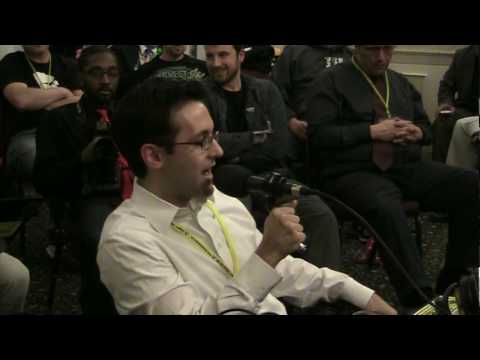
What’s funny about this, is that his name has been dropped at least once in this thread. The thread started as a talk about a book which Charles co-edited, and his position on thickness has been brought up several times.

Its just silly to say “you’re wrong” to one of the guys whose position is THE position we are talking about and has actually contributed published books and articles explaining it – without having read any of them.

AdrianHealy:

Yes, I have very frequently and openly described myself as a “left-libertarian,” if asked, in the sense of that term under discussion. I usually prefer other terms, if I am describing myself on my own terms rather than answering questions about myself, simply because “left-libertarian” has been used to describe many different positions in intra-libertarian debates, as well as outside debates about libertarianism – and a number of them are mutually exclusive of each other.

A lot of your comments seem to be based on a misunderstanding that I think a substantive difference between left-libertarians and non-left-libertarians would make one of them a libertarian and the other not a libertarian. That’s not my position. My position is that left-libertarians are advancing one sort of libertarian analysis and politics (as I happen to think, the most radical, coherent, and correct sort) as distinct from a number of other possible sorts of libertarian analysis and politics. I do not think that the differences involved are differences that make one party count as libertarians, and the other fail to count as libertarians.

I do think that the differences involved are nevertheless substantive and important differences that are not just over issues of “signaling” or “style” (or for that matter over their empirical predictions about the overall net effects of abolition – left-libertarians do have differences from non-left libertarians over that, but that’s not the only substantive difference that they have). Whether or not these substantive differences are differences that are important, or worth noting, or in some sense “affect the core of libertarianism,” does of course depend on what conception you have of what the “core of libertarianism” is, and of what the relationship is supposed to be between the “core” and non-“core” commitments. Thus:

AdrianHealy:

Those ‘substantive’ positions do not affect the core of libertarianism. Let’s take Rothbard’s example definition. A libertarian is someone who wants the world based on the NAP principle. . . .

That may be your understanding of “the core of libertarianism” and what does or does not affect it. It is not necessarily my understanding of it, or the understanding of most self-described left-libertarians. Most left-libertarians tend to insist on (5) a “thick” conception and comparatively inclusive picture of libertarian commitments, as opposed to a “thin” conception of libertarianism or a picture of “core” libertarian commitments that is more or less exclusively limited to the Non-Aggression Principle and its direct logical entailments. (As a result, we reject Rothbard’s and Block’s position that libertarian theory is purely and simply a matter of the Non-Aggression Axiom, its corollaries and applications.) So for somebody who rejects (5), it may seem that (1)-(4) are not really matters that substantively “affect the core of libertarianism.” But for somebody who accepts it, they may well be. Perhaps we are wrong to think about libertarianism this way; perhaps we ought to have a thinner conception of libertarian politics or libertarian theory. But if that’s so, we’d need an argument to be convinced that that’s so. And whether it’s so or not, then the disagreement over (5) seems like it’s going to be a substantive disagreement that left-libertarians have with some other, non-left libertarians. (*)

(* Not all – there are non-left libertarians who also have a thick conception of libertarianism. Let’s oversimplify and say for the sake of argument that all left-libertarians have a thick conception of libertarianism; but while all thin conceptions are – therefore – non-left-libertarian views, not all non-left-libertarian views involve thin conceptions. Some people think that there should be a “thick” package of libertarian commitments intertwined with the NAP; but they want a package with right-wing, or otherwise non-left, contents.)

John James said, “Please show me where I said any of that.”

“I’m pretty sure I’ve heard that term “Markets Not Capitalism” before. Pardon my french, but fuck that. Enough perfectly great words have been co-opted by socialists already. I’m not content to just surrender one of the most important, (and arguably a cornerstone) of the entire free-market philosophy (“capitalism”) and let them fully mutate its understood meaning into what is actually the opposite. It’s funny that you would point to something like that as a positive contribution because in my view that’s a negative thing…playing along with (and ultimately acquiescing to) socialists.”

…aren’t you the guy who calls himself a “free market anti-capitalist”?

@decleyredelune

Thanks. Care to respond to any of the rest of my post? I addressed every part of yours.

John James:

…aren’t you the guy who calls himself a “free market anti-capitalist”?

. . . Well, yes, that’s me. Although I can hardly claim originality on that point. I owe the rhetorical flourish to Kevin Carson’s good old Mutualist Blog.

Anyway, as a matter of fact I rather prefer that kind of terminology to “left-libertarian,” all things considered. Because while “free market anti-capitalist” is a (deliberately) paradoxical-sounding label, (*) it’s a label that, paradoxical or not, has more or less one well-defined meaning. Whereas “left-libertarian” has a number of more or less well-defined meanings that have been attached to it in the past few decades. Each of which is relatively well defined, but all of which mean something rather different from the other meanings that have been attached to it. (**)

Anyway, was there a further point you meant to make by your question? Or just asking out of curiosity?


(* I think that it sounds paradoxical, not that it actually is; my explanation for why it’s not is part of the point of adopting the term.)

(** In particular: that stuff that Murray Rothbard’s complaining about when he writes about “left-libertarianism,” meaning, more or less Cato and Reason, has exactly nothing at all to do with the way that the term is being used when folks like Roderick Long or others in ALL are explaining the position that they advocate. Not surprisingly, Rothbard hasn’t got much to say about that, since Rothbard had no way of writing about a position that would largely hashed out about a decade or so after his death. You might then ask: well, why use the term to mean something different than what Rothbard meant by it? And there are a lot of answers to that question, but one important thing to note is that Rothbard was hardly the first to use it, and his own usage was really pretty peculiar.)

So…what’s wrong with using a term people in general better understand

@Charles Johnson: Do you call yourself a socialist? And are you anti-boss like many others in the ALL seem to be?

You think that being pro-free market, and simultaneously against- private ownership of capital goods, by investments that are determined by private decision, and by prices, production, and the distribution of goods that are determined mainly by competition in a free market…isn’t paradoxical?

So…what’s wrong with using a term people in general better understand

That would make him a conformist.

“You think that being pro-free market, and simultaneously against- private ownership of capital goods, by investments that are determined by private decision, and by prices, production, and the distribution of goods that are determined mainly by competition in a free market…isn’t paradoxical?”

Well, if I might chime in, part of the reason Left-Libertarians identify as left is because they are engaging in leftist discussions with a libertarian standpoint. Capitalism as defined as a system in which the economy is organized around wage labor, the definition leftists use, makes the term “free-market anti-capitalist” non-paradoxical. It wouldn’t even call for the abolishment of the wage system, only for the creation of one in which a class of people are not dependent on selling their labor. Whether or not such a view is correct, coherent, or relevent has little to do with the discussion at hand.