When the FED returns it's profits to the Treasury, what does the Treasury do with it?

Just to clarify, I’ve just heard that the FED earns perpetual interest on the money it creates forever. But then I’ve also seen that the FED returns all it’s profits to the Government - which would prove that to be false. I want to follow the process through to see if this is actually correct or not.

So (in laymans terms) you’re saying that the government does not actually pay off debt. It only considers how much further into debt it needs to go? If thats the case, than the interest payments WOULD eventually find their way to the shareholders of the FED.

According to this:

$164 bilion was paid as interest on the National Debt. Lets assume for the sake of simplicity that all of that debt-interest was paid to the FED*. That means $164 billion is profit for the year of 2010 for the FED. The fed pays 6% of that to it’s shareholders. So that would be $9.84 Billion as profit to banks.

That leaves $65.6 Billion that the FED returns to the Treasury**. That brings me back to my original question - what does the Treasury do with that money? Well it seems obvious to me that eventually the government will have to pay more interest to the FED because (as ThinkBlue stated above - they don’t pay the debt down. And as the Wiki article above states - the US Budget only records payments being made as interest on the debt and not the actual debt itself). So all of that money will find it’s way back to the FED in the form of interest payments. At that point, the FED will again give 6% of that to its shareholders.

Lets again say for the sake of simplicity that there is no new Federal debt created next year and the only interest paid is in the amount of 65.6 Billion (in reality the number would be higher than that). So 6% of $65.6 Billion is $3.4 Billion - that is paid to the shareholders of the FED (banks). This process would continue year after year until all of that money is paid to the shareholders of the FED (banks). What conclusions do I draw from this?

  1. The FED creates money to buy securities. Those securities generate interest. Over time, year after year, the FED (and in turn shareholder banks) eventually get to keep all of the interest gained from new money as long as the government never pays the debt off (buys the security back from the FED)

Am I correct or incorrect in this conclusion? Sorry for being slow on this - I’m really new to it all.

**FED returns $46.1 billion to Treasury in 2009 - http://www.cbc.ca/money/story/2010/01/12/federal-reserve-profit-2009.html
I think you should, Start looking towards books, and get a step by step breakdown of the process.

The Fed does earn interest on its assets (Loans)

Except, not with the Treasury, The Treasury will never pay money to the FED, The FED rolls the debt, if you dont know what that means, check google.

The treasury never has to empty its bank accounts to pay off its cheques (treasuries), it could instead, write more cheques to new people, like a ponzi scheme.

With the surplus profits from being the FED, it gives that to the treasury, the treasury can use that money to buy trinkets, lottery tickets, Budweiser anything!

The Treasury does not give the FED anything.

WASHINGTON, Jan. 12 (Xinhua) – The U.S. Federal Reserve said on Tuesday that it posted a record profit of 52.1 billion dollars in 2009 and thus paid 46.1 billion dollars to the Treasury.

I think its pretty clear if you need more help, download some books from mises.org there are many free PDFs that explain in alot more detail.

Let me understand this. Take the $164 billion in interest payments, assume 100% goes to the Fed, and multiply that by 6%?

That is not how the dividends are calculated. Remember the member banks are required to purchase Federal Reserve shares, of which the Fed pays a 6% dividend.

Here is how it’s calculated. Take the capital contributed to the Fed by the member banks (from the purchase of Fed shares) and multiply it by 6%, and that should give you the dividend.

Let’s use the real numbers from the Federal Reserve financial statements, for the period ending Dec. 31, 2009:

http://www.federalreserve.gov/monetarypolicy/files/BSTcombinedfinstmt2009.pdf

Note: Dollar amounts in millions.

Total Interest Income $63,135
Total Interest Expense -$2,548
Provision for Loan Restructuring -$2,621
Net Income $57,966
Total Non-Interest Income -$570
Total Operating Expenses -$4,980
Net Income Prior to Distribution $52,416
Change in Funded Status of Benefit Plans $1,007
Comprehensive Income Prior to Distribution $53,423
Dividends Paid of Member Banks $1,428
Transferred to Surplus $4,564
Payments to Treasury $47,431
Total Distribution $53,423

Notice the total dividends paid to the member banks (highlighted above in yellow) is $1,428 million.

Let me reiterate that the dividend is not a 6% cut of the interest income received by the Fed. This is based on the amount of capital contributed by the member banks. Here are the capital accounts for the Fed:

Capital Paid-In $25,640
Surplus $25,640
Total Capital $51,280

The item Capital Paid-In is how much the member banks contributed to the Fed through the mandatory purchase of Fed shares, which is $25,640 million. Take the $25,640 and multiply it by 6%, and the dividends should be $1,538 million.

Notice there is a mismatch between Dividends Paid to Member Banks at $1,428 and my computation at $1,538 million. There are accounting reasons for the mismatch (which I will not go through), but it’s close enough.

That is how the dividends are calculated in reality.

So let me see if I understand what you’re saying. Banks buy shares in the FED every year? And in 2009 the amount of those shares bought was $25,640 million? So the member banks get 6% of what they gave to the FED back as dividends? Wouldn’t shares normally only be bought from the FED once?

Nevertheless, if that’s the case, the $164 billion paid from the Treasury to the FED in the US Budget is not considered profit when the FED is paying dividends?

Normally you would pay your shareholders dividends based on profits. Is the $164 billion in interest paid to the FED (in our hypothetical example) not considered profit? If not, what does the FED do with the $164 billion the Treasury gave it as interest payments?


Aside…

In response to this I will say that I, like most US citizens, do not have time to read every book on economics and the Federal Reserve available to me. I simply want to know who I should vote for - and I want to understand why I’m voting for that person. However, if we all lose our jobs maybe we will all have time to better investigate the reasons why.

Not sure if you’re familiar with accounting, but any business entity that publishes valid financial statements would have something called an Income Statement and a Balance Sheet.

Income statement shows Revenues and Expenses. Balance sheet shows Assets and Liabilities.

Here the item Capital Paid-in is from the Fed Balance Sheet on the liabilities side, showing how much capital the Fed has accumulated from the contributions of the member banks, not how much the member banks contributed in a one year period.

To answer your question, the member bank only needs to purchase shares from the Fed only once, not every year.

Furthermore, the member banks gets a 6% dividend return on the capital it contributed to the Fed, as shown in the Capital Paid-in account.

For common stock in a publicly-held corporation, this is true, but for preferred stock there is a mandatory fixed dividend rate, based on the capital invested per share, provided there are profits available.

For the Fed, the mandatory dividend rate on capital contributed is 6%, irrespective of net income, similar to a preferred stock.

Each Fed share has a value of $100, which pays a dividend of $6.00 per share, no matter what the level of net income is, provided there is enough net income to pay those dividends.

Maybe you may want to re-consider your position, not necessarily reading every book in economics (nobody can really do that), but those books that can help you understand this topic.

The Fed is supposedly a non-profit organization, but it pays out dividends to shareholders. Go figure!!

For your question, what does the Fed do with interest payments from the Treasury, I would prefer to use real numbers:

Total Interest Income $63,135
Comprehensive Income Prior to Distribution $53,423
Dividends Paid of Member Banks -$1,428
Transferred to Surplus -$4,564
Payments to Treasury -$47,431
Total Distribution -$53,423

The Treasury pays the Fed up to $63,135 million in interest payments.* The Fed returns back to the Treasury $47,431 million.

From an accounting perspective, there is a net cash outflow from the Treasury to the Fed of up to $15,704 million ($63,135 million - $47,531 million = $15,704 million), so the Treasury’s real cash payments to the Fed is up to $15,704 million.

Here is the breakdown where the $15,704 million went:

Total Interest Expense -$2,548
Provision for Loan Restructuring -$2,621
Total Non-Interest Income -$570
Total Operating Expenses -$4,980
Change in Funded Status of Benefit Plans $1,007
Dividends Paid of Member Banks -$1,428
Transferred to Surplus -$4,564
  • Not all the Fed interest income it receives are from Treasury securities, but for this example, I assume it is.

Dont vote for anyone. Its mathematically extremely improbable your vote will make a difference.

Its historically never happened, and the way the rules are set up now IF your vote pushed ur party 1 vote ahead, they would do a recount, and if its still 1 vote, they would do an entire revote.

If you wanna make a difference in this world, your going to have to use abit of effort, no one cares about your crummy piece of paper you filled out in 35 seconds.

Step 1. So the Treasury pays the FED

Step 2. Then the FED gives a portion of that to its shareholders and a surplus (as well as “Loan Restructuring”, “Operating Costs” and more)

Step 3. The FED returns whatever is left to the Treasury.

So, please correct me if I’m wrong, essentially what’s happening is that when the FED creates new money to buy a Treasury, shareholder banks make a portion of that money. And over time, year after year (with “operating costs” and other expenses aside) shareholder banks will eventually make ALL of the interest money because of the money-loop going back and forth between the Treasury and the FED. And also - because the security was bought with new money and the treasury owes interest on that security, there’s a good chance that the government will never be able to pay it off because it owes more than it got. (The same way the economy as a whole cannot pay off all it’s debts because there is more money owed to banks than even exists)

I made this diagram to try and better understand the process. (Start from the Federal Reserve loaning money to the Treasury to follow the loop)

Eventually (with operating and other costs aside) all interest would end up going to banks right?

Let me reiterate that the dividend is not a 6% cut of the net income remaining after the Fed has paid all other expenses. In other words, just because the interest income to the Fed has increased, does not necessarily mean the dividends will increase as well.

Like I earlier described, the dividends are fixed at $6.00 per $100 share. Because the net income may increase (or decrease), the dividend is still $6.00 per $100 share.

For a member bank to receive greater gross dividends, it needs to buy more Fed shares at $100 per share.

Member banks cannot simply buy more Fed shares on demand. The Fed places a maximum limit on how many shares a member bank can buy.

There is a linkage between the Fed increasing the base money supply and bank profits increasing. However, I think you are placing too much emphasis on the Fed dividend, which in the general scheme of things, is a minor consideration.

Before I continue with my feedback, do you understand the Fed dividend concept?

To keep things in perspective, take the Dividends Paid to Member Banks at $1,428 million and divide it by the Total Interest Income the Fed received at $63,135 million, and you will see the dividends as a percent of total interest income is 2.26%.

Okay, yeah I understand that now. Do you know what the maximum limit for shares that a bank can own is?

What is that linkage?

The Fed requires that a member bank buy an amount equal to 6% of the member bank’s own “capital stock and surplus.”

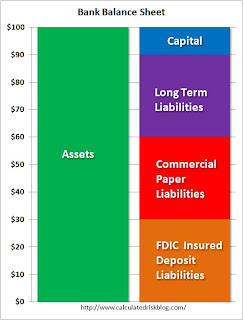
Here is a graphical illustration from a blog post to illustrate capital stock:

For a private bank (or in any company), investors have to invest capital in the business.

Take a look at the sample balance sheet above, and you will see the word “Capital” on the liabilities side, which is how much capital the private investors (shareholders) invested in the private bank so far. This investment amount is called capital stock.

Take the capital stock amount (from the member bank’s balance sheet) and multiply that by 6%, and you will have how much the member bank needs to contribute to the Fed. This contribution to the Fed is both a minimum and a maximum.

Take the contribution amount and divide it by $100 per share, and this is the amount of Fed shares the member bank must buy.

For every $100 share the member bank owns, the Fed has to pay a $6.00 dividend.

Heh. This unfortunately cannot be done in a single post. Either take a college class on Money and Banking, or read a Rothbard book on banking (which I understand is free on the Mises.org site).

Thanks for helping me out on this. I’ll have a look at that book.

The main reason I ask is because I want to know who is profiting from the perpetual debt and interest payments the Government gives to the Fed.

Is it the FED’s operating expenses that use up most of the taxpayers money going towards interest?

Or do all of the profits get divided up between a combination of paying banks dividends, covering costs of running the FED, and putting money into a “surplus”?

I guess the question is - who’s profiting here? It’s perpetual debt that all Americans have to pay!

Here are some Murray Rothbard books you might be interested in:

The Mystery of Banking

What Has Government Done to Our Money?

Thanks for those links - I will check them out.

On a sidenote: I find it interesting that I need to basically take a college course in economics to find out who is profiting from the perpetual debt the government is in and the creation of new money. It’s an issue that affects every single American on a daily basis.

Well the answer to that is easy, the mechanics your having trouble with.

The Govt benefits, because it has a big buyer of its debt.

The member banks benefit because they have someone they can run to if there in trouble (discount window.)

And because they have someone to run to they can be more risky, and make more profit.

Also the whole “The fed is owned by the people” type crap gives em a good front for what is quite obviusly a dishonest practice.

The whole who gets the cash is a non-issue.

No.

Yes.

Refer to strat2131’s response above.

So essentially, when you break everything down:

-The Treasury is in perpetual debt to itself - with bankers taking a tiny cut each time around.

  • Everytime the Treasury issues a security that the FED buys, the Treasury gets to spend the new money
  • The Treasury also gets most of the interest money it gave to the FED back.
  • But the Treasury still owes that interest nonetheless
  • This requires the Treasury to either create more money (through the FED) or tax people more in order to pay The FED (and essentially itself) the interest on the Security - money for which hasn’t even been created yet.
  • Because of that it requires that new money is constantly created to pay the interest on the previous loan.

So thats how the Treasury benefits.

  • The banks benefit because they take a tiny cut each year ($6 for every $100 share)
  • If they risk too much in Fractional Reserve Lending the FED will bail them out
  • The new money that is created by the Treasury (essentially) allows banks to further create money as Fraction Reserve Banking takes its course

I think I may be starting to get it here. However, wouldn’t this eventually be NOT in either of their best-interest if the currency starts to inflate?

Think about it. If you borrow from your friend $100 at $10 interest annually, and then later on buy back the same IOU from your friend for $100, do you still owe money to yourself and keep paying yourself interest?

That would be true if the treasury was buying the securities back. But it appears to be only paying the interest - not buying the security. Because of that, and the fact that the FED returns the interest back to the Treasury, in reality the Treasury is in perpetual debt to itself. No?