Why Are Most Mises Users from the US?

Pretty much all of the mainstream US media, with the exception of Fox and other Murdoch empire assets, is left as well. Newspapers are a bit more evenly divided, since, like blogs, they are much cheaper to set up than massive news networks, (and thus swing and red states get a higher chance of representation than they do in the coastal, limousine liberal areas like the Mid-Atlantic and Southern California that dominate big money media) but the really big ones, like the NYT, are center left. Overall, I’d place most US media between the dot in this image next to USMSM and the middle of the last “M”, with NPR/MSNBC/PBS most left and CNN most right:

“There seems to be quite a few Austrian scholars in Spain, but Spain in general is not a country really open to libertarian ideas.”

Now, I don’t live in Spain or anything, but I’m assuming by libertarian you mean Austrians and not libertarian broadly defined.

Lol, should Fox nnot be in like the very center of that box? There are liberals like Geraldo Rivera and co on the network. “Traditionalist” like O Reilly on the network as well. And above all else libertarians like John Stossel and Judge Andrew Nepalatano ( or how ever its spelled). Neocons like Hannity and a bunch of other people whom don’t seem to have any affiliation at all. It’s a pretty mixed up network.

Liberals on Fox seem chiefly to be there as token opposition, so to speak. It’s to the American Right what the New York Times is to the American Left, or what Le Monde and The Guardian (and BBC) are respectively to the French and British Left. O’Reilly is probably closest to where I place Pat Buchanan here, though obviously a few squares more authoritarian. And the purple side of the chart is pretty much nonexistant for anybody but the Cosmotarians and this guy. Ron Paul is slightly above the centre and two squares away from full right, so Napolitano would probably be about the same, though maybe a bit lower due to his focus on civil liberties. Stossel would be pretty similar.

Yes I’d like to know where that chart comes from and how it was created. I’d love to know what it means that Reason is farther right than Fox.

I created it using this tool, based on my own observations and experience with various news outlets. Largely, it was just for fun, but I did try and put some serious analysis to it. The reason (hah!) Reason is to the right (which, keep in mind, is defined in purely economic terms in the Political Compass) of Fox is sort of a gut feeling based on what I’ve read from it and Cato, as well as the fact it tends to focus more on fiscal issues when it’s not hawking cosmo stuff like marijuana. It’s pretty close to Chicago-school style reformism in this regard. I might be wrong though, not being a regular reader, and I’ve certainly read some appallingly statements from senior Cato staff that make me regret this ranking.

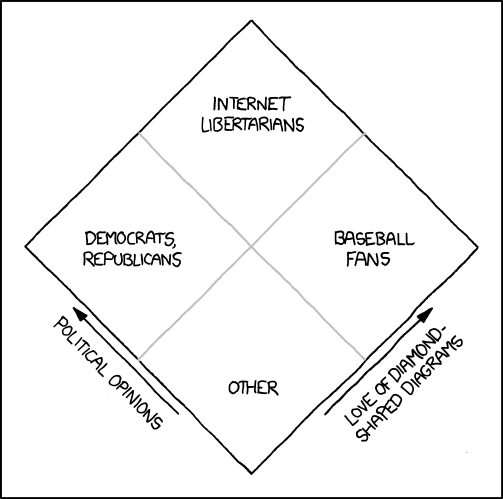
Well first of all, I obviously don’t have to bring up the unscientific nature of the way that chart came about, but I also feel the chart is misleading. I’m not exactly sure how someone could be on the very bottom or very top and still have room to be far right or far left. I mean, what would be the difference between someone in the bottom right corner and the bottom left corner?

I think the Nolan Chart is a much better orientation.

I’ve tried to embed this a few times, but haven’t had any luck:

Well, I don’t see how The Economist (or WSJ) can be more libertarian than Takimag. The Economist is pro-Empire and for killing people in foreign countries. Takimag has a peace and freedom foreign policy outlook. And they are paleocons - for low taxes, gun freedom, no anti-smoking laws, an end to the Patriot act etc.

Why is FDR so much more libertarian than Mussolini and Pinochet? Why is Putin more authoritharian than any contemporary Western leader? Why are Clinton and Carter so libertarian? Seriously, Jimmy Carter more libertarian than Milton Friedman??

The Nolan Chart is good for what it does, but it’s based on 6 questions, not 60 (admittedly, the Compass has some silly ones about abstract art and astrology). It doesn’t really show the nuances of politics, nor does it account for political models outside of the US model (for instance, where would Ralph Nader sit? Or Nicolas Sarkozy? Or Tony Blair?) with a token “bottom” category for the budding Stalinists among us. The bottom left of the PC would be anarcho-communism. Kevin Carson and the Mutualists would probably fall there. The purple area seems to exist solely to fill out the chart. I can’t find anybody, of any persuasion, who seems to fit deep in it. The wording suggests anarcho-capitalists, but even Ron Paul fits just above the middle line and far to the right. There’s certainly significant philosophical, historical and structural differences between, say, Mikhail Bakunin and Murray Rothbard, for instance.

FDR: How was he more authoritarian (keep in mind that in the political compass, left and right are solely economic questions) than them? Mussolini had his henchmen force feed people castor oil, and Pinochet massacred by the hundreds in soccer stadiums. The worst FDR did in the non-economic field was Japanese internment and court-packing, unless there’s something I’m missing. He certainly wasn’t obsessed with smoking bans, social engineering and multiculturalism like the modern left.

Putin: You’re from Russia, so you undoubtedly know more about this than I do, but isn’t Putin basically an oligarch who regularily whacks his opponents with the polonium stick? On the chart I have depicting US political figures, Lincoln comes far higher than Putin, and on this chart (depicting my perception of the approximate political “center” in various countries), several Western countries equal or even exceed Putin’s authoritarianism.

Clinton/Carter: Both seem a bit more liberal and easygoing than the modern left, which is more obsessed with the aforementioned social engineering than they seemed to be. Carter was, frankly, too ineffectual to enact much authoritarian measures, and apart from Janet Reno, nothing jumps to mind that Clinton did on the national level that wasn’t just continuing the policies of his predecessors. Also, the authoritarian/libertarian spectrum isn’t so straightforward as it seems. People on the lower side of the chart may actually be more authoritarian in “real” terms than people on the upper or middle sides, such as Ron Paul with Reason. It generally suggests a sort of easygoing cosmopolitanism as well as political policy, and while Obama and Blair’s authoritarianism are sufficient to crowd out their cosmo cred, Clinton and Carter’s (IMHO) aren’t.

Friedman: I’m actually convinced I’ve put him a bit too far to the right, and he should instead be a square or two right of Thatcher. His differences with Ron Paul, for instance, are much more pronounced than current charts would indicate. He seemed more the “efficiency technician”, as Rothbard called him, while Carter was just, as above, ineffectual.
I see now, the description says Social Libertarian / Social Authoritarian. That is different. I see where they are coming from. Albeit realistically today Social Liberals are just as preachy and thirsty for control and influence as Social Conservatives are, only their material is different.

Is the left right axis economic freedom ? If so it is pretty telling that The Economist is more left than Fox.

Yes it is. Keep in mind it’s only my own, personal assessment, and I have no formal training in political science nor media studies. That said, the Economist is ranked where it is…

On the social scale: Because, although it is only occasional, you are still more likely to find arguments against the drug war than you are in most mainstream media outside of borderline far-leftist outlets like the Guardian or Die Tageszeitung, which, ironically, condemn the Economist as a tool of international banking, which they mistakenly believe is the agent and executor of the free market.

On the economic scale: As LeeO describes in this thread (and I can vouch for him given my admittedly limited reading of the Economist and the cultural/sociopolitical “tone” it and it’s staff and affiliaties give off), the Economist chiefly reflects a form of centrist Keynesian (or more properly, Modern Keynesian-Neoclassical synthesis) internationalism more bound to a utilitarian “efficiency technician” role than the quasireligious Pietism of social democracy reflected in most establishment non-Eastern European media. Fox, and the rest of the Murdoch empire in general, is more bound to a rightist form of cultural conservatism combined with promotion of American exceptionalism as conducive to Western interests, and effectively acts as the mouthpiece of the US Republican Party, which holds similar principles. Keynesian internationalism is far less popular in the US than it is in Europe, given America still retains a strong nationalistic temperament and has not yet been subjugated to an international domineering entity like the UN, EU or the hypothetical North American Union, though Progressive Rooseveltian thought is undoubtedly it’s ideological progenitor. I suspect the Economist also reflects a Fox like role towards the London School of Economics.

Now, I don’t live in Spain or anything, but I’m assuming by libertarian you mean Austrians and not libertarian broadly defined.

I mean broad libertarianism: pro-market, small government.

Speaking as someone from the UK, that had a tradition of free markets but that has been quite heavilly eroded, I can say that libertarian/free market ideas are so far outside of the general mind set as to seem completely looney and extreme by the vast majority of people here. Holding these beliefs myself it can often be quite difficult and infuriating trying to explain my point of view to others.

I only became exposed to it through the internet and stumbling upon sites like these and getting involved in conversations on line. There’s virtually zero likelyhood of encountering advocates of these ideas from the people you meet.

I guess time may tell and I think that the current financial crisis has re-awoken some interest in alternative economic schools of thought such as Austrian. Indeed, there is a radio programme to be broadcast shortly re-examining the old Keynes vs. Hayek debate and asking which of these would have been best able to sort out the current mess. It’s a small start but hopefully you will eventually see more British (and other non-US) people appearing on these boards…

Allright guys. I lived in Europe and attended as a guest, not a student a few law classes in Trier. Germany has a Civil Law system. No Juries, and you must have law school to become a judge, and then be selected by a panel to sit the bench.

From those two that I did attend, I gleaned the following. Liberty is taught extensively as a failed experiment, so is Communism. Social Democracy is the Utopia In fact the courts are not even considered part of the government. They are what a Roman would call a Tribune.

My guess is that by the time anyone finds Mises, Rothbard, etc… They already know it is a failed experiment, and are just waiting for it to fail so Liberty advocates will come around to the enlightened ideas of social democracy.

Positive rights are the keystone to their political philsophies.

I thought so, because from my understanding there is quite an Anarchist movement in Spain.

Seriously? You can create as many questions as you want. I’m just talking about the orientation of the chart itself. Again, if you want to use your chart, what is the difference between someone who is in the bottom left corner and the bottom right corner?

I don’t know what this is supposed to mean. There is no purple anywhere on the chart I posted, and you put two organizations in the purple that appears on your chart.

It’s an anarcho-syndicalist movement that is based on the same biases as the communist movement. It’s a rejection of capitalism, not only because they equate capitalism with corporate welfare, but also because they see the capitalist system (profit) as unjust. I think these anarcho-syndicalists would rather prefer a communist government than an anarchy characterized by unfettered capitalism.

“I think these anarcho-syndicalists would rather prefer a communist government than an anarchy characterized by unfettered capitalism.”

Well, once again, I don’t live in Spain so I can’t speak too accurately to the thoughts of the movement there, but judging from the Anarchist movements I am quite familiar with I’m not sure that assessement is true. And activist circles today tend to be highly communicative. Greek Anarchists, for example, are seeking to overthrow a very socialist government, and they have certainly earned the support of Spanish Anarchists.

Regardless, I still understand why the libertarians in Spain aren’t exactly drawn to this forum.