Why blacks were freed and women received equal rights?

Firstly, the idea that women were “enslaved” is somewhat ridiculous.

I certainly don’t have any notes or references at hand but I did a lot of research on this kind of stuff some years ago and I can sum up some elements for you:

Firstly, a MAJOR part of the early feminist movement, that is to say the original ‘woman’s movement’ was to PROTECT their right to stay at home, looking after children and NOT being expected to join in that horrible, dirty, dangerous “industrial revolution” thing.

Just because women now COULD be super-productive and pull levers and push buttons just like the men didn’t mean they wanted to. In the beginnings of the steam and industrial era children were working, men were working and it was kind of expected that perhaps women should start pulling their weight in the factories (as well as at home) earning money..?

The only “enslavement” involved there was the fairly probable idea that most would still be expected to do the bulk of the housework. As such women banded together and protested this idea, demanding that they be maintained as rulers of the household.

They even recruited (some say actually started) the KKK in order to preserve their near-Holy white womenhood and dainty stay-at-homeness. However, possibly because they’d now be taxpayers, black men got the vote but women at that time didn’t.

After that (white) women dumped the KKK and swung towards communism/socialism, which promised them the vote if only they’d support the political ideology.

Yes, in one of those all-too-common examples of irony, the women’s movement changed from demanding the freedom to NOT work in the factories to demanding the freedom TO work in the factories.

Of course the communists didn’t care for women’s freedom, they just wanted more factory fodder to compete with capitalism.

Some of the most famous American feminists were, in their day, known as some of the most famous racists. That’s not something you’ll ever learn much about in an American “public” school though. So please, spare us the “women were enslaved” thing. Black women were, because they were black, not because they were women. White women sought to keep them that way and to maintain their own “special” status.

Staying at home as ruler of the household, often supported by black slaves, while the menfolk do the work and take the risks, is hardly “enslaved” now, is it?

As for slavery, politics doesn’t always follow rational economics, as you may have noticed. Look around today and you’ll see there is political pressure to reduce or get rid of illegal immigrants. Why? Because they’re too cheap, don’t ask for safe working conditions and do the jobs others don’t want, reducing wages etc. Well that’s exactly how many people, especially young men trying to raise and support a family, felt about slaves.

Not just in America, most nations were doing away with the idea, in fact America held onto slaves much longer than Europe for example. Lincoln used slaves and the promise of freedom as a way of disrupting the South, he was also a screaming racist.

Hope that helps?
Well, let’s not exaggerate… women received the right to vote which is not at all the same thing as freedom. The value of having a vote diminishes as suffrage becomes more universal. Today, the value of a vote is essentially zero on anything greater than, perhaps, the scale of local government. A realization of this fact on the part of the ruling Elite may be part of their decision to allow women and minorities to have the vote. As suffrage becomes more universal, the less meaningful it is to have a vote.

  1. The heat engine (steam/internal combustion/etc.)

  2. Slaves are vastly less productive than free men

I think the development of the heat engine explains why slavery was abolished at the time that it was and not sooner or later.

No. This is definitely not an explanation.

No. These campaigns are not motivated by some kind of selflessness. They merely serve political interests in non-obvious ways. Animal rights, for example, is one way for the State to further aggrandize itself by providing yet another non-entity on behalf of which it speaks. The State “protects animals” and “protects the environment” for the same reaosn it “protects society”, that is, so that it can collect taxes to fund said protection of legal non-entities. It can also sue for imaginary torts (created by statute) against these legal non-entities. The modern State is just a protection racket with first-class PR.

Clayton -

No, those are separate issues. And event the most baloney feminists will hardly maintain that all White women were kept as slaves in the US.

That "all-men-are-created-equal isn’t actually from the bible. It sounds like a post enlightenment theological statement

And only suitable for certain types of repetetive labor, like in the plantation system.

I would say there was a change in perception in the Western world. But then slavery wasn’t an institution in Europe since the fall of the Roman empire. Ironically, the civilzation the cultural Marxists hate so much is the one that abolished slavery and treated women pretty well.

What you write here is only correct to some extent, but contains a number of false assumptions.
Yes, in the beginning slavery was beneficial for slave owners. Bear in mind that this started with commodity production in the Southern states that produced for international markets. At that stage the colonist may not have seen America as his new home, but just a means of making a quick buck and then returning to England. There is a good argument that slavery isn’t beneficial to society as a whole. It crippled the markets for free craftsmen, it let to all kinds of vices and it stigmatised manual labor as base and let to common idleness among Southern Whites. And I am leaving out long term problems here.

No, Southern slave owners did actually care about the welfare for their slaves.
Yes, wealthiness and the possibility of a common large leisure class has lead to more caring about social and environmental issues. But there is some common emphasis on empathy in Western culture as well, that preceeds the era of capitalis productivity.

Segway on JJ’s vid, Steven Pinker explains how biology sets limits on what sorts of social goals are humanely realizable:

http://www.youtube.com/watch?v=RRRHAXxLs5M

Interestingly, he almost exactly paraphrases Rothbard (though I’m sure inadvertenly as I doubt very much that Pinker has read Rothbard):

“Suppose, for example, that it has come to be adopted as a universal ethical goal that all men be able to fly by flapping their arms. Let us assume that “pro-flappers” have been generally conceded the beauty and goodness of their goal, but have been criticized as “impractical.” But the result is unending social misery as society tries continually to move in the direction of arm-flying, and the preachers of arm-flapping make everyone’s lives miserable for being either lax or sinful enough not to live up to the common ideal. The proper critique here is to challenge the “ideal” goal itself; to point out that the goal itself is impossible in view of the physical nature of man and the universe; and, therefore, to free mankind from its enslavement to an inherently impossible and, hence, evil goal.” [emphasis added]

  • Egalitarianism as a Revolt Against Nature

The more I think about the new normal in polite society - that women are to be thought of as essentially every way equal to men and made equal in any ways in which they might be at a disadvantage - the more I realize it’s just absolute insanity. The female brain is, as Pinker says in another lecture, not indistinguishable from the male brain. This is a wry litotes - women think about life, the world and other humans in ways very different from men and they react to similar situations in very different ways than men do. In particular, I believe that the integration of women into the workplace has created a huge set of new social problems with no obvious solutions.

When you go back to the origin of male/female behavior in humans, you see that the female brain evolved to cope with a very complex set of circumstances that are largely irrelevant in the modern world. Our pre-human ancestors engaged in socialized reproduction, that is, the father was unknown or, even if he was known, did not take responsibility for the care and feeding of his children. The mother - as in most mammal species - was the primary provider for her children and any other support that went to the children was provided socialistically, that is, by genentic non-relatives motivated by a communal instinct.

Eventually, the idea of monogamous (from the female PoV) attachment to a single male (at least, for some duration) - who would both father children with her and contribute to the care and feeding of those children - emerged. We can see how this is a “privatization” of the costs of reproduction (I got this from Hoppe, can’t remember the cite right now) and how such privatized reproduction would lead to reproductive advantages over time as things that are owned are cared for better than things that are unowned (socially owned). Biologists believe that the uniquely human trait of concealed fertility played a crucial role in making this situation possible as women who knew when they were fertile would be able to “cheat” the system by copulating with the genetically best male while she is fertile and pretending to be faithful to the less genetically excellent “provider male” the rest of the time. Male jealous rage also evolved in tandem with these developments (see the book Why Beautiful People Have More Daughters by Miller and Kanazawa).

I think that a lot of distinctly female behavior - credible threats of doing something absolutely insane in order to invoke a response from her male partner, gambits for sympathy through crying or other ways of being pitiable, etc. - probably originated in the Ancestral Environment where there were no family law courts or recognized child support rights in divorce or separation, and so on. A woman who could get the father of her offspring to take pity on her plight or shame him into cooperation or - the darker side of female nature which is never discussed nowadays - credibly threaten the survival of his offspring with her, would have had a reproductive advantage over other women who could not prod their children’s father into acting. Thus, modern women are the descendants of those mothers who survived that environment and passed on their genetic disposition to “crazy” behavior.

OK, I’m going to stop kicking the hornet’s nest for now.

Clayton -

Mon. 12/07/02 18:58 EDT
.post #193
[url=Why blacks were freed and women received equal rights? - #25 by ClaytonB]

I’ll give a kick.

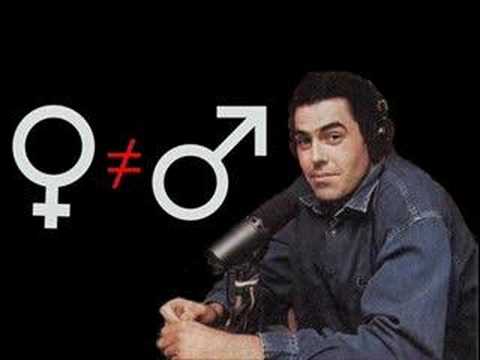
In “Men are superior,” Adam Carolla says “I just don’t like it when we try to force this ‘everyone’s exactly the same’ mentality down everyone’s throat.” He goes on to give examples of the things men do better than women and the things women do better than men, and points out that instead of insisting that women and men are “the same,” we should embrace and appreciate the differences (“I sorta like the diversity part” are his words).

Then, in
Adam complains about women (@2:35)

he opines that a woman will sit on a sofa reading a women’s magazine featuring a beach in Negril and feel bad because she’s sitting on a sofa and not in Negril, whereas “(men) look at genocide in Rawanda pictures and we’re happy to be on our sofa.”

At 3:39, he rhetorically asks “How 'bout you broads pick up a textbook every once in a while? How 'bout you learn something about World War II? How 'bout you learn one god-damn thing about World War II?!”

This seems inconsistent with his earlier lip-service to the virtues of diversity. Would a woman who exhibits more “masculine” interests (such as conversance with war history, for example) really be more attractive to Carolla?

I think Christopher Hitchens makes some valid observations in this video:

Christopher Hitchens: Why Women Still Aren’t Funny

At 1:27 Hitchens says “…women don’t need to be funny. But for most men, if they can’t make women laugh, they’re out of the evolutionary contest; they’re never going to get laid (most men are fantastically unattractive). … With women, there’s no need to be rendering yourself attractive to men (by trying to be funny); we already find you attractive, thanks.”

By the same token, I don’t think women need to be rendering themselves attractive to men by, for example, boning up on war history. We already find you attractive, thanks (and we probably find you more attractive on a sunny beach than on the sofa discussing war history).

Oh Clayton, just a friendly correction:

The correct spelling is “segue,” not “segway.”

Mon. 12/07/02 19:27 EDT
.post #194

“Why Can’t a Woman Be More Like a Man?” Rex Harrison

I don’t think Carolla is saying women should learn more about history because it would make them more “masculine”. (In fact I’ve never before in my life heard anyone suggest knowledge of any kind of history was a “masculine” trait. That actually sounds incredibly dumb to me.)

I think Carolla was simply suggesting that women should take it upon themselves to become more knowledgeable…hence “pick up a textbook every once in a while”…as opposed to one of the “279” women’s magazines that all feature the “same junk” that “really just breeds envy.”

I find it strange that you could miss that point. (Unless of course you were simply looking for a way to refute Carolla/ take him down a notch. Then it would be understandable as to how you might reach so far to mischaracterize his suggestion that way. You wouldn’t happen to be one of the women he’s talking about, would you?)

Mon. 12/07/02 23:55 EDT
.post #195
[url=Why blacks were freed and women received equal rights? - #28 by John_James]

I also don’t think Carolla is saying that.

Okay…I’m glad that’s not what I suggested. I certainly did not write those words. You seem to imply here that I did. Perhaps, by changing my wording, you misconstrued my meaning?

Mmmm…well, I think he’s saying a bit more than that. He mentions “a textbook” once, at the beginning of his rhetorical questioning, but then he gets more specific: World War II. That subject of study is then suggested eight times. Some of the knowledge he disparages as “the same junk” and “nonsense” includes learning to “grow your own gourds with Martha Stewart.” But all this tells us is that Carolla is interested in different knowledge than the women he “complains about.”

Would Carolla really be happier if “women” took more of an interest in World War II, as opposed to learning how to grow gourds, or sunny beaches, or any of the other things that “women,” according to Carolla, are typically interested in?

Is that the kind of woman Adam married? Here’s an interview with his sexy wife, Lynettte:

Lynette Carolla Interview on The Paul Leslie Hour

“The real Lynette Carolla,” straight from the horse’s mouth, spends her typical Saturday “in the kitchen with the kids; I just made them lunch, … I’m pouring myself a cup of coffee, and we’re about to go take our blind dog Molly for a walk, and then we’re gonna go run some errands … and I’m gonna stay up and watch my reality TV.”

Lynette co-hosts a “women’s issues” show For Crying Out Loud. Here’s a description of the June 21, 2012 show:

Now, do I disparage this as “junk” and “nonsense,” just because it’s not, typically, what men are interested in? Not in the least. She is a sexy, intelligent, ambitious, hard-working, successful woman. She’s involved in things that, typically, women are more interested in than men.

So, Adam Carolla’s “complaining” strikes me as not only inconsistent with his earlier lip-service to the virtues of diversity, but also as hypocritical, given that he seems to have married the very type of woman he “complains” about.

But hey, maybe I’m wrong. Maybe Adam and Lynette have really great discussions on the sofa about World War II, and what he really loves about her is her knowledge of history, especially war history.

As I said and have now elaborated, I think he’s saying a bit more than what you infer as “that point.”

I don’t necessarily believe his rant represents what he personally believes. For example, he could be either “playing to his audience,” or perhaps he’s even ridiculing these very attitudes by pretending, using caricature, to espouse them.

John, I very much enjoy your energy and enthusiasm, both as a promoter of libertarianism, and also as the “forum pit bull” when you suspect your values are (either directly or subtly) under attack. I think you sometimes overreact, but I also understand that this is “part and parcel” of who you are.

You think I’m “reaching so far” and “mischaracteriz(ing) his suggestion,” possibly because I’m “looking for a way to … take Carolla down a notch.”

None of those allegations, which pertain to my intentions, are true.
I think you’re overreacting here.

haha! Nooo (not last time I checked, anyway)!

I had not, before seeing your post, even heard of Adam Carolla. I did a bit of listening via YouTube. He seems funny and entertaining. Wasn’t offended by anything he said. I enjoyed his performances. I see that he hosted “The Man Show” and has authored a book entitled In Fifty Years We’ll All Be Chicks: . . . And Other Complaints from an Angry Middle-Aged White Guy, which I’ve just requested from my local library. From my limited exposure, I gather his “shtick” is to portray the “manly man with a vulgar bent” persona. Sort of a modern Archie Bunker. He also reminds me a bit of Doug Stanhope, although Carolla is no libertarian; from his wikipedia page:

And then, inconsistently,

Except, apparently, to keep and bear semi-automatic and automatic weapons.

Then why did you suggest it? What is even your point?

Tues. 12/07/03 00:13 EDT
.post #196

[url=Why blacks were freed and women received equal rights? - #30 by John_James]

I didn’t, although you seem to have inferred it.

John, I must go to bed, sorry. Go back and re-read what I wrote. After I re-read what I wrote, I’ll try to answer this question of yours tomorrow (or later today, as the case just became).

@MMMark: I think Carolla, in the “complains about women” clip, isn’t even talking about what women should be like. Rather, I think he’s making a point that women have a propensity toward dissatisfaction with their status quo, whereas men tend to be happy with the status quo. This is actually one of the most common plot tensions in movies, sitcoms and fiction so I don’t see how it’s controversial.

As for the point about the textbook, I think he’s saying that rather than doing things that enhance dissatisfaction with the status quo, such as looking at glossy magazines of all the places you could be instead of where you are right now, perhaps they should study history and put their current situation into perspective. We’re not being bombed. We’re not fleeing the Nazis. What, really, is so bad about our day-to-day life that we need to fly to Bermuda or we need to remodel the entire downstairs or whatever in order to be happy.

Of course, men are materialistic bastards, too. But there’s a crucial difference in motivation that’s worth noting (neither form of materialism is “better” than the other). Men are materialistic as a matter of competition with other males, that is, in order to show off to the ladies. Women are materialistic as a matter of cashing in on child-bearing (yes, I said it). And this is the root conflict in the marital relationship. There is no contractual agreement stating how much of the man’s wealth will be saved, invested, passed on in inheritance versus spent on expensive clothes, expensive food, expensive travel, etc. for the gratification of the woman’s material appetites. In the traditional “man is provider, woman stays home” relationship, this is a major source of tension. In more modern relationships where the woman also works, new and even bigger tensions arise as a result of the fact that the man no longer actually supports the woman. Regardless of how the housework is divided (50/50, 90/10 he does it all, etc.), she is still the one who must get pregnant and give birth to the children so her net contribution to the relationship (full-time work + child-bearing) massively outweighs his contribution (full-time work only).

And thanks for the catch on segue. Noted.

Clayton -

Oh? Then what exactly where you “inferring” with the statement:

“Would a woman who exhibits more “masculine” interests (such as conversance with war history, for example) really be more attractive to Carolla?”

I just assumed you were talking about this.

I call bullshit. It is a rare exception that one will find a woman who truly works “full time” and bears children. And even in that case, it’s not as if she can be working while in labor or directly after. She is taking time off work to literally bear that child.

And “the man no longer actually supports the woman”? Please. For one thing, I’m sure that would certainly be news to all the poor saps paying (what Tom Leykis so aptly calls) “vaginamony”. For another, again, how exactly are all these women “supporting themselves” while they’re bearing all these children?

And what’s worse is the way you portray this female combination as “massively” outweighing the male contribution.

Warren Farrell destroys these and other myths in his excellent book.

Even if they did know all about it, it would be via what feminists claim is “woman’s way of knowing”, so there’s that.

Funny how it is estimate who “contributed more” men or women. Isn’t this a bit like weighting and comparing whether the stomach or the brain contributed more to the body?!

@JJ: You’re reading me completely backwards. Male power is a myth, that’s my point. But there’s a reason why - wombs are more valuable than testes. That’s why women hold all the power in the reproductive relationship. As far as Nature is concerned, the man’s contribution is whatever food he puts in the mouth of the children, clothing, shelter, etc. whatever he does that increases their survival and reproduction chances.

The time the woman takes off from work to give birth is irrelevant. The point is that she had to go through the cost to her body in terms of risk, permanent changes and discomfort. While she benefits, too, (by propagating her genes as well as yours) she will have that benefit no matter who she reproduces with, so the real question is how much benefit she receives from reproducing with you versus someone else. Because testes are cheap and wombs are expensive (Nature’s PoV), men are locked into competition with one another for access to wombs so that, as the average man becomes more productive, the price of the womb steadily rises. Unless you’re ridiculously handsome, in which case, women’s brains short-circuit and tell them that you’re “worth it” no matter how much of a deadbeat you might be. Damn those lucky, handsome jerks.

The fundamental exchange that is occurring in the reproductive relationship is “you give me stuff, I give you children.” The only question left is price. When a woman works, the pile of “stuff” she’s going to want from you increases by that much, since she can do without that much “stuff” from you. That is, she measures your actual contribution as the difference between your income and hers. If you earn $50,000 and she earns $0, then your contribution is $50,000. If she earns $50,000 and you earn $50,000, then your contribution is $0 because she could have the same standard of living without you as she would have if she quit work and lived off of you.

Clayton -

I don’t see what any of that has to do with what you previously said.

You alleged two things which I challenged:

  1. It is a fact that the man no longer actually supports the woman.

  2. her net contribution to the relationship massively outweighs his contribution…because hers is “full-time work + child-bearing” and his is “only” full-time work only.)

Number 1 is not only contradicted by plenty of empirical evidence, but also by you yourself in this new post of yours, by your stating that “The fundamental exchange that is occurring in the reproductive relationship is ‘you give me stuff, I give you children.’”

Number 2 is not only contradicted (or should I say “proven false”) by the empirical data offered by Farrell, but also contradicted by your own math that claims that “she measures your actual contribution as the difference between your income and hers.”

So if anything, you’re contradicting yourself…and that’s only if one pretends for the sake of argument that that latest post is even relevant. “Fact the man no longer actually supports the woman”? Seriously?

And what’s more, your one-sided view of the whole setup essentially assumes women are all equally desirable in the eyes of men…that every womb is just as valuable as another, and thus all have the same “price”. Laughably you allege that men are all in competition with one another for “access to wombs”, and therefore “as the average man becomes more productive, the price of ‘the womb’ steadily rises”…as if women aren’t in competition with each other for access to the men’s “pile of stuff” as you put it.

And finally, how exactly can you allege that a man who makes the same amount as a woman does is automatically valueless in her eyes? You’re telling me that a woman who makes $1 million/yr meets a man who makes $1 million/yr and determines “meh. This guy is worthless to me.” As if none of his million could/ would be spent on her? As if all he is to her is money? As if the woman is not at all interested in a long-term partner and companion, a father for all these children she’s going to bear, a provider for when she can’t be earning her million dollars? Give me a break.

I’m actually kind of surprised that this kind of narrow-sightedness would come from you.

From her PoV, in a relationship where she earns an income on parity with his. Now, this is only the case ceteris paribus. If you want, you can argue that the woman might try to bargain for a more desirable male but, in that case, her income has priced her out of reach of the males who could have had her if she did not earn that income. The real world is probably a more complex mixture of these effects.

I’ll retract my statement that made a direct comparison between the contributions of the man and the woman. My argument only holds relatively. A woman who doesn’t earn an income could attempt to attract a more desirable male than the exact same woman in every other way except she doesn’t earn an income.

Well, of course there is a scale of desirability of both men and women. No one disputes that a man who earns a high income is - ceteris paribus - more desirable to women than the exact same man who earns no income or a low income. My point is that the reverse also holds. A woman with a high income is more desirable (can demand more concessions in the relationship in terms of decision-making power, or attract a more desirable mate) than a woman with a low income or no income. Look at the logic of dowries in 19th-century English high society… you can read a Jane Austen novel to get the idea of how it worked.

I don’t think any of that. Of course a man is not just money to the woman, nor a woman just sex/children to the man. But we can posit that all those other factors are held constant (ceteris paribus) for the sake of reasoning about the effects of changes in the relative desirability of a man or woman on the terms of the reproductive relationship. And these factors - sex/children, material goods/lifestyle - comprise the preponderance of the exchange in the reproductive relationship.

I thought of replying further but I think I’ll just leave it as it is. The crux of the matter is that women earning income fundamentally alters the balance of the reproductive relationship. That seems obvious to me.

Clayton -