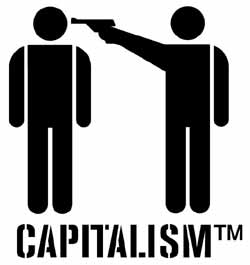
Why coercion is an essential and beneficial element of maximal-capitalist society.

angurse,

I am sorry you dont understand the arguments I have made in this thread..

All I can offer is that you actually read the posts, and I will respond when your questions/challenges are based on my assertions and not your misinterpretation or misunderstanding of those assertions.

in sum, I dont have the time to engage in repeated corrections of strawmen arguments and semantic criticisms.

You keep using that word (pacifism). I do not think it means what you think it means.–jackcuyler

n.

  1. The belief that disputes between nations should and can be settled peacefully.
    1. Opposition to war or violence as a means of resolving disputes.
    2. Such opposition demonstrated by refusal to participate in military action.

I would add the following for this thread:

opposition of coercion to transfer economically inefficiently managed resources to economically efficient management.

This sentence made me laugh.

We can’t determine efficiency (calculation problem) without a market, and yet the solution proposed by rettoper is violence instead of the market, to solve problems only the market can identify (and rationally solve).

Rettoper, has it occurred to you that you’re basically making communist arguments for the last, I dunno, 200 posts?

I am sorry you dont understand the arguments I have made in this thread..

All I can offer is that you actually read the posts, and I will respond when your questions/challenges are based on my assertions and not your misinterpretation or misunderstanding of those assertions.

I have quite accurately refuted each of your points presented. If you have a particular qualm please name it.

You, on the other hand, have repeatedly dodged counter-points made and failed to provide proof for your admitted assertions. You’ve lamented my “semantic criticisms” yet haven’t defended your own Newspeak as being more useful than that which is commonly understood or technical in nature. The fact that you had to present your own translation page is just hysterical and makes me wonder if this is just a big satire. Still, I press on…

Your ideas about “capitalism” have been revealed as nothing more than than a re-hash of the “grand illusion” of efficiency without concrete liberty in property, much like Marx, George, and Keynes. Like them, you have demonized idle resources and presented an objective view of efficiency, but unlike them you completely avoid explaining it, instead merely asserting it. A simple economic study will reveal the inherent subjectivity within all entrepreneurial decisions - renderering any claims of “uneconomic” or “inefficient” to be meaningless. Or as Shackle put it:

At what moment can a test of the efficacy of a proposed course of action be usefully applied? At the moment when that course is to be adopted or rejected.. . .The orthodox view is different. That view prescribes the application of some public standard after the event, when the “objective,” publicly observable outcome of the action can be seen. A public standard is inappropriate because the conduct has not been chosen in view of circumstances of publicly agreed character, but of circumstances privately supposed by the individual. A standard only applicable after the event [Read: Panzer invasion] is plainly useless as a guide to choice.

An analysis of the decision relating to the inter-temporal pattern of resource
use shows why this decision (like all other entrepreneurial decisions) is in-
herently subjective. It also reveals that a high rate of time preference rela-
tive to the market interest rate does not imply uneconomic resource use.

Further, your bizarre notion of Capitalism - devoid of any factual or logical basis - peaked my interest as to how anyone could possibly come up with such a definition. So I searched and I believe I’ve found the source of the error. Behold:

The man without a gun is the “environmentalist” who is “inefficiently” exploiting his resources (probably a “pacifist”) the man on the right the maximal-capitalist.

Of course, this gross error in understanding of capitalism will certainly impress the comrades.

This last post of yours, like all of your dodges, just reveal that you are simply incapable of formulating a coherent response. And to this, most likely, just more of the same will come. Still, I press on…

I understand all of your assertions (you call them arguments). What does it matter whether or not I appreciate them? I said I disagree with what you say in your threads. This has nothing to do with “understanding” or “appreciating” your assertions.

That makes perfect sense to me.

Grayson has had nothing to do with your understanding of anything. Different viewpoints? Pacifist-capitalist? Realist-capitalist? You make up terms as you go along.

My interest in this thread was to follow how other forum members chose to debate you. I watched the methods they employed, and how you rebuffed everything presented that conflicted with your own ideas (and you confirmed above that these ideas are your own).


I summarize your idea as follows:

Without government, a PDA would use violence (you call it coercion) to steal property (you call it acquire vital resources). Violence is the most economic means to allocate resources when one party refuses to use his own property in accordance with the other party’s desires.

If the defending party can’t defend himself, it proves he is not using his resource effectively because he did not extract profit from it to invest in a sufficient amount of defense. Any PDA that did not use violence would go out of business because it could not compete with the PDA that uses violence. The violent PDA would be the most profitable PDA because it would use the most cost effective means (violence) to acquire resources.

Profit lies within, or is intrinsic to, the resource to be stolen by the PDA. If I am sitting on oil reserves, I am sitting on profit. If I use my land to enjoy its scenic view, a PDA would steal my property to extract profit (oil) from underneath.

There would be no recourse for the aggrieved party. There would be no private production of law, courts or enforcement. One powerful PDA would emerge, an absolute dictator, so to speak. Thus, anarcho-Capitalism would decay into absolutism. The only effective means to avoid absolutism is liberal democracy, which provides safeguards against such intrusions on liberty.

This is way anarcho-Capitalism is a dangerous idea, a waste of time. Anarcho-Capitalists should be made to see the error of their way and instead become stalwart supportors of the only defense of liberty known to mankind, liberal democracy. Mises is then quoted in regards to anarchism.


Did I explain your position correctly? I would call your ideas “anarcho-Conservatism”. It has nothing to do with capitalism.

I think ego drives your time here more than a quest for knowledge.

Did I explain your position correctly? I would call your ideas “anarcho-Conservatism”. It has nothing to do with capitalism.

Please don’t taint conservatism (even more).

^^ This.

You keep using that word (pacifism). I do not think it means what you think it means.–jackcuyler

n.

  1. The belief that disputes between nations should and can be settled peacefully.
    1. Opposition to war or violence as a means of resolving disputes.
    2. Such opposition demonstrated by refusal to participate in military action.

I would add the following for this thread:

opposition of coercion to transfer economically inefficiently managed resources to economically efficient management.

I have not seen anyone in this thread state they are opposed to all violence, merely that they are opposed the the initiation of violence. This is an important distinction, and clearly not pacifism.

A rudimentary review is needed for those who dont understand the concepts I have presented – although I believe the barriers to comprehension are more ideological and philosphopical. Moreover, this is a short list, for further clarification read my posts and please dont make assumptions, ask for definitions and clarification:

  • within ancap society – investors, firms, and societies that do not realize a net profit on investment will fail.

  • within ancap society – those investors, firms, and societies that are the most profitable will have the most capital available for security and acquistions. In contrast, investors and firms that do not act in the interest of economic gain or profit will have less capital available for security.

*within the security industry – investors, firm, and societies that do not effectively manage resources and investments relative to competitors will see their ability to defend valued resources from those competitors negatively impacted due to less capital available for security.

*within ancap society – if a valued resources is not subject to peaceful exchange, then the more economically valuable an investor, firm, and society judges the resource, the more likely that investor, firm, society will use coercion to annex the resource.

  • within ancap society – the more profit driven a particular investor, firm, and society, the more likely that firm will use coercion (when profitable) to obtain valued resources when peaceful exchange is not possible.

*within ancap society – profit driven investors, firms, and societies will be economically stronger than firms that base their actions on goals other than economic profit. Hence these investors, firms, and societies will have more capital available for security and acquisitions.

*Within ancap society — in the absence of a peaceful and fair exchange – if an investor, firm, or society believes that it can annex a valued resource by coercion for economic profit, then coercion will be used to obtain the resource.

*within ancap society – the lower the security provided for a given resource, the more likely it will be subject to predation. in plain english for the skeptics, economic incentives to use coercion are inversely proportional to the level of defense of a given resource.

  • within ancap society – the less effective a resource is utilized for economic gain or profit, the less capital will be available for security.

  • within ancap society – the less effective a resource is managed, the less overall economic growth and productivity for society in general.

  • within ancap society – investors and firms that reallocate mismanaged resources to more economically productive enterprises and uses lead to an overall increase in societal economic growth and productivity.

  • within ancap society – generally it is preferrable to seek a peaceful exchange of resources, however when peaceful and voluntary exchange of resource from an unproductive and wasteful investor, firm, society is not possible – then coercion will result provided the act of coercion results in an economic net gain for the aggressor.

*within ancap society – those investors, firms, and societies that inordinately place aesthetic goals ahead of economic profit will see a reduction in capital available for security relative to investors, firms, and societies that emphasize economic gain or aesthetic gain.

*aesthetic goals are incalculable in economic terms, in contrast profit seeking investors, firms, and societies can identify real costs and returns for economic goals – as a result of the inability to quantify the economic benefit of these goals, there exists the problem of economic calculation for those actors who place aesthetic goals ahead of economic goals.

  • idle resources are not generating a profit, similarly mismanaging resources and the economic opportunity costs of utilizing valued resources for non-economic goals (aesthetic goals) results in less profit which results in less capital for security.

in sum, pretty logical and simple stuff if your vision is not clouded by philosphical and ideological bias (pacifism, egalitarianism, nationalism, et al).

Some points may be missing and some maybe stated more than once. The list is an ad hoc review of more detailed posts from the thread.

Before going off half-cocked with unsubstantiated criticisms based on misrepresentations and misunderstanding, please ask specific questions on points you disagree with so I can clarify in greater detail my assertions.

Question for Retropper:

You contend that correct use of coercion can bring forth greater wealth for society as a whole. When to use this coercion will be decided by omniscient individuals such as yourself, who pick and chose where resources can best be used. Any attempt to point out that your trying to play god, you call them illogical. Consider the following two scenarios.

PersonA with Carrots approaches PersonB with potato’s. PersonA wants Potato’s. PersonB wants carrots.

Profiles:

PersonA potato wanting carrot owner

PersonB carrot wanting potato owner

The two decide to trade.

PersonA → carrots → PersonB

PersonA ← potato ← PersonB

The end result is

PersonaA potato wanting potato owner

PersonB carrot wanting carrot owner.

Both PersonA and PersonB are better off then they were before, as scarce resources have been distributed to individuals who prefer them the most. This ensures that each object is utilized to the maximum benefit of our two man economy.

In exchange, both parties trade for objects they more greatly prefer, and give up objects they prefer less. The result is that both parties gain wealth subjectively by receiving tangible goods they prefer more then the other party. Resources have been allocated to match the greatest need.

Lets assume PersonB would rather use force, coercion.

PersonA → carrots → PersonB

PersonA ← Gun in the face ← PersonB

In the situation where PersonB uses coercion to force a trade that would not have occurred, or just straight steals the wealth of PersonA, what has happened is PersonB has benefited, while PersonA has not received anything he preferred more. PersonA was was pushed into a trade he did not prefer, and is now no longer in a position to trade to someone more reasonably elsewhere.

In the first scenario, both parties gained, general wealth was created. Resources were allocated to people who most preferred to consume them. In the second scenario, where coercion was employed, PersonB benefited by the misfortune of PersonA. So to repeat again, the first scenario all parties win, the second scenario only one party wins, and the other party paid a heavy price to benefit PersonB

How can you say that the second scenario, the use of coercion, makes our hypothetical society overall more wealthy?

flic,

You contend that correct use of coercion can bring forth greater wealth for society as a whole. When to use this coercion will be decided by omniscient individuals such as yourself, who pick and chose where resources can best be used. Any attempt to point out that your trying to play god, you call them illogical. Consider the following two scenarios.–flic

complete and utter misrepresentation and misunderstanding of my position.

You contend that correct use of coercion can bring forth greater wealth for society as a whole–flic

if valued resources are being withheld from production or mismanaged AND those resources cannot be acquired by peaceful means – then, yes, coercion to reallocate resources to productive use is beneficial to society from an economic standpoint.

When to use this coercion will be decided by omniscient individuals such as yourself, who pick and chose where resources can best be used.–flic

Yes, the free market actors who best reallocate and administer valued resources will reap the greatest economic gain. IN contrast, actors who mismanage resources will see a net loss on investment or lower returns that will reduce their competitive economic edge relative to more efficient investors, firms, and societies.

In sum, that is what capitalism is about – the efficient allocation of scarce resources for maximum societal benefit. NOt the allocation of resources to maximum pacifist benefit.

I ask you :

What gives you the right to deny a wise investor and his PDA of choice the means to allocate resources to their most economically profitable use ?

Any attempt to point out that your trying to play god, you call them illogical. Consider the following two scenarios.–flic

Again, who appointed you God and gave you the power to deny investors and PDAs the right to secure inefficiently allocated resources to more efficient and beneficial economic use ?

The free market is about profit, not your self aggrandizing goal of pacifism.

In sum, the astute profit motivated investor will fund a willing PDA of hard charging warriors and force societal laggards to improve their business model or face predation for ineffectively and inefficiently managing scarce resources irrespective of what a few handwringing pacifists think about the evils of a coercion.

How can you know in all cases which resources are being used for their greatest need? Who is the judge/arbiter of where and when resources should be consumed? Who can have this level of omniscience? How do you know they’re being mis-managed? How can you be sure that your judgement is not simply an opinion?

And as these firms shrink they will relinquish their consumption of natural resources back to the market. So why do we need to use coercion to force business into different behavior? If what you say above is true, we should just let the market function and let these business’s fail. Why do you think we need to employ coercion? When do we employ coercion? How do you know a better place for said resources?

I don’t understand the question. What gives the investor this right? What right are you referring to?

Would you so kindly go back and answer the question of my scenario?

Comrade, why so many questions? The Party always knows best!

In the first scenario, both parties gained, general wealth was created. Resources were allocated to people who most preferred to consume them. In the second scenario, where coercion was employed, PersonB benefited by the misfortune of PersonA. So to repeat again, the first scenario all parties win, the second scenario only one party wins, and the other party paid a heavy price to benefit PersonB

How can you say that the second scenario, the use of coercion, makes our hypothetical society overall more wealthy? -flic

I have stated previously that voluntary exchange is preferred since it doesnt have the opportunity costs associated with coercion.

however, you assume far too much in your simplistic scenario which represents the best case exchange within a free market system – however free market machinations within the the real world are not always so mutually symbiotic

Note the following conditions that your simplistic middle school economic scenario omits

(1) the exchange must be considered fair and profitable to BOTH actors or it will not take place.

(2) a peaceful exchange must be more profitable then coercion to BOTH parties or it will not take place.

(3) a peaceful exchange must be possible, BOTH actors must be willing to trade or the exchange will not take place.

(4) the exchange or trade must involve resources being used effeciently or the actors involved in the trade will be wasting and misallocating capital relative to competitors.

if your potato farmer overcharges for his product, then a peaceful exchange is not possible. If a potato loving investor or his customers determine that they can annex the property by force and secure a bounty of potatos for less than the costs they are paying now – then they will use coercion. OVerpriced goods whose demand is inelastic can be brought to the marketplace at costs considerably below that which is now being charged thanks to the use of coercion.

If your potato farmer’s land rests on vast coal deposits, yet he denies this bounty to society because he prefers the aesthetic pleasures of farm life then he has inefficiently managed scarce economic resources. in addition, he has less capital available to defend a valuable resource since he is not exploiting that valued resource efficiently. An astute investor, firm, society will soon identify the misallocation or resources and the resulting lack of appropriate security and annex the land for a net profit. moreover, society as a whole benefits economically since the land is now being used more productively and profitably.

If both your potato and carrot farmer inefficiently mismanaged valued resources to bring their products to market, then eventually both will fail or at least have less capital available for security then they would otherwise have if they utilized their valued resources more effectively. Most likely, these shortcomings will not lead to predation and loss of their resources – however, if the mismanagement is significant and the resources are valued enough by a competitor, then coercion will be contemplated as has occurred myriad times by both governments and privately led individuals and armies throughout history

The bottom line is that irrespective of whatever middle school level economic scenario you site describing an mutually beneficial and peaceful exchange within the free market – there exists the possibility that peaceful exchange is not always possible or profitable.

flic,

How can you know in all cases which resources are being used for their greatest need? Who is the judge/arbiter of where and when resources should be consumed? Who can have this level of omniscience? How do you know they’re being mis-managed? How can you be sure that your judgement is not simply an opinion?

an investor will do a cost analysis on the productive capacity of the valued resource and the cost required to annex it by force. like all machinations within the free market, nothing is a sure thing. however, the most astute and efficient capitalist will end up in possession of the most resources, irrespective of the means used to acquire these resources.

moreover, how will YOU know when you have misallocated resources ?

when tanks are parked outside your bedroom.

And as these firms shrink they will relinquish their consumption of natural resources back to the market.–flic

resources are not exclusively land – oil reserves can denied to society by an environmentalist who places the spotted owl above economic health. in this case, depending on the price of oil and the amount of oil the enviromentalist is denying to production, annexation of the economically inefficient owner’s land is likely.

If what you say above is true, we should just let the market function and let these business’s fail. Why do you think we need to employ coercion?–filc

In most cases, the mismanaged resources will result in peaceful and natural reallocation. However, in a minority of cases the opportunity costs of coercion are a fraction of the overall benefit to society from coercive action to reallocate resources to more productive uses.

for example, the use of coercion to remove the government of north korea would likely lead to a net benefit to society as a whole. within ancap society, the negligent and self-serving owners of north korea would have been removed by an aggressive profit seeking investor and his PDA of choice long ago.

also, many owners of mismanaged resources still make a profit. however, they may be witholding far greater profits from society for other than economic goals. islamic extremists do not allow women to participate in the free market thereby witholding over 50% of the most valuable of resources (people) from production. By any objective measure, using coercion to break the bonds of servitude for the 100’s of milllions of women now enslaved against their will within islam represents a net economic benefit to society.

How do you know a better place for said resources?–flic

I dont.

however, the market will reward individuals, firms, and societies who place profits above aesthetic values like pacifism.

in sum, capitalism is about the accumulation of capital, not goodwill and pacifism.

moreover, investors and firms who make economic calculations based on promoting pacifism will have to trade-off in profits to attain this goal.

I don’t understand the question. What gives the investor this right? What right are you referring to?–filc

your condemnation of coercion and violence is empty since you will have to enforce your pacifist goals by using coercion. Moreover, it is futile to deny those individuals with a natural or acquire skill set to wage war since you are not their equal in projecting armed force.

it would be equivalent to telling engineers that they cant use calculus to attain goals in a competitive free market since they would have an unfair advantage over mathematically challenged competitors.

in sum, capitalism is about the freedom to earn a profit and employ whatever skill set an individual possesses and use whatever means at his disposal to accomplish desired goals.

when you employ a means test on what is accepted and what isnt accepted, that is government fiat irrespective of whether it is by an arbitration agency or state law enforcement agency.

Would you so kindly go back and answer the question of my scenario?–flic

I did in my previous post and in numerous posts throughout this thread.

your base example is the best case scenario that exist in the free market — however it is not possible in every instance that individual investors, firms, and societies covet a scarce resource that is not for trade.

Comrade, why so many questions? The Party always knows best!–liberty student

Then why do you force your pacifist views on individual investors, firms, and societies who determine that coercion is the most effective means to reallocate scarce and valued resources from idleness or mismanagement ?

capitalism doesnt make distinctions or value judgments on the manner in which profit is attained. only that individuals, firms, and societies that operate profitably by allocating valued resources to productive enterprises are rewarded.

using your logic, it is more important to judge the means profit is attained, not the overall profitablitity of an enterprise.

sounds like your the judgmental marxist

Comrade rettoper, thank you for explaining to Comrade Filc how we make decisions with central planning! That fool still thinks that markets are necessary to form prices, but as you and I know, Mises was wrong about the socialist calculation argument, and bureaucrats with really large calculators can plan an economy without the need for voluntary exchange or the price discovery process.

Down with praxeology! Up with communism!

Comrade, we’re both marxists! Let’s confiscate property by force for the good of the proletariat! Revolution! Revolution!

Comrade, those Austrian fools believe that effective is a subjective determination as covered in praxeology, but you have finally overthrown von Mises with your fantastic argumentation! Down with bourgeois praxeology! Down with subjective value! Down with markets! Coerce, maim, club and kill! For the Party! For the people!

Comrade, don’t confuse other readers by mentioning profit! Deep in the politburo, our unspoken secret is that profit is not bad, but that we cannot calculate it without markets, and how can we have a proper communist paradise if we allow markets!? Our greatest minds know that it is impossible to form prices without a market, and so it is impossible for us to know what is and is not profitable. Thus we must stand by our tools of coercion and collectivism should anyone question our methods!

We can only create a free society by crushing individual action! No man is greater than the Party!

Not at all comrade. If we have to grind the skulls of every child into fertilizer for the crops which feed our glorious revolution, it must be. Coercion above life, coercion above all.

Whoa, I can’t believe I am reading this. Holy #$&@ lolol

angurse,

the following quotes is a perfect example of a gross ignorance of the true nature of freedom, security, and capitalism.

the perfect capitalist society world wouldn’t need PDA’s, nor would it need locks, chains, or keys. All of that capital sadly has to be allocated differently, resulting in less than maximum production. Theft is the antithesis of capitalism.-- angurse

Anyone who supports freedom must reject specific means, particularly those that run contra to freedom. I’m not ashamed to admit that I reject actions that aren’t peaceful. Yes, I reject slavery, murder, rape, and theft.–angurse

emotional and empty appeal to freedom and peace.

what is disturbing is that you fail to realize that both of these worthy goals are not free. they must be attained and defended largely by the accumulation of capital required to fund an adequate level of defense.

moreover, you believe that within a society driven by profit that defense, freedom, and peace will no longer be scarce resources ?!

the grand naivete associated with this kind of “logic” is palpable.

No, as I’ve explained (and you agreed!) there are perfectly good economic reasons to deny theft as legitimate market activity. I could care less if its by the proletariat, the bourgeoise, or even the “warrior class.”–angurse

in contrast, there are perfectly legitimate reasons to advocate and employ coercion to reallocate idle or mismanaged resources that are not open to peaceful exchange. I have outlined numerous examples of these in previous posts if anyone cares to read them.

"Private property is the tangible and intangible things owned by individuals or firms over which their owners have exclusive and absolute legal rights, and can only be transferred with the owner’s consent. …–angurse

in the fantasyland of naive faith-based ancaps that might be true, but in the real world of profit seeking investors and their PDAs of choice private property rights and valued resources must be defended. Hence, those that misallocate valued resources will have less capital available for defending those resources.

moreover, capitalism makes no distinction or value judgment regarding the means that investors, firms, and societies use to obtain wealth, security,and power.

those hand wringing pacifists who try to inject their personal value judgments on the morality of using coercion to attain ends had better insure that they are productive users of valued resources or they will not have the capital to defend and project their pacifist views.

Private property rights is egalitarian? Ironically, Marx used similar “efficiency of production” reasoning as yourself to justify the taking of private property.

complete misunderstanding of the point I was making, namely that marxists and pacifist base economic decisions on non-economic aesthetic, moral, or ethical value judgments that represent the problem of economic miscalculation and inefficiency.

hence, if an investor, firm, or society is motivate by some measure of pacifism then a corresponding incalculable measure of profit is forfeited to attain pacifist outcomes.

Then you’ve conceded my point. As there is a point where the farmer isn’t reaping the benefits of his land, by your expressed logic, he’s inefficiently exploiting his land and therefore won’t have enough capital to defend it from the tanks.–angurse

if property or resource cannot be used to gain wealth or profit then they are not subject to predation. So yes, inactive land that is useless or whose utility for economic gain is slight would not be worth the effort to take either by coercion or peaceful trade.

"Capitalism - an economic system based on private ownership of capital" - nothing pacifist there.

and again, when coercion is used to reallocate idle or mismanaged resources, the valued land or resources are still privately owned, hence capitalism and improved societal efficiency.

you will know when a resource has been mismanaged when a competitors tanks are parked on it or next to it.–Rettoper

This has absolutely nothing to do with economics. --angurse

then you are ignorant of what capitalism stands for. Of course, the use of tanks to annex a valued resource is about economics and capitalism. I will try and make it easy for you:

(1) an owner fails to efficiently manage his valued resources. (capitalism)

(2) as a result, the negligent owner has less capital available to provide for security (capitalism)

(3) an profit driven investor identifies a resource that is being under utilized and under defended and determines that it would be profitable to annex the resource by force (capitalism)

(4) the property is annexed when tanks roll with little opposition, resources that heretofore were denied from production are now open to society.

if an individual, firm, and society covet a valued resource for its economic utility that cannot be obtained by peaceful means and that property can be annexed by coercion for a net profit – then coercion it is.–Rettoper

Heard it all ready, you’ve yet to show how that makes it capitalism. You’ve just asserted what capitalism is without backing it up.–angurse

Do you even know what capitalism is angurse ?’

investors and firms who covet a valued resource for its economic value will take the resource by force if it is profitable to do so.

in contrast, those actors who dont understand the economic benefits of unbridled capitalism or that are motivated by some other aesthetic, moral, ethical considerations will see a decline in their economic strength relative to the profit seeking actor.

what dont you understand about that ?

for example, in open competition between you (the pacifist) and the capitalist investor — you will lose.

He will be making money, you will be making peace — and eventuallly He will possess more capital then you and use this economic disparity to fund a PDA of his choice to remove you from your possessions and valued resources, if you have any left after economic miscalculation derived from financial decisions driven largely by incalcuable moral, ethical, and aesthetic considerations.

In sum, maybe you have resorted to strawmen and misrepresentation of my positions because you dont understand them.

please ask for clarification before making assumption or misrepresenting my positions.

this last one is a doozy:

the notion that it is a “poor assumption” to state that an ineffectively managed resource will provide less capital for defense is manifestly absurd.–rettoper

That notion wasn’t presented. I gave an example, you’ve dodged it.–angurse

are you saying that I am WRONG when I assert that an inefficiently managed resource will provide less capital ?!

are you kidding dude. read my statement.

i will repeat slowly for you — if a resource is inefficiently or ineffectively managed then it will provide less profit/ capital for its owner.

are you refuted this obvious truth ?!

how can I dodge this statement — I stand behind it and it doesnt require explanation, it is self-evident to an elementary school student

nonetheless, thanks for your post – it was entertaining