The series itself is a number. That number may or may not be able to be calculated/defined displayed in a more pleasing manner. Regardless, the sum of the sequence is still exactly one number. It is possible that the sequence itself, preceded by a sigma, may be the only way to accurately display said number.
Numbers are not like space or time - the residue in a convergent infinite series is not an “error term” representing some kind of “unknown quantity” which we could be surprised, after enough iterations, to find differs from what it is provably equal to. When we prove that the “least upper bound” of the sequence 0.999… is 1.0, what we have proved is that “when carried out to infinity”, the sum 0.999… is identically equal to 1.0. This is not some kind of speculation that we can’t verify, it is actually the case. What we mean by 1.0 can also be written as 0.999… these numerals are aliases for one and the very same number.
Where analysis qualifies this is in the nature of the approach to the limit. Frequently, it matters which direction you’re approaching a limit from in order to fix the limit. For example, if you approach zero in the equation 1/x, you get two different answers depending on whether you approach it from the negative side or the positve side. This gets really crazy in complex space where you can approach the limit from any direction in the complex plane.
Consider any of the closed-form equations for pi or e such as those given by Friedmanite. Those equations are not merely correct to within some epsilon-delta value that is dependent on how far you carry out the equation… the equation is exactly equal to the constant in question in the limit. That is, the proportion of a circle to its diameter is precisely equal 4 * (1 - 1/3 + 1/5 - 1/7 + … ). There are equations that are only approximations of pi… 22 / 7; they “approach” pi in an utterly different sense than Leibniz’s beautiful equation does because they do not ever, even in the limit, actually equal pi. A l.u.b. specifies the limit of a sequence of partial sums and, in the case of a converging infinite series, the l.u.b of its partial sums is identically equal to its sum both of which are a number - the very same number.
Clayton -
It depends on what formalism you are using. Some series are particularly slippery. It is not unqualifiedly true to say that a “series is a number.”
Clayton -
Clayton,
I’ve edited my previous post to clarify.
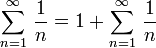
Again, you are not correct. A series diverges if its sequence of partial sums does not have a limit. Take, for instance, the harmonic series

Precisely because this series is unbounded, it is perfectly valid to say
Guys, I am just repeating basic advanced calculus.
In the Project Gutenberg edition of Hardy, it’s all laid out in Capter Four, Section 76. [Page 168 in the print pagination, and 184 in the pdf pagination.
My computer can’t copy the sigma summation sign from the pdf file, but I’ll copy what I can here
Here’s Hardy:
76. Infinite Series. Suppose that u(n) is any function of n defined
for all values of n. If we add up the values of u(ν) for ν = 1, 2, . . . n, we
obtain another function of n, viz.
s(n) = u(1) + u(2) + · · · + u(n),
also defined for all values of n. It is generally most convenient to alter our
notation slightly and write this equation in the form
sn = u1 + u2 + · · · + un ,
[skipped a bit].
If now we suppose that sn tends to a limit s when n tends to ∞, we
have
[an equation in sigma notation, look it up].
This equation is usually written in one of the forms
[here he uses sigma notation again] or u1 + u2 + u3 + · · · = s,
the dots denoting the indefinite continuance of the series of u’s.
The meaning of the above equations, expressed roughly, is that by
adding more and more of the u’s together we get nearer and nearer to the
limit s.
Guys, he said it right here. a+b+c…=s means that by adding more and more etc we get nearer and nearer etc. Not that by adding up all of them together we get exactly s. {He says that’s what it means “roughly”, because in the next paragraph he restates it precisely, using epsilons and inequalities.]
Again, go to your local math teacher and ask him. Or read that section from Hardy a couple of times untill you grasp what he means with every single word he writes there [not just some vague general idea], in the pdf file.
The series itself is the sum of the sequence, by definition. The most accurate way to represent that sum is:
1 + 1/2 + 1/3 +1/4… is an infinite sequence, the sum of which is above.
you’ve claimed multiple times in this thread that an infinite series equals its least-upper-bound.
No. The notation used to denote the so called sum of an infinite series, the sigma notation, and also the three dots notation, equals, by definition, the least upper bound of the series. See Hardy in the previous post of mine for chpater and verse.
A series itself is a function from the set of natural numbers into the real or complex numbers. A function is not a number. It is a function. And you cannot say that the value of the function is equal to the sum of the series, because if F(n) is positive for infinitely many values of n, then no value of F(n) is equal to the sum of the series. Because the LUB is strictly greater than all the values of F.
What a function can have is a limit. And the limit is a number. But a function is not a number.
Here’s Hardy, too:
.. the sum of the geometircal series 1 + x + x^2 + … is a function of x, viz. the function which is equal to 1/(1-x) if -1 < x < 1 and undefined for all other values of x.
You do not understand what Hardy is saying. Here’s the definition of a convergence of a sequence

as

if and only if

Now, if we apply this definition to the sequence of partial sums Sn, to say that {Sn} converges to a means that for any positive real number epsilon we can find a positive integer N such that n > N implies that Sn’ is within epsilon units of a. Hence, if we keep adding the terms of the sequence ad infinitum, the resulting sum is precisely what the sequence converges to.
JackCuyler,
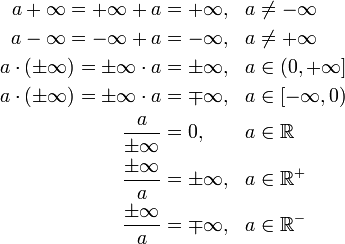
That series does not converge to a finite value. It diverges to infinity. Here’s how arithmetic operations are defined in the extended real number system (which includes positive and negative infinity)
It’s equally valid to say that the harmonic is equal to the series that keeps adding 1’s forever.
Jack,
What he means is that the LUB of 1+x… is a function of x. After all, he defined “1+x…= s” as meaning that the limit of a certain function is s.
Glad to see you are researching the sources.
Now, if we apply this definition to the sequence of partial sums Sn, to say that {Sn} converges to a means that for any positive real number epsilon we can find a positive integer N such that n > N implies that Sn’ is within epsilon units of a. Hence, if we keep adding the terms of the sequence ad infinitum, the resulting sum is precisely what the sequence converges to.
Freidmanite,
Everything you wrote is correct but for the last sentence. That last sentence is the very mistake Hardy [and all math books] are going out of their way to make sure you don’t make.
You cannot add stuff up “ad infinitum”. Such an operation is not defined. The only thing that is defined is the limit, or LUB.
Dave,
Yes, but he also said the following things mean the same thing:
- converges and has the sum s
- converges to the sum s
- converges to s
- tends to the limit s as n approaches infinity
That is, the last statement is just another way of saying any of the first three,
Yes, but he also said the following things mean the same thing:
- converges and has the sum s
- converges to the sum s
- converges to s
- tends to the limit s as n approaches infinity
That is, the last statement is just another way of saying any of the first three,
Jack,
All those mean the same thing, but he clearly says that they all mean an epsilon inequality. The only definition he gives for any of the four statements is that s is the LUB.
Ask yourself this. If you can add stuff up ad infinitum, and 1+ 1/2 … really adds up to 1, then why bother with limits and epsilons at all? Why does he go so far as to DEFINE the sum as a limit, and not just say it is what it “really” is?
Guys, I’m tired, it’s late. Go to your math teachers. It’s not rocket science.
No, you go to your math teachers. Or better yet, start reading an actual math book.
“Ask yourself this. If you can add stuff up ad infinitum, and 1+ 1/2 … really adds up to 1, then why bother with limits and epsilons at all? Why does he go so far as to DEFINE the sum as a limit, and not just say it is what it “really” is?”
The sum is the limit which is finite, for any convergent series.
Dave,
One would use the epislon as it means the sum of, and it’s a tidy way of expressing that thought. Aside from that, I’m not sure what you’re getting at. This is basic logic. If a, b, c and d all mean the same thing, then a definition applied to d also applies to a, b and c.
You are correct when you say that the LUB of 1/2 + 1/4 … is 1. However, you are incorrect when you make a distinction between sum and LUB (in this case) when there is none, as Mr. Hardy clearly states. The sum of 1 + 1/2 + 1/4 … is 2, as Mr. Hardy also clearly states, addressing the very issue presented in the OP.
I haven’t had a math teacher in almost 20 years or so; I think you may be misguessing my age. In any event, go ask your math teacher whether .999… is a number or not. (hint: it’s a real number)
Umm… the least upper bound of 1/2 + 1/4 + … is not 1.
The least upper bound of 1/2 + 1/4 + … is most certainly 1.
“The sum of the geometircal series 1 + x + x^2 + … is a function of x, viz. the function which is equal to 1/(1-x) if -1 < x < 1 and undefined for all other values of x.”
x=1/2
1/(1-1/2)
1/(1/2)
2
2-1
1