Allegations of economic recovery

Here is a recent Washington Post article, complete with charts and graphs, showing movement toward an “economic turnaround” since early 2009. Presumably, Bernanke has been doing the right thing.

<http://voices.washingtonpost.com/ezra-klein/2010/04/the_economy_of_the_2010_electi.html

But, as Ezra Klein points out, “…though the country may like Keynesian economics in practice, they don’t like it in theory.”

Perhaps some information was left out here. Are we seeing a “suckers’ rally” in the economy?

I’ll try my hand.

  1. Jobs up 160,000. How many of them are temporary census jobs? How many are govt jobs in general? Both those kinds of jobs are unproductive. And taxpayers are apying for them out of their pockets, getting nothing in return.. Private sector jobs make things, and are paid for by profits, meaning somebody paid for them in exchange for a good or service he received.

  2. Housing Prices. All that graph says is that they have stopped going down. Not a surprise, given the huge incentives the gov is giving, such as low interest rates and tax breaks. Peter Schiff adds that keeping housing prices up is a BAD thing. They should drop, so people can afford to buy them. And, he adds, they will drop when the govt is forced to raise interest rates or see the dollar turn into zimbabwe money.

There is an interesting question here. In every market, there are two parties, the buyer and the seller.
What is good for the buyer [low prices] is bad for the seller. So that whatever happens to prices hurts 50% of the economy. Why then, does the govt take a stand one way or the other? The answer is that it always takes a stand to support itself and its wealthy pals. But we are getting off the topic.

  1. Dow Jones. I’ve heard two things about this. First, that when stocks crashed, they dipped below their true worth, so of course they were going to bounce back a bit. Second, that they went up in dollars [=inflated paper money], but not in realtion to commodities and gold.

  2. Interest Rate. Isn’t this controlled by the Fed? How does it indicate anything? Would appreciate help here.

  3. GDP. This is not an indicator of economic health if the increase is from govt spending, which it probably is. For that matter, it is not good if the increase is from private consumption in this particular situation, because we [=most Americans] are broke and in debt and should be saving, not spending.

Finally the two graph that don’t lie. Unemployment is at Depression levels [if we use the definition of unemployment used at that time] and the national debt has never been so huge.

Is there any reason to believe that the tools that have been used by both the Fed and the government wouldn’t lead to at least a temporary economic recovery?

Housing prices have been propped up by easy money and government incentives for first time homebuyers as well as the government clearly urging many banks to renegotiate loans with homeowners who are underwater.

Unemployment ought to go up eventually if there’s more money moving around. Although I’m pretty sure most of the recent numbers are government jobs.

I mean…it’s entirely possible that the stock market will continue to make gains for some time. I’m actually betting that it will. Inflation is good for asset prices.

Gold has stayed strong though. I think it closed at 1160 on Friday.

It’s kinda like saying that Communist Russia worked because everyone had an automobile. Just ignore that no one had gasoline to run their automobile. Their goal was to have everyone own an automobile, but they never said anything about being able to use them. Furthermore, let’s ignore that some people might not have wanted automobiles, and would have rather used the resources that went into their automobile to make, perhaps, water boiler.

You mean this in reference to the “home owners society?”

Not necessarily. But yeah, that would be one example. You could also apply it to jobs. If their goal is to reduce unemployment, then it’s not impossible for the government to do it. The government could simply outlaw trucking companies have people carry boxes across the country. But that would be what the market wants.

Or how about this one: Say I like mango sorbet and hate vanilla ice cream so I go the store to buy some. But when I get their, all their is vanilla ice cream. So the owner of the store all we have is vanilla ice cream because the resources that would have gone into making mango sorbet went into vanilla because the government’s goal was to increase the supply of vanilla. Okay, so there is a crap load of vanilla, but that’s not what I want: I want mango sorbet. I don’t want the vanilla ice cream.

I stumbled onto this, from http://www.denverpost.com/business/ci_14898834?source=pop_section_business

"Everything that economists point to as a sign of growth usually comes with some kind of qualifier.

"The Dow is at 11,000, but interest rates have been artificially low for years.

"Many of the big banks have repaid their Troubled Asset Relief Program funds and reported profits, but they have been gorging on nearly free funds from the Federal Reserve Bank.

"GDP is up, but so is the national debt.

"Auto sales are up, but it’s off a very low base and sparked by 0 percent interest financing.

“We created jobs in March, but most of them were temporary, or census-taking, or government or health care jobs.”

Yes… so it’s really not a legitimate recovery.

It would be legitimate if it was due to increases in productivity or investment. But it’s not. It’s due to government spending and other schemes. Instead of these schemes setting a foundation that wil allow the economy to succeed on its own they’re making sure it isn’t going to be able to succeed indepdendent of government.

Honestly, a recovery was bound to happen. It was just a matter of malinvestments being wrung out of the market. We are experiencing a recovery right now. The problem is that there would have been a recovery in late 2008 had there been no government intervention.

Didn’t all the govt spending [trillions of dollars!] suck up all the resources and prevent a recovery? Not to mention the regulations hampering the market from functioning. Look at Japan, they are waiting 20 years now, and the USA waited 15 years in the 30’s.

Not to mention that El Krugman himself says there’s only a phony recovery now [as of January this year, when he wrote the article].

There is no recovery. Bank balance sheets are still a mess, residential housing has barely seen a correction (thanks to government programs), the commercial real-estate crisis is around the corner, and the real unemployment rate is around 17%. Bernanke has literally built artificial money markets, mbs markets, and 20 other pseudo markets. The FED flushed the banks with liquidity which they are now using to speculate in the securities markets, causing a stock market rally. The FED is also paying interest on reserves in order to prevent the inflationary holocaust. The FED is essentially Atlas at the moment, and Austrian theory says that such a condition is untenable. There can only be 4 outcomes, none of which are good: (1) inflationary Armageddon, (2) sharp deflationary contractions, (3) extended and severe stagnation (for many years), or (4) the pseudo boom continues for a few more years and is then followed by a systemic collapse.

The fiscal “stimulus” was so small that it couldn’t have made much difference to the US $14 trillion economy. I’m more worried about the bank bailouts and monetary “stimulus” causing a secondary recession, when further financial losses occur.

You can’t say that there is no recovery when economic numbers have been turning a corner. Job markets have been looking better and business activity has picked up. This recession is over, as far as I’m concerned. Now what we have to worry about is a secondary recession when all the credit the Fed pumped in is going to lead to an even bigger bust.

Which means nothing.

What numbers are you referring to?

That’s the definition of recovery.

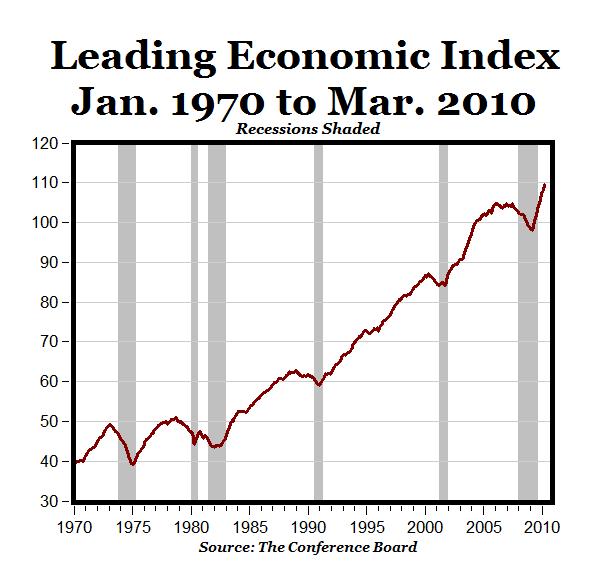
The Leading Economic Index:

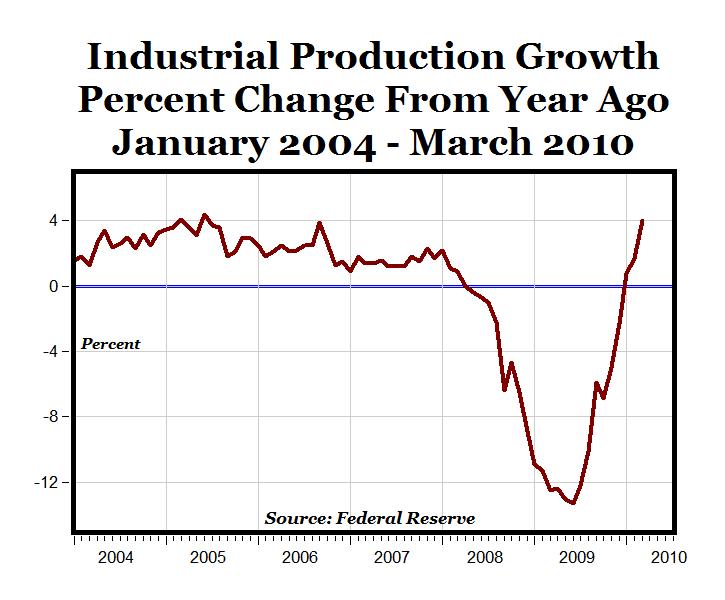
Industrial Production Growth:

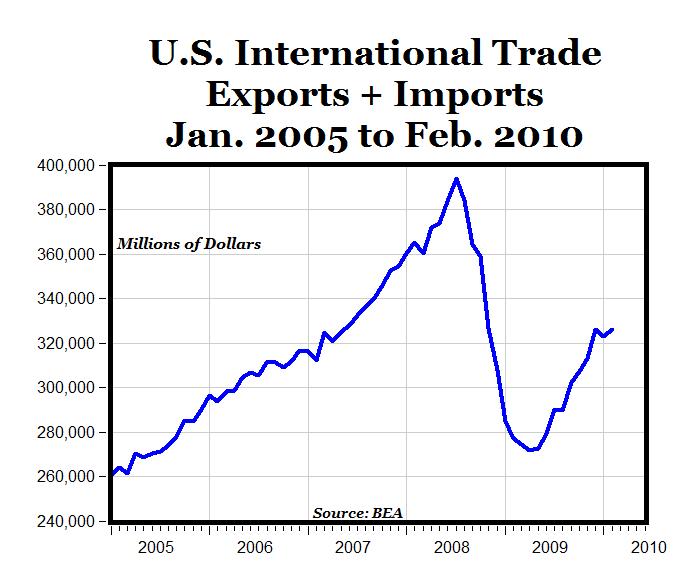
America’s International Trade:

Unemployment numbers have also been stabilizing/heading downwards.

Oh, and did I mention GDP?

Job markets “looking better” is not a definition of anything.

I’ll deal with the charts one at a time.

Chart 1: I don’t know what this chart is referring to, though it has a very authoritative name!

Chart 2: Liquidation, which every Austrian knows is required for an actual recovery, entails a reduction in the price of producer goods relative to consumer goods. This chart merely shows that FED inflationary policies have facilitated further malinvestments rather than liquidating them. Pushing interest rates to 0% tends to increase over-all investment and production.

Chart 3: An increase in trade tells us nothing about fundamentals. Trade is easily stimulated by inflation.

Chart 4: GDP tends to rise when you reduce interest rates to 0%.

When Austrians talk about “recoveries” they mean an actual structural realignment, i.e., the liquidation of malinvestments. Your charts tell us nothing about actual fundamentals.

Esuric, by your definition, the US must have not recovered since the Great Depression, because the Fed has continually used monetary stimulus since the 1940s.

An upturn in business activity is.

Well, I’ve said the little I know on this subject.

Here’s Krugman:

As you read the economic news, it will be important to remember, first of all, that blips — occasional good numbers, signifying nothing — are common even when the economy is, in fact, mired in a prolonged slump. In early 2002, for example, initial reports showed the economy growing at a 5.8 percent annual rate. But the unemployment rate kept rising for another year.

And in early 1996 preliminary reports showed the Japanese economy growing at an annual rate of more than 12 percent, leading to triumphant proclamations that “the economy has finally entered a phase of self-propelled recovery.” In fact, Japan was only halfway through its lost decade.

Such blips are often, in part, statistical illusions. But even more important, they’re usually caused by an “inventory bounce.” When the economy slumps, companies typically find themselves with large stocks of unsold goods. To work off their excess inventories, they slash production; once the excess has been disposed of, they raise production again, which shows up as a burst of growth in G.D.P. Unfortunately, growth caused by an inventory bounce is a one-shot affair unless underlying sources of demand, such as consumer spending and long-term investment, pick up. [Note: I think that last “unless” part is the Keynes in him talking. It’s the only controversial phrase in what I am quoting here. Everything else makes a lot of sense, I think].

Which brings us to the still grim fundamentals of the economic situation.

During the good years of the last decade, such as they were, growth was driven by a housing boom and a consumer spending surge. Neither is coming back. There can’t be a new housing boom while the nation is still strewn with vacant houses and apartments left behind by the previous boom, and consumers — who are $11 trillion poorer than they were before the housing bust — are in no position to return to the buy-now-save-never habits of yore.

What’s left? A boom in business investment would be really helpful right now. But it’s hard to see where such a boom would come from: industry is awash in excess capacity, and commercial rents are plunging in the face of a huge oversupply of office space.

Can exports come to the rescue? For a while, a falling U.S. trade deficit helped cushion the economic slump. But the deficit is widening again, in part because China and other surplus countries are refusing to let their currencies adjust.

/Krugman.

Now to kaju’s graphs.

I need help with the Leading Economic Index. I don’t know what it is, and why it is or isn’t relevant.

Industrial Production, Krugman took care of, I believe.

Exports Plus Imports seems a pretty funny thing to look at. If we are importing a lot and exporting very little, which Peter Schiff has been warning about for at least three years now, that is not a sign things are good. It’s a sign things are awful and disaster looms. Because it means we are borrowing, and will ahve to pay interest, and won’t be able to repay without massive inflation [so that we can repay in useless dollars. But then they will be useless to us also].

Unemployment I took care of in earlier posts on this thread.

GDP I also took care of.

I look forward with great interest to see how this thread continues.
Well, it’s not my definition. If you’re asking what level of liquidation is adequate for a recession to be considered “successful,” so to speak, then I don’t know. The more the malinvestments are purged, the stronger is the recovery (and more stable). But the point is that we haven’t really seen any liquidation of malinvestments at all. The FED is propping up the malformed capital structure and facilitating additional malinvetments.

This may be a semantical issue. If you insist on using the mainstream’s definition of a recovery (positive GDP growth for 2 or more quarters) then I would say that a such a recovery should be feared. Recoveries are only useful when (a) they are stable, and (b) they don’t cause even larger catastrophes.