What do you want me to clarify?
Nothing, because you said in the very next sentence to not ask you to clarify.
(But maybe you meant that you could explain it, but just couldn’t justify believing it?)
I can clarify it, I just can’t give you all of the reasons that scientists believe it.
If you can at least see yourself believing this, then it means that contradictory things can be true, and that a priori arguments are pretty weak.
Alright, then can you explain what it means?
an example of this is when electrons occupy the orbit of two (or more) atoms at once. This happens all of the time. Apparently, atoms aren’t just ‘sharing’ the electron, the electron is actually simultaneously in two different places.
(I’m sure wikipedia is a better resource than me for this.)
I had to run some errands, and while I was waiting for something, I continued to work my way through Mises’ Memoirs on my iPhone, and I just happened to reach the part where he talks about writing Epistemological Problems of Economics, and read something directly related to what we’re talking about. (It’s the strangest thing: this is the 2nd or 3rd time this kind of thing has happened.)
What I read has led me to revise my understanding of Mises’ position. While it is apparent from the passage I quoted before that Mises asserted a pragmatic verification for Euclidean geometry, he did NOT (at least in his earlier writings) extend pragmatic verification to the principles of logic themselves.
From pages 108-109:
The principles of logic are said to be arbitrarily chosen conventions that have proven themselves practical or useful. Viewed in this way, one is only postponing the problem without bringing it any closer to resolution. One may claim that man has tried various arbitrarily chosen rules and, in the end, has held fast to those that have proven themselves effective. But in terms of what purpose did these rules appear effective? If this is the question posed, then one has arrived again at the problem of intellectual mastery of worldly things, and at the problems of explication and truth. For this reason it is also futile to attempt to solve the problems of truth through an appeal to usefulness. Since these principles of logic were arrived at arbitrarily, could one just as easily have chosen other principles, if their effectiveness were the same in terms of purpose? No, certainly not. The basic relations used by logic to link statements are necessary to and inseparable from human thought; irreconcilable relations are unimaginable. The category of negation is not arbitrarily chosen; it is necessary to thought. No thought can dispense with it. Even if we wanted to assume that the distinction between yes and no were a product won by experience, or that once arbitrarily established proved itself through experience, one has not yet refuted the contention that, logically, the ability to comprehend yes and no must precede all thought.
Why does Mises submit Euclidean geometry to pragmatic verification and not logic? It must be because, as he says in Human Action, the axioms of Euclidean geometry have been shown by what he calls “modern epistemology” to be “freely chosen postulates”.
That being said, Hulsmann said that Mises adopted the pragmatic definition of truth starting with Human Action and going forward (and Memoirs was written before Human Action). So it is conceivable that he changed his position. But, since nowhere does he seem to directly contradict what he wrote in Memoirs with regard to the principles of logic themselves (as far as I know), I can only assume that the above is his final position on that matter in particular.
What a great quote. This is the Mises that I’m more familiar with.
I think it opens back up the question I asked in the OP.
the “rules” of logic are a cypher. logic is just seeing, just reading off what is in your mind. people only ever need to be taught logic because they are confused by language. the subject that should be taught in a logic class is language slipperiness, not logic rules. logic is so easy that you cannot get it wrong when it is phrased clearly:
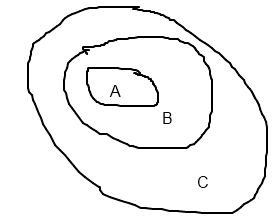
now tell me, are all A’s C’s? it just means, is the A region fully contained in the C region? even a 4-year-old could answer this without a second thought once she understood the question.
so first of all it is a distraction to speak of the rules of logic, and that somewhat muddles Mises’s presentation.
caution: this is a very sticky wicket, because first of all you are on to something in saying that “everything is based on induction” and that is a majorly important thing to realize. the big HOWEVER is that logic is not one of those “things” because logic is not a “thing” but rather a lack of something, as i will show now:
QM cannot defy deductive logic, as that would be incoherent. the language we use to describe it can appear contradictory, but that just means we haven’t understood it yet. it cannot BE contradictory.
this is a common misconception, even among scientists, but it is easily disposed of: what cannot be thought about cannot be communicated, and a contradiction is impossible to think about (Mises), hence impossible to write about. if you read it somewhere, the author was not thinking it, so her words were nothing more than ink.
just because an electron appears to behave as a “particle” and as a “wave” based on certain measurements, and just because our full conceptions of particle and wave contradict each other, doesn’t mean that there is really a contradiction sitting there in nature. nature knows no contradictions; contradictions are human language confusion. hence the frequent usage: “a contradiction in terms”. there is no other kind of contradiction than a contradiction in terms!
as i said above, the rules of logic are a cypher; logic is just what you do automatically when you see a problem clearly because the fog of language is not creating too many ambiguities or re-labelings for your mind to sort out. it is not learned from experience in the ultimate sense, because there is no “it”. what there is is a failure to correctly deduce something, because of not seeing the problem in lucid terms. we call the lack of that failure “logic”. it is a not a thing or a process, but rather a lack of confusion. or else it is simply putting the obvious process of noting what one is seeing in one’s head (see above illustration) into words.
forget scientists, how can YOU even believe this, based on your understanding of the terms “single particle” and “place”? does not the concept of a single particle entail the notion that “it can only be in one place at a time”? if not, isn’t the particle not a particle but more of a cloud? and if it is like a cloud, then where is the contradiction? there will not be one.
sounds more like a cloud than a particle, so where’s the contradiction?
the scary thing about you and Grayson here is that you seem to believe that contradictions are possible, even though they never appear in any other area of your experience, just because the scientists think so. scientists are not paragons of logical reasoning; their field these days is almost solely concerned with making accurate predictions. since they are always testing, they can be fuzzy on the logic because the empiricical results will correct them if they go wrong in a way that has practical implications for their field. so it is not reliable to take this kind of “contradiction” and run with it into the social sciences merely out of some perceived rigor in the hard sciences. they are only rigorous where they need to be.
to illustrate the point, what if i scientifically measure your nose and conclude, in a peer-reviewed journal, that your nose is both there and not there at the same time? would you believe it? would you not ask them what on earth they mean?
when someone says something incoherent or apparently contradictory, you don’t just accept it, you ask for clarification. if none is forthcoming, you’re dealing with an evangelist, not a scientist. or at least a scientist who has overstepped the bounds of science, into religion.
notice that this all follows from the fact that logic is simply the lack of confusion in reasoning, or it is just something in language. for that second part i just mean that we can call the idea that “a thing and its negation are both true” illogical, but that only means that we have identified a way to use words to point at no conceivable thought. what Mises is really saying, although i am not sure how much he is aware, is that it is possible to misuse language but that we should not let that distract us. or at least the passage amounts to the same.
if we understand that language is communication of one’s thoughts, we can see that this has turned the function of language on its head, and that that is the real source of the confusion. the confusion is hard to notice in academic discourse since that discourse is also conducted in language!
in short, it is a tacit norm of communication that your words are an attempt to convey some thought in your head. if they are not an attempt to convey some thought in your head, like because the thought is not thinkable in the first place, it confuses the daylights out of people because they are used to assuming the norm. so they are left inexplicably thinking, “this person thought this and then spoke it, so it must be thinkable…but what is the thought behind the words?” the answer is sometimes that there isn’t any thought there (or the actual thought there is just something true but trivial).
First up apologies to I Ryan for the lateness of this reply- I have been incredibly busy over the past few weeks.
I’m really not sure what you’re asking here. What do you mean by conceive and by what criterion could I convince you that I could conceive of the immaterial?
Well one could but as I continue to maintain if one atoms exist then all that exists there is neurons and synapses doing there thing; giving human like qualitites to the atoms is impermissable. Under naturalism the subject cannot exist, only the object so if you in fact observe “emotions” this implies your premise to be incorrect.
You assume, I think, that language is purely an evolutionary process which developed man’s our survival hence it being a kind of action. When you discuss acting man which man are you referring to? Neandetals, homo sapiens …? If you claim that language began with the latter then you would still have the ground work to prove that pre-man evolution could provide man with the revelant tools.
Ok an argument for why language must be more than action: No word is defined as itself, or can be understood as such, which implies that there is necessarily more than one word needing to be in existence for a language to function. As such the 1+x number of words required for language cannot appear on an incremental, evolutionary level, therefore it implies a creator. I’ve just realised I’ve used the irreducible complexity argument to language; hadn’t joined thte dots before.
Why does it only relate to space? How do you conceive of time?
Firstly let’s deal with the two general theories of time A and B- A holds that only the present exists whereas B treats time as line which can be jump back and forward upon. The latter is however contradictory since it cannot account for a stable I: under that model I can be simultaneously drowning and writing this post, further I both feel and do not feel pain of drowning whilst I write. The only cogent explanation of this is by Jonathon Edwards who argued God determines who the I is throughout this constant “recreatiion” of sorts. Since it takes a deterministic and somehwat arbitrary line it is false. Therefore the A theory or presentism is true.
Action implies time since without it one could not use means to satisfy ends. As such time is a resource of sorts and it cannot be reproduced so when it is used that piece of time can never be used again; it is scarce in a sense: time unit t exists only for t but can be used by everything however only for the duration of t. Supposing that you stop time a t and x constellation is present and at t+1 y is present. It does not implie however in t+2 that we are in fact in t just because x constealltion exists.
Action implies time and as such time must exist in an objective, hence it cannot be looped.
Do you believe that the law of identity, A=A, is true? If so can identities change entirely, not at all or only within a dynamic conception of the identity?
The bolded part is uncontraversial. My question clearly implied how could you justifiably hold someone accountable for their actions under determinism?
I read the posts. It seems you are making a similar point to Wittgenstein in the Tractatus:
"4.063 An analogy to illustrate the concept of truth: imagine a black spot on white paper: you can
describe the shape of the spot by saying, for each point on the sheet, whether it is black or white.
To the fact that a point is black there corresponds a positive fact, and to the fact that a point is
white (not black), a negative fact. If I designate a point on the sheet (a truth-value according to
Frege), then this corresponds to the supposition that is put forward for judgement, etc. etc. But in
order to be able to say that a point is black or white, I must first know when a point is called black,
and when white: in order to be able to say,‘“p” is true (or false)’, I must have determined in what
circumstances I call ‘p’ true, and in so doing I determine the sense of the proposition. Now the
point where the simile breaks down is this: we can indicate a point on the paper even if we do not
know what black and white are, but if a proposition has no sense, nothing corresponds to it, since
it does not designate a thing (a truth-value) which might have properties called ‘false’ or ‘true’.
The verb of a proposition is not ‘is true’ or ‘is false’, as Frege thought: rather, that which ‘is true’
must already contain the verb.
4.064 Every proposition must already have a sense: it cannot be given a sense by affirmation.
Indeed its sense is just what is affirmed. And the same applies to negation, etc."
I think the real issue here is why does the concept of satisfaction have to be static? Why could it no be the case that satidfcation actually requires action?
This is somewhat question begging.
Let me lay out my positive case for why God is required for a foundation of truth.
- A truth exists. (This is necessarily the case since to deny it presupposes it and therefore, in principle, knowledge thereof)
- It is in principle knowable.
- One has a method by which to determine whether to believe it is true, false or indeterminate. (Belief is basic by necessity)
The question now is how do we ground the method? Well as humans we have all our capacities- senses, mind, feelings etc.- by which we can determine whether a statement x is true, false or indeterminate (I include this since holding an A theory of time statements regarding the future do not have an identity, since the future does not exist, and as such cannot be true or false). So by what criterion can we say that our capacities are working to ascertain truth? The only non-arbitrary criterion is that they were created to be truth ascertaining and that they are working correctly which implies a creator or God. If our capacities are working incorreclty then they won’t discover truth. The task my position is to fill the box of working correctly with non-arbitrary processes which I am unable to do at this time however this does not undermine the basis of the criterion for truth.
Part 1:
Sorry, I wasn’t clear enough.
Let me try to explain what was talking about.
Words aren’t thoughts. No, words aren’t anything but a specific way of mirroring our thoughts into the outside world. We can’t use English’s words, or for that matter those of any other language, for anything but either (1) communicating with other people, or (2) communicating with our future selves. They’re nothing but a particular method for showing somebody else, or one of your future selves, how to re-build a thought that you had. Well, at least that’s all that I’ve found so far. I’m not pretending that I unearthed anything a priori: No, I’m just saying that I’ve searched far and wide, but haven’t managed to discover anything else but that. But, you might be thinking, isn’t language important for thought? Isn’t it absolutely essential for at least certain kinds of thinking? Isn’t there more to it than just talking to yourself or other people? Well, yes to the first two questions; but no to the third one. Sure, it’s important to our thoughts, but then again only for the two reasons that I already gave. We converse with other people: We get new ideas. And we converse with ourselves: We use it as a memory device. But, before you object, let me interject: That’s not to downplay it. No, of course it’s very useful to get ideas from other people, and indeed it’s absolutely indispensible as a memory aid. I’m not trying to diminish it. Well, then what the hell’s my point? What am I attempting to get at here? Well, let me just spell it out: For clear thinking, it’s utterly essential to recognize that there just isn’t anything else to it but this, lest we mystify its powers, and inaugurate our journey into the unthinkable abyss.
But I still don’t think that I’ve managed to spell out the import of that yet. Really what the hell’s the big deal? Well, it’s simply this: English, and every other language, isn’t anything but a communication tool. It’s for conversing with yourself and other people. But who cares? Why am I pointing this out? Well, the implication is that anything that you can’t think is just nonsense. If language is for nothing but communicating your thoughts, a string of words must correspond to a thought to mean anything. So I want to know, what’s the word “immaterial” mean? What’s it mean to be immaterial? What thought, if any at all, does that word refer to? Can you show me how to think of something immaterial? Can you draw me a picture? Can you point to something in the outside world? Or can you show me how to build it in my imagination? Or is it an empty word about nothing? Well, you say, by what criterion? Let’s see. Think of a black horse. Can you do that? Well, either way, here’s an angle of one. Now think of fear. Isn’t that more difficult? Yes, but it’s still the same principle. What happens when you feel fear? Well, for me, I feel a ripple go through the side of my chest closest to the “danger”, and some other stuff. I almost believe that the matter in my chest is being shuffled around in the same way that the water in a pond would ripple if you drop a rock in it. Like this. Or this. That’s it. Now what thought does the word “immaterial” refer to? If you can’t think of one, maybe you should start questioning whether you’re really saying anything at all.


Part 2:
Which premise?
What’s it mean to be “justifiable”?
Wait, where did I mention anything about “determinism”?
It’s not that I hold anybody accountable. It’s that some people impose their will on other people. Some people think that society is useful, so they seek to defend it. And others find doing things detrimental to society useful, so they seek to break those defenses. And, fortunately for us (but not for them), the social people are at least in general winning the battle.
It’s not that might makes right, but that there’s no cosmic standard for right and wrong (at least from what I’ve seen so far). The social people aren’t any better than the anti-social people. It’s just that society wouldn’t exist if the social people weren’t stronger. Throwing a murderer in jail is imposing your will on him because he wants something incompatible with what you want. But there’s no cosmic standard (again as far as I’ve seen) saying who’s ultimately right. It’s just two people with incompatible ends, one of which wins and the other of which loses.
Can you explain?
(I had a lot of trouble trying to follow the quotations.)