if we knew the “ideal outcome,” we wouldn’t need markets.’
QFT. I need to make this a poster and put it on my wall. That or wear it as a pin.
if we knew the “ideal outcome,” we wouldn’t need markets.’
QFT. I need to make this a poster and put it on my wall. That or wear it as a pin.
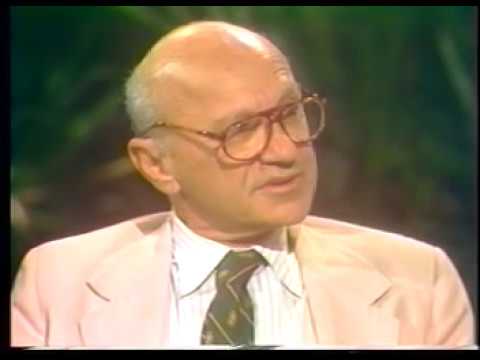
There’s also that winning video where Milton Friedman asks someone where he’s going to find all these angels to organize society for us.
I’m not even going to ask you how people can act other than individually, because they can’t. People always act individually, because they are individuals.
People can act without knowledge of other people’s intentions and without other people having knowledge of their intentions. When people have communicated beforehand and devised a plan of action, they are not acting individually. If there were only individual actions, there could be no voluntary exchanges. The exchange would simply be two individual acts indistinguishable from any other two individual acts.
Voluntaryist principles ≠ only looking at the first step of the process (e.g. what is popularly called “selfishness”)
I was not critiquing voluntaryist principles. I was trying to show that voluntaryists must employ the same game theory principles in their critique of the statist system that I used here for the market system.
You appear to be arguing against some strawman of “rational self-interest.” You claim that because it’s in the interest of the individual to get cheaper stuff, they will do just this and forego the “socially optimal” situation where mom and pop survive.
When people perform actual selfish calculations, they want to maximize their utility. This necessarily includes taking into the account the actions of others. Thus, anyone who recognizes the prisoner’s dilemma would act in their highest self interest by taking the prisoner’s dilemma into account as well.
Your last sentence gets at the gist of my critique: people must recognize it in order to take it into account.
It’s a straw man that rational self interest implies taking the option which yields the most immediate/obvious benefits.
Yes, this is what Kohn says in the selection I quoted.
I’d argue that someone who only looks at the first step of the consequences is not appropriately selfish because he’s ignoring the actions of others which have an interplay with his own. Thus, it is most selfish to consider the desires of others as well. Indeed, cooperation with other people is truly selfish because it recognizes the reality of interactions with real people and how this may create situations where the individual benefits.
Sure. And we might be able to say in the case of Wal-Mart that people aren’t being appropriately selfish.
How do we determine the ideal outcome besides empowering people to engage in voluntary trade in the first place? You’re (or rather the OP, if this was his question) missing the whole point - if we knew the “ideal outcome,” we wouldn’t need markets.
Have I suggested something contra to voluntary trade? I’m not sure I understand your point.
Sure. And we might be able to say in the case of Wal-Mart that people aren’t being appropriately selfish.
Perhaps. Alright.
FotH, game theory applied to economics tells us that oligopolies and cartels don’t typically work. In fact, the Nash equilibrium out of game theory is a higher quantity produced than would be by a single monopoly.
Plus, FotH, it has been shown (and is obvious) that the prisoner’s dilemma example is incomplete when applied to a situation where repeated interactions occur, because actors can choose different outcomes based on previous experiences. This is what happens in markets - consumers have memories and are not just “lowest-price-takers.”
So I thought I’d actually look up the reason why the Nash equilibrium says cartels don’t work. It’s because the participants make the irrational choice in the PRISONER’S DILEMMA.
How does the prisoners’ dilemma apply to oligopoly? Consider a cartel that sets output ceilings for each member. Every member will enjoy reasonable profit if no firm cheats by exceeding its quota, but a lone cheater will gain even more profit. If cheating is rampant (and it will be if players follow dominant strategies), all members’ profits suffer. The power of the prisoners’ dilemma game is reflected in the collapse of OPEC. The dilemma OPEC members faced ultimately brought down energy prices. The prisoners’ dilemma model also applies in such areas as bids at an auction, the nuclear arms race, and strikes by unions when collective bargaining breaks down.
CARTELS ARE AN EXAMPLE OF THE PRISONER’S DILEMMA SCENARIO: If all of the firms abide by the rules set by the cartel and actually restrict their outputs as agreed, all of the firm can generate economic profit (their collective payoff is higher than if they compete)
-If one member of a cartel cheats, however, they can potentially earn even GREATER profits than if they acted according to the restrictions of the Cartel
-If all members of a Cartel cheat, however, the Cartel will break apart and all of the firms will be in competition.
Additionally, the some have used the same arguments that you have to suggest that cartels will form:
We’ve seen that in the one-shot PD [Prisoner’s Dilemma] the only NE [Nash Equilibrium] is mutual defection. This may no longer hold, however, if the players expect to meet each other again in future PDs. Imagine that four firms, all making widgets, agree to maintain high prices by jointly restricting supply. (That is, they form a cartel.) This will only work if each firm maintains its agreed production quota. Typically, each firm can maximize its profit by departing from its quota while the others observe theirs, since it then sells more units at the higher market price brought about by the almost-intact cartel. In the one-shot case, all firms would share this incentive to defect and the cartel would immediately collapse. However, the firms expect to face each other in competition for a long period. In this case, each firm knows that if it breaks the cartel agreement, the others can punish it by underpricing it for a period long enough to more than eliminate its short-term gain. Of course, the punishing firms will take short-term losses too during their period of underpricing. But these losses may be worth taking if they serve to reestablish the cartel and bring about maximum long-term prices.
Furthermore, some Austrians have argued that the ABCT is an example of the prisoner’s dilemma.
So it seems you have to admit at least one of two things:
The irrational outcome of the prisoner’s dilemma applies to the free market
Cartel’s naturally occur within the free market
Is this how you’re (implicitly) defining “acting individually”? Otherwise, I think this is irrelevant.
How not? You don’t explain yourself here.
I can’t make sense of whatever point you’re trying to make here. Please clarify this.
Cartels sure occur in the free market, only that they break apart. See Rockefeller’s South Improvement Company or the Steel cartel. Notable, too, is that new, outside companies also started up that weren’t part of the market.
As to the prisoner’s dilemma, I’m not sure it’s the same in the cartel case and the Walmart customer case. In the cartel case, each company is demonstrably worse off by the profit numbers. In the Walmart customer case, you can’t quantify and reconcile the desire for both cheaper items and more mom and pop stores. You can’t prove that “we’re all worse off.”
What makes the outcome of the prisoner’s dilemma “irrational”, exactly? Using the Misesian definition of “rationality”, the two prisoners are acting rationally even when they rat each other out.
What makes the outcome of the prisoner’s dilemma “irrational”, exactly? Using the Misesian definition of “rationality”, the two prisoners are acting rationally even when they rat each other out.
Really? What is the Misesian definition of rationality?
By irrational, I mean they could chose an outcome that is better for both of them.
In the Misesian framework the term “rational” means simply a means to an end. It can be an improper means, or an end which won’t cause them to obtain their ultimate goal, but that’s still what it is. With this said the entire reason the prisoner’s dilemma exists is because no matter what the other person prisoner picks it makes sense for the other prisoner to rat on the other one.
We recently had a Tesco (like british walmart) move in to a building at the end of the street. Right next door to is a bakery that has been there for 30 years. Right next door to that is a butcher who has been there for 10+ years. Across the street there is a shop owned by indians that has been there for years and down the road, closer to my house there is another shop owned by a very nice indian family. I have spoken to the shop owners in the area, apart from the bakery as I have not been in there, they are furious.
Not only did they open up what is called a tesco express (mini walmart) they also created a bakery inside the tesco, now this is a bit malicious because not all tesco express have a bakery, in fact it is relatively rare to find a bakery inside a tesco express. Obviously the bakery and the local shops are now considering their options and are not happy, to say the least.
Personally I am glad that tesco has moved in, they have long opening hours and they sell just about everything. Which means I will be able to get things on the way home from work where in the past I would have had to carry it on the train. I still think it was a bit unnecessary to put a bakery inside the tesco and i think they could of refrained from doing that.
I will monitor this situation over the coming months and it will be interesting to see how it develops. Interestingly enough across the road there is a chinese take away shop that has been there for 10+ years and just a few months ago another chinese take away shop opened literally next door to it. I could not understand how this could be a good business decision and non surprisingly the new chinese shop is struggling to do business. But their justifications after speaking to them about the decision was that in London there is so many people that you can get away with having two of the same businesses selling same products right next to each other. Especially when the business model is based on home deliveries and putting menu through people doors.
But from the consumer perspective a bit of competition has forced the two newsagents to improve their shops, the one has purchased a new counter and cleaned up his shop. The other has rearranged his shop to make it more accessible inside. If these shops do move or close, then there will be an empty premises that will hopefully be filled by something different.
But we have seen in the UK what is called now the “death of the high street” there was recently a documentary in the UK and a campaign the “save the british high street”. Basically the advent of malls and massive retail parks on the out skirts of the towns and online shops, have caused the biggest closure of high street shops in history, unprecedented in modern times. We are hearing daily about new massive retail chains that are potentially going in to bankruptcy.
http://www.itv.com/news/tonight/episodes/death-of-the-high-street/
http://uk.finance.yahoo.com/news/tycoon-predicts-death-high-street-211838214.html
In the Misesian framework the term “rational” means simply a means to an end. It can be an improper means, or an end which won’t cause them to obtain their ultimate goal, but that’s still what it is. With this said the entire reason the prisoner’s dilemma exists is because no matter what the other person prisoner picks it makes sense for the other prisoner to rat on the other one.
Then what does “irrational” mean in a Misesian framework?