I have a friend who loves Zeitgeist (and The Venus Project), as well as Michael Moore. I don’t want to get into a long debate with him, so if there are any videos or online articles that rips this shit apart, please give me the links.
http://www.youtube.com/watch?v=kf3MtjMBWx4&feature=relmfu
Sick in America, from John Stossel. Goes head to head against Moore in the later videos and makes a great case for free market healthcare.
A Critique of Anarcho-Communism and the Zeitgeist Movement | by Jörg Guido Hülsmann
Any philosophy that doesn’t recognize property is automatically invalid. It is scary that my University still has chapters devoted to the Marxist argument, in political economy courses.
I think you should go with economic critique instead of ethics, because both “movements” are based on really unsound economic theories.
You may be interested in a debate I have been having with Ben McLeish of the Zeigeist Movement via blog posts.
My first post to Ben is here: http://managainstthestate.blogspot.co.uk/2012/06/critique-of-firing-back-by-ben-mcleish.html. (See also my debate with another Zeitgeister, Carlos, in the comments).
My second post to Ben is here: http://managainstthestate.blogspot.co.uk/2012/07/2nd-post-to-ben-mcleish.html.
In his latest post, Ben referred me to a book called The First Civilization. Here is a quote from that book, where the author describes what his life would be like in an RBE:
In Ben’s latest reply, he makes the classic error of confusing definitions (clearly marked as such in your post) for assertions. He does this many times, even though you warned of this very mistake when you said, “Definitions can never be true or false, of course; definitions are to be judged on their usefulness for communicating ideas.” I’ve highlighted all the instances of this error in a passage from Ben’s post below:
Graham’s last post includes several points which I have to address before launching off on my description of the train of thought which I am here to characterize. For one, he launches immediately off by defining money as “a general medium of exchange.” In fact, in a comment on his own first post, he even calls money a “rationing system”. It might sound strange, but it [money] is neither of these. This was the reason why I spent a whole section dissecting the thought-origins of the role of money vs. natural resources as defined by Locke (and all following who based themselves on his treatise, right through to modern economics.) Graham ignores this part of my post, not even seeming to have actually read it. So I’ll put the point into plain words.
Money is a form of private property. And in fact, if you re-read my section (“Money and Private Property”) you will see Locke’s thought process clearly – money, in its form as property, actually replaces and negates the original labour, resources and risk of spoilage factors that used to define “property” originally. What we have here is a new form of property that overrides and at once rescinds the value principles. … Graham’s assertion (and presumably the generalised Austrian assertion) that money is a neutral exchange mechanism runs against the whole base of money’s conceptualisation for use. It’s not some academic point. This is what i mean by “framing” – it is acting as one agent (private property, a good in itself which grants power and access to one member of society instead of another), whilst being ideologically considered as another (a medium of exchange, as Graham repeatedly portrays it.) This assertion accounts for the first third of his lengthy post, and though I admire his speed in replying, it seems a shame he utterly neglected this point.
This affliction of confusing definitions for assertions ends up with the person attempting to “prove a definition,” because to them it is the same as proving an assertion. Persons in the terminal stages of this affliction will fetishise words (strings of sounds or letters), seeing them as having objective, cosmic meanings that cannot really be redefined.
Since, as you said, “conversations don’t go anywhere until key terms are defined and agreed upon,” and he has a fundamental and persistent misunderstanding of what definitions are, you’ll almost certainly have to address this before progress can be made. On the bright side, if he can stop fetishising words that alone could be enough to eventually break him out of the haze. By being stuck on what money “really is” rather than what would be a useful definition for the word money, he could easily chase his tail forever on that subject, as is the case whenever this confusion arises (which is a lot!).
Ahahahahahahaha!
AHAHAHAHAHAHAHAHAHAHAHAHAHAHA!
You are exactly right AJ. I emailed him about that immediately after I read his response. Here is an abridged version of our subsequent email exchange:
Epic facepalm moment for me when he wrote that last post. I didn’t bother responding. I am not sure I have the energy to continue the discussion at this point. How can you have a fruitful discussion with someone who doesn’t know what a definition is?!
Common sense, rationality, and logic is probably the best critique.
Graham,
Wow. That is just about the starkest example I’ve ever seen, and I don’t think that is because this affliction is uncommon, but rather because you pressed him on it so patiently. That kind of response gets to be old hat when you constantly ask people to define the key strategic terms that make or break their argument. At least this way you know where the core problem is!
This is why I find it of the utmost importance to elucidate the (would-be obvious) facts of the communication process and the role of words in it: it is an absolute prerequisite to clear thinking in general, and one that is quite often completely missing. Something like this may help to send him, but I’m not all that hopeful at this point. It looks like he has way too much of his worldview invested in not understanding what a definition is. Still, if progress is to be made, pushing on this point in a neutral context seems the fastest way to do it.
Yes, he is definitely heavily invested in his worldview. Nothing I can say will change his mind. I only debate him because he seems to have a small following and maybe I can sew some seeds of doubt among his followers. That and to satisfy my curiosity about how someone who appears to be so bright can be so truly muddled.
Talking with Zeitgeisters about money is always skirting the core disagreement, anyway. It is not just money they oppose, but all ownership, trade, laws, etc. It all springs from their denial of the existence of scarcity, which is a confusion resulting from their failure to define the term and stick to their definition. Every Zeitgeister I’ve talked to says (sooner or later) that nothing I say about economics or ethics matters because it simply doesn’t apply to their “post-scarcity” world (see Carlos in the comments, for example).
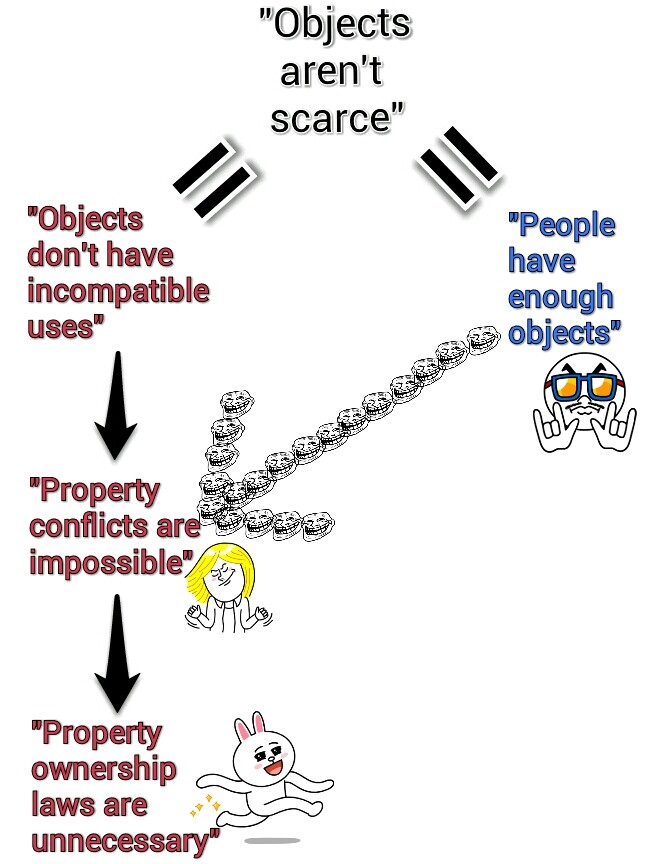
They first define scarcity as something like “not having enough,” and then they say that with 3D printing, vertical farms, etc, everybody will have “enough” of everything, so they conclude that ‘there is no scarcity in the RBE’. But then comes the word-thought overwrite. They switch their definition of scarcity to mean a world where objects have multiple incompatible uses, so conflicts are possible. Using this definition they conclude that ‘laws/ownership are necessary only in conditions of scarcity’. They equivocate on the word scarcity to conclude that laws/ownership are unnecessary in the RBE.
When I went through this in painful detail with Carlos in the comments (starting here), I did get him to acknowledge that RBE is not a post-scarcity world in the sense that conflicts are impossible in an RBE. He agreed with me that scarcity in that sense will always exist, and therefore rules about resource use (ownership) will always be necessary. But then when I asked him to explain how arbitration would work in the RBE and what ownership rules would exist in the RBE, he stopped replying. He came back 6 weeks later saying he’d “changed his mind” and he re-asserted that there is no scarcity in an RBE so no ownership rules are needed!
If you keep politely harping on the fundamental equivocations on which their entire argument hinges, some of them will eventually become…unhinged.
I guess we know the answer to that now. Equivocation is impossible when you have solid definitions nailed down and held to. Therefore, if equivocation is baked into the foundation of your worldview you will eventually become adept at weaseling out of any attempt to pin down or keep to definitions (and this becomes less and less conscious, if it ever was).
I think the only way to demonstrate a “systematic equivocation” (as I. Ryan has called it) to an unsympathetic audience is to do it in pictures. The memory burden when using words is simply too great. People will forget and the same ground will be covered over and over, as with Carlos. After all, the goal is to get them to see what they’re doing, so the only things that matter are making it so clear that they can’t possibly not see it, and preferably also doing it in a way that leaves their “ego” out of it (unless it’s only for the gallery).
It’s of course a bit of a hassle to think through and put together a diagram that is both clear and complete, but since equivocation (and the word-thought overwriting that enables it) follow the same kinds of patterns in every case, much of the visual conventions could be recycled each time.
There are two sides to the knife of equivocation: on the one hand it is a deadly error that destroys lives, lets intellectual wordspinners pull the wool over just about everyone in every field, and holds civilization back in myriad ways, but on the other hand almost none of these wordspinners nor their followers can ever refute these kinds of attacks (hard to even call them “attacks” when all you really do is ask for unambiguous and immobile definitions of the strategic terms). So the other side of the knife is that those who are able to see through equivocations can tear through endless swaths of bad theory in an extremely efficient manner, without really even attacking nor breaking a sweat.
The key I have found is to focus on this one thing without introducing other arguments or getting tempted into jumping ahead before the definitions are set, but also to remain tactful about it and not come off as a curmudgeon or whatever. You’ve been doing that very well, from what I’ve seen. Diagramming equivocations to make it utterly clear what is going on moves the burden off the listener/audience and onto the speaker/presenter, but you already seem very patient in your debating style, so this kind of thing might hold some interest for you.
Here’s just a little something I did on my phone. It doesn’t show the word-thought overwriting process itself, but it shows what the equivocation is between and it’s fairly easy to see how this leads to erroneous conclusions.
I like that. I may use that when the time comes.
I had a go at a diagram that will bring money into it…
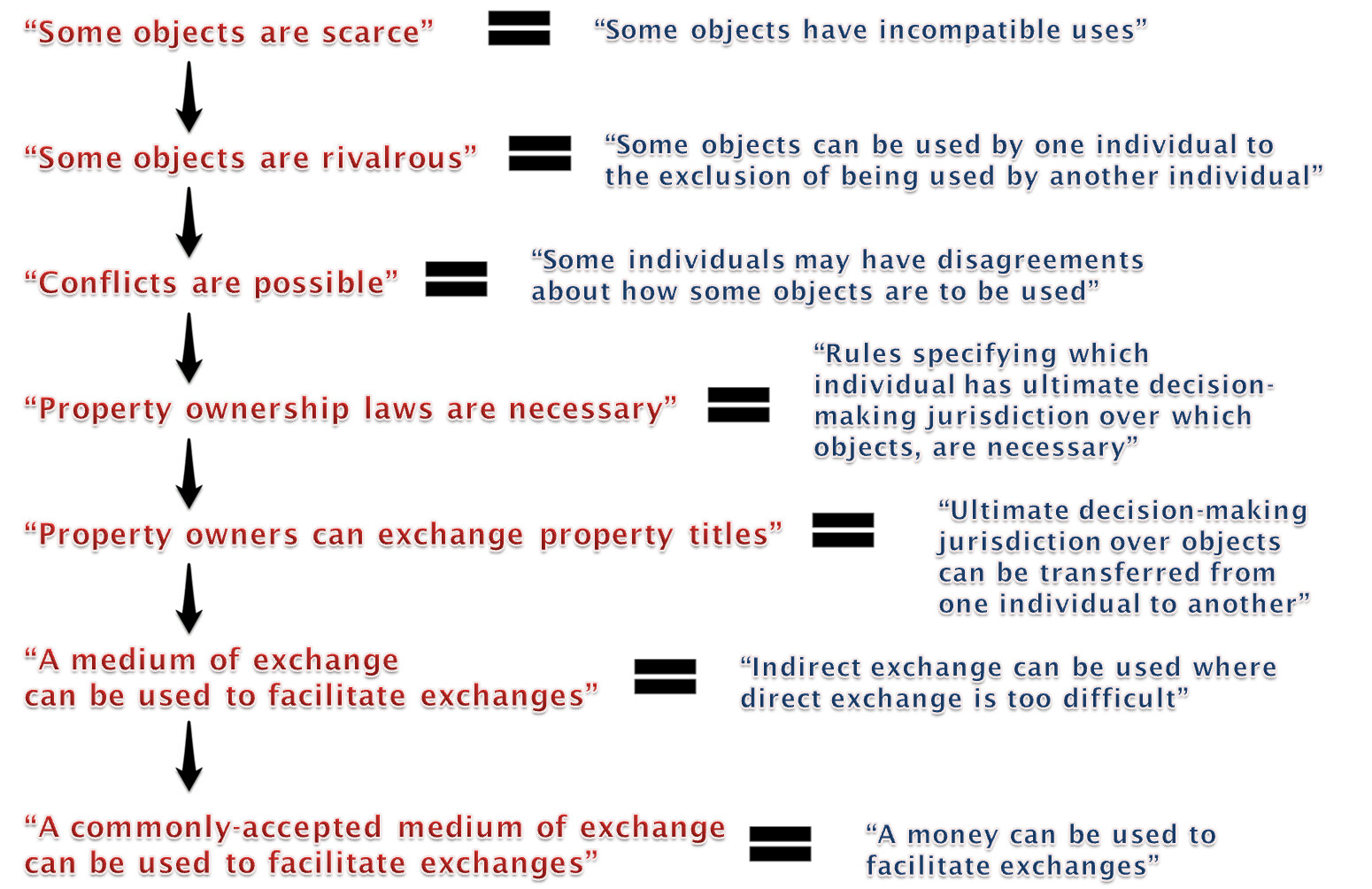
That puts a segment of the argument quite clearly. I think mine is too inflammatory to be useful for persuading someone directly, though it could be good for the gallery. I’d have made the trollfaces say, “CUZ OBJECTS AREN’T SCARCE!”
Another way to do it textually is to say something like:
There are several ways to proceed from there. You could agree to always keep the terms numbered, for clarity. Or they might say that in every case they only mean scarce-1 so it isn’t necessary. Either way, when they inevitably are forced to equivocate by switching from scarce-1 to scarce-2, it will be easy to identify. Another possibility is to agree to taboo the word scarce and simply talk directly about “having enough objects” and “objects having mutually incompatible uses.”
However, I like the first option best. Even more elegant is to color code them:
The advantage with this is you can then go back and color their uses of the word “scarce” to lay bare the equivocation, and of course let them clarify their meaning by re-coloring the words to try to make their argument work.
The ultimate way to reach clarity is now I think to create a prezi map of the argument.
This is what I mean by a prezi map of an argument.