What is the most succint way to answer (preferably, refute) the following claim? “Under anarcho-capitalism, people would get the quality of ‘government’ (legislation, arbitration, protection) service proportional to how much they will pay. Hence, the rich will get better protection of the law from the society than the poor.”
Any time you pay people to have power over others, corruption is inevitable.
To answer your post, why refute it? The truth of it actually seems fairly self-evident.
The rich also get better food and housing.
Yeah, you’re gonna need a better answer than that.
If the quality of your rights are determined by what you can pay for, in what sense are individuals legal equivalents? How is libertarianism possible when individuals have different rights?
“What is the most succint way to answer (preferably, refute) the following claim? “Under anarcho-capitalism, people would get the quality of ‘government’ (legislation, arbitration, protection) service proportional to how much they will pay. Hence, the rich will get better protection of the law from the society than the poor.””
That claim cannot be refuted. But why is that necessarily a bad thing if there is more justice? Also, the fact that people would find it morally wrong for legal disputes to favor rich people would have an effect on dispute resolution.
The rich are already favored. They can afford the best lawyers.
If the quality of your rights are determined by what you can pay for, in what sense are individuals legal equivalents?
At the time of the writing of Friedman’s Machinery, the justice system cost roughly $40 per person. RIch people can afford better defense in the sense that if they have a mansion they can get themselves night guards. Your point?
Food and shelter are also vital for survival.
So you’re taking the ontological status of individuals within a state as given?
When the rights of an individual are what that individual can provide for, unless there are conditions that allow for equal capacity to provide, there will be disparate sets of rights.
This is a difficult challenge because the poor get such superior protection from the police under the State, and their neighborhoods show it:
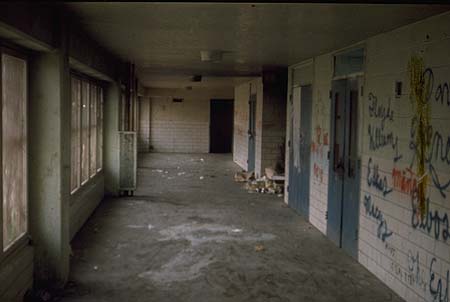
Clayton -
I think the rich would get higher quality of service, but not of a completely different kind of service.
Ie: The rich might be able to get faster justice, but not be able to buy the court-outcome they want. The rich might be able to hire bodyguards and police escort, but the police would try to protect people’s rights equally. They have a reputation to uphold, and no one rich person can pay all that the multitudes of poorer people pay for police protection. Thus it wouldn’t make financial sense to cheat the poor of the police services they pay for.
And if any company did, the poor would flock to another service.
How does that compare with today’s society, where government overcharge the poor for police service, then drastically underservice them without recourse to another agency.
The poor would be better served in a free society.
I’m surprised no one posted Libertarian Anarchism: Responses to Ten Objections by Roderick Long. One of his points directly addresses your question, though Clayton’s picture might be an even shorter explanation.
When the rights of an individual are what that individual can provide for, unless there are conditions that allow for equal capacity to provide, there will be disparate sets of rights.
Once again, police protection is not as expensive as you think.
I pay roughly $200 a year for my renters insurance. If someone broke into my apartment and stole a whole bunch of electronics, I would file a claim and be reimbursed for my stolen property.
Conceivably, I could pay $100,000 a year for a private security task force that would patrol my block and prevent any break-ins from happening in the first place, and they would also reimburse me for any damages that happen on their watch.
The thing is, its not at all clear that I’m actually better off with the super awesome security group. Although the level of service is proportional to the amount I pay, at a certain point, that level of service becomes unnecessary. Sure, I am less likely to experience a break in if I hire the security company, but what matters to me - that I don’t have to spend thousands replacing my stuff - is covered in both cases.
The poor get a better service in a stateless soicety…
But how could a poor person afford private protection he would have to pay for instead of getting free protection, as he does now?” There are several answers to this question, one of the most common criticisms of the idea of totally private police protection. One is: that this problem of course applies to any commodity or service in the libertarian society, not just the police. But isn’t protection necessary? Perhaps, but then so is food of many different kinds, clothing, shelter, etc. Surely these are at least as vital if not more so than police protection, and yet almost nobody says that therefore the government must nationalize food, clothing, shelter, etc., and supply these free as a compulsory monopoly. Very poor people would be supplied, in general, by private charity, as we saw in our chapter on welfare. Furthermore, in the specific case of police there would undoubtedly be ways of voluntarily supplying free police protection to the indigent — either by the police companies themselves for goodwill (as hospitals and doctors do now) or by special “police aid” societies that would do work similar to “legal aid” societies [p. 220] today. (Legal aid societies voluntarily supply free legal counsel to the indigent in trouble with the authorities).
— Murray Rothbard, For A New Liberty, p. 215.
Yeah, you’re not getting the problem. In the absence of the state, individuals will have to establish themselves as social agents with the requisite capacity to provide for their own rights.
When you open up rights to an open ended competitive process you will get vary sets of rights depending on the capabilities and preferences of the consumers. You’re assuming an equivalent status of individuals. When that status must be socially constructed and reproduced. So reducing governmental services to a purely instrumental apparatus misses the constitutive function of politics.
There’s more going on here than the cost of policing in 1970s America.
No one promised total living standard equality under libertarianism.
Yes. Equal rights, non-equal living standards.
Well it’s a good thing I didn’t mention equal living standards then
Then what does op mean by better “services”?
As far as I know, having a more expensive lawer contributes to my standard of living.
National Acrobat is trying to ask that, if “rights” are conferred by wealth, how do we ensure poor people will have “rights” under a given legal system comparable in any sense to the rich.
NA, have you examined stateless legal orders of past times? Essentially, stateless legal orders can arise in a number of ways (many of which I’m not familiar with), but one such way is via the building up of precedent of past cases that have been arbitrated by private judges. The idea that you “pay” for rights doesn’t seem to make sense in this form of emergent law, because it’s not that you pay for more “rights” (I don’t even think the term “rights” in this context is useful), it’s that you pay for a judge whom you think will rightfully settle a case. Given that most disputes of commoners will be with other commoners, I don’t see how they could somehow break off into different classes of people, each with different rights, especially since ruling on the basis of precedent demands some sort of consistency and reasonableness (real word).
Now, I think it’s possible the wealth rich people have may tilt how cases are decided over time, and a precedent may develop which favors rich people. I think this is highly dependent on specific circumstances in society, may not be a problem at all, and certainly wouldn’t nearly be the problem you envision, which is actually persistently present throughout statist societies in histroy.
There is a lot more to be said on the subject. I can’t express it all, nor do I desire to. Hopefully my points here made some sense.